品

Corea든 Korea든, 품격이 먼저다
Whether Corea or Korea, dignity comes first.
Whether Corea or Korea, dignity comes first.
Now
지금
751 Diaspora
Heritage
유산
Humanity
인문
Mirengsi
未冷尸
Politics
정치
Media
언론
시베리아철도는 과연 어디인가?

회고回顧/懷古
칼럼
PinkPepper
Nostalgia 162. Ahn Jung-geun and Moon Se-gwang

0
2026. 10. 26
Voter Competence
The political energy in Korean society has grown to the point where movies are increasingly becoming a fringe phenomenon, sparking the fervor of the far-right. It has become clear that countless infiltrators like Moon Jae-in, Kim Eo-jun, and Yoo Si-min, whose actions have been proven over decades, along with the incompetent Democratic Party, which cannot shed its image as a perennial leftist party, and the left-leaning factions within minority opposition parties, are completely indifferent to realizing the public interest. The change in public sentiment, to the extent that their ugly true nature can no longer be denied, is due to the political reality that transitioned from Moon Jae-in to Yoon Suk-yeol and the failed state of emergency, not to the increased perceptual ability of the public. The vast majority of people originally have no access to the principles by which the political system operates. They were just lucky.
The barrier that kept people away from politics covered the public's eyelids and prevented the expansion of thought through dictatorial political systems and anti-communist/leftist communist witch hunts, thereby concealing the realities of war and colonialism from previous eras. This anti-communist propaganda is a deceptive operation, similar to Operation Trust (a Soviet operation that created a fake anti-Bolshevik organization to lure and neutralize actual anti-communist forces). However, it is an interesting phenomenon that highly educated elites and, conversely, those at the opposite end of the spectrum, pursue the same path, namely the anti-communist line. The reason why the educated and the uneducated walk the same path is that physical torture and violence are inherent in its nature.
Anti-communism has functioned as a political language that binds the interests and anxieties of different social classes into a single narrative of hostility, regardless of educational attainment. For the elite, it becomes a means to protect existing power and order, and for the anxious public, it becomes a framework for dichotomizing complex reality into good and evil and confirming a sense of belonging. It is unbelievable that, despite different motives, people can rally around the same anti-communist line, and that the interests of elites who rationalize the reality of fear politics and individuals who physically conform to fear are the same.
Deception operations like Operation Trust can attract and disperse energy aimed at uncovering conspiratorial operations, thereby weakening the momentum for truth-finding and resistance. Thus, conspiracy theories don't just end with believing false narratives; they can generate another conspiracy, a counter-conspiracy, when those who are convinced of their truth take actual action. The film 'Assassins' provides an opportunity to reflect on how such deception and counter-conspiracies operate. It is now time to thoroughly investigate, based on historical facts and evidence, the true nature of the past 'leftist witch hunts' and the political motives and operations behind them.
The stones thrown at Yoo Hae-jin, a '10-million-viewer actor,' are similar to those thrown at the late Lee Sun-kyun, also a '10-million-viewer actor.' If needed, they are heroes; if they go against what's needed, they are demonized, leading to their deaths or being pressured to take their own lives. When even actors die like dogs, ordinary people face a fate worse than dogs. I hope people understand this and become agents of their own actions. We see the repetition of ideological purges in the film industry, mirroring the political methods of Rhee Syng-man, Park Chung-hee, and Chun Doo-hwan, and the national character shaped by Lee Myung-bak's comment squad. However, despite the prevalence of extreme right-wing incitement masquerading as malicious conservatism, the 'conservative establishment fantasy' that has long blinded the public is starting to crumble. Defending the establishment does not elevate me to its ranks. Using the public outrage expressed by figures like Assemblyman Joo Jin-woo as an excuse to enrich Joo Jin-woo and dilute illegalities, turning the essence of the problem into a 'dragon's head and snake's tail' (a grand start with a weak finish) – this is the reality of the right that the Democratic Party should take as a cautionary tale if it claims to be leftist in both public and private spheres. The right wing of South Korea, biologically intertwined with pro-Japanese collaborators, is a remnant of Japanese imperialism that still thrives in various places, both domestically and internationally. Even when disguised as professors, scholars, doctors, religious figures, or businesspeople, at their core, they absolutely do not want Korea to be united. It is now the turn of public authority to answer who is behind the siege of Yoo Hae-jin's home.
Moon Se-gwang's capabilities
Moon Se-gwang (文世光, 1951~1974) disappeared into the dew of the execution ground at the age of 22, six days before his 23rd birthday. Unlike Jang Bong-hwa's blood-soaked body, Yuk Young-soo was dragged away by her sock-clad feet from both sides, with not a drop of blood visible. The incident video shows that the direction and position Moon Se-gwang shot from are not what anyone would expect. It is nonsense to say that Moon Se-gwang shot and killed Yuk Young-soo while trying to shoot Park Chung-hee. Whoever recruited that young child and how, if they are still alive, they should make a conscience declaration. How could someone who had to use a forged passport steal a pistol from an Osaka police box, get into a luxury car, and go to the stage?
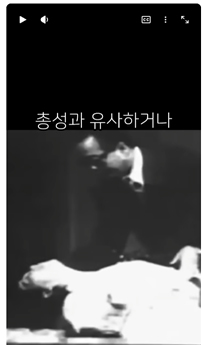
https://www.youtube.com/shorts/tN_sNROzZFQ
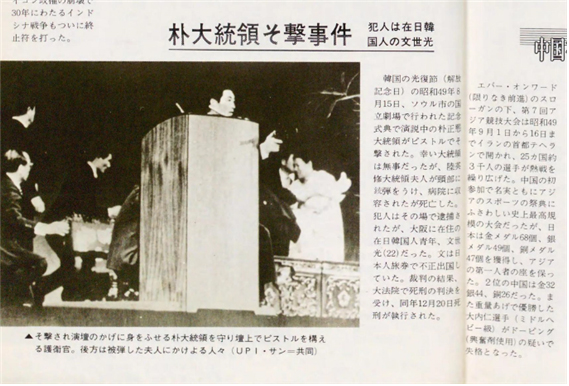
靜岡年鑑 1975年
However, that era was a world where both politics and the people were blind. Moon Se-gwang's death is intertwined with the historical sin of failing to liquidate the colonial past and the political secrets between Korea and Japan. Behind his death is a world history not unrelated to the complete and thorough trampling and disregard of Koreans' human rights, and that structure still remains, with its framework not yet fully broken. Syngman Rhee and Park Chung-hee are the ones who liquidated Japan's colonial sins with an unprecedented law called the National Security Act. Because they arbitrarily traded their political survival and the past history of national destruction, the view that they could conduct politics based on rational judgment within sound human relationships is even more unrealistic.
However, Koreans were brainwashed to live with the sentiment that defended their past deeds—whether it was a voluntary choice or due to brainwashing is a separate matter—and they spent their lives that way, becoming adults, having and raising children, and growing old. Therefore, it is not surprising that the younger generation easily disregards 'politics and adults.' Is it a law of nature or karma that members of a society who have experienced politics that follow dog-like instincts act like dogs? Readers believe that courage is needed to kick at the concealment of modern and contemporary history that Moon Se-gwang's death symbolizes.
The name Moon Se-gwang is a double victim, not only symbolizing a sacrificial lamb of the cruel, murderous politics of Syngman Rhee and Park Chung-hee, who relentlessly pursued surreal politics in reality, but also symbolizing a victim of malicious politics who was framed as a spy among Zainichi Koreans during the two dictators' implementation of their policy of not liquidating colonial legacies, thereby creating a public security atmosphere in both countries. In other words, Moon Se-gwang is "The Victim of Deception," who played the villain in an incident staged by serious criminals who arbitrarily suppressed historical issues, an incident in which he was portrayed as a sacrifice.
However, Moon Se-gwang's background and footsteps are full of sloppy questions the more you dig into them, and the history of suffering of Zainichi Koreans after liberation, When categorized into: ① cases of arrest, imprisonment, or execution in Japan, ② Koreans imprisoned as war criminals in post-war trials, and ③ cases of Zainichi Koreans imprisoned or executed in Korea, the unbelievable reality of Park Chung-hee's dual politics—the coexistence of public security incidents and kisaeng tourism—was so far removed from the treatment received that a 22-year-old's life was politically stolen.
The Korea Democracy Foundation cited statistics from the 'Association of Families and Compatriots for the Salvation of Korean Political Prisoners in Japan,' stating that out of approximately 160 espionage cases related to the 1970s and 80s, about 120 cases involved Zainichi Koreans, excluding those of domestic origin. Even without the execution of Mun Se-gwang, politics that ruined people's lives was a piece of cake in both Korea and Japan, and a representative case among them was the public security incident announced on November 22, 1975, by Kim Ki-choon, then director of the anti-communist investigation bureau of the Central Intelligence Agency. This was a fabricated espionage case by the Central Intelligence Agency that indicted a total of 21 people, including 13 Zainichi Koreans, as spies, also known as the Seo Seung and Seo Jun-sik brothers' case, who were accused of being a Zainichi Korean student spy ring. Since Yuk Young-soo died the previous year, it is believed that such incidents had to continue to maintain a reign of terror.
Seo Seung (徐勝, 1945~), a Zainichi Korean, was arrested in 1971 while studying at Seoul National University Graduate School, accused of being a spy infiltrating the campus. During torture, he attempted self-immolation, suffering severe burns to his face and upper body. He was sentenced to death in the first trial and life imprisonment in the second. It was a ruthless dictatorial regime. He served 19 years and was released in 1990, later becoming a professor at Ritsumeikan University. His brother, Seo Jun-sik (徐俊植, 1948~), who was arrested with him, was released in 1988 after serving 7 years in prison and 10 years of protective custody, and became a human rights activist. The youngest brother, Seo Kyung-sik (徐京植, 1951~2023), who participated in the campaign to save his two brothers, was a writer with a background in French literature and a professor at Tokyo Keizai University, who passed away in 2023.
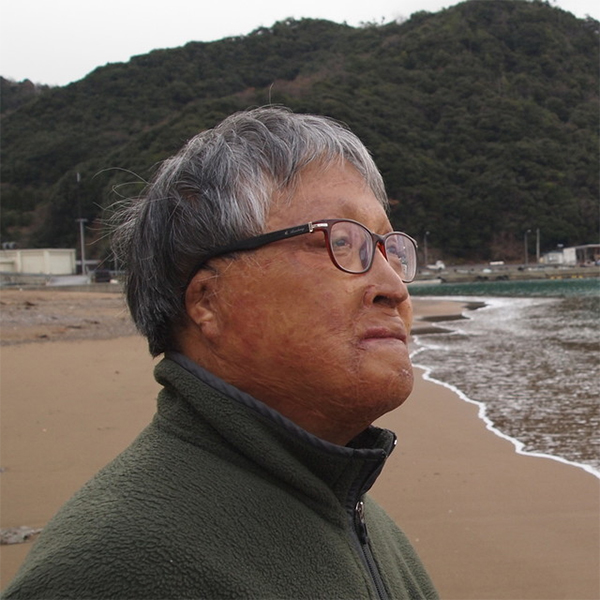
If you search for Seo Seung in Korea, you will find a notice blocking illegal/harmful information (sites). Pro-Japanese anti-nationalists, how long do you think you can suppress history?
Today's generation doesn't know the power of the National Security Act, but the generation that experienced its might would wet themselves just hearing the name. It's an undeniable fact that Democratic Party lawmakers Kim Geun-tae and Lee Hae-chan suffered unfortunate lives of pain, both physically and mentally, due to torture under this very law. Yet, the complacent pigs, devoid of shame, mock them and still romanticize that era, a reality so bleak it's hard to interpret.
However, as this bleak political consciousness is replaced and filled by the brazen consumer desires of the public, the families of the Seo brothers campaigned to save the two brothers who were tortured and imprisoned in Korea, not only within Japan but also in Korea. Yet, the Korean media did not cover this process significantly. Voters must continuously be aware that the media, since the modern enlightenment, has been pro-Japanese and has never shed its anti-nationalistic nature, betraying the nation.
Not only that, but no media outlet shed light on the story of the era when Seo Seung's family moved to Japan, and we focused on suppressing and disparaging the biological era when we were compatriots. The political lives of Syngman Rhee and Park Chung-hee are a history written with the young lives of students tortured like this, and the blood of the people who opposed them. They lived like dogs as pawns of the United States and Japan, but many people bled and died for them to enjoy luxury. While all blood is precious, the deaths of conscious and conscientious individuals were a huge negative for the biological lineage that constitutes the nation. So, Korea, caught up in the propaganda of economic development during this period, forgot that the essence of the politician Park Chung-hee was like a vampire who stood on a red carpet paved with human blood, representing the authority and dignity of dictatorship.
During the dictatorial era, films featuring nudity were a boom. The night streets of Korea, where prostitution and human trafficking were openly rampant, became the very subject matter for films. This alone did not sustain the dictatorship. After the Korea-Japan normalization of relations in 1965, 'kisaeng tourism' targeting Japanese people expanded, reaching its peak in the mid-to-late 1970s. The hosting of the 1986 Asian Games and the 1988 Olympics also stimulated demand for kisaeng tourism, which gradually declined after the 1990s. On one hand, Japanese local mistresses were cultivated, and on the other hand, the genes of conscious young male youths were eradicated, which is why intelligent 'tetos' are not born today. The same goes for North Korea. They offered sexual favors to Western diplomats to glorify their dictatorship. Korea is a country where dirty politics raped the people.
Thus, history became increasingly distant. History is like a plant that must be cared for daily, and in the sense of tracing human footprints to predict the future, it is an existence that cannot be explained by materialism. Western positivism, which unravels history within the conveniences of civilization, cannot revive the chapter of hidden Korea-Japan history that was diluted during Korea's economic development period, just like a plant cut off at its roots. Even today, Park Geun-hye sells laughter as a symbol of fake conservatism. In the past, such individuals would not even be worth a posthumous decapitation.
First, as a human being, Park Chung-hee was a dictatorial strongman who openly engaged in bigamy and adultery, destroying several families. There was a time when those who emulated him mistakenly thought it was a display of Korean male machismo. The issues of Syngman Rhee and Park Chung-hee's divorces and remarriages, and their 'family lineage,' are the first steps in historical reconciliation that Korean society must address. Of course, Yoon Suk-yeol cannot be free from this issue. The modern history in which Park Geun-hye became president showed a lower level of political maturity than the Philippines or Ukraine, meaning that Park Geun-hye, who was elected with a pre-leaked vote share of 51.6%, is a subject of investigation along with the National Election Commission. The dirtiest stains are the Sewol ferry disaster and the abolition of the adultery law. The process by which the daughter of a concubine, born from an extramarital affair, became president is suspicious, but Kim Ki-choon is an indispensable figure in the politics of Park Geun-hye and Park Chung-hee. This person represents a quintessential villain in the history of the Republic of Korea. The existence of President Park Geun-hye, under whom dirty deeds are now rampant in this land, and the society created by the person behind the then-famous 'ghost fetus,' makes it less likely that Park Chung-hee, who swore allegiance as a Japanese by writing a blood oath and whose father built his career in the Manchukuo Army's tyranny, did not eliminate Yuk Young-soo. Park Chung-hee's way of thinking was colonial, so he used a young man named Mun Se-gwang.
Japan summons Ahn Jung-geun
After Moon Se-gwang's arrest, a Japanese magazine, <Asia Report>, in its November 1974 issue, published an article titled 'Exposing the Flaws in the Historical Distortion Claims Seen Through Ahn Jung-geun and Moon Se-gwang.' The reporter was Choi Seo-myeon (崔書勉, 1928~2020), a Zainichi Korean and director of the Korea Research Institute in Tokyo. His real name was Choi Jung-ha (崔重夏) of the Gangneung Choi clan. He was a cousin of former President Choi Kyu-hah and sought asylum in Japan in 1957 due to political conflicts with the Syngman Rhee regime. He graduated from Yonhi College and worked as a reporter for Daedong Sinmun. In 1947, he was even sentenced to death by the U.S. military government for the assassination of Jang Deok-su (張德秀, 1894~1947). Jang Deok-su, the head of the political department of the Korea Democratic Party, was assassinated at his home in Jegidong in December 1947. The U.S. military government, which investigated the case, considered Kim Gu, Choi Seo-myeon, and others as the masterminds of the assassination, which was similar to the Governor-General's political maneuver to eradicate the Sinminhoe by fabricating the Terauchi assassination in 1911. Instead of arguing over whether the Korean War was an invasion from the North or the South, we should look at more fundamental issues.
Choi Seo-myeon's move to Japan was due to the customary law of South Korean society after liberation, which prevented intellectuals who questioned the history of colonial rule with normal thinking from engaging in intellectual activities. Syngman Rhee, Park Chung-hee, and Chun Doo-hwan were the ones who created an ignorant populace and fostered a low-quality culture for their sustainable dictatorships, and they were the beneficiaries of that low-quality environment. That ugly politics gave birth to foolish, pro-American and pro-Japanese junior figures like Moon Jae-in and Yoon Suk-yeol, who lack a sense of justice and responsibility and are full of private desires. Although not a Zainichi Korean, Kim Dae-jung, who became president as an exile like Choi Seo-myeon, failed to realize the aspirations of the nationalist camp and, while advocating for an outdated centrist integration, ended up colluding with the vested interests. This was because he knew that reforms could not be achieved without risking his own life, and his politics ultimately led to Roh Moo-hyun being sacrificed.
Returning to the article, 'The Theory of Ito Hirobumi's Assassin and President Park's Sniper as Historical Transformations, Seen Through Ahn Jung-geun and Moon Se-gwang' begins with his memoir's assertion that 'Ahn Jung-geun was not Ito Hirobumi's assassin.' On the morning of October 26, 1909, the 13th day of the 9th lunar month, Russian Finance Minister Vladimir Nikolaevich Kokovtsovㅠ, 1853~1943) entered the train car and greeted Ito. After a few minutes of conversation, they descended together, passed the Russian honor guard, and reached the foreign consular corps, shaking hands with a few people before turning to review the honor guard. The reason why the three generations of the Kim family in North Korea used a special train for their trips to China, especially during Kim Jong-il and Kim Jong-un's movements to China, where general train operations and access to the surrounding areas were controlled, and they mainly traveled to key destinations, is simple, but it might have been to completely block any approach that aimed to repeat history. It is suspicious for them to appear so openly, like a fortress.
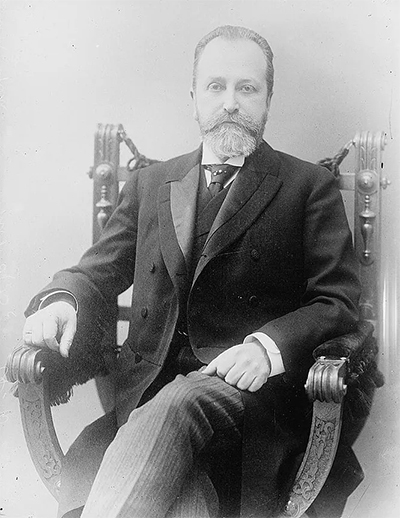
Влади́мир Никола́евич Коковцо́вㅠ
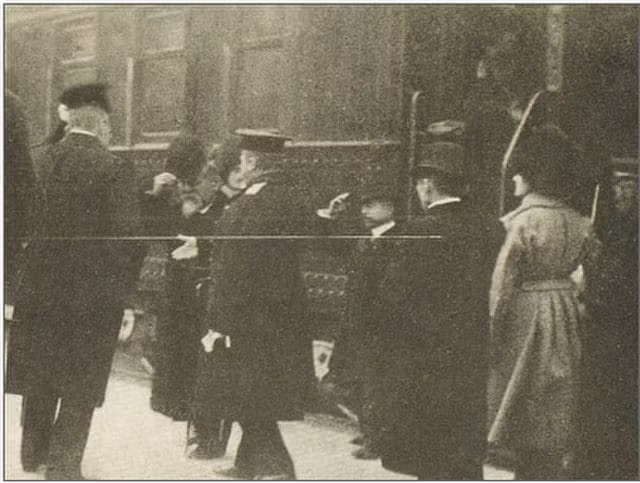
The second person from the left is Ito just before his assassination.
Murota Yoshifumi (室田義文, 1847~1938), Ito's favorite who accompanied him on his trip to Manchuria, joined the Ministry of Foreign Affairs in 1872 through Ito's influence, served as the Busan consul from 1887 to 1890, became a director of Sanyo Railway in 1905, and served as the president of the 110th National Bank, which he took office in 1901, for over ten years. He was injured with Ito at Harbin Station during Ito's Manchurian trip. According to the records of the Japanese Legation in Korea and the documents of the Residency-General, Murota was the author of the investigation and report documents related to the Donghak Peasant Movement in 1899. The name, nature, and place of origin of the Donghak Peasant Movement conflict with modern knowledge. Murota's career is also like that. He did not reveal everything about where he worked and what he did in his memoirs. However, he was a person who calmly recorded his surroundings, even describing an incident where his young daughter drowned after falling into a pot of boiling bathwater during a cold Korean winter.
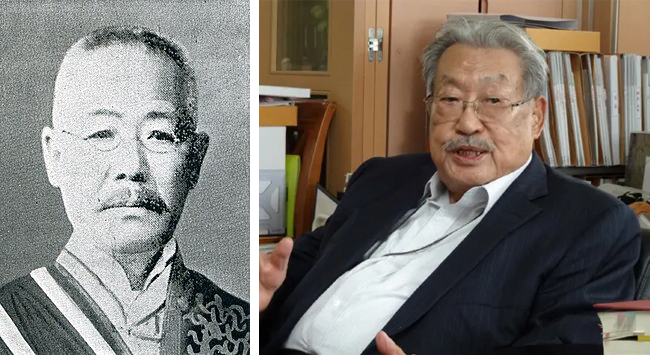
Left) Murota Yoshifumi in 1932 during the Inukai cabinet, Right) Choi Seo-myeon (崔書勉, 1928~2020)
Murota did not remember Ahn Jung-geun as Ito's assassin. In the trial, it was also revealed that the gunpowder residue on Ahn Jung-geun was from a French cavalry rifle bullet. However, the gun that hit Ito was confirmed to be a Belgian-made FN Browning M1900, serial number 262336, but the exact manufacturing date and the entire process from the first buyer to its delivery to Ahn Jung-geun are unknown. This is a similar pattern to the situation where Moon Se-gwang entered the country with a stolen pistol from an Osaka police box and a forged passport, intending to shoot Park but instead shooting Yuk.
Ahn Jung-geun was tried at the Kwantung Government-General District Court in Lushun. The public trial records state that he had only seen Ito's face in a photograph and had heard he was a tall man with a beard. He thought the person leading the group was Ito and shot him, but found him to be smaller than expected. Given that the gunpowder residue on the culprit and the victim differed, and Ahn Jung-geun, who had only imagined the target from a photograph and had never seen him in person, had a low probability of successfully carrying out a pistol assassination, there's even a possibility he mistook Ito for Murota, who had a mustache.
However, if Ahn Jung-geun were not the true culprit, the case would not be closed until the real culprit was apprehended, potentially disrupting diplomatic relations between Russia and Japan. Later consensus suggests that Yamamoto Gonnohyōe (1852-1933), a military councilor, did not want to reveal the bullet issue, which would have sparked controversy over the true culprit. Murota, however, protested and was urged to remain silent. Murota was a figure Ito brought into politics, and Yamamoto appears to have played a significant role in Ito's assassination, though his actual involvement is unclear. Ito's decision to travel to Manchuria to meet the Russian Minister of Finance was arranged by Gotō Shinpei (1857-1929), the first president of the South Manchuria Railway. One might wonder if it was perhaps time for Ito to gradually fade from the stage of history. Japanese imperialism was a militaristic system where the military and corporations vied for colonial territories, but there was an even larger force behind it.
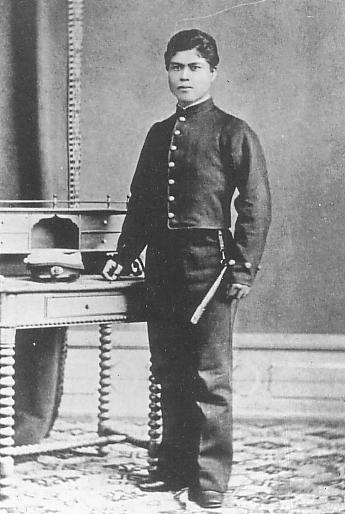
Yamamoto Gonnohyōe as a naval ensign in 1877; mixed-race individuals' faces change differently throughout childhood, youth, middle age, and old age. When will the fact that Japan was an unprecedented experimental stage in human history, a successful mixed-race society, be revealed?
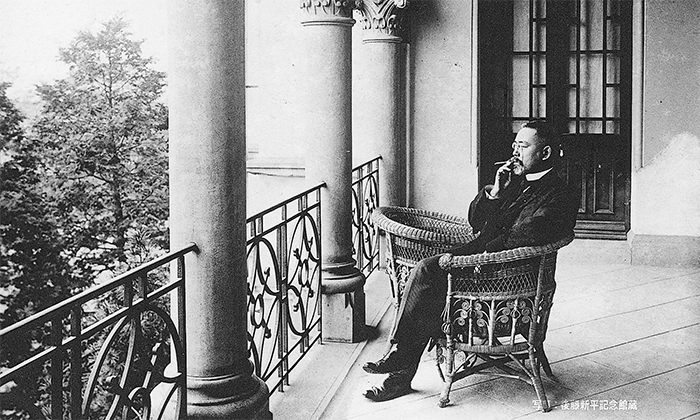
Gotō Shinpei, presumably during his time as Civil Administrator of the Taiwan Governor-General's Office
Ahn Jung-geun's mother was from the Baekcheon (白川) Jo clan, and her given name is uncertain, but she is commonly known as Jo Maria. Jo Maria is said to have been born during the period of activity of French missionaries who had entered Hwanghae Province early on, and was baptized by Bishop Gustave-Charles-Marie Mutel (閔德孝 1854~1933) in 1897. However, history remains silent on where Hwanghae Province is and why so many French missionaries were stationed there.
The early activities of French missionaries in Hwanghae Province date back to Bishop Siméon-François Berneux's (張敬一, 1814~1866) visit in 1863. The person directly connected to Ahn Jung-geun's three families is Father Nicolas Joseph Marie Wilhelm (洪錫九, 1860~1938), who was appointed to Hwanghae Province in 1896. In 1909, Russia and France were allies, and both countries had signed agreements with Japan in 1907, adjusting their spheres of influence in East Asia and cooperating. The assassination of Ito could be a means of persecuting Koreans and a good opportunity for spies to thrive; if Ito were Korean, it would simply be an actor whose role was finished disappearing from the stage.
(https://www.p-um.net/p/diaspora/zainichi/clocfor1w008l01ah8pokwp81)
Born in China in 1985, the Korean-American scholar Lee Jung-sik (李庭植, 1931∼2021) described Park Chung-hee's wavering and the establishment of the Yushin system during the Détente era in his book 『Japan and Korea: The Political Dimension』. The reduction of US intervention in Asia and the withdrawal of US forces in Korea were a crisis for Park Chung-hee. Cornered, Park Chung-hee attempted to assassinate Kim Dae-jung in Japan through the Kim Dae-jung kidnapping incident, but Kim Dae-jung was released just before the assassination by some unknown hands and was able to return to Seoul. The reason why the assassination of a future Korean leader should not have occurred was not due to consideration from the US and Japan to prevent the undermining of democratic values, but rather because it touched upon territorial issues where a Korean politician should not die within Japan, and unresolved past issues. On August 14, 1974, the day Japan was notified of the suspension of investigations related to the Kim Dae-jung kidnapping incident, the Yuk Young-soo shooting incident occurred the next day.
댓글
( 0 / 500 )
萬松
5
국가가 정한 범죄자라는 낙인이 언제나 진실을 의미하는 것은 아닙니다. 재일동포 간첩 조작 사건과 고문 피해자들의 역사가 보여주듯, 권력은 때로 자신의 생존을 위해 무고한 사람의 인생까지 희생시켰습니다. 과거의 국가 폭력을 철저히 재조명해야 합니다.
( 0 / 500 )
知非者
9
이 글은 안중근과 문세광이라는 두 인물의 의문을 넘어, 우리가 어떤 역사를 배웠고 무엇을 보지 못하도록 강요받았는지를 묻고 있다고 생각합니다. 역사의 진실은 권력이 허락한 기억 속에만 존재하지 않습니다. 외면당한 사람들의 삶을 복원하는 일이야말로 진정한 역사 바로 세우기입니다.
( 0 / 500 )
joonggil
5
안중근과 문세광이라는 두 인물을 통해 식민지 청산의 실패와 독재 권력이 역사를 이용해 온 방식을 되짚어 보게 하는 글입니다. 우리가 배운 역사가 과연 충분한 사실 위에 세워졌는지, 아직 밝혀지지 않은 진실은 없는지 끊임없이 질문해야 합니다.
( 0 / 500 )
maria
7
글쓴이께서 말씀하시려는 핵심은 특정 인물에 대한 호오가 아니라, 식민지 청산에 실패한 역사가 독재와 공안 정치로 이어지고 그 유산이 오늘날까지 청산되지 않았다는 데 있는 것 같습니다. 과거를 단절된 사건으로 바라보지 않고 하나의 구조로 읽어내려는 문제의식에 깊이 공감합니다.
( 0 / 500 )
koko
5
역사를 바로 세우는 일은 단순히 과거의 인물을 단죄하는 데서 끝나지 않습니다. 국가 권력이 어떻게 진실을 통제하고, 언론이 무엇을 외면하며, 국민이 어떻게 선동에 휩쓸렸는지를 밝혀야 합니다. 다만 의혹은 의혹으로 남겨두지 말고 사료와 증거로 검증해야 합니다.
( 0 / 500 )
hong_J
5
가장 무서운 것은 독재자 한 사람의 폭력이 아니라, 그 폭력을 정당화하고 다음 세대에까지 미화하는 사회의 구조입니다. 경제 발전이라는 성과가 고문과 인권 유린을 지워주는 면죄부가 될 수는 없습니다. 과거를 직시하지 않는 사회는 같은 잘못을 반복할 위험이 있습니다.
( 0 / 500 )
speaker
4
안중근 의사의 의거와 문세광 사건을 동일한 선상에서 단정하기보다는, 두 사건을 둘러싼 기록과 증언을 면밀하게 검증하는 작업이 필요합니다. 역사는 권력자의 설명만으로 완성되지 않습니다. 의문을 제기할 자유와 그 의문을 증거로 검증할 책임이 함께 있어야 합니다.
( 0 / 500 )
상용78
4
역사를 잊지 말라는 말은 흔하지만, 정작 불편한 역사를 마주할 용기를 가진 사람은 많지 않습니다. 글쓴이께서는 독재자의 공적이라는 이름 아래 묻힌 고문과 희생, 재일동포의 수난, 한일 과거사의 미청산을 한데 연결해 우리가 외면해 온 책임을 묻고 계십니다.
( 0 / 500 )
안병주
3
문세광이라는 한 청년의 삶을 통해 국가 권력이 개인의 운명을 어떻게 빼앗고, 한 사람을 시대가 필요로 하는 악역으로 만들 수 있는지 생각하게 됩니다. 그가 실제로 어떤 역할을 했는지에 관한 의문은 사료로 검증되어야겠지만, 권력의 발표만으로 역사를 완결해서는 안 된다는 작가님의 문제 제기는 무겁게 다가옵니다.
( 0 / 500 )
파도
1
결국 이 글이 독자에게 요구하는 것은 과거의 진실을 대신 판단해 달라는 것이 아니라, 스스로 생각하고 의심하며 역사의 행위 주체가 되라는 뜻이라고 봅니다. 누가 영웅이고 누가 악인인지 권력이 정해 준 구도에서 벗어나야 합니다. 기록을 읽고 증언을 살피며 감춰진 희생을 기억하는 시민만이 역사의 반복을 막을 수 있습니다.
( 0 / 500 )
신고내용
신고내용을 선택해주세요
회원비난/비하/욕설글 및 댓글도배성 게시물저작권 침해/불법자료 유출허위사실유포개인정보 유출.사생활 침해무단광고/홍보음란물 및 도박 불법 광고물범죄행위 관련 글불법행위 관련 소개물품 판매 및 사기글악성코드 및 스파이웨어 유포기타 사유 및 운영진 판단


비밀번호를 잊으셨나요?
Sign in with Google
All information provided by us is free of charge and is for the public good.