

청구영언
Cheonggu Yeongeon 13-16 This Dynasty - Jeoljae, Maejukdang


The winter wind blows at the treetops, the bright moon is cold in the snow, and in the border fortress ten thousand li away, I stand with a long sword, my long whistle and loud shout unhindered.
* Kim Jong-seo (金宗瑞, 1383~1453), whose courtesy name was Gukgyeong (國卿) and pen name was Jeoljae (節齋), was such an important figure in the early Joseon Dynasty that there's even a Jeoljae-ro (節齋路) in Chungcheong Province. He was a high-ranking official of great dignity. However, the more one digs into this country called Joseon, the more unclear and ambiguous it becomes. Cheonggu Yeongeon begins with Kim Jong-seo's poem and uses the expression 'bonjo' (本朝), which refers to the court of the existing dynasty. However, the format and style of the Veritable Records—Joseon, Ming, Qing—share many commonalities, and expressions like 本朝·上·詔·遣使·朝貢 are also shared, making it difficult to distinguish the subject of the records. The 15th-century Japanese aristocratic diary 『Sanetaka Kōki』 recorded 'Goryeo,' so the expression 'late Goryeo, early Joseon' is also a history for domestic consumption. It's time to consider how the outside world truly defined 'us.' The unclear distinction between the Joseon Dynasty Veritable Records and the Ming and Qing Veritable Records holds significant implications.
This poetic imagery reveals the unwavering spirit of a person amidst the cold and harsh nature of the frontier, as seen in the fierce wind, moonlight, and snow of the formidable Great Wall. The dignified and resounding whistle of the person standing with a long sword expresses Kim Jong-seo's confidence, dominating both sight and sound, yet modern people know nothing of his northern activities. Since all history has been tampered with by imperial Japan, it is dangerous to memorize and discourse on shoddy historical narratives. Colonial rule is an eternal yoke, so instead of thinking about escaping, we must consider a 100-year review process as essential.
The Korean sentiment that has interpreted the Great Wall in Kim Jong-seo's poem as some distant border fortress (城) is a complete Sadaejuui (servile diplomacy) sentiment. Although Cheonggu Yeongeon is also a collection of sijo influenced by imperial Japan, why did it specifically leave 'Great Wall' as is? History holds many secrets. It's because territorial wars were hidden, the movement of culture was concealed, and the history of taking and being taken was also hidden.
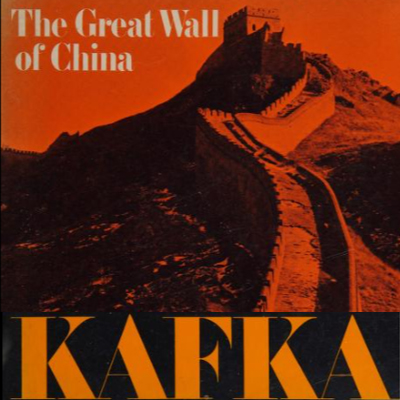
In 1917, Franz Kafka (1883-1924) wrote an unfinished short story about the construction of the Great Wall, depicting the plight of individuals who participate in a massive national project without understanding its purpose or the true nature of the power behind it. The original title is 'Beim Bau der chinesischen Mauer,' translated as 'At the Building of the Chinese Wall' or 'The Building of the Great Wall.'
A narrator from southern China recounts their experience participating in the construction of the Great Wall. Once a certain section is completed, they don't continue building right next to it but move to a different site far away. This leaves gaps throughout the Wall. It's not a wall to keep out invaders, but a Great Wall built for show. Who ordered this method, and why, is unknown. The narrator believes there must be a deeper meaning known to the highest leadership, but ultimately cannot explain their intentions. The people have never seen the northern enemy directly, yet they dedicate their lives to stopping that enemy.
The modern Great Wall is a new Great Wall built for the New China. While it could be seen as having been built during Kafka's lifetime or earlier, proving this historically would take time, though data abounds. Kafka, a Jewish novelist, depicted the fin de siècle, the decline of the old order, decadence, and anxiety, but no one at that time knew Big Brother. Of course, we know nothing of Kim Jong-seo's abilities, loyalty, race, height, favorite foods, or Big Brother. It is a reality that human history often involves destruction for reasons unknown.
1) 朔風 (Sakpung) - 朔 (Sak) means north, and 朔風 is the north wind, a harsh, cold wind of winter. The northern region is called '削榜' (Sakbang), the northern energy '朔氣' (Sakgi), and the 'North Border' '朔雪' (Sakseol).
2) 나모긋 (namogeutdae): At the end of the tree. '나모' (namo) is an old word for tree. When a particle beginning with a vowel follows, it becomes '나ᇚ' (naht). (Refer to the '뎜그디도' (dyeomgeudido) entry in Sijo 1 (2))
3) 듸 (chandeui): Searching. The active form of 'ᄎᆞ다' (chada - to fill/be full). Here, it means the bright moon is fully shining in the snow.
4) 萬里邊城 (Manri Byeonseong): A city near the border far away, meaning a frontier fortress. Here, it refers to the Six Garrisons in the northern Hamgyeongdo region, which Kim Jong-seo went to defend.
5) 람 (param): Whistle
6) 큰소릐 (keunhan sori): A loud shout, a single great cry.
7) 거칠것 (geochilgeot): Something that resists, something that blocks.
8) 업세라: A conjunction of '없애라' meaning 'there is none,' 'it's not there.' The ending '에라' is in the form of 'ᄒᆞ얘라.' (Refer to Sijo 7 (3) 머흐레라)

We plant our flag on Baekdusan and wash our horses in the Duman River, you rotten scholar. Are we not true men? What do you say, who will be the first to have their portrait hung in the Girin-gak?
* An early record that refers to Baekdusan as Jangbaeksan is the sequel to 『Songmo Gyeomun』 by Hong Hao of the Southern Song Dynasty. '長白山在冷山東南千餘里, 蓋白衣觀音所居。其山禽獸皆白, 人不敢入, 恐穢其間, 以致蛇虺之害。(Jangbaeksan is located over a thousand li southeast of Naengsan, and it is said to be where the White-Clad Guanyin resides. All the birds and beasts on that mountain are white. People dare not enter, fearing they might defile the place and suffer harm from snakes and vipers.)' Naengsan has been identified with present-day Heilongjiang Province, but the foolishness of blindly believing this record has made Koreans simple-minded. Believing in fake place names while calling history fake does not help brain activity. To prevent dementia, we must not forget the history that was stolen from us. We must stay awake.
This is a poetic expression of confidence in northern expansion and border defense, where military forces were led north to assert power. But who defined the existing interpretation that Kim Jong-seo cannot be seen as having actually planted a flag on the summit of Baekdusan? If there is a reason why Kim Jong-seo should not stand on the Great Wall and plant a flag of victory on Baekdusan, it is because the essence of history as an academic discipline is a territorial issue, and thus a geopolitical problem whose influence extends to the present day. However, Kim Jong-seo's expedition might have been a southern or western expedition, not a northern one, but we cannot know. History only truly reveals itself when we refrain from making any definitive statements.
It is an argument that scolds the buyu (腐儒: useless scholars with old and stubborn ideas) who are trapped in narrow views and formal scholarship and are unable to act, and proposes to take on great tasks, make contributions to the country, and compete for the honor of having their portraits hung in the Girin-gak. Did Kim Jong-seo put the portraits of meritorious officials of the Han Dynasty in his poem and sing about the Great Wall? If we cannot trust the poetry collection Cheonggu-yeong-eon or the Annals, what should Koreans believe? Is this truly an area where politicians can intervene?
9) (Changbai Mountain: A mountain that marks the border between Manchuria and Korea. It is called Changbai Mountain in Manchuria and Baekdu Mountain in Korea.)
10) Seogeun jeo seonbi: That somewhat old scholar. 'Seogeun' is not considered the adnominal form of 'seokda' (to rot), but rather the adnominal form of 'hyeokda' (small).
11) Sanahui: Man. (男兒) Meaning a great man. Derived from 'sanahae'. This word has been transmitted as 'sanahae > sanahui > sanaui > sanae'.
12) Rin-gak: 'Rin' is interchangeable with 'Lin', and Rin-gak is the same as 'Kirin-gak', and Rin-gak is an abbreviation of Kirin-gak. Kirin-gak was a tall building built by Emperor Wu of the Former Han Dynasty when he obtained a Kirin, and later Emperor Xiaoyi had the portraits of national meritorious officials painted and hung there.
13) Nugo: Who (誰)

Looking at Suyangsan, I lament Baek-i and Suk-je. Even if they starve to death, do they eat bracken? Even if it's just a plant, whose land did it grow on?
* Mae Jukdang is the pen name of Seong Sam-mun (成三問, 1418~1456), one of the six loyal ministers who plotted to restore Danjong to the throne. Baek-i and Suk-je were figures who, when King Wu of Zhou overthrew the Yin Dynasty, considered it wrong and refused to eat the grains of Zhou, entering Suyangsan. Seong Sam-mun, the speaker of this sijo, goes further than the story of Baek-i and Suk-je, asking, “If they refused the grains of Zhou, shouldn't they also not eat the bracken that grew on the land of Zhou?” While taking the form of scolding Baek-i and Suk-je, he is filled with a stronger resolve to uphold his loyalty more thoroughly than them.
The final question, 'Whose land is it?', when interpreting 'Suyang' in 'Suyangsan' as Grand Prince Suyang, brings to mind three implications. First, whose land is the land of Zhou? That is, if Baek-i and Suk-je are foreigners to Seong Sam-mun, then Kim Jong-seo, who sang about the Great Wall, and Seong Sam-mun are close to being insane. Their expressions are like modern Koreans imagining pyramids and sphinxes and staking their lives on ancient Egypt. Even in Kim Jong-seo's time, the Great Wall would have been like a legend, and the story of Baek-i and Suk-je in Seong Sam-mun's time is a thoroughly distant past for serving King Danjong. Koreans must realize that to understand their history, they need a worldview that blends national and world history. What civilization is truly related to the builders of the pyramids and sphinxes? Was the world five hundred years ago, without communication, a world without cultural heterogeneity?
14) Suyangsan: Suyangsan has the same name in several regions in China, and also in Hwanghae Province in Korea.
15) Ije: Abbreviation for Baek-i and Suk-je.
16) Juryeo jugeuljindeul: Even if one starves to death. 'ㄹjindeul' is a hypothetical non-restrictive form corresponding to 'ㄹjirado' in modern Korean.
17) Chae-mi: Picking bracken. Baek-i and Suk-je, after the fall of the Yin dynasty and the establishment of the Zhou dynasty, refused to eat Zhou grain and entered Suyangsan to pick and eat bracken, eventually starving to death.
18) Haneungeotga: Is it doing? 'Ga' is an interrogative ending used in declarative sentences. Its counterpart 'go' is humble and has a weaker degree of interrogation.
19) Birogae: Same as 'birok'. Is it to emphasize the meaning by adding the particle 'ae' to the adverb 'birok'?
20) Pusaeet: Of the grass. 'Et' is a form where a linking sound is connected to the genitive case particle 'ui' and the locative case particle 'e'.
21) Gye: That. A combined form of 'geu + i'. 'Geu' is a pronoun. 'I' is an incomplete noun.
22) Natdeuni: Was it born? 'Deu' is a corrupted spelling of the retrospective auxiliary stem 'deo'. 'Ni' is an interrogative ending. (Refer to Sijo 2, (3) Eodigani)

If this body dies, what will it become? It will become a towering pine tree on the highest peak of Bongraesan, and when white snow covers the whole world, it will remain green and blue alone.
* The core of the work is a resolution to maintain integrity even after death by becoming a pine tree. If 'Looking at Suyangsan' earlier revealed loyalty to Danjong by questioning the conduct of Baek-i and Suk-je, this work is an expression of will, depicting the author's appearance after death. It means that even if the whole world follows other powers, the author alone will maintain loyalty to Danjong. 'White clouds' accumulate when they melt, and now seems to be the time for the snow to melt.
Like Danjong's tragedy, the tragic ends of imperial bloodlines number in the tens, and far more if you include forced suicides and poisonings. The reason modern people cannot understand history, which has become a grand, mythical narrative, even when analyzed as realistic events, is due to distorted history and Japanese manipulation. The practice of blaming others for our own faults is the main culprit that has made Koreans historically ignorant.
23) Bongraesan: One of the Three Divine Mountains said to be in Balhae. It is said that there are immortal palaces and immortals. In Korea, it is sometimes compared to Geumgangsan (summer), but here it is considered to be a metaphor for the mountains around Seoul where the king resides, especially Namsan. (Refer to (2)※ of this poem)
24) First Peak: The highest summit
25) 낙락장송 (Nangnakjangsong): A tall, vigorously growing pine tree. '낙락 (Nangnak)' refers to 'a tall appearance'.
26) 만건곤 (Mangon-gon): Filling heaven and earth.
27) 독야청청 (Dokyacheongcheong): Green and verdant alone.


All information provided by us is free of charge and is for the public good.