品

Corea든 Korea든, 품격이 먼저다
Whether Corea or Korea, dignity comes first.
Whether Corea or Korea, dignity comes first.
Now
지금
751 Diaspora
Heritage
유산
Humanity
인문
Mirengsi
未冷尸
Politics
정치
Media
언론
이원영 (국토미래연구소장, 시민인권위 공동위원장)

정책 이슈
칼럼
blueSky
Algae grows in stagnant water — from the starting point of the Four Major Rivers project to a diagnosis of life

0
2026. 11. 07
- A Keimyung University research team's investigation found microcystins, a possible carcinogen designated by the International Agency for Research on Cancer, in the urine of residents near the Nakdong River basin and metropolitan area waterways experiencing algal blooms, confirming the toxins' entry into the human body.
- Water quality deterioration is worsening, with a sharp increase in harmful cyanobacteria outbreaks in the Nakdong River and algal blooms persisting until late autumn, a result of the 16 weirs installed by the Four Major Rivers Project blocking water flow and creating an environment for cyanobacteria proliferation.
- Despite procedural illegality controversies like the exemption from preliminary feasibility studies, the Four Major Rivers Project was pushed through by "sajeong pan-gyeols" (judicial discretion rulings) and Supreme Court decisions; however, with toxins now detected in residents' urine, a re-verification of those past predictions is needed.
- Even with changes in government, decisions to open or dismantle the Four Major Rivers weirs have been reversed or delayed, indicating strong vested interests formed by the project that make policy changes difficult, forcing residents to directly prove the harm they suffer.
- Beyond political controversy, the formation of an international investigation team for the Four Major Rivers, involving domestic and international experts, is proposed to ensure objective and reliable diagnosis and countermeasures, representing a responsible first step towards passing on healthy rivers to the next generation.
From the river into the body
Green algae toxins were found in human bodies. According to an announcement by a Keimyung University research team, the team, in collaboration with a civic group, collected and analyzed 150 urine samples from 93 residents living near the Nakdong River basin and metropolitan area waterways where green algae occurred, from August 2025 to February of this year. Microcystins were detected in 29 of these samples (19.3%). The most frequently detected MC-LR is a toxin classified as a possible carcinogen by the International Agency for Research on Cancer.
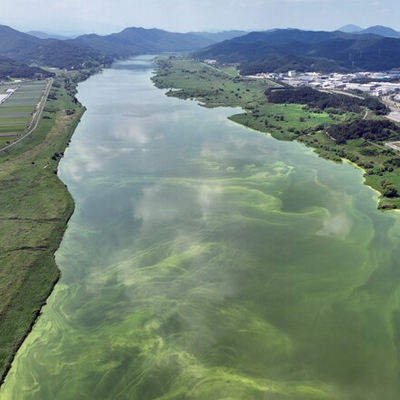
The river is also deteriorating. According to an analysis of data by Daegu MBC up to August of this year, the number of times harmful cyanobacteria exceeded 50,000 cells per mL at the Gangjeong-Goryeong point, which is the drinking water source for Daegu citizens, increased from 2 times between 2016 and 2021 to 7 times between 2022 and 2026. Professor Lee Seung-jun of Kyungpook National University explains that when the number of cyanobacteria cells exceeds a certain level, the risk of toxin production also increases. Green algae is no longer just a mid-summer phenomenon; algal bloom warnings continue until late autumn.
Green algae is caused by a combination of factors: rising water temperatures due to climate change, nutrients flowing in from the watershed, and water flow. The 16 weirs significantly increased the time water stays in place. As the flowing river became stagnant like a lake, conditions for cyanobacteria to grow were created.
The starting point of coercion
Looking back, the starting point of a world where the coercion of the powerful prevailed was the Four Major Rivers Project. In 2008, President Lee Myung-bak declared that he would not pursue the Grand Canal if the public opposed it. The following year, the Grand Canal returned under the name 'Four Major Rivers Restoration'. Although it was a 22 trillion won project, the preliminary feasibility study was exempted by amending the enforcement decree. The justification was that it was a disaster prevention project. It did not violate the law but circumvented it by amending the law. The form was preserved, but the substance was taken away.
It wasn't the first time there was coercion. However, the nature was different. In 2000, the Kim Dae-jung government scrapped the Donggang Dam plan when faced with public opposition. It stopped in front of the public after attempting to block the river. The Four Major Rivers Project did not stop in front of the public but changed its name.
Ended lawsuit, unanswered questions
Citizens asked the court. In February 2012, the Busan High Court ruled that the Nakdong River project violated the National Finance Act because it did not undergo a preliminary feasibility study. However, it dismissed the claim, stating that canceling the disposition would not be in the public interest. It was a 'sajeong pan-gyeon' (judgment based on circumstances) that acknowledged the illegality but accepted the fait accompli.
In December 2015, the Supreme Court took a different approach. It viewed the preliminary feasibility study as a procedure for budget formulation, and therefore, not undergoing it was not a direct reason to cancel the river construction implementation plan. The Supreme Court overturned the Busan High Court's ruling and ruled in favor of the defendant. It stated that the administrative authority's predictions regarding the project's effects should be respected. The citizens' lawsuit seeking the cancellation of the project implementation plan thus ended in final defeat. However, the end of the lawsuit does not mean the end of the questions. Whether the predictions at the time were actually correct is a separate issue. Now that green algae toxins have been detected even in residents' urine, those predictions must be re-verified with real-world data.
Obstinacy protects itself.
In 2021, the National Water Management Committee decided to dismantle or permanently open some weirs on the Geum River and Yeongsan River. In 2023, when the government changed, that decision was canceled. According to reports, the Ministry of Climate, Energy, and Environment announced in its plans for January and May of this year that it would open eight weirs on the Nakdong River. In reality, from late July, only the four downstream weirs were sequentially opened for three to five days each, with the government citing drought and heatwaves as reasons. The National Institute of Environmental Research predicted that opening the weirs would reduce green algae by about 30%. The actual execution rate of the budget for improving water intake and pumping facilities this year is just over 20%. The minister announced that the summer opening of weirs would be made permanent starting in 2028.
Economist Mancur Olson called the phenomenon of society becoming rigid 'sclerosis.' He argued that vested interests accumulate in layers where power does not flow. The same applies to structures built by force. Over time, pumping stations and waterfront developments tailored to the weir's water level, and the agencies that spend those budgets, emerge. The weir is protected by those vested interests. Even if those who opposed the Four Major Rivers project take power, the sluice gates do not open easily. Just as green algae grows in stagnant water, obstinacy grows in stagnant power.
The Burden of Proof in Reverse
Perhaps this is the deepest wound left by the Four Major Rivers Project. Last year, residents found toxins in their noses, and this year, in their urine. They had to conduct the tests themselves. The government's response to the urine tests was that they were "discussing measures." There isn't even an international health standard yet for microcystins in urine. Those in power don't need to prove safety, while those without power must prove harm. The burden of proof is reversed.
Of course, the presence of toxins in urine is evidence of exposure, not evidence of illness. How the toxins entered the body and what health effects they have are also yet to be determined. That is precisely why an investigation is needed. If exposure is confirmed, it is the responsibility of the state and science, not the residents, to uncover what happens next.
Why an international investigation team?
Who will conduct that investigation? Over the past 17 years, policy decisions regarding the Four Major Rivers Project have been overturned with each change of government. Investigations by governments in favor were not trusted by the opposition, and investigations by governments against were not trusted by those in favor. If investigations by either side fail to gain trust, the method of investigation itself must change. There are countries that have experience blocking rivers and then reopening them. The United States removed two dams on the Elwha River, and Munich, Germany, revitalized the Isar River, which was confined by concrete, over a decade. France demolished the dam on the Sélune River, and Japan removed the Arase Dam on the Kuma River for the first time. Their experiences serve as good references.
However, the credibility of an international investigation team is not solely derived from the participation of foreign experts. River, water quality, and health experts from both domestic and international spheres should collaborate, and the selection criteria, funding, and conflicts of interest must be disclosed. The investigation methods and results should be open to external verification. The goal is to review the impact of the weirs, the exposure pathways for residents, and possible countermeasures without predetermined conclusions. The aim is to leave a record that cannot be erased even if the government changes, and that anyone can verify.
떠나기 전에
Rivers outlast us. We cannot pass on to the next generation the responsibility of making rivers flow again that we have blocked. What we must leave to the children who will drink that water, and to all life that will depend on that river, is an accurate diagnosis. From the river that became the starting point of this forced situation, we now begin a diagnosis for life. As a first step, the Preparatory Committee for the Four Major Rivers International Investigation Team asks for citizens' participation.
댓글
( 0 / 500 )
do_hyun
6
4대강 사업의 가장 큰 문제는 강을 살린다는 명분으로 강의 생태적 흐름을 끊고, 그 결과에 대한 책임마저 국민에게 떠넘겼다는 데 있습니다. 이제는 정치적 논쟁을 넘어 과학적 자료와 객관적 검증으로 진실을 밝혀야 합니다.
( 0 / 500 )
강창국
5
강을 막는 데는 22조 원을 쏟아부으면서 강을 되살리는 데는 왜 그렇게 인색한지 묻지 않을 수 없습니다. 녹조독소가 주민의 몸에서 검출됐다면 정부는 더 이상 방관자가 아니라 책임 있는 조사와 대책의 주체가 되어야 합니다.
( 0 / 500 )
東方77
4
이 글에서 특히 공감하는 대목은 증명의 짐이 거꾸로 지워져 있다는 지적입니다. 국민이 자신의 몸속에 독소가 있는지 직접 검사해야 하는 현실은 국가의 존재 이유를 되묻게 합니다. 국민의 생명과 안전을 지키는 것이 국가의 첫 번째 책무입니다.
( 0 / 500 )
최남규
3
강은 어느 정권의 소유물도 아니고 특정 정치세력의 치적을 위한 사업장도 아닙니다. 한번 훼손된 자연을 회복하는 데는 수십 년이 걸릴 수 있습니다. 지금 필요한 것은 책임 회피나 또 다른 정치적 공방이 아니라 미래 세대에게 건강한 강을 물려주겠다는 결단입니다.
( 0 / 500 )
철우
3
4대강 문제를 정권이 바뀔 때마다 정치적 유불리에 따라 뒤집는 관행부터 끝내야 합니다. 국제조사단을 통해 조사 과정과 결과의 객관성을 확보하고, 보의 존치와 해체 문제도 정치가 아닌 생태적·과학적 기준으로 판단해야 합니다.
( 0 / 500 )
김길규
2
강은 흐를 때 생명을 품습니다. 물을 가두고 수위를 유지하는 것이 강을 살리는 일이라는 발상부터 재검토해야 합니다. 녹조 문제를 일시적인 수질관리로 덮지 말고 강의 자연스러운 흐름을 회복하는 근본 대책을 마련해야 합니다.
( 0 / 500 )
Pink6
1
주민들의 몸에서 독소가 검출됐다는 사실은 결코 가볍게 넘길 일이 아닙니다. 질병과의 인과관계가 아직 밝혀지지 않았다는 이유로 조사를 미룰 것이 아니라, 오히려 그 인과관계를 밝히기 위해 국가가 적극적으로 나서야 합니다.
( 0 / 500 )
신고내용
신고내용을 선택해주세요
회원비난/비하/욕설글 및 댓글도배성 게시물저작권 침해/불법자료 유출허위사실유포개인정보 유출.사생활 침해무단광고/홍보음란물 및 도박 불법 광고물범죄행위 관련 글불법행위 관련 소개물품 판매 및 사기글악성코드 및 스파이웨어 유포기타 사유 및 운영진 판단


비밀번호를 잊으셨나요?
Sign in with Google


All information provided by us is free of charge and is for the public good.