品

Corea든 Korea든, 품격이 먼저다
Whether Corea or Korea, dignity comes first.
Whether Corea or Korea, dignity comes first.
Now
지금
751 Diaspora
Heritage
유산
Humanity
인문
Mirengsi
未冷尸
Politics
정치
Media
언론
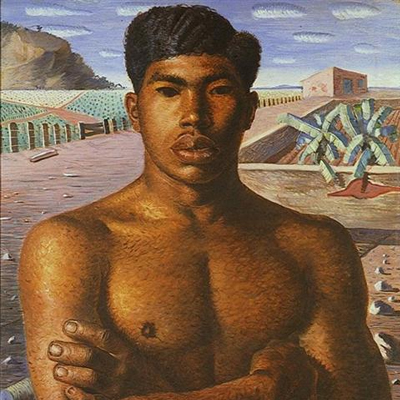
브라질 화가 칸디두 포르치나리(Cândido Portinari)의 Mestiço, 1934년

천하天下
칼럼
baba77
Syngman Rhee of Brazil

0
2026. 10. 30
- Agreeing with Aristotle's critique of democracy, the author, who views direct elections as a 'shackle,' analyzes the complexities of modern politics through the case of the Brazilian presidential election.
- The Brazilian presidential election between Bolsonaro and Lula showcased identity politics intertwined with lineage, colonial history, and socioeconomic polarization, symbolizing that US attempts to intervene in elections are no longer effective.
- Lula's victory was driven by policies aimed at resolving income polarization and an aggressive voter mobilization strategy, but complex factors such as controversy over incumbent premium and unexpected shifts in support from eliminated candidates also played a role.
- The author criticizes the mainstream Korean media's tendency to disparage the Brazilian election as 'left-wing chaos' and link it to election fraud conspiracy theories, attributing this to chronic ailments in Korean politics and US influence.
- Ultimately, the author strongly criticizes that the Korean political system forces the choice of the 'lesser evil,' and Koreans, having tasted the bitter fruits sown by the US, are contributing to the perpetuation of this sick society.
Aristotle said, “Democracy is as bad a system as the tyranny of a dictator.” This is because democracy is the politics of numbers, not the quality of numbers. However, I believe that humanity at the time Aristotle wrote his Politics was not on the foundation of a uniformly developed civilization. Furthermore, I think humanity is foolish to have embraced direct election as a 'manipulation,' given that clever people, dull people, stagnant people, young people, old people, brave people, cowardly people, nationalists, and indigenous Japanese collaborators all have the same weight of one vote. However, I agree with Aristotle's opinion regarding real-world politics that transcends time and space. Modern Koreans must break free from this 'psychological shrinking that transcends time and space' where Aristotle's citation suddenly gains legitimacy, and with a classic doubt (Questioning Politicized Classics) that he might be a fictional character, we must also look at what lies at the intersection of Brazilian politics and the United States.
Bolsonaro and the United States
According to a 2018 investigation by Brazilian genealogist Daniel Taddone (born 1978) – an academic who is also of Italian-Brazilian immigrant descent – 13 of Bolsonaro's 16 great-great-grandparents were Italian, 2 were German, and 1 was Brazilian with no earlier confirmed ancestry. The original form of the Bolsonaro surname begins its history with the Italian 'Bolzonaro,' and his maternal lineage is Italian from Tuscany, while his paternal lineage is a combination of Italian from Veneto and Calabria, and German from Hamburg.
In contrast, the victorious Lula (Luiz Inácio Lula da Silva, born 1945) is from a rural area in Pernambuco, a state in northeastern Brazil. According to Lula's interviews, his grandparents were 'Caboclos,' meaning a mix of indigenous Brazilians and Europeans, and are presumed to have been descendants of Black or indigenous people. The fact that the distant ancestors of Brazilians could be European or African has a subtle but absolute impact on the Brazilian presidential election.
The Portuguese term 'Mestiço' refers to a broader range of mixed heritage, including European, indigenous, and African descent, more extensively than 'Caboclo'. This term encapsulates a history of Western colonial rule, forced population movements, social discrimination, and political mobilization. Modern electoral politics reduces this complex historical identity to a single vote, which is then divided into 'us' and 'them' and incorporated into power calculations. By delving deeply into the history of how Brazil came to speak Portuguese, one can see that Caboclo and Mestiço transcend ambiguous concepts, revealing the extensibility and fluidity of politics where the complex mixed-race identity of human socio-cultural history lives and breathes within votes. The same applies to Korea.
Brazil's 2026 presidential election can be seen as symbolic of the weaknesses in Brazilian politics, where both father Jair Bolsonaro (born 1955) and son Flávio Nantes Bolsonaro (born 1981) each challenged Lula once, and where the influence the United States once held in presidential elections no longer carries weight. Two days after Lula won the presidential election on October 30, 2022, Jair Bolsonaro challenged the electronic voting machines, but the electoral court did not accept his claim. Instead of Trump, who actively supported Jair, Trump's associate Steve Bannon denied the election results and demanded a recount. On December 30 of that year, Jair departed for Florida, USA, on a Brazilian Air Force presidential plane.
Steve Bannon was the person who hastened his own dismissal by publicly pouring cold water on Trump's hardline stance on North Korea, making extreme statements that 10 million Seoul citizens could be victims within 30 minutes of a war breaking out with North Korea's conventional weapons, while assuming that the withdrawal of US forces in South Korea could be considered a bargaining chip against China and North Korea. Just before the election, Trump criticized Lula and supported Bolsonaro on his Truth Social, calling Lula, “His opponent, ‘Lulu,’ is a Radical Left Lunatic,” treating him as mentally ill. It's like Kim Eo-jun, as the current president and CEO of a polling company, Flower, freely making statements that influence the election landscape, telling people what to do in the general election.
On October 25, 2026, after Jair's son, Flávio, lost the presidential election, Trump, the next day, made remarks suggesting that the Brazilian election seemed rigged without evidence, raising suspicions of election fraud, but soon after, he backed down, stating he would not interfere in the Brazilian election. The US midterm elections are just four days away. Trump's America, a true melting pot with a mix of past European colonial activities, their immigrant descendants, and emerging Asian races, is exposing many difficult problems. It remains to be seen whether Bolsonaro's political dynasty in Brazil will end with the second generation, or if another American dog will bark. Why? The history of Western invasion of South America is not to be taken lightly. This is because the history of 'colonialism,' where humanity devours humanity, has not been properly recorded in any single era.
Major South Korean media outlets immediately began to label Lula's victory in the Brazilian presidential election as fraudulent, linking it to South Korea's own election fraud or conspiracy theories, and portraying Brazil's democratization as a "leftist mess" to Korean voters. This is a very low-level irony. The mainstream media in South Korea, whose very existence is intertwined with the tragic modern history of American political dominance in Korea through Syngman Rhee and the history of Korean elections that ran like dogs behind it, is now overstepping its bounds by lecturing on another country's presidential election. Korean public opinion fundamentally perceives Brazil's democratization as a "leftist mess." To judge that it goes against the vested interests' taste without asking the public's opinion, and then to offer unsolicited advice on distant Brazilian politics, mimicking Trump's "tongue-lashing," is a difficult attitude to maintain without a methodology that maximizes election techniques.
Like his father, son Bolsonaro fled to the United States. Let's recall the incident when Syngman Rhee fled to Hawaii. Election fraud, or the fraud of elections, is the exclusive privilege of pro-Japanese anti-nationalists. The ruling party of Korea, which cannot shake off the old strategy of blaming this history on the "communist" Lee Jae-myung, is inherently an eternal opposition party. The Democratic Party of Korea, lacking a brain that understands political history, has allowed the New Right's colonial view of history to portray Syngman Rhee's "exile" as such, and remains intertwined with them in a powerless sexual encounter, unable to move forward or backward, sailing on a rotten ship. The Democratic Party must be prepared to reveal what percentage of Shincheonji and Unification Church members are involved in the People Power Party and the Democratic Party, and how many pro-Japanese anti-national biological species are mixed in.
A system that encourages the lesser evil
On January 3, 2026, Trump issued a statement expressing great satisfaction that the United States had arrested Venezuelan President Nicolás Maduro in a military operation and transferred him to New York. While it cannot be definitively concluded that this incident was caused by allegations of electronic vote manipulation in the 2020 US presidential election, there is a political link between the two events: the Trump campaign's claims of Venezuela-related election fraud. Venezuelan entrepreneurs founded Smartmatic in Florida, USA, in 2000, and supplied technology for the 2004 Venezuelan elections. In November 2020, after Trump lost to Biden by an electoral college count of 232 to 306, Trump's lawyers Sidney Powell and Rudy Giuliani claimed that Smartmatic and Dominion Voting Systems were connected to Venezuela and had manipulated votes. However, no evidence of vote machine manipulation on a scale sufficient to overturn the US presidential election results was confirmed. The actual US criminal charges against Maduro were drug terrorism, drug trafficking, weapons offenses, and conspiracy to commit torture, not charges of manipulating the 2020 US presidential election. The speculation about interference in US elections, or that drugs are just an excuse, is because the US has never engaged in politics that would stop it from "straw-sucking" and asserting influence in other countries.
After Maduro was taken to the United States, Venezuelan opposition leader María Corina Machado (born 1967) presented her 2025 Nobel Peace Prize medal to Trump in January 2026. Machado had been an opposition leader seeking to overthrow the Maduro regime, so the US arrest of Maduro aligned with her political goals. However, Trump's America, after Maduro's arrest, did not recognize Machado as Venezuela's leader, choosing instead to cooperate with Delcy Rodríguez, who had been Maduro's vice president. The whole world watched this scene, where the dog that chased the chicken ended up staring at the roof.
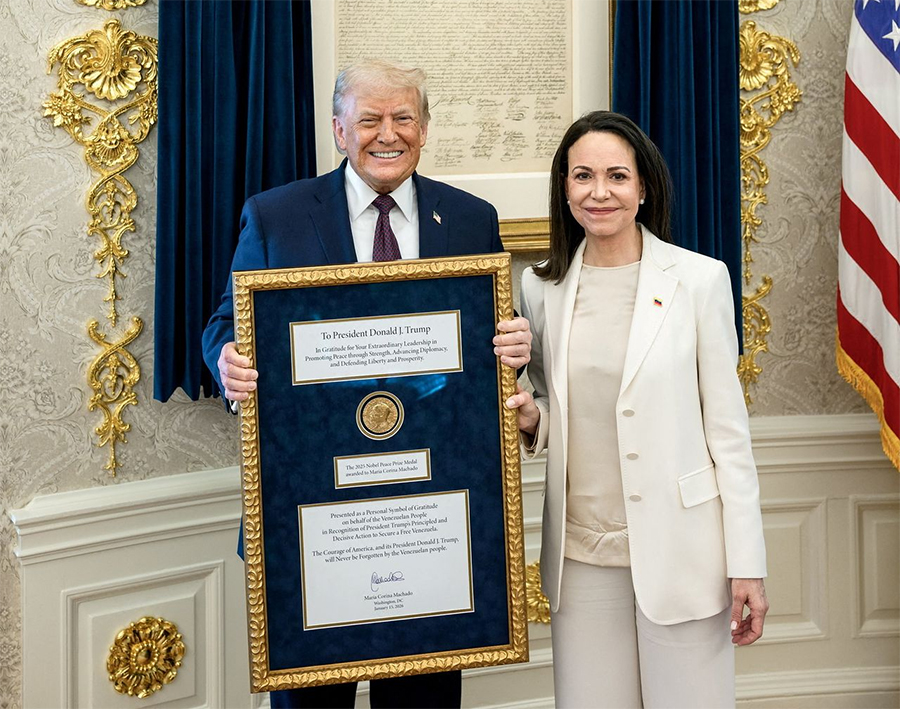
Happy Trump, Machado hiding a smirk, on January 15, 2026, in the Oval Office of the White House, what did he hand over the medal for, for an unassignable award qualification?
What's funny is that this incident wasn't heavily satirized in Korea. Korean media ignored the controversy over election fraud in the US presidential election, the US public authority dragging Maduro away, and the female politician who sacrificed her carefully built tower of pretense to Trump. The media, which drags Koreans' mental energy to the ground with sub-par, third-rate information that remains unchanged even as rivers and mountains change, will not have a positive influence on foreigners learning Korean. We must eradicate the rampant third-rate media. Korean society is a sick society thoroughly marked by 'election fraud - suppression of opposition leaders - politicians and media who volunteered to be America's dogs.' This situation, where public opinion is preempted and incited, and counter-conspiracies are produced to prevent people from escaping a level of political disability that is exhausting and arduous, is fundamentally the responsibility of politicians who cannot be reformed. The political system that seeks the lesser evil among them as candidates, and Koreans who have tasted the sweet fruit of evil sown by the US, are also a sinful people.
How Lula won
The biggest structural fault line that divided the electoral landscape in this election was income polarization. However, that alone does not fully explain why Lula lost in the first round and then overturned the result in the runoff. It is more accurate to say that polarization set the stage for the battle, and the actual outcome was determined by voter mobilization and policies just before the election. The Superior Electoral Court confirmed that Lula, from the Workers' Party, won with 51.77% of the votes, while Senator Flávio Bolsonaro of the Liberal Party lost with 48.23%. In the first round of voting on October 4, Bolsonaro led with 47.03% against Lula's 45.16%. This is the first time in Brazilian history that a candidate who lost in the first round won in the runoff. Votes were divided along income and regional lines. Foreign media assessed that Lula's victory was secured by the support of voters in impoverished regions, especially the Northeast. Bolsonaro initially led in the early stages of vote counting, but the tide turned as votes from Lula's stronghold in the Northeast poured in later. The Lula government's policies also targeted this demographic. They raised the minimum wage higher than the inflation rate and reformed the tax system to lower the tax burden on middle and lower-income groups while increasing it for the highest earners. They also introduced an increase in Bolsa Família (a welfare program for low-income families) family allowances and a large-scale program to renegotiate consumer debt with private banks.
But why did he lose in the first round? Because the same economic issues worked in the opposite direction. In the first round, Flávio persuaded the working and middle classes with the argument that Lula's economic policies would drive up living costs. He linked the Lula government to inflation, describing it as bloated, tax-heavy, and debt-accumulating, and his strong public safety message resonated with voters who cited violence as their biggest concern. In other words, polarization not only drew low-income groups towards Lula but also pushed some working-class and middle-class citizens, weary of rising prices, towards the right wing.
The decisive factor that overturned the runoff was mobilization. During the last 15 days of the runoff, Lula focused on targeting those who did not vote in the first round and undecided voters. As a result, between the first round and the runoff, Lula gained over 10.3 million more votes, while Bolsonaro added less than 3.8 million, turning a 2.2 million vote deficit into a 4.4 million vote victory. Andrei Roman, CEO of AtlasIntel, which analyzes polls and data, also analyzed that the higher-than-expected voter turnout favored Lula. However, there are still unexplained parts. Even though all four candidates eliminated in the first round supported Flávio before the runoff, a significant portion of their supporters appears to have shifted to Lula, leaving analysts unable to find a precedent. It's like a miracle of Moses. Perhaps everyone's support for Flávio directed the public's faith towards Lula, the Moses. In direct elections, various 'manipulations' operate before, during, and in the results of the vote, and perhaps the eliminated candidates' support for Flávio strongly twisted the voters' psychology.
The controversial part is that the Lula government increased the Bolsa Família payment by 15% and brought forward the payment schedule so that it could be received before the runoff, which critics saw as an abuse of incumbent power and state budget. On election day, there were allegations of voter suppression and a last-minute extension of voting hours, and while the Bolsonaro camp is likely to argue that the extension favored Lula, Bolsonaro also wanted the voting extension. Lula's supporters saw the same policy as the outcome of a legitimate distribution policy. In fact, in terms of benefiting the people, a good policy is good for anyone, whether it's Lula or Bolsonaro. However, it is human psychology that a policy is effective when it favors one's own side and bad when it favors the other side. In that sense, the pinnacle of election mechanisms might be psychological warfare.
To summarize, income polarization was indeed the biggest structural factor that formed the core of Lula's support base. However, what determined the outcome was the mobilization power that brought that support base to the runoff polls and the distribution policies implemented just before the election. Nevertheless, opinions within Brazil are divided on whether these policies were legitimate achievements or merely the incumbent's premium, so Brazil's future will depend on Lula's future policies. Korea's future, however, depends not on policy, but on the degree of hatred from ideological opponents.
댓글
( 0 / 500 )
soop77
7
브라질의 룰라와 보우소나루의 대결을 단순한 좌우 진영의 승패로 읽어서는 안 된다는 점이 인상적입니다. 선거 결과를 부정하고 외세의 영향력에 기대어 권력을 유지하려는 행태는 브라질만의 문제가 아닙니다. 이승만 시대부터 이어진 한국 정치의 오래된 병폐를 함께 돌아보게 하는 글입니다.
( 0 / 500 )
xp56
5
선거에서 패배한 세력이 결과를 인정하지 않고 부정선거라는 의혹을 확산시키며, 언론이 이를 검증하기보다 정치적 프레임으로 확대한다면 민주주의의 토대는 흔들릴 수밖에 없습니다. 브라질의 사례를 통해 한국 언론이 얼마나 공정하게 세계를 바라보고 있는지, 또 우리 선거를 어떤 시각으로 보도하는지 되묻게 됩니다
( 0 / 500 )
Bluebird4
5
브라질 정치에서 미국의 영향력이 작동하는 방식과 한국 현대사의 경험을 연결한 시각이 흥미롭습니다. 주권국가의 선거와 정치적 선택은 외부 권력이 좌우할 문제가 아닙니다. 미국의 민주주의를 말하면서 다른 나라의 민주적 선택에는 개입하려는 이중적 태도부터 돌아봐야 합니다. 한국 역시 예외일 수 없습니다.
( 0 / 500 )
jaedong
5
룰라의 승리를 단순히 빈곤층의 결집으로만 설명하지 않고 투표 동원력과 정책, 유권자의 심리까지 분석한 대목에 공감합니다. 결국 선거는 상대를 악마화하는 구호만으로 이기는 것이 아닙니다. 국민의 삶을 이해하고 실제 변화를 만들어 내며, 마지막까지 유권자와 소통하는 정치가 승리한다는 사실을 한국 정치도 배워야 합니다.
( 0 / 500 )
sung_Lee
5
민주주의의 위기는 투표제도 자체보다 유권자에게 선택할 만한 정치를 제공하지 못하는 정치권에서 시작됩니다. 차악을 고르는 데 익숙해진 국민에게 책임을 돌리기 전에 왜 최선의 선택지가 사라졌는지 물어야 합니다. 이승만에서 오늘날까지 이어지는 권력과 언론, 기득권의 유착을 끊지 못한다면 선거를 반복해도 민주주의의 질은 나아지기 어렵습니다.
( 0 / 500 )
┖ 大虎
3
정확한 지적입니다. 국민에게 현명한 선택을 요구하기 전에 정치권이 먼저 선택받을 자격을 갖추어야 합니다. 민주주의의 수준은 투표 횟수가 아니라 국민에게 얼마나 책임 있는 선택지를 제공하느냐에 달려 있습니다.
( 0 / 500 )
┖ moondo
2
결국 문제는 국민의 선택이 아니라 선택을 왜곡하는 정치 구조에 있습니다. 권력과 언론, 기득권이 서로의 이해관계를 지키는 동안 국민은 늘 차악을 강요받습니다. 이제는 정권교체를 넘어 정치 구조 자체를 바꾸는 개혁이 필요합니다.
( 0 / 500 )
sung_Lee
삭제된 내용입니다
( 0 / 500 )
chuljoong
3
브라질의 보우소나루 부자와 한국의 이승만을 연결한 문제의식이 날카롭습니다. 권력을 잃은 정치인이 선거 결과를 부정하고, 외부 세력과 언론이 그 불복을 정당화하는 구조는 민주주의의 가장 위험한 적입니다. 과거를 청산하지 못한 사회는 결국 같은 역사를 다른 얼굴로 반복하게 됩니다.
( 0 / 500 )
이주영
2
브라질 국민의 선택은 존중하지 않으면서 미국의 정치적 입장에는 지나치게 관대한 한국 언론의 태도를 돌아봐야 합니다. 민주주의는 우리 편이 이겼을 때만 정당한 것이 아닙니다. 언론이 권력의 해설자가 아니라 권력을 감시하는 본연의 역할을 되찾지 못한다면 민주주의의 위기는 계속될 것입니다.
( 0 / 500 )
길준
1
이 글에서 가장 주목한 대목은 이승만의 역사적 책임만이 아니라 오늘날 민주당의 무기력까지 함께 비판했다는 점입니다. 과거의 민주화 성과만으로 현재의 정치적 정당성이 보장되는 것은 아닙니다. 개혁을 외치면서 기득권과 타협하고, 역사적 청산을 미루는 정당은 결국 국민의 신뢰를 잃습니다.
( 0 / 500 )
신고내용
신고내용을 선택해주세요
회원비난/비하/욕설글 및 댓글도배성 게시물저작권 침해/불법자료 유출허위사실유포개인정보 유출.사생활 침해무단광고/홍보음란물 및 도박 불법 광고물범죄행위 관련 글불법행위 관련 소개물품 판매 및 사기글악성코드 및 스파이웨어 유포기타 사유 및 운영진 판단


비밀번호를 잊으셨나요?
Sign in with Google


All information provided by us is free of charge and is for the public good.