品

Corea든 Korea든, 품격이 먼저다
Whether Corea or Korea, dignity comes first.
Whether Corea or Korea, dignity comes first.
Now
지금
751 Diaspora
Heritage
유산
Humanity
인문
Mirengsi
未冷尸
Politics
정치
Media
언론
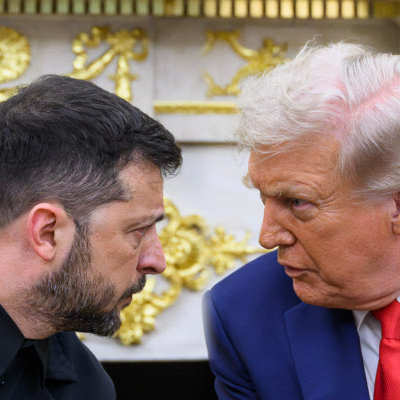
젤렌스키는 파이낸셜타임스와의 인터뷰에서 트럼프가 독재자와 초부유층에 본능적 친밀감을 느낀다고 직설적으로 비판

천하天下
칼럼
wonderboy
Zelenskyy's provocation, Trump's calculation, the turning point of the war

0
2026. 10. 17
- Zelensky's criticism is a strategic response to reduced US aid, aiming to re-establish Europe as a key backer and strengthen domestic and international unity.
- Under "America First," Trump is pressuring Ukraine by dealing with Russia to solve domestic energy issues ahead of the midterm elections.
- The US is likely to reduce aid to Ukraine and cooperate with Russia for short-term domestic political gains, which will prolong the war and deepen Ukraine's strategic isolation.
Zelenskyy's public criticism is not merely an emotional outburst, but a calculated provocation reflecting the rapidly diminishing leverage available to Ukraine amidst deepening strategic isolation. In mid-October 2026, immediately after Trump struck a deal with Putin for Russian oil imports and unilaterally declared an 'energy ceasefire,' Zelenskyy directly criticized Trump in an interview with the Financial Times, stating that Trump felt an instinctive affinity for dictators and the super-rich. He also labeled the threat to cut off US intelligence support as a 'dangerous' move and declared that Ukraine would resume attacks on Russian oil refineries. European leaders, while secretly urging de-escalation at the Brussels summit, publicly embraced Zelenskyy and reaffirmed their commitment to support him.
Zelenskyy's true intentions can be summarized in three main points. First, it is an attempt to reposition Europe as the de facto core power, given that transactional pressure from the US, a key patron, has reached a critical point. The Trump administration, ahead of the midterm elections (November), blamed rising fuel prices on Ukrainian drone attacks and sought short-term price stability through Russian oil imports. Simultaneously, it pressured Ukraine by discussing reduced intelligence sharing and demands for leadership change. From Zelenskyy's perspective, this is not just a diplomatic spat but signifies a qualitative shift in support that will determine the war's sustainability. His public praise of Europe as the 'real leader' and demands for additional funds and air defense assets (such as Patriots) are a calculated move to concretize Europe's financial and military burden, premised on the idea that US support is no longer predictable. While Europe still watches the US, the public criticism aims to strengthen internal solidarity pressures within Europe.
Second, maintaining domestic political and front-line morale. With the war now over four and a half years long and Russia's winter energy infrastructure attacks intensifying, if Zelenskyy appears to acquiesce to Trump's demands, there is a high risk that it will be interpreted as "surrender negotiations" within Ukraine. In particular, attacks on Russian oil refineries are one of the few asymmetric pressure tactics Ukraine possesses. When the US demand to stop these attacks, coupled with Russia's continued aggression, appears unfair, public refusal becomes a means to maintain domestic public opinion and military morale. At the same time, it also sends a signal to Putin that "even with US pressure, Ukraine will not easily give in."
Third, securing leverage at the negotiating table. Zelensky has, in the past, maintained support by somewhat complying with US pressure, but this oil deal was perceived as a measure that would provide Russia with a real financial lifeline. With Putin not responding to a ceasefire and continuing to strike Ukrainian energy facilities, unilateral concessions would further disadvantage the balance on the front lines. Through public criticism, the intention is to draw a line, stating that "Ukraine will not be sacrificed for America's short-term political needs," and to reset the negotiation framework with Europe. Of course, this strategy is high-risk. If US intelligence and weapons support are substantially reduced, maintaining the front lines could become even more difficult.
Trump's handling of Ukraine is a typical combination of "America First" transactionalism and midterm election politics. He moves between the desire to package the Ukraine war as his foreign policy achievement and the need to externalize the burden of domestic fuel prices and inflation. Trump claims that global diesel supply tightened in 2026 due to disruptions in logistics in the Strait of Hormuz from the US-Iran war, and that Ukraine's attacks on Russian refineries further exacerbated this. While experts believe the Middle East factor is larger, Trump attempts to appease voters (farmers, truck drivers, etc.) by making Ukraine a scapegoat. The diesel deal with Putin was an attempt to secure short-term supply in exchange for sanctions relief, and at the same time, by declaring an "energy ceasefire," he tried to make it seem like progress was being made towards ending the war. However, Russia did not substantially accept this, and Ukraine resumed attacks after a temporary halt.
Trump publicly criticized Zelensky, calling him "harder to deal with than Putin," "not a fan," and "destroying his country," even mentioning a change in leadership. This is a result of his personal style (preference for direct dealings with strong leaders) and pragmatism. Putin is seen as someone with whom a deal can be made (supply of oil), but Zelensky refuses the quick compromises Trump wants, such as territorial concessions or neutralization. Trump redefines Ukraine not as an "American security asset" but as a "cost-generating partner," and seeks to increase his negotiating leverage through pressure. Threats to reduce intelligence sharing, adjusting the pace of arms support, and public criticism of leadership are his means. At the same time, he is also calculating to concentrate resources on other priorities, such as containing China, through normalizing relations with Russia or energy cooperation. However, if the midterm election results are unfavorable to the Republican Party, this pressure could intensify, or conversely, it could somewhat ease as domestic political responsibility is dispersed.
The US profit and loss statement is divided into short-term and long-term. In the short term, the costs of supporting Ukraine are clear. There is enormous financial aid, intelligence and weapons supply, and the burden of public opinion in domestic politics (especially when linked to fuel prices). With the midterm elections approaching, avoiding responsibility for inflation and alleviating voter dissatisfaction are political priorities. On the other hand, the benefits of leaning towards Russia include securing energy supply, promoting the achievement of 'ending the war,' and the possibility of personal dealings with Putin. In the long term, if Russia gains substantial benefits in Ukraine, NATO's credibility could be undermined, the burden of European security could be transferred to the US, or it could affect China's calculations regarding Taiwan. However, the Trump administration tends to underestimate these long-term costs. Unlike the Biden era's framework, which views Russia as a major competitor, Trump is closer to the view that Russia is a potential partner for containing China or at least a low-priority issue.
Predictably, while a complete abandonment is difficult, the US is likely to gradually reduce the quality and quantity of its support. If the Republican Party loses a significant number of seats in the midterm elections, Trump may pressure Ukraine more strongly to force a 'quick compromise.' Conversely, if the results are not as bad as expected, he will maintain the current level while shifting more of the burden to Europe. Either way, Ukraine will find it difficult to expect unconditional support from the US. Although Europe has pledged to increase financial and air defense support, there are limits to its scale and speed. In particular, ammunition and air defense assets needed to defend energy infrastructure in winter and maintain the front lines are difficult for Europe alone to sufficiently provide.
The direction of the war is likely to proceed with the front lines and diplomacy separated. On the front lines, Ukraine's counterattack in northern Donbas (Operation Vivaldi) in 2026 slowed Russia's encirclement attempts and showed signs of regaining territory in some areas. Russia's net territorial gains slowed or were temporarily reversed, and casualty figures remained high. However, Russia maintained its war of attrition strategy, pressuring Ukraine's sustainability through drone and missile attacks and winter energy strikes. Putin has not abandoned his maximalist goals (establishing security zones, strengthening control over Donbas, etc.) and has repeatedly shown no interest in a ceasefire.
Diplomatically, the stalemate is expected to continue. Trump's desired 'quick deal' presupposes substantial concessions from Ukraine, but Zelensky refuses this and tries to draw Europe in. Putin is likely to adopt a strategy of maintaining pressure on the front lines while waiting for Western fatigue. As a result, the war is highly likely to continue in the form of a 'low-intensity war of attrition and a frozen front' rather than a complete end. However, if US support decreases sharply, Ukraine's defense capabilities will weaken, and there is a risk of intensified gradual Russian advances or winter infrastructure destruction. Conversely, if Europe substantially expands financial and air defense assets and maintains Ukraine's long-range strike capabilities, it could keep Russia's war costs high and maintain negotiation pressure.
Ultimately, this crisis shows that the war in Ukraine has entered a phase where it is more strongly defined by American domestic politics and energy interests. While Zelenskyy's provocation may strengthen European unity in the short term, it does not eliminate the structural risk of reduced US support. Trump, while seeking domestic political gain through a deal with Putin, has limited interest in a fundamental resolution of the war itself. Regardless of which side the US leans towards between Russia and Ukraine, that decision is likely to be more heavily influenced by Washington's short-term political calculations than by the military balance on the front lines. The prolonged war and the reduction of Ukraine's strategic autonomy are likely consequences.
댓글
( 0 / 500 )
대동단결
7
우크라이나가 믿었던 안보 동맹도 미국의 국내 정치와 경제적 이해관계 앞에서는 흔들릴 수 있다는 사실이 씁쓸합니다. 젤렌스키의 공개 비판은 무모한 도발이라기보다 더는 물러설 곳이 없다는 절박함의 표현으로 읽힙니다. 결국 동맹도 국익 앞에서 시험받는다는 점을 보여줍니다.
( 0 / 500 )
doong_A
5
이제는 더 이상의 희생과 파괴를 멈춰야 합니다. 전쟁이 길어질수록 고통받는 것은 권력자들이 아니라 평범한 시민과 미래 세대입니다. 러시아와 우크라이나, 미국과 유럽 모두 자국의 이해관계만 앞세우지 말고 하루빨리 실질적인 휴전과 평화협상에 나서기를 바랍니다.
( 0 / 500 )
88Lee
4
유럽의 결속을 끌어내기 위해 미국 대통령을 공개적으로 비판하는 전략은 양날의 칼입니다. 유럽의 지원을 확대하는 계기가 될 수도 있지만, 미국의 정보와 무기 지원이 줄어들면 전선에서 치명적인 결과를 낳을 수도 있습니다. 원칙을 지키는 것만큼 그 원칙을 현실에서 지켜낼 수단을 확보하는 일도 중요합니다.
( 0 / 500 )
M742580
4
젤렌스키가 미국의 압박에 맞서 우크라이나의 주권을 지키려는 입장은 이해하지만, 미국 대통령을 공개적으로 자극하는 방식이 과연 실질적인 국익에 도움이 되는지는 따져봐야 합니다. 전쟁 지도자의 발언은 개인의 감정 표현이 아니라 국민의 생존과 직결되는 전략적 선택입니다.
( 0 / 500 )
한상길
3
전쟁이 4년 넘게 이어지는 현실이 너무나 안타깝습니다. 영토와 안보, 국제적 영향력을 둘러싼 갈등도 결국 사람이 살아남아야 의미가 있습니다. 트럼프의 거래도, 젤렌스키의 저항도, 푸틴의 군사적 목표도 무고한 생명을 지키는 평화보다 앞설 수는 없습니다. 지금 필요한 것은 상대를 굴복시키겠다는 고집이 아니라 서로 한발씩 물러서서 전쟁을 끝낼 용기입니다.
( 0 / 500 )
한마음
3
강대국끼리 에너지와 안보를 흥정하면서 정작 전쟁 당사국의 주권과 생존을 뒷전으로 밀어낸다면 그것은 진정한 평화가 아닙니다. 전쟁을 멈추는 것과 침략의 결과를 정당화하는 것은 엄연히 다릅니다. 휴전의 속도보다 중요한 것은 전쟁이 다시 반복되지 않을 조건을 만드는 일입니다.
( 0 / 500 )
purple
3
우크라이나의 저항 의지가 아무리 강해도 무기와 탄약, 정보 지원, 경제적 기반이 뒷받침되지 않으면 장기전을 버티기 어렵습니다. 유럽이 진정한 전략적 주체가 되려면 연대의 수사를 넘어 실질적인 군사·재정 지원을 보여줘야 합니다. 이번 사태는 유럽 안보의 자립 능력을 시험하는 중대한 분기점입니다.
( 0 / 500 )
사랑나무
3
전쟁의 출구가 보이지 않는 지금, 국제사회가 해야 할 일은 대립을 부추기는 것이 아니라 협상의 문을 여는 것입니다. 우크라이나의 주권과 러시아의 안보 우려를 외교적으로 다루되, 무력으로 현상을 바꾸는 일이 정당화되지 않도록 실효성 있는 안전보장 장치를 마련해야 합니다. 완벽한 합의가 아니더라도 사람의 생명을 살리는 휴전부터 시작했으면 합니다.
( 0 / 500 )
신고내용
신고내용을 선택해주세요
회원비난/비하/욕설글 및 댓글도배성 게시물저작권 침해/불법자료 유출허위사실유포개인정보 유출.사생활 침해무단광고/홍보음란물 및 도박 불법 광고물범죄행위 관련 글불법행위 관련 소개물품 판매 및 사기글악성코드 및 스파이웨어 유포기타 사유 및 운영진 판단


비밀번호를 잊으셨나요?
Sign in with Google


All information provided by us is free of charge and is for the public good.