品

Corea든 Korea든, 품격이 먼저다
Whether Corea or Korea, dignity comes first.
Whether Corea or Korea, dignity comes first.
Now
지금
751 Diaspora
Heritage
유산
Humanity
인문
Mirengsi
未冷尸
Politics
정치
Media
언론

과학/건강
칼럼
andante
Is the Fukushima contaminated water release an experiment on the future of humanity?

0
2025. 08. 24
The Fukushima nuclear power plant contaminated water discharge issue is not just a local matter, but a critical scientific issue that can directly affect the global marine environment, ecosystem, and human health. The Japanese government and TEPCO claim that they have removed most radioactive nuclides with the Advanced Liquid Processing System (ALPS), but some nuclides such as tritium (³H) and carbon-14 (C-14) cannot be removed or are extremely difficult to remove. Diluting these substances in large amounts of seawater does not completely eliminate the harm, and may cause cumulative risks in the long term.
The problem of bioaccumulation of radioactive materials cannot be ignored. Radionuclides such as tritium, carbon-14, strontium-90, and cesium-137 released into the sea can be absorbed by marine microalgae and plankton, and are concentrated and transferred to fish, mammals, and ultimately humans along the food chain. This is a problem that cannot be explained by simple dilution logic, and can lead to fatal health damage such as increased cancer rates, decreased reproductive function, and genetic mutations, especially with long-term exposure.
In the case of tritium, as an isotope of hydrogen, it can directly bind to the DNA and protein structures of living organisms, and internal exposure due to this is known to be much more dangerous than external exposure. In particular, fetuses, infants, and pregnant women are more susceptible to radiation, so even the same concentration can have a more serious impact. In addition, radioactive carbon-14 has a half-life of 5,730 years, and has the characteristic of being able to accumulate in organisms while remaining in the environment for thousands of years.
There is a high possibility of disruption to the marine ecosystem. Radioactive materials can damage the DNA of organisms, leading to a decrease in biodiversity. In particular, if microalgae or plankton, which form the basis of the marine ecosystem, are affected, a chain effect may occur, causing the entire marine food web to collapse. This can affect not only the depletion of fishery resources in specific areas but also the balance of the global marine ecosystem.
The reproduction and development processes of marine organisms are particularly vulnerable to radiation. Exposure to radioactive materials during the spawning season of fish or the molting process of crustaceans such as shrimp and crabs can lead to deformities or decreased survival rates. In addition, if primary producers such as seaweed are exposed to radiation for a long period of time, their photosynthetic capacity may decrease, causing fundamental changes in the energy flow of the entire marine ecosystem.
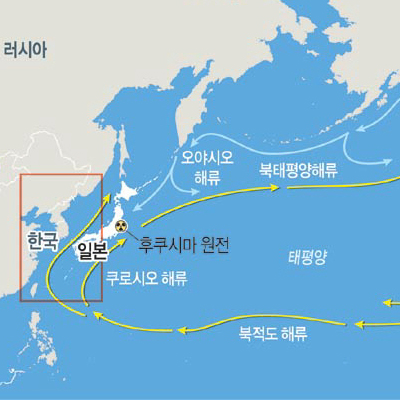
Long-term and global spread is a concern. Seawater moves across borders through currents and circulation. Radioactive materials released from the waters near Fukushima could spread throughout the Pacific Ocean within a few years and potentially reach the Indian and Atlantic Oceans in the long term. This is not just a problem for a specific country, but a problem for all humanity. Due to the nature of ocean currents, materials released from Fukushima are expected to circulate in the North Pacific along the Kuroshio Current, reaching the west coast of the United States, Canada, and Alaska. It will then move to the South Pacific via the Equatorial Current and ultimately spread to oceans around the world. In particular, migratory marine organisms such as salmon, tuna, and whales have extensive migration routes and can serve as vectors for spreading radioactive contamination globally.
Scientific uncertainty remains high. The Japanese government emphasizes safety based on verification by the international organization (IAEA), but data on long-term cumulative effects are lacking. Considering that the discharge is expected to continue for decades, it is difficult to predict future environmental and biological outcomes based solely on current laboratory analysis. In particular, the long-term effects of low-dose radiation exposure have not yet been clearly identified, and this remains the greatest potential risk. Monitoring results to date indicate that tritium concentrations are being managed within the expected range in the initial stages of discharge. However, this is only short-term data, and the cumulative effect of continuous discharge over decades is still unknown. Furthermore, questions are being raised as to whether the current monitoring system can fully track all radioactive nuclides and their interactions and variations.
The Fukushima contaminated water discharge issue also raises important issues from an international legal perspective. According to the United Nations Convention on the Law of the Sea (UNCLOS), each country has an obligation to protect and preserve the marine environment and must ensure that activities carried out under its jurisdiction do not damage the environment of other countries. Japan's unilateral decision to discharge the water may conflict with these international legal obligations. Furthermore, the lack of sufficient consultation and agreement with neighboring countries in the decision-making process is also a problem. Countries bordering the Pacific Ocean, including South Korea and China, have consistently expressed concerns, but their opinions have not been adequately reflected. This can be seen as a violation of the principles of environmental justice and international cooperation.
The economic ripple effects of the discharge cannot be overlooked. The long-term impact on the fishing industry and related industries is expected to be very significant. Consumers' anxiety about radioactive contamination may lead to a general avoidance of consuming Pacific seafood, which will directly hit the livelihoods of fishermen in the region. In particular, as consumer confidence in seafood from Fukushima has not yet recovered in Japan itself, greater economic losses are feared once the discharge begins. Furthermore, there is a possibility that it will spread into trade disputes between countries with active seafood exports and imports. Some countries have already taken measures to ban or restrict imports of Japanese seafood, and there are concerns that these economic conflicts will intensify.
In addition to the marine discharge currently chosen by Japan, various alternative treatment methods exist. Technical alternatives such as evaporation, electrolysis, underground burial, and solidification have been proposed, but the Japanese government has ruled them out due to cost and technical limitations. However, there is a need to explore safer treatment methods through more in-depth research and international cooperation on these alternatives. In particular, high-temperature steam treatment and tritium separation technology have not yet reached the commercialization stage, but they are technologies with development potential from a long-term perspective. If the international community cooperates and invests in the development of these technologies, it will be possible to find a safer alternative than ocean discharge. In addition, a plan to secure sufficient storage capacity and store it until radioactivity decreases naturally can also be considered.
The transparency of the discharge process and the participation of civil society are also important tasks. Questions are being raised as to whether the current monitoring and information disclosure system is sufficiently transparent and reliable. It is necessary to establish an independent international monitoring system, disclose real-time data, and expand the participation of civil society and experts. In addition, safety devices and emergency response systems should be established to immediately stop the discharge process if unexpected situations occur. Securing this transparency and accountability is a prerequisite for gaining the trust of the international community.
The most important thing is responsibility for future generations. We must fully consider how current decisions will affect humanity in decades or hundreds of years. Considering the half-life of radioactive materials, the impact of currently discharged contaminated water can last for generations. In particular, if changes in the marine environment due to climate change are combined with radioactive contamination, unexpected complex effects may appear. It is difficult to predict how rising sea temperatures, ocean acidification, and changes in ocean currents will affect the spread and biological impact of radioactive materials.
The release of Fukushima contaminated water can be seen as an act of forcing a scientifically unverified experiment on a global scale, rather than a typical international environmental conflict. While it may show insignificant numerical changes in the short term, it can have a significant impact on human health, marine ecosystems, and global food security in the long term. This requires a cautious and conservative approach, as it could bring irreversible disaster to future generations. Alternative treatment technology development, long-term storage, and the establishment of an international cooperation system should be discussed in international consensus. In addition, a transparent monitoring system and the participation of civil society should ensure a democratic and responsible decision-making process. Above all, this issue cannot be resolved by the unilateral decision of one country. Bearing responsibility for the marine environment shared by all mankind, the international community must work together to find safe and sustainable solutions. We must not compromise the safety of future generations for the convenience of the current generation.
댓글
( 0 / 500 )
농부아재
7
후쿠시마 오염수 문제는 단순히 일본의 사안이 아니라 지구촌 모두의 문제라는 점을 강조한 부분이 인상 깊습니다.
( 0 / 500 )
maria
5
정말 핵심을 찌른 글이네요. 일본 정부가 말하는 ‘희석’ 논리가 얼마나 위험한 자기합리화인지 잘 드러나 있습니다.
( 0 / 500 )
bravoMyLife
7
국제법적 관점까지 언급하니, 일본의 일방적 결정이 단순한 환경문제가 아니라 국제 분쟁 요소가 될 수 있다는 게 명확해집니다.
( 0 / 500 )
TopGun
5
IAEA 검증만으로 충분하다는 주장은 무책임합니다. IAEA는 일본 정부의 예산 지원을 받는 기관이고, 장기적인 누적 효과나 생물학적 농축에 대한 데이터는 여전히 부족합니다. 인류 전체의 문제인데 일본의 일방적인 결정은 용납될 수 없습니다.
( 0 / 500 )
hansansoo
6
대체 기술이 있음에도 불구하고 비용 문제로 외면한다는 건 일본 정부가 얼마나 무책임한지 보여줍니다.
( 0 / 500 )
koreanboy
4
결국 돈이 문제 아닙니까? 다른 대안이 있는데도 가장 저렴하고 쉬운 해양 방류를 선택한 건 미래 세대의 건강과 해양 생태계를 담보로 잡는 무책임한 결정입니다. '처리수'라는 말장난으로 진실을 가리려 하지 마십시오
( 0 / 500 )
dataman
3
읽으면서 가장 공감한 부분은 ‘현재 세대의 편의를 위해 미래 세대의 안전을 담보로 잡아선 안 된다’는 결론이었습니다.
( 0 / 500 )
자수정
3
경제적 파급효과까지 짚어주셔서 이 사안이 환경·건강 문제를 넘어 생존권과 직결된다는 점을 잘 보여주네요.
( 0 / 500 )
jongman
4
방사성 물질의 반감기를 고려하면, 이 문제는 수천 년에 걸쳐 영향을 미칩니다. 겨우 수십 년치 데이터로 안전하다고 주장하는 건 과학적 근거가 부족합니다.
( 0 / 500 )
Daehan
3
해류가 전 세계를 순환한다는 것은 상식입니다. 이 문제는 특정 국가의 문제가 아니라 전 지구적 환경 문제이며, 일본 정부는 유엔해양법협약에 명시된 해양환경 보호 의무를 위반하고 있습니다
( 0 / 500 )
Bluebird4
0
특히 삼중수소와 탄소-14의 누적적 위험성을 짚은 부분은 일반인들이 잘 모르는 중요한 대목 같아요.
( 0 / 500 )
신고내용
신고내용을 선택해주세요
회원비난/비하/욕설글 및 댓글도배성 게시물저작권 침해/불법자료 유출허위사실유포개인정보 유출.사생활 침해무단광고/홍보음란물 및 도박 불법 광고물범죄행위 관련 글불법행위 관련 소개물품 판매 및 사기글악성코드 및 스파이웨어 유포기타 사유 및 운영진 판단


비밀번호를 잊으셨나요?
Sign in with Google


All information provided by us is free of charge and is for the public good.