品

Corea든 Korea든, 품격이 먼저다
Whether Corea or Korea, dignity comes first.
Whether Corea or Korea, dignity comes first.
Now
지금
751 Diaspora
Heritage
유산
Humanity
인문
Mirengsi
未冷尸
Politics
정치
Media
언론
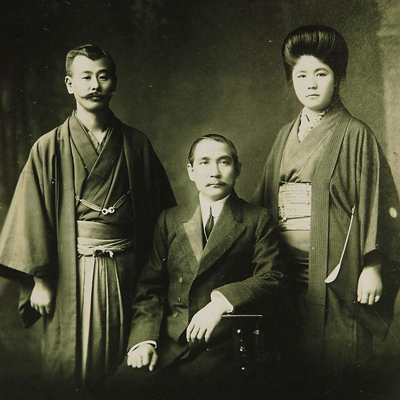
손문의 패트론 梅屋庄吉(1869~1934) 부부

차압기사
칼럼
PinkPepper
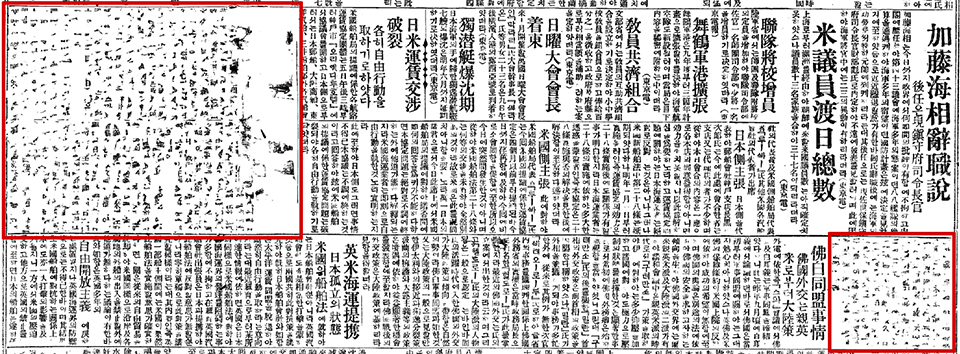
Dong-A Ilbo, July 24, 1920: Armed Anti-Japanese Group in Gando (Text Supplemented)

0
2026. 11. 15
- Consul General Sakai's report on Gando reveals Japan's hardline stance: the armed anti-Japanese movement of Koreans in Gando is organized and robust, beyond the control of Japanese police, with military deployment being the only solution.
- In his Dong-A Ilbo contribution, Sun Yat-sen argues that Japan's annexation of Korea deepened China's distrust and anti-Japanese sentiment, and that Eastern peace would be restored if Japan recognized Korea's independence after the collapse of the Russian Empire.
- Sun Yat-sen's argument is a superficial logic aiming for improved Sino-Japanese relations and Eastern peace through Korean independence, but it actually reflects the limitations of viewing the Korean issue from a Sinocentric perspective of 'One China'.
- The author points out the fictitious nature of the Gando map instilled by colonial historiography, criticizes the tragic reality of seeking the history of anti-Japanese struggle in Gando and Manchuria within current national borders, and emphasizes the importance of restoring historical facts.
- This article, through Dong-A Ilbo articles from the 1920s, illuminates Japan's intent to suppress Koreans and Chinese intellectuals' arguments for Korean independence, criticizing historical perceptions distorted by colonial historiography and aiming to reclaim true historical meaning.
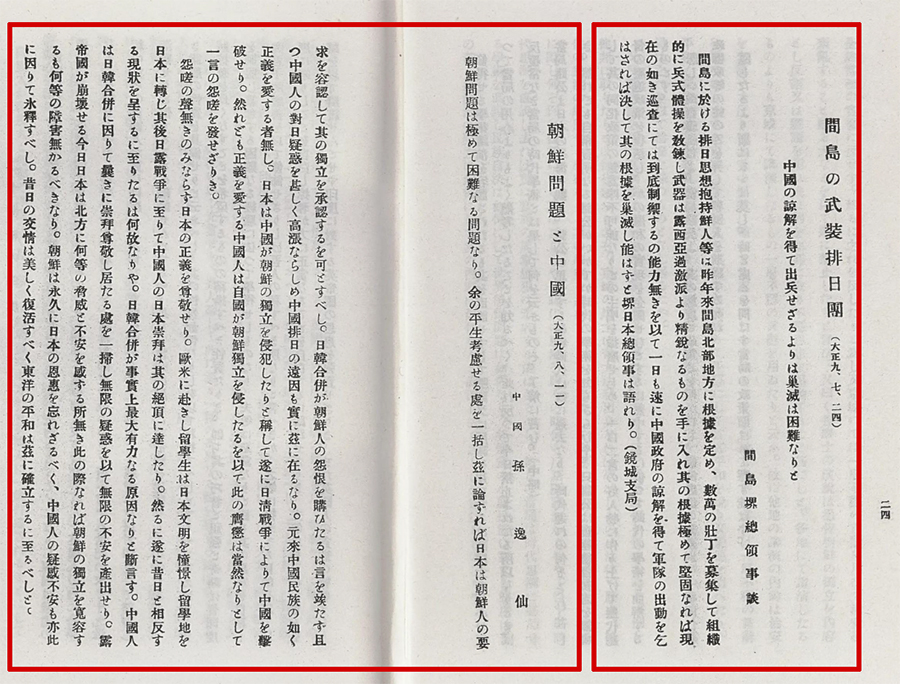
*The Dong-A Ilbo article from July 24, 1920, titled 'Armed Anti-Japanese Group in Gando,' which was introduced earlier, is attached because it omitted the article following the statement made by Gando Consul General Sakai Yosakichi (堺與三吉, 1873~1931).
Japanese Consul General Sakai stated that Koreans in Gando who harbor anti-Japanese sentiments have established a base in the northern part of Gando since last year, recruiting tens of thousands of young men and systematically teaching them military drills. They have also acquired elite weapons from Russian radicals, making their base very strong. He added that the current police force (巡査: Japanese colonial police) is utterly incapable of controlling them, and unless the Chinese government's understanding is obtained quickly to dispatch troops, their base can never be eliminated. (Gyeongseong Branch)
*Sakai Yosakichi, acting Japanese Consul General in Gando, reported to the Japanese Ministry of Foreign Affairs on the migration and return trends of Koreans, including those from Gyeongseong County, North Hamgyong Province, to Gando. The aforementioned article was deleted from that report. It can be interpreted as meaning that the natural anti-Japanese sentiments of Koreans who were driven to Gando were considered subversive ideas, and that troops should be dispatched to kill them all. Therefore, if the article were published, it would not be favorable to the Governor-General's Office. However, Gando (間島), a buffer zone between the borders of China and Joseon, was not originally a place name. Was it an island or land? The Gando instilled by colonial historiography is not the Gando where diasporic Koreans were dispossessed of their ancient homeland and driven out thousands of years ago. Just as Dokdo is not Dokdo, Gando is not the Gando that modern Koreans know. This tragedy, where the history of anti-Japanese armed struggle in Gando and Manchuria is sought within the current border lines, has merely been made a fait accompli by public authority and public education. Historical facts and reality are different stories. Knowing a history that is different from the facts as facts creates a fictional worldview. Unfortunately, we stand in the midst of it.
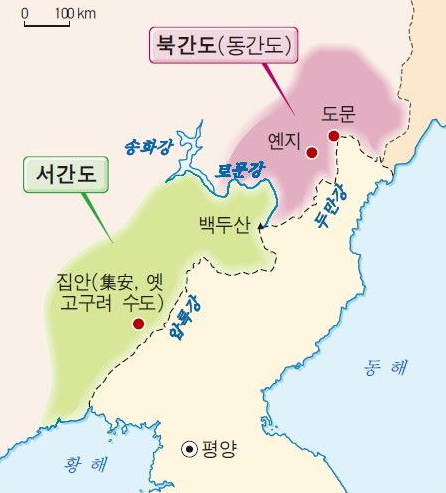
The colonial historiography's map of Gando differs from the facts. A history that differs from the facts does not firmly embed itself in people's minds. However, perhaps by mastering even this map for memorization, we can dream of decolonizing historiography. How can a Korean who has forgotten the letter 'ㄱ' (giyeok) even with a sickle in hand, possibly know the Chinese character for sickle?
Dong-A Ilbo, August 11, 1920, The Joseon Problem and China, Sun Yat-sen of China
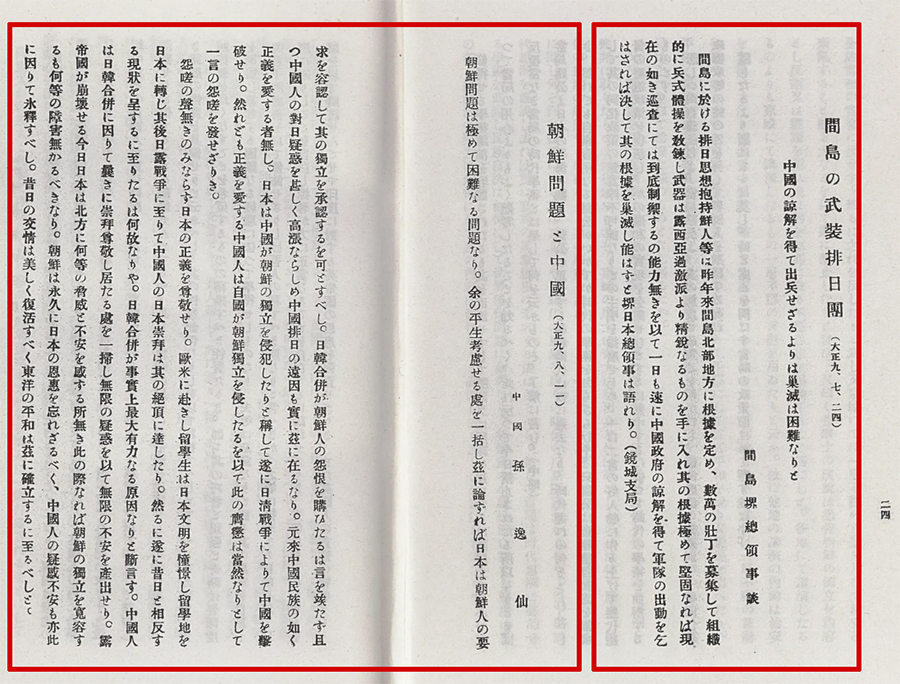
The Korean Question and China: Sun Yat-sen
The Korean question is an extremely difficult one. To summarize what I have thought about throughout my life and discuss it here, Japan must accept the demands of the Koreans and recognize Korea's independence. It goes without saying that the annexation of Korea by Japan caused resentment among Koreans, and it severely intensified Chinese suspicions towards Japan. Indeed, this is also the distant cause of China's anti-Japanese sentiment. Originally, there is no nation that loves justice as much as the Chinese people. Japan eventually defeated China in the Sino-Japanese War, using the excuse that China had infringed upon Korea's independence. However, the Chinese people, who love justice, believed that this punishment was deserved because their own country had violated Korea's independence, and they did not utter a single word of complaint or lament.
Not only was there no resentment, but they even respected Japan's sense of justice. Students who had been heading to Europe and America changed their study destinations to Japan, admiring Japanese civilization. Later, during the Russo-Japanese War, Chinese admiration for Japan reached its peak. So, why did the situation eventually become the exact opposite of what it was in the past? I assert that the annexation of Korea by Japan is, in fact, the biggest reason. With the annexation of Korea, the Chinese people swept away their previous worship and respect (for Japan) and were filled with infinite suspicion and anxiety.
Today, with the collapse of the Russian Empire, Japan no longer feels any threat or anxiety from the north. At such a time, there would be no impediment to tolerating Korea's independence. Korea would never forget Japan's benevolence, and the suspicions and anxieties of the Chinese people would also be resolved like melting ice. The friendly relations of the past would be beautifully revived, and peace in the East would thereby be established.
*Sun Yat-sen's (孫文, 1866~1925) contribution to the Dong-A Ilbo is an article that simplifies several significant historical aspects. First, we will briefly touch upon its meaning, and on January 1, 2027, we plan to compile and upload its full details.
The title is 'The Korean Problem and China.' It's not 'China and the Korean Problem.' What is big and important? Sun Yat-sen, who made a mistake in assigning meaning in the title of his writing, is merely a demagogue, not a true hero. That's why Taiwan currently expresses discomfort with the existence of the National Sun Yat-sen Memorial Hall. Sun Yat-sen, a politician who was necessary then, has now become a politician who would endanger the nation. From Joseon to Korea, during this time, a system that produces politicians who suppress the nation's growth has become entrenched in Korea.
Sun Yat-sen, who symbolized 'One China' and 'the unification of the Chinese nation,' died in 1925. However, the government of the Republic of China moved to Taiwan in 1949, and while the current Communist China also uses Sun Yat-sen as a historical symbol of Chinese unification, Taiwan's independence-oriented forces believe that the same symbol could weaken Taiwan's autonomy and political identity. It's ironic. Does the great nation of China, which claims Joseon fell into sycophancy like a mental illness, have no spiritual symbolic figures other than Sun Yat-sen?
In this op-ed, Sun Yat-sen argues that Japan's annexation of Joseon triggered anti-Japanese sentiment among peace-loving Chinese, and since the Russian Empire also collapsed, China should accept Joseon's independence as soon as possible to restore Chinese distrust of Japan and peace in the East. It all comes back to Joseon's independence. However, how many modern people would be convinced by this argument that Joseon's independence could improve Sino-Japanese relations and restore peace in the East? It is necessary to restore the true meaning that breaks the superficial thinking of Koreans. Although this article was erased without a trace, it remains and circulates, allowing us to infer the geopolitics of Joseon in 1920. I will describe that process later.
댓글
( 0 / 500 )
kang79
6
1920년 간도 무장 배일단에 관한 기사는 당시 일본이 조선인의 독립운동을 어떻게 인식했는지 보여주는 중요한 사료입니다. 독립을 향한 조선인의 저항을 불온사상으로 규정하고 중국군까지 동원해 진압하려 했다는 대목에서 식민통치의 본질이 드러납니다.
( 0 / 500 )
大同團結
5
쉽게 접하기 어려운 1920년의 신문 사료를 발굴하고, 그 속에 담긴 역사적 의미까지 깊이 있게 풀어주셔서 감사합니다. 우리가 당연하게 배워온 역사적 인식에 질문을 던지고 새로운 시각으로 생각할 기회를 주는 귀한 글입니다.
( 0 / 500 )
nahyun89
4
특히 간도라는 지명과 영토 인식에 관한 문제 제기가 흥미롭습니다. 우리가 당연하게 받아들인 국경과 역사적 공간이 과연 어떤 과정을 거쳐 현재의 모습으로 정착했는지 되짚어 볼 필요가 있습니다. 익숙한 역사적 상식부터 의심하는 것이 탈식민사관의 출발일 것입니다
( 0 / 500 )
seeu79
4
손문의 기고문은 단순한 조선 독립 지지 발언으로 읽을 내용이 아닌 것 같습니다. 조선의 독립을 중국의 대일 관계와 동양의 국제질서 속에서 바라본 그의 지정학적 계산까지 살펴야 합니다. 역사적 인물에 대한 존경과 비판은 별개의 문제입니다.
( 0 / 500 )
8502park
4
과거의 역사를 오늘의 국경과 국가관으로 재단하면 당시의 국제정세와 민족운동을 제대로 이해하기 어렵습니다. 간도 무장투쟁과 손문의 조선 독립론을 함께 다룬 것은 매우 의미 있는 접근입니다. 1920년 동북아시아의 지정학적 실체를 어떻게 복원할지 2027년 후속 글도 기대하겠습니다.
( 0 / 500 )
백현이
4
잊히거나 왜곡된 역사의 흔적을 찾아내 오늘의 관점에서 다시 조명해 주시는 노력에 감사드립니다. 단순한 자료 소개를 넘어 우리가 무엇을 알고 무엇을 놓치고 있었는지 돌아보게 합니다. 이런 귀중한 기록과 해석이 계속 이어지기를 바랍니다.
( 0 / 500 )
파스텔
2
일본 총영사가 간도의 조선인 무장세력을 수만 명의 장정과 정예 무기로 무장한 위협으로 묘사한 것은 역설적으로 당시 독립운동의 규모와 조직력을 보여주는 증언입니다. 식민권력의 보고서에서 오히려 항일투쟁의 실체를 발견한다는 점이 인상적입니다.
( 0 / 500 )
88수혁
1
역사는 우리가 배운 지식의 반복이 아니라, 기존의 해석을 사료로 검증하는 과정이어야 합니다. 특히 간도와 만주를 둘러싼 영토 인식은 항일독립운동의 공간적 배경을 이해하는 데 중요합니다. 이번 글처럼 오래된 신문기사를 발굴하고 재해석하는 작업이 더 많이 이어지길 바랍니다
( 0 / 500 )
신고내용
신고내용을 선택해주세요
회원비난/비하/욕설글 및 댓글도배성 게시물저작권 침해/불법자료 유출허위사실유포개인정보 유출.사생활 침해무단광고/홍보음란물 및 도박 불법 광고물범죄행위 관련 글불법행위 관련 소개물품 판매 및 사기글악성코드 및 스파이웨어 유포기타 사유 및 운영진 판단


비밀번호를 잊으셨나요?
Sign in with Google


All information provided by us is free of charge and is for the public good.