品

Corea든 Korea든, 품격은 이름보다 먼저다
Whatever the name—Corea or Korea—dignity comes first.
Whatever the name—Corea or Korea—dignity comes first.
Now
지금
751 Diaspora
Heritage
유산
Humanity
인문
Mirengsi
未冷尸
Politics
정치
Media
언론
時事新聞(한일합방 직전 1910년 1월 1일 창간되어 일진회 기관지처럼 운영되다가 휴간, 3.1 운동 직후 매일신보에 3.1운동 비난 글을 연재하면서 동아일보와 같은 날 재창간)의 세 신문사 탄생을 낳았다.

차압기사
칼럼
PinkPepper
Dong-A Ilbo, July 24, 1920, Armed Anti-Japanese Group in Gando

0
2026. 10. 08
- Newspapers like Chosun, Dong-A, and Sisa, founded after the March 1st Movement, collaborated with colonial rule and weakened national consciousness, revealing a dark chapter in Korean media history.
- Under the guise of "cultural rule," imperial Japan used the media to brand anti-Japanese forces as "rebellious individuals," fostering division within the nation and subtly advancing its policy of national annihilation.
- A Dong-A Ilbo article conveyed Japan's intention to suppress anti-Japanese armed forces in Gando with China's consent, a ploy that disregarded international affairs and aimed to preemptively block the Korean people's self-help efforts.
- Through the 105-person incident, the term "rebellious" was imprinted on the public, used to portray anti-Japanese forces as vagrants and strengthen a reign of terror, while colonial historiography justified torture and distorted history.
- This historical context is crucial for understanding the dystopian reality currently faced by Korean society, suggesting the importance of confronting distorted past history and restoring national identity.
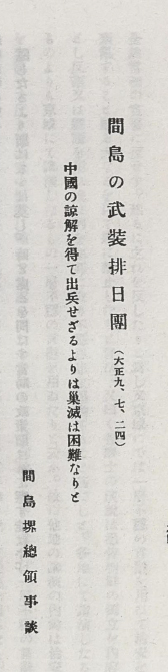
Although it's a short article, its meaning is profound. It seems to be an article from a hundred years ago that, at the time, cast the fate of all Koreans into a world of 'madness akin to death.'
On March 1, 1919 (January 29th by the lunar calendar), the ripple effect of the March 1st Movement led to the birth of three newspaper companies the following year: 朝鮮日報 (Chosun Ilbo, founded March 5, 1920), 東亞日報 (Dong-A Ilbo, founded April 1, 1920), and 時事新聞 (Sisa Sinmun, founded January 1, 1910, just before the Japan-Korea annexation, operated like an Iljinhoe organ, then suspended, and re-founded on the same day as Dong-A Ilbo after serializing articles criticizing the March 1st Movement in Maeil Sinbo).
Although there was a separate Government-General organ, Maeil Sinbo, Dong-A Ilbo also came into the world through Maeil Sinbo's printing presses, so they were all in the same boat. The banner raised by Chosun Ilbo was 'New Civilization Progressivism,' and it was a newspaper created by the 'Taisho Business Friendship Association,' formed by those who experienced a rapid rise in status due to the dismantling of traditional social hierarchies. Therefore, the history of newspapers in Korea is essentially a history of national betrayal. These still-solid newspapers dilute and distort history while occasionally reporting facts, making Korea's future moderately bleak.
It is time for a free interpretation of whether Korea's education, which interprets this history of public opinion as so-called 'cultural rule,' is not also a self-mutilating and self-destructive historical perspective that has undermined the nation's future. The existence and role of newspapers at the time were not a conciliatory gesture from the Government-General, but rather the beginning of consuming the Korean people's self-esteem, which would not be subdued by military force, through modern public opinion warfare. This means that the Korean people's self-help efforts were thereby fundamentally blocked. In other words, the Government-General's cultural rule policy, which changed after the March 1st Movement, superficially provided the error of perception that even under Japanese colonial rule, one could live a humane life through civilized treatment, while internally signaling the advent of a period when the policy of national annihilation was firmly and steadily implemented.
The article was just one line: 'The existence of armed anti-Japanese groups in Gando makes it difficult to eradicate their strongholds without obtaining China's consent to dispatch troops and suppress them.' This was a statement made by Sakai Yosakichi (堺與三吉, 1873~1931), the Consul General of Gando, and published in the Dong-A Ilbo's Gyeongseong branch. The Korean text below also explained content of the same purport. In short, Japan, pretending not to know that there was no firm government in China—at that time, the Republic of China, before the establishment of the People's Republic of China by the Chinese Communist Party after the Qing Dynasty fell due to the Xinhai Revolution—made empty promises to obtain 'China's consent' to wipe out Koreans, a rather contrived attempt to get help from a China that was a masterless land. The China imagined by the public and the actual China were different, and it was Japan that manipulated a part of it and acted as its master.
Perhaps the public who bought this newspaper at the time would have already considered the anti-Japanese armed forces in Gando as 'unruly Koreans.' This is because Japan, which defined Koreans who had lost their homes, wives, and children as 'resentful humans,' began using the word 'unruly' (不逞) in February 1912, after the attempted assassination of Governor-General Terauchi Masatake (the 105-person incident). This incident showcased the power of terror politics and the irresistible system of the Governor-General's office to the public, and it seems that the word 'unruly' (不逞) had already been ingrained as a significant term for quite some time, leading to the treatment of anti-Japanese forces in Gando as vagrants in 1920.
The 105-person incident was an event in 1911 where the Japanese Governor-General of Korea, Terauchi Masatake (寺内正毅, 1852-1919), fabricated an assassination plot against himself while investigating a plan to train independence fighters in the northwestern region, a hotbed of anti-Japanese sentiment, thereby dismantling the Sinminhoe (New People's Association) in the northwestern provinces (Pyeongan-do and Hwanghae-do). It is unclear whether the intellectual society in the northwestern region, where Western learning had been introduced early on and Christian and national education grew simultaneously, was part of the original goal of white missionary activities. How Western powers behind imperial Japan viewed this incident is open to re-examination. The photographs of the 105-person incident are from the collection of the son of Samuel Austin Moffett (馬布三悅, 1864-1939), an American Presbyterian missionary, known by his Korean name Mapo Samyeol. Moffett was appointed as a missionary in 1889 and arrived in Joseon in 1890. He initially worked in Seoul before moving to Pyongyang in 1893 to focus on missionary work in the northern region. Moffett's seminary continued for 17 years and became the predecessor of the current Soongsil University, but not all of this happened on the Korean Peninsula. Can the public realize the reasons why colonialist historical views and colonial media existed? Moffett alone taught people to believe in the Western God, and he was a living witness who saw the 'enlightened ones' of the northwestern region, who had grown into a national movement force, being eliminated by imperial Japan. As long as actual events are diluted and fabricated, treated as fiction, and narratives reshaped to suit their tastes are recognized as real history, national mental illness is an imaginary historical game with no cure.
The Terauchi assassination fabrication case involved 105 people who received heavy sentences, with a total of over 700 arrests. Their confessions to assassinating the governor-general were entirely due to torture. Torture, a common investigative technique used to maintain power in modern Korean history, involved burning, waterboarding, searing, and stabbing, leading 105 individuals to confess their sins. However, colonial historiography obtained absolution by asserting that Joseon was originally a country that emphasized inhumane punishments like torture and assassination. Even if nose rings and earrings were torn off, bleeding, there is not much that can be done now. Many people don't even know what their faces originally looked like. A person's face holds their spirit, and that spirit is history. Having lost everything, what remains as a function of thought?
Instead of the stigma of 'disloyalty' (不逞) gained from the 105-person incident, the public certainly received news of the collapse of anti-Japanese organizations and the effects of terror politics. Since Western missionaries would not have taught the Korean people self-reliance, anti-Japanese sentiment would not have been beneficial to the United States, and the assumption of assassinating the governor-general would have been good news for both the United States and Japan. If we cannot read the past, we cannot understand what the rapidly accelerating dystopia means.
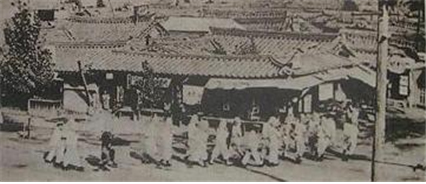
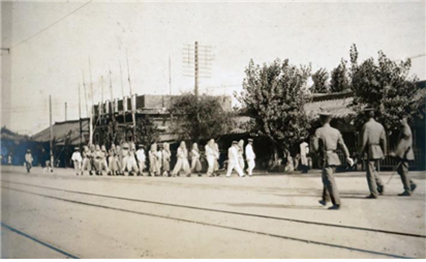
The two arrest photos from the 105-person incident above are from Moffett Korea Collection, the son of Sam-po Sam-yeol.
Let's summon a bit more of the history of such conspiracy theories with this one-line article from Dong-A Ilbo. The meaning is that a 'disloyal' (不逞) Joseon reader is immediately a traitor, a betrayer, a vagrant, and a potential criminal. This implies that Dong-A Ilbo, which published this article, also regarded its own people in that way. As Joseon people, the Dong-A Ilbo reporters themselves, the editor-in-chief, and the president all volunteered to be the priming water for 'Hell Joseon.' A nation that knelt and bowed its head before Japan and the forces hidden behind Japan, who had gradually encroached upon their homes, property, family history, and national history, and conformed to their methods and systems—that is what is expressed and remains in this article from July 24, 1920.
Let's pause here and broaden our perspective. A hundred years ago, Koreans were ignorant of international affairs, but now, with an even narrower view, does the March 1st Independence Movement still hold any value beyond a game story? The catalyst for this movement was the Paris Peace Conference in 1919, held after World War I, based on US President Woodrow Wilson's 'principle of national self-determination.' Korean students in Japan, who learned of this early, were the first to react to this global trend with the February 8th Declaration of Independence, which in turn sparked the March 1st Independence Movement among the people in Korea and Manchuria. However, the Russian Revolution, the March 1st Movement, and even the May Fourth Movement, which can be seen as its aftermath, are actually irrelevant. The point is that Koreans were not considered a 'nation' eligible for self-determination.
The Russian Revolution was the result of prepared forces and British machinations, and the March 1st independence demand in Joseon was a demonstration that, from the outset, blocked any possibility of attracting international attention. In the international community, Joseon was already a travel destination for Western dilettantes seeking materials that treated its demise as a foregone conclusion. This aspect, without hiding the conspiratorial viewpoint, deserves separate treatment, but now is not the time. Parents whose children read '3.1운동' as 'sam-jeom-il undong' (three-point-one movement) might call themselves patriotic conservatives. We should first ask them what Christianity and national suffering mean to them.
How has human civilization maintained its continuity? What appears to be led by grand institutions and administration is merely the fabrication of later generations; in reality, it is a virtual history built upon rape and torture, and the writings of censored scribes. Isn't it cowardice that we often say the world we live in is virtual, yet hope that the ground we stand on is not? Sakai, the Consul General in Gando, excessively consumed alcohol, women, and money as he traveled from Japan to Chongqing, Manchuria, and Beijing. To them, Chinese land was Korean land, Japanese land, a bonanza and a new frontier. That is why Shincheonji still exerts its influence, bringing shame upon the nation.
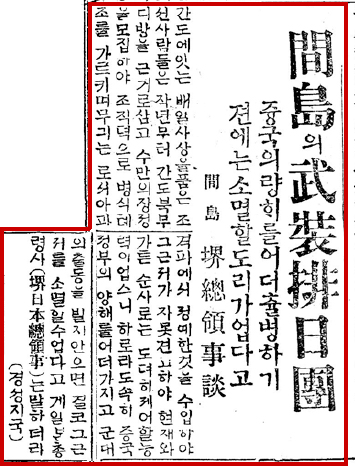
Armed Anti-Japanese Group in Gando
There is no way to eliminate them before obtaining China's consent for deployment.
Statement by Consul General Sakai of Gando
Sakai, the Japanese Consul General, stated that Koreans in Gando who harbor anti-Japanese sentiments have, since last year, established a base in the northern Gando region. They have recruited tens of thousands of young men, systematically taught them military manufacturing, and imported high-quality weapons from Russian extremists. Their base is quite strong, and the current police force is utterly incapable of controlling them. He added that unless the Chinese government's understanding is secured quickly and military deployment is requested, their roots can never be eradicated. (Gyeongseong Bureau)
댓글
( 0 / 500 )
弘益人間
9
1920년의 이 짧은 기사는 단순한 치안 기사가 아니라 식민 권력이 조선인을 어떻게 규정했는지를 보여주는 기록이라고 봅니다. ‘배일단’이라는 표현 뒤에는 실제로 무장투쟁을 준비하던 사람들이 있었고, 일본은 그들을 불령선인이라는 낙인으로 지워버리려 했습니다. 기록의 언어부터 다시 읽어야 합니다.
( 0 / 500 )
big_brother
6
특히 “중국의 양해를 얻어 군대의 출동을 빌지 않으면”이라는 문장이 섬뜩합니다. 타국 영토에서 조선인 무장세력을 소탕하기 위해 군사력을 동원하겠다는 일본 총영사의 발언입니다. 식민지 지배가 국내 통치에 그치지 않고 만주와 중국까지 확장된 군사적 질서였음을 한 줄의 기사에서 확인할 수 있습니다.
( 0 / 500 )
안동댁
6
쉽게 지나칠 수 있는 1920년 7월 24일의 짧은 기사를 붙잡고 그 시대의 사람들과 권력, 언론과 역사의 관계를 되짚어 주신 글에 감사드립니다. 우리가 당연하게 배워온 역사도 누가 기록하고 어떤 언어로 설명했는지를 다시 물어야 한다는 생각이 듭니다. 오래된 기록을 오늘의 질문으로 되살려 주신 점이 참 뜻깊습니다.
( 0 / 500 )
pyo2000
6
아무도 눈여겨보지 않을 법한 100년 전 신문기사 한 줄에서 당시의 권력과 언론, 항일세력의 흔적을 찾아내신 시선이 인상 깊습니다. 역사는 이미 끝난 이야기가 아니라 무엇을 기억하고 무엇을 잊었는가에 따라 끊임없이 다시 쓰인다는 사실을 일깨워주셔서 감사합니다.
( 0 / 500 )
Min_lee
4
‘불령’이라는 단어는 역사적으로 매우 무서운 낙인이었습니다. 독립을 요구하는 사람을 범죄자와 부랑자로 먼저 규정하면, 그들을 탄압하는 행위가 치안 유지처럼 보이기 때문입니다. 오늘날에도 특정 집단을 먼저 위험한 존재로 규정한 뒤 그에 맞춰 사실을 해석하는 언론의 습관이 없는지 끊임없이 경계해야 합니다.
( 0 / 500 )
오광수
3
105인 사건에서 1920년 간도의 무장 항일세력으로 이어지는 맥락을 함께 보면, 3·1운동 이후의 ‘문화통치’를 단순히 식민지 지배가 부드러워진 시기로 설명하는 데는 한계가 있습니다. 폭력만으로 억누르기 어려워진 민족적 저항을 언론과 제도, 여론의 영역에서 관리하려 했다는 측면도 함께 살펴봐야 합니다.
( 0 / 500 )
moon82
3
역사를 단순히 교과서의 사건과 연도로 기억하지 않고, 그 시대 사람들이 어떤 언어로 서로를 바라보았는지까지 살펴보게 해주셔서 감사합니다. 특히 ‘불령’이라는 단어 하나가 식민 권력이 사람을 어떻게 규정하고 기억을 어떻게 만들었는지를 생각하게 합니다. 귀한 자료와 문제의식을 함께 나눠주셔서 고맙습니다.
( 0 / 500 )
제임스K
2
역사는 거창한 독립선언문만으로 남는 것이 아니라 이런 짧은 신문기사에도 숨어 있습니다. “현재와 같은 순사로는 도저히 제어할 능력이 없다”는 일본 총영사의 말은 당시 항일세력이 결코 허구의 존재가 아니었음을 역설적으로 보여줍니다. 우리가 잊어버린 것은 사건만이 아니라 그 시대 사람들이 품었던 저항의 현실감인지도 모르겠습니다.
( 0 / 500 )
minho7
1
100년 전 신문기사 한 줄을 이렇게 깊이 파고들어 당시의 시대상과 언론의 언어, 항일운동의 실체까지 연결해 주셔서 감사합니다. 지나간 역사를 단순히 외우는 것이 아니라 오늘의 눈으로 다시 질문하게 만드는 글이었습니다. 특히 ‘불령’이라는 단어에 담긴 권력의 시선을 다시 생각하게 되었습니다.
( 0 / 500 )
신고내용
신고내용을 선택해주세요
회원비난/비하/욕설글 및 댓글도배성 게시물저작권 침해/불법자료 유출허위사실유포개인정보 유출.사생활 침해무단광고/홍보음란물 및 도박 불법 광고물범죄행위 관련 글불법행위 관련 소개물품 판매 및 사기글악성코드 및 스파이웨어 유포기타 사유 및 운영진 판단


비밀번호를 잊으셨나요?
Sign in with Google


All information provided by us is free of charge and is for the public good.