品

품격있는 정치, 품위있는 정치인과 함께 하는 세상이어야 하는데
All Koreans are refugees like animals in the zoos. Corea, Korea, Corean, Korean, Coreans and Koreans. Whatever they are!
All Koreans are refugees like animals in the zoos. Corea, Korea, Corean, Korean, Coreans and Koreans. Whatever they are!
Now
지금
751 Diaspora
Heritage
유산
Humanity
인문
Mirengsi
未冷尸
Politics
정치
Media
언론
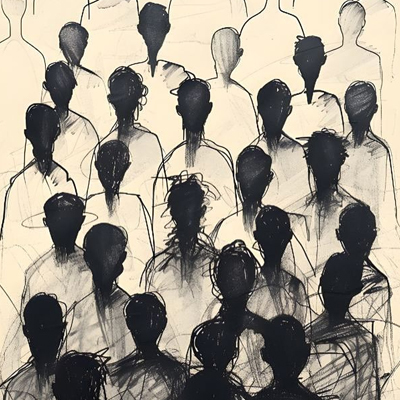
숨기는 것보다 잘 드러나는 것은 없다. 때와 장소를 불문하고 당국의 정책이 드러나 숨길 수 없다.

차압기사
칼럼
PinkPepper
Dong-A Ilbo, July 22, 1920: Order to disband the Hakwoohoe touring lecture group and suppression of the press

0
2026. 09. 16
- We criticize the Japanese Government-General's dissolution of lectures under the guise of "Oriental peace" and "Korean stability" as a deceptive act aimed at suppressing freedom of thought and speech to extinguish the vitality of Koreans.
- The "harmony" the Government-General speaks of conceals an intention to destroy Korean culture and identity and assimilate them into Japan; we point out and condemn the contradictions between Governor-General Saito's past remarks and current policies.
- We emphasize that the justification for dissolving the lectures is unclear and arbitrary, exposing how the authorities are distorting the truth and deceiving Koreans with an anachronistic mindset.
- We assert that the life of Koreans lies in freedom of thought and speech, and warn that no matter how much the authorities try to conceal their policies, their true nature will eventually be revealed.
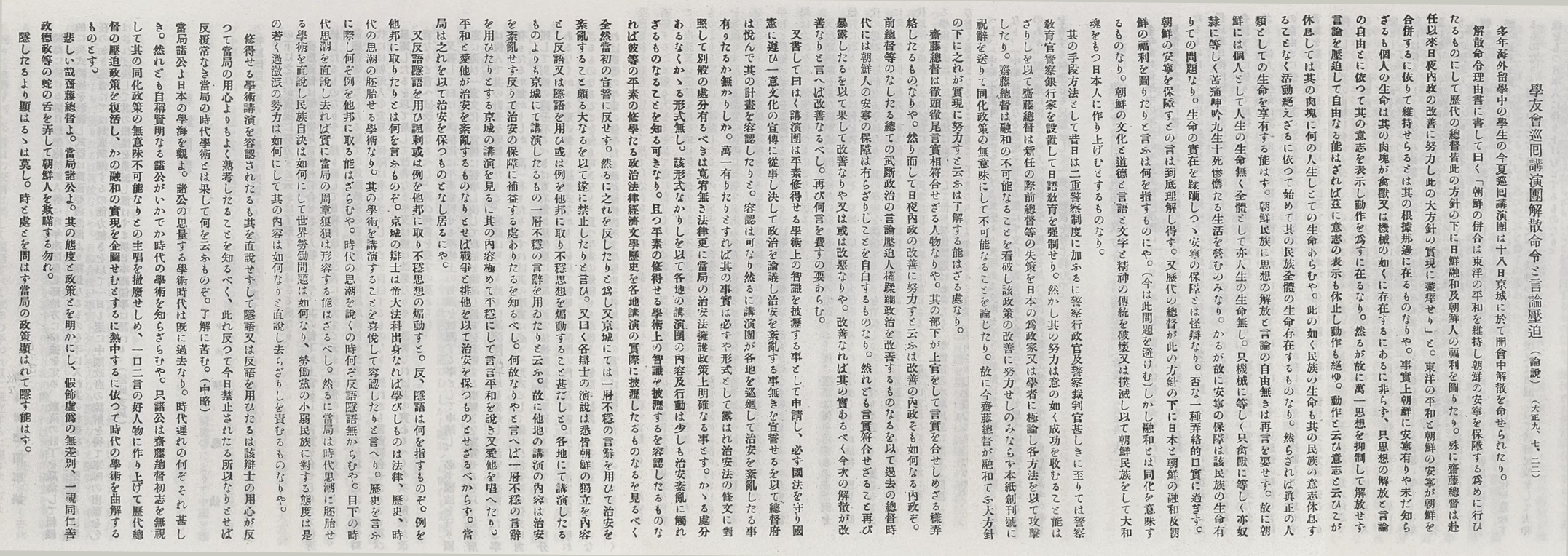
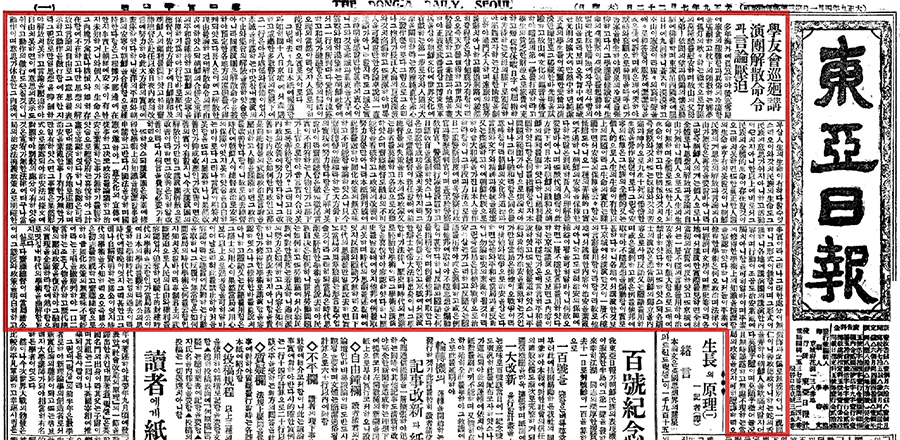
The lecture tour group of students who have been studying abroad for many years was ordered to disband on the 18th in Gyeongseong during its opening. The reason for the disbandment order stated, 'The annexation of Joseon was to maintain peace in the East and ensure the well-being of Joseon. All successive governors-general have followed this policy to promote harmony between Japan and Joseon (日鮮融和) and the welfare of the Joseon people. In particular, Governor-General Saitō (斎藤) has, since his inauguration, worked day and night to improve internal affairs and dedicated himself (盡瘁: to exert oneself body and soul until one becomes emaciated) to the realization of this grand policy.'
Where is the basis for the claim that peace in the East and the well-being of Joseon are maintained by annexing Joseon? While it is uncertain whether there is indeed well-being in Joseon, an individual's life does not consist merely of their body existing like an animal or a machine; rather, it exists solely to express and act upon their will through freedom of thought and speech. Therefore, if thought is suppressed and not liberated, and speech is oppressed and not free, then the expression of will ceases, and action stops. What life as a human being can there be in a body whose actions and will have ceased?
Similarly, the life of a nation exists only when the nation's will is unceasingly active and its activities are uninterrupted. Otherwise, it is not truly enjoying life as humanity. It goes without saying that the Joseon people lack freedom of thought and speech. Therefore, Joseon has no life as individuals, nor does it have life as a whole. It merely endures a miserable existence of suffering and groaning, like a machine, like an animal, or like a slave, living a life of 'nine lives and fourteen deaths' (구생십사). Therefore, the guarantee of well-being is a matter that comes after the existence of the nation's life. To guarantee well-being while trampling on the reality of life is sophistry. No, it is merely a pretext for manipulation.
It is utterly incomprehensible to say that it guarantees the peace and security of Joseon. Furthermore, what does it mean when successive governors-general say that under this policy, they will strive for the harmony between Japan and Joseon and the welfare of Joseon? (I will avoid this issue for now.) However, harmony (融和) means assimilation (同化). It aims to destroy and eradicate Joseon's culture, morality, language, writing, and spiritual traditions, thereby transforming the Joseon people into Japanese with Yamato-damashii (大和魂).
As a means to achieve this, in addition to the old dual police system, police administrative officers, police judges, and even police education officers and police bankers were established, and Japanese language education was enforced. However, these efforts did not succeed as intended, so Governor-General Saitō, before his new appointment, strongly criticized the mistakes of previous governors-general to politicians and scholars for the sake of Japan and attacked them from various quarters. Governor-General Saitō, realizing the impossibility of harmony, not only worked to improve this policy but also sent a congratulatory message to the inaugural issue of this magazine, arguing that the assimilation policy was meaningless and impossible. Therefore, it is difficult to understand why Governor-General Saitō is now working to realize this under the grand policy of harmony (融和).
Is Governor-General Saitō a person whose words and actions are thoroughly inconsistent? Are his subordinates manipulating him so that his words and actions do not align? But what exactly is this 'improving internal affairs' that is supposedly working day and night to improve internal affairs? It means improving all the oppressive speech and human rights violations of the military rule carried out by previous governors-general, which is an admission that the peace and security of Koreans did not exist during the era of past governors-general. However, is it truly an improvement or a deterioration to once again expose the inconsistency between words and actions? If it is an improvement, there must be a reality to it, and if the dissolution of the lecture group this time is an improvement, then it must be an improvement, so there is no need for further discussion.
The dissolution order also stated that the lecture group applied to express their usual academic knowledge, swore to abide by national laws, respect the constitution, engage in cultural propaganda with one mind, and never discuss politics or violate public order. The Governor-General's Office reportedly readily accepted their plan. Acceptance is permissible. However, did the lecture group tour various places and violate public order, or not? If they did, that fact must be formally revealed, and a separate disposition must be made in accordance with the public order law. Moreover, the law without leniency is a clear fact in the authorities' policy of upholding public order. Since there is no such disposition, there is no such formality. It is necessary to understand that the absence of this formality means that the content and actions of the lecture groups in various places did not violate public order.
Furthermore, if it is permissible to express the academic knowledge acquired through their usual studies, then it is necessary to see them actually express the politics, law, economics, literature, and history they have studied in their lectures in various places, which does not contradict their initial declaration at all. However, it is said that this was opposed, and in Gyeongseong, even more unsettling language was used, which was considered a serious violation of public order, and eventually prohibited. The dissolution order also states that the speeches of each speaker used allusions or euphemisms about Korea's independence, or took examples from other countries, and that the incitement of unsettling ideas was severe.
It is said that the lectures in Gyeongseong used more unsettling language than those in other regions. Therefore, it is necessary to understand that the content of lectures in other regions did not violate public order, but rather contributed to its maintenance. This is because, upon examining the lectures in Gyeongseong, which were said to use more unsettling language, their content was very peaceful, advocating peace through words and asserting altruism. If peace and altruism are considered violations of public order, then public order must be maintained through war and exclusion. Do the authorities believe that public order can be maintained in this way?
It is also said that they use irony and slang to satirize or cite examples from other countries to incite subversive ideas. What do irony and slang refer to? What does it mean to cite examples from other countries? The orator of Gyeongseong is a graduate of the Imperial University's law department, so what he learned was law, history, and the academic trends that gave birth to the spirit of the times. It can be said that he was pleased and allowed to lecture on those academic subjects, so what is wrong with citing examples from other countries when speaking of history? How can there be no irony or slang when expounding on the trends of the times?
If the current trends of the times were stated directly, the authorities' confusion and disarray would be indescribable. However, if the authorities were to directly state the academic theories embedded in the trends of the times, would they then criticize him for not directly stating what national self-determination is, what global labor issues are, what the Labor Party's stance on weak nations is, what the power of these young radicals is, and how their acceptance is?
Although he was allowed to lecture on the academic knowledge he acquired, the fact that he did not state it directly but used slang or irony shows that the orator's prudence was more carefully considered than that of the authorities. On the contrary, it is difficult to understand what the repeated 'academic era' of the authorities, which is cited as the reason for today's prohibition, actually means. (Omitted)
Officials, look at Japan's academic world. The academic era that officials contemplate is already in the past. Why is there such severe anachronism? But how can self-proclaimed wise officials not know the academic trends of the times? It is simply that officials are distorting the academic trends of the times by ignoring Governor-General Saitō's initial intentions, forcing the abandonment of claims that his assimilation policy is meaningless and impossible, creating a hypocritical figure who says one thing and does another, reviving the oppressive policies of previous governors-general, and eagerly attempting to realize that 'harmony.'
Alas, Governor-General Saito, and you authorities! Clarify your attitudes and policies, and stop deceiving Koreans by spouting hypocritical and false words like 'unconditional benevolence' and 'benevolent governance' with your serpent-like tongues.
Nothing is revealed better than what is hidden. The policies of the authorities are revealed regardless of time and place and cannot be hidden.
*This article is an editorial from the Dong-A Ilbo regarding the order to disband the Danseongsa lecture tour group of the Association of Korean Students in Tokyo, which was held at 1 PM on July 18, 1920. While 'hak-u-hoe' (학우회) simply means an alumni association, it was a life-threatening adventure for Korean students studying in the colonial power to gather and lead lectures on current affairs. Although the article only emphasizes that the lecture was held in Gyeongseong, it does not explain what the euphemisms, ironies, and examples from other countries refer to. When the assembly of about 4,000 people was disbanded, what did the Dong-A Ilbo's retrospective account of the past dual police system, the establishment of police administrators, police judges, police educators, and police bankers, and the forced Japanese language education signify, and what era did it represent? Even in 1920, it was described as something from the distant past. When and where did that administrative system take place? A colony, even if its territory is taken, does not say it has been taken.
The annexation of Joseon could never have been based on peace in the East and the well-being of Joseon. While individual Koreans or the entire Korean people lacked freedom of thought and speech, a deceptive policy was consistently pursued, and the individuals mobilized for it continue to cling on like ghosts, even across generations. The article quotes a passage from 'Zhongyong' (中庸), 'There is nothing more manifest than what is hidden, and nothing more apparent than what is subtle; therefore, the superior person is watchful over himself when he is alone,' to indirectly comment on history. It states that nothing is revealed better than what is hidden, and nothing becomes clearer than what is subtle, so a superior person is cautious when alone. Why did Koreans, who were skilled in writing, intelligent, and physically strong, lose their country? Why did they have to compare metaphors and ironies to other countries? When the day comes that the history they thought they had hidden well is clearly revealed, what kind of life would it have been for those who turned their backs on their hometowns? A history of betrayal, unimaginable, will unfold.
Below is an analysis and translation of an article from the Dong-A Ilbo.
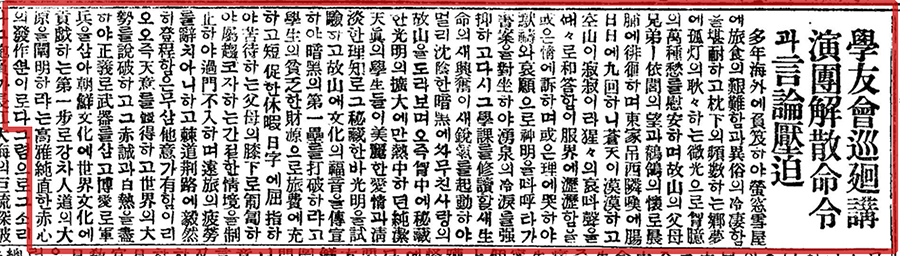
Having lived abroad for many years, enduring the hardships of a traveler's life in a humble dwelling and the coldness of unfamiliar customs, comforting the myriad sorrows in my heart with the faint light of a lonely lamp in my frequent dreams of home, I wander at dawn, thinking of my parents and siblings in my hometown—their longing gazes and my yearning for them. When I hear the lament of the neighbor's sorrow, my heart aches daily. The vast sky is boundless, and the empty mountains are desolate. Sometimes, I respond to the mournful cries of the orangutans, clearly evident in the natural world, either appealing to emotion or weeping for reason, calling out to the divine with silent prayers and pleas. Then, sitting at my desk, I suppress the gushing tears and resume my studies. New excitement for life ignites new vigor, and looking back at my beloved hometown shrouded in deep darkness, these pure and innocent students, engrossed only in expanding the light hidden within their hearts, test that hidden light with beautiful affection and clear intellect. They intend to spread the gospel of culture to their hometown, to break through the first layer of darkness. They use their meager student resources to cover travel expenses and, despite their short vacation, they overcome obstacles to rush to their eagerly awaiting parents. What other intention could there be in restraining such earnest feelings, not entering their homes, not complaining about the fatigue of a long journey, and resolutely climbing thorny paths? It is merely the manifestation of a pure and straightforward heart, having grasped the will of heaven and expounded on the great trends of the world, dedicating all their sincerity and fervor, using justice as their weapon and philanthropy as their army, to contribute to Korean culture and world culture, and to proclaim the great principles of humanity as their first step.
(Modern interpretation: For many years, I studied abroad, carrying bundles of books, enduring the hardships of life in a foreign land in cold window seats and snow-covered houses, and facing the indifferent attitudes of unfamiliar customs. Due to the frequent homesickness that arose at my bedside, I soothed all the sorrows accumulated in my heart under the dim light of a lonely lamp. My heart wandered morning and evening, holding the longing of parents and siblings in my hometown who leaned on the door, waiting for my return, and the feeling of a wagtail yearning for its siblings. Thinking of the condolences in the eastern house and the lamentations of the western neighbor, my intestines seemed to twist nine times every day, and the blue sky was distant, and the empty mountains were desolate. I made sorrowful sounds like the mournful cries of monkeys, sometimes appealing to emotion and sometimes relying on reason to weep, and cried out to the divine through silent prayers and supplications. Then, sitting at my desk, I forced back the cold tears that welled up like a spring and began to study again, and a new excitement for life brought forth new vigor. There were pure and innocent students who looked back at their beloved hometown, shrouded in distant, gloomy darkness, and were solely devoted to expanding the light they held in their hearts. They tested the light they had preserved with beautiful affection and clear, calm reason, and sought to break the first stronghold of darkness by spreading the gospel of culture to their hometown. So, they raised travel expenses from the resources of poor students. Counting down the short vacation days, they suppressed the earnest desire to rush like crawling to the bosom of their parents who eagerly awaited them, and passed by their homes without entering. Moreover, they did not shy away from the fatigue of long journeys and resolutely set out on rugged paths covered with thorns and brambles. What other intention could there have been here? They merely sought to understand the will of heaven, clearly explain the trends of the world, and with all their fervent sincerity and fiery passion, using justice as their weapon and philanthropy as their army, to illuminate the great source of humanity as a first step in contributing to Korean culture and world culture. This was nothing but the manifestation of a true, sincere heart born of a noble and upright mind.)
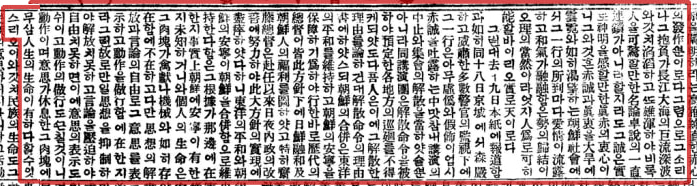
Therefore, even if his voice and aspirations are not a continuous chain of remarkable theories and profound insights that can astonish people, like the mighty currents and deep waves of the Yangtze River and the vast ocean, his sincerity is truly a genuine and heartfelt loyalty that can move the gods. In a Joseon society that yearns for such sincerity and true devotion like clouds and rain in a great drought, it is a natural consequence and a logical outcome that affection flows and harmony abounds wherever he goes. How could this be achieved by human effort? It is truly heaven-sent. However, as reported in this newspaper on the 19th, on the 18th, under the strict and solemn surveillance of numerous police officers in Gyeongseong, his group, while expressing their genuine sincerity without any pretense or falsehood, was not only forced to stop their lecture and disperse the gathering, but the lecture group was also compelled to cancel their planned tour of various regions due to the dispersal order. We now discuss the reason for the dispersal. The reason given in the dispersal order was that the annexation of Joseon was carried out to maintain peace in the East and ensure the stability of Joseon, and that successive governors-general have all pursued the integration of Japan and Joseon and the welfare of the Joseon people under this policy. In particular, Governor-General Saitō, since his inauguration, has worked day and night to improve internal affairs and dedicated himself to the realization of this grand policy. However, it is unclear on what basis it is claimed that peace in the East and stability in Joseon are maintained by annexing Joseon, and whether there is actually stability in Joseon. The life of an individual does not reside in the mere existence of their physical body, like an animal or a machine, but rather in the freedom of thought and speech to express their will and carry out their actions. Therefore, if thought is suppressed and not liberated, and speech is oppressed and not free, then the expression of will will cease, and the carrying out of actions will also stop. What kind of life can be said to exist in a physical body where actions and will are at rest?
(Modern interpretation: Thus, their voices and aspirations were as grand and magnificent as the mighty currents and deep waves of the Yangtze River. Although the words spoken by the eight individuals were not a continuous chain of astonishing and brilliant arguments, their sincerity was truly a genuine and fervent loyalty that could move even the gods. In a Joseon society that yearned for such sincerity and passion, like longing for clouds and rainbows during a great drought, it was an inevitable outcome and a natural consequence that affection flowed and harmony overflowed wherever the group went. How could this be created by artificial means? However, as reported in this newspaper on the 19th, on the 18th in Gyeongseong, under the watchful eyes of numerous police officers, sternly and majestically deployed, specifically the Jongno Police Station police, the group was expressing their sincerity without any pretense or artifice. During this, not only were their lectures stopped and the assembly dispersed, but the lecture group itself received a dissolution order, preventing them from undertaking their planned tour of various regions. Therefore, we intend to discuss the reasons for the dissolution of that lecture group. The statement of reasons for the dissolution order said the following: “The annexation of Joseon was carried out to maintain peace in the East and ensure the well-being of Joseon, and successive governors-general have all, under this policy, striven for the assimilation of Japan and Joseon and the welfare of the Joseon people, and especially Governor-General Saito, since his inauguration, has worked day and night to improve internal affairs, dedicating all his efforts to the realization of this great policy.” However, if peace in the East and the well-being of Joseon are maintained by annexing Joseon, where exactly is the basis for that? It is even uncertain whether ‘well-being’ actually exists in Joseon. Furthermore, an individual's life is not merely about the physical body existing like an animal or a machine. The meaning of human life lies in being able to express one's will and carry out one's actions through the liberation of thought and freedom of speech. Therefore, if thought is suppressed and prevented from being liberated, and speech is oppressed and not allowed to be free, then as a result, the expression of one's will will cease, and actions will also stop. If that is the case, what kind of human life can be said to exist in that physical body where actions have stopped and will has ceased?)
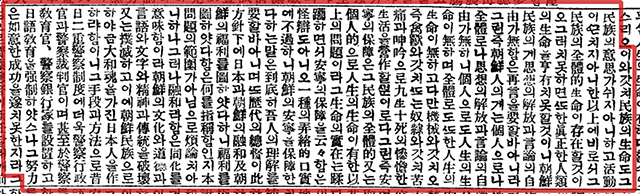
Similarly, the life of a nation will only exist as a whole if the will of that nation is ceaselessly active and its activities do not cease. Otherwise, it will not be able to enjoy the true life of humanity. It is beyond doubt that the Korean people lack freedom of thought and freedom of speech. Therefore, Koreans, both as individuals and as a whole, lack freedom of thought and freedom of speech. As individuals, they lack the life of a human being, and as a whole, they also lack the life of a human being. They merely live a miserable life of nine deaths and ten lives, suffering and groaning like machines, like beasts, or like slaves. Therefore, is the guarantee of peace a matter that arises only when the nation, as a whole or individually, has the life of a human being? To talk about guaranteeing peace while trampling on the reality of that life is not a strange phenomenon, but merely a kind of deceptive pretext. The talk of guaranteeing peace in Korea is utterly incomprehensible to us. Furthermore, the successive governors-general claimed to have promoted harmony between Japan and Korea and the welfare of Korea under this policy. What they meant by promoting welfare is not within the scope of this issue, so I will not elaborate on it. However, harmony means assimilation. It means destroying or eradicating Korean culture, morality, language, writing, spirit, and traditions, and thereby making the Korean people into Japanese people with the Yamato spirit. As a means and method, in the past, in addition to the dual police system, they established police administrative officials, police judges, and even police education officials and police bankers, and enforced Japanese language education. However, their efforts did not achieve the desired success.
(Modern interpretation: Similarly, the life of a nation can only be said to exist if the will of that nation does not cease and its activities do not stop. If it stagnates, it will not be able to possess a truly human life. The fact that the Joseon people lack individual freedom and freedom of speech is so obvious that there is no need to compare it with other nations. Therefore, if the Joseon people, individually and collectively, do not have freedom of thought and freedom of speech, then as individuals they do not have a human life, and as a nation, they also do not have a human life. In such a case, they would be like machines, like beasts, and like slaves, merely continuing a miserable life of suffering and groaning, living and dying. If so, the 'guarantee of peace' is a matter to be discussed only after assuming that the nation, collectively and individually, possesses a human life. To trample on the reality of that life and then talk about 'guaranteeing peace' is not merely something to be considered strange, but rather a kind of criminal pretext. Therefore, the phrase 'guaranteeing the peace of Joseon' is a statement that we absolutely cannot understand. Furthermore, it is said that successive governors-general, under this policy, promoted harmony between Japan and Joseon and the welfare of the Joseon people. What exactly they meant by 'promoting welfare' is beyond the scope of this issue, so I will not discuss it here. However, the 'harmony' they speak of actually means assimilation. That is, to destroy or eradicate Joseon's culture and morality, language and script, spirit and traditions, and to make the Joseon people 'Japanese with Yamato spirit.' And as a means and method for this, in addition to the dual police system of the past, the police were not merely responsible for public order, but in fact also took on the roles of administrators and judges, and even extended police control to the areas of education and finance. They also enforced Japanese language education. However, such efforts did not succeed as intended.)
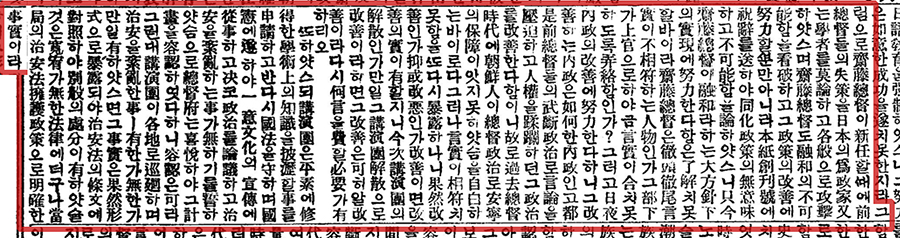
Therefore, when Governor Saitō took office, he attacked the mistakes of previous governors in various ways, regardless of whether they were Japanese politicians or scholars. Governor Saitō also realized the impossibility of reconciliation and not only strived to improve his policies but also sent a congratulatory message to the inaugural issue of this magazine, arguing that the assimilation policy was meaningless and impossible. It is incomprehensible that Governor Saitō is now striving to realize a grand policy of reconciliation. Is Governor Saitō a person whose words and actions are completely inconsistent? Are his subordinates manipulating him so that his words and actions do not align? And it is said that he is striving day and night to improve internal affairs, so what kind of internal affairs is he improving? It is said that he is improving the politics of the previous governors, who suppressed freedom of speech and violated human rights through their authoritarian rule. Therefore, it is an admission that during the past governor-general era, Koreans could not be guaranteed peace and security under the governor-general's rule. However, I will once again expose the inconsistency between words and actions: is it truly an improvement or a deterioration? If it is an improvement, there should be tangible results. Is the dissolution of the lecture group an improvement? If the dissolution of the lecture group is considered an improvement, then that improvement is understandable, and there is no need for further words. It was also stated that the lecture group applied to express their acquired academic knowledge, swore to abide by national laws, conform to the national constitution, devote themselves solely to the promotion of culture, and never discuss politics or disturb public order. Therefore, the Governor-General's Office joyfully accepted their plan, which is acceptable. However, did the lecture group, while touring individually, disturb public order—did it happen or not? If it did happen, that fact would have been clearly exposed, and there would have been a special disposition in accordance with the provisions of the public order law, as there is no leniency in the law, especially with the authorities' policy of upholding the public order law, which is a clear fact.
(Modern interpretation: Therefore, when Governor-General Saitō newly took office, Japanese politicians and scholars alike criticized the misguided policies of his predecessors from various quarters. Governor-General Saitō himself, having discerned the impracticality of the 'harmony policy,' not only strove to improve it but also, in his congratulatory message for the inaugural issue of this publication, argued that the assimilation policy was meaningless and unfeasible. Yet, now, Governor-General Saitō is said to be working towards the realization of the grand principle of 'harmony' once again, which is utterly incomprehensible. Is Governor-General Saitō a person whose words and actions have been inconsistent from beginning to end? Or are his subordinates manipulating him to make his words and actions diverge? Furthermore, they claim to be working day and night to improve internal affairs, but what kind of 'improved internal affairs' are they referring to? Ultimately, this means they intend to improve the very governance under which previous governors-general suppressed free speech and violated human rights through military rule. If so, they are implicitly admitting that Koreans were not guaranteed peace and security under the Governor-General's rule in the past. However, the actual content not only fails to align with their words but, on the contrary, reveals further contradictions. Is this truly an 'improvement' (改善), or rather a 'deterioration' (改惡)? If it is truly an improvement, there should be actual evidence of it, but is the disbandment of this lecture group precisely that 'improvement'? If disbanding the lecture group is an improvement, then perhaps such an improvement could even be called a 'complete improvement.' In that case, what more needs to be said? Moreover, the lecture group had applied to present their academic knowledge, swearing to abide by national laws and the constitution, to engage solely in the promotion of culture, and never to discuss politics or disturb public order. Therefore, the Governor-General's office reportedly gladly accepted this and approved their plan. In that case, the approval itself was correct. The lecture group had clearly pledged from the outset not to engage in political agitation or disturb public order. So, did the lecture group ever, even once, actually disturb public order while touring various regions? If such an incident occurred, it would have been duly punished according to established legal procedures, and there is no doubt that a separate disposition would have been made in light of the provisions of the Public Order Law. Furthermore, this is even more evident given that the authorities claim to strictly uphold the Public Order Law.)
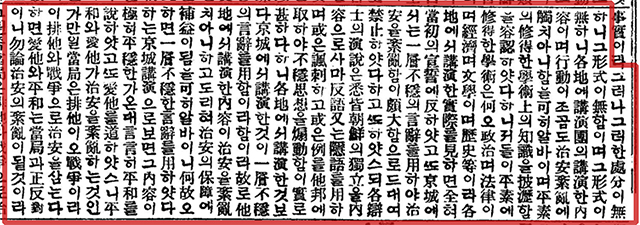
However, since such a disposition is null, its form is null, and since its form is null, it can be understood that the content and actions of the lecture group's lectures in various places did not touch upon disturbing public order at all, and that they usually
were allowed to express their acquired academic knowledge, so what kind of academic knowledge did they usually acquire? Politics, law, economics, literature, history, etc. If we look at the actual lectures given in various places, they completely contradicted the initial oath, and in Gyeongseong, they frequently used even more inflammatory language to disturb public order, so it was finally prohibited. It was also said that the speeches of each lawyer all contained the independence of Joseon, using metaphors or euphemisms, or satirizing, or taking examples from other countries to incite subversive ideas, which was truly severe, so it is said that the lectures in Gyeongseong used even more inflammatory language than those in other places. Therefore, it can be understood that the content of the lectures in other places did not disturb public order, but rather contributed to the maintenance of public order. Why? If we look at the Gyeongseong lecture, which is said to have used even more inflammatory language, its content was extremely peaceful, and it spoke of peace in every word and also advocated altruism. So, do peace and altruism disturb public order? If the authorities are exclusive and warlike, and they maintain public order through this exclusivity and war, then altruism and peace are the exact opposite of the authorities, and of course, they will disturb public order.
(Modern interpretation: However, there was no such disposition in reality. This means there was no concrete form or fact that warranted punishment. And the absence of such a form indicates that the content or actions of the lecture groups in each region did not violate public order in any way. Furthermore, the authorities reportedly allowed students to express academic knowledge they had acquired. If so, what was the academic knowledge they had acquired? It was politics, law, economics, literature, history, and so on. However, the authorities stated that the lectures actually given in each region were completely different from the initial pledge, and that in Gyeongseong, even more subversive language was used to such an extent that public order was significantly disturbed, leading to the eventual prohibition of the lectures. The dissolution order also stated: “All speakers’ speeches focused on the independence of Joseon, using irony or euphemisms, sometimes satirizing and sometimes drawing on examples from other countries, to such an extent that they truly incited subversive ideas.” If so, according to the authorities’ explanation, the lectures given in Gyeongseong used even more subversive language than those given in other regions. Conversely, this suggests that the content of the lectures given in other regions not only did not disturb public order but actually helped to maintain it. Why is that? If we examine the Gyeongseong lecture, which the authorities pointed out used even more subversive language, its content was delivered in an extremely peaceful manner and spoke of the meaning of loving others. So, are peace and altruism, that is, loving others, disturbing public order? If the authorities take exclusion and war as their principles and try to maintain public order through exclusion and war, then altruism and peace are diametrically opposed to the authorities’ position, and under such logic, it would, of course, be considered ‘disturbance of public order.’)
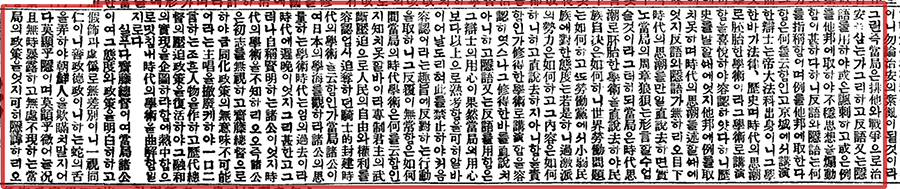
So, do the authorities maintain public order through exclusion and war? And it is said that they severely incite subversive ideas by using irony or slang, or by taking examples from others to satirize or illustrate. What do irony and slang refer to, and what does it mean to take examples from others? The orator who lectured in Gyeongseong is a graduate of the Imperial University's law department, so his studies encompassed law, history, and scholarship born from the trends of the times. It is said that they joyfully permitted him to lecture on his scholarship, so when speaking of history, how can one not take examples from others, and when describing the trends of the times, how can there be no irony or slang? If one were to speak directly about the current trends of the times, the authorities' confusion and disarray would truly be inexpressible.
However, are the authorities criticizing him for not directly stating the scholarship born from the trends of the times, such as the state of national self-determination, the state of global labor issues, the attitude of the labor party towards oppressed nations, the strength of extremist factions, and their content? They permitted him to lecture on the scholarship he acquired, but his use of slang or irony instead of directly stating what he had acquired shows that the orator's intentions were more carefully considered than those of the authorities. Yet, they prohibit this, acting contrary to their initial permission. Their inconsistency is such that it is impossible to know what kind of scholarship of the times the authorities are referring to. Are they referring to the scholarship of the chivalric feudal era, when absolute monarchs arbitrarily deprived people of their freedom and rights without permission? Gentlemen of the authorities, observe the academic world of Japan. The academic era you envision is already in the past. How can the times be so slow? However, how could you, who call yourselves wise, be ignorant of the scholarship of the times? Perhaps you, gentlemen, are ignoring your initial intentions and are so engrossed in making Governor Saitō retract his assertion that the assimilation policy is meaningless and impossible, thus creating a good example of speaking with a forked tongue, and reviving the oppressive policies of past governors to attempt to realize harmony, that you ultimately misinterpret the scholarship of the times.
It is sad. Governor Saito, and all you officials, clarify your attitudes and policies. Do not deceive Koreans with the serpent's tongue of pretense and falsehood, claiming impartiality, equal treatment, and benevolent governance. How can the authorities' policies, which are constantly exposed and evident everywhere, be concealed, especially when nothing is more manifest than what is hidden, and nothing more visible than what is subtle?
(Modern interpretation: So, does the government mean to maintain public order through exclusion and war? Surely, the Governor-General's office doesn't favor exclusion and war, deeming peace and philanthropy subversive, does it? The authorities claim that students excessively use irony and euphemisms, sometimes satire, and sometimes cite examples from other countries to incite subversive ideas. But what exactly do they mean by irony and euphemisms, and what does it mean to cite examples from other countries? The lecturer who spoke in Gyeongseong is a graduate of the Imperial University's Faculty of Law. The subjects he studied were law and history, disciplines born within the intellectual currents of that era. He lectured on such subjects, and moreover, he lectured with Governor Saito's permission, so how could there be no irony or euphemisms at all? Furthermore, if the intellectual currents of this era were to be spoken of directly as they are, the authorities' confusion and panic would be beyond words. Despite this, shouldn't the authorities rather be praised for not explicitly stating, in the context of the academic disciplines born from the intellectual currents of the time, things like, 'What about national self-determination? What about global labor issues? The Labor Party's stance on minority nations is thus, and what is the power of the radicals and what are their contents?'
The authorities allowed students to lecture on the subjects they had learned. However, the fact that the speaker used slang and irony instead of directly stating what they had learned shows that the speaker considered and was more cautious of the authorities' position than the authorities themselves. Yet, they prohibited this, taking actions completely contrary to their initial intention to allow it. Why such vacillating behavior? It is impossible to understand what the authorities mean by 'scholarship of the era.' Are they perhaps referring to the scholarship of the feudal era, when absolute monarchs arbitrarily oppressed and deprived people of their freedom and rights? Officials, look at the academic world in Japan today. The era of scholarship you envision has already passed. How can you be so behind the times? But how could you, who call yourselves wise, not know the scholarship of today's era? In the end, you are disregarding your initial intentions and forcing Governor-General Saito to retract his own assertion that 'assimilation policy is meaningless and impossible to achieve,' making him out to be a strange person who speaks with a forked tongue. Furthermore, in your zeal to revive the oppressive policies of past governors-general and achieve so-called 'harmony,' you are ultimately misinterpreting even today's scholarship and the trends of the times.
Governor-General Saito, authorities. Clarify your attitudes and policies. Do not deceive Koreans with your snake-like tongue, speaking of indiscriminate treatment, equal treatment, or benevolent governance, all with pretense and falsehood.
No matter how hidden a matter, it will eventually be revealed, and no matter how trivial a matter, it will eventually become clear. How then can the authorities' policies, which are exposed regardless of time and revealed everywhere, possibly be concealed?)
댓글
( 0 / 500 )
sarang2948
8
당시 총독부가 내세운 ‘조선의 안녕과 동양의 평화’라는 말이 얼마나 공허한 논리였는지 글을 통해 선명하게 드러납니다. 언론과 사상의 자유를 억압하면서 평화를 말한다는 것 자체가 모순이라는 지적이 특히 인상적입니다.
( 0 / 500 )
mama
7
1920년이라는 시점에 학생들의 학술 강연조차 ‘불온’하다는 이유로 해산시켰다는 사실이 당시 식민통치의 본질을 잘 보여주는 것 같습니다. 정치적 구호가 아니라 법률·역사·경제·문학 같은 학문을 말하는 것조차 통제의 대상이 될 수 있었다는 점이 중요합니다.
( 0 / 500 )
moonlight
6
‘융화’와 ‘동화’의 차이를 따져 묻는 대목이 매우 날카롭습니다. 서로 다른 문화와 언어를 존중하는 융화가 아니라 조선의 문화와 정신을 없애 일본인으로 만들려는 동화라면, 그것을 복리나 선정을 위한 정책이라고 포장하기는 어려웠을 것입니다.
( 0 / 500 )
magma
5
더 생각하게 되는 부분은 학생들이 왜 반어와 은어를 사용할 수밖에 없었느냐는 점입니다. 자유롭게 말할 수 있는 사회라면 학문과 시대사조를 직설적으로 논하면 되지만, 그것이 위험한 상황에서는 우회적인 표현이 저항의 언어가 될 수밖에 없었을 것입니다.
( 0 / 500 )
안동댁
5
100여 년 전 신문이 ‘안녕’보다 먼저 필요한 것이 인간의 생명과 사상의 자유라고 주장했다는 사실이 깊이 남습니다. 역사는 거창한 사건만으로 기록되는 것이 아니라 누군가가 말할 수 있었는지, 말하려는 사람의 목소리를 누가 막았는지에서도 드러납니다. 마지막의 ‘숨은 것은 결국 드러난다’는 메시지가 글 전체를 관통합니다.
( 0 / 500 )
woo
5
식민지 지배의 언어가 참 교묘했다는 생각이 듭니다. ‘복리’, ‘안녕’, ‘융화’, ‘선정’처럼 누구나 긍정적으로 받아들일 만한 단어를 앞세우면서 실제로는 언론과 사상을 통제하는 방식입니다. 그래서 당시 신문이 그 말의 내용과 현실을 하나씩 따져 물었던 것 같습니다.
( 0 / 500 )
백현이
4
학생들의 강연을 단순한 정치적 선동으로만 볼 수 없는 이유가 글에 잘 나타나 있습니다. 정치·법률·경제·문학·역사 등 자신들이 공부한 내용을 사회와 나누려 했다는 점에서, 당시의 강연은 지식인들이 시대를 해석하고 사회와 소통하려는 행위이기도 했다는 생각이 듭니다.
( 0 / 500 )
Jincheon
4
이 글에서 가장 무서운 대목은 ‘치안’이라는 명분이 무엇이든 금지할 수 있는 논리로 변하는 과정입니다. 실제로 치안을 어지럽힌 구체적인 행위가 있었는지 따져보지도 않고 강연 자체를 문제 삼는다면, 법과 질서라는 이름이 오히려 자유를 억압하는 도구가 될 수 있다는 지적이 설득력 있게 다가옵니다.
( 0 / 500 )
piccolo
4
작가가 이 글을 통해 단순히 1920년의 언론탄압을 소개하려는 것만은 아닌 것 같습니다. 당시 총독부가 내세운 ‘안녕·융화·선정’이라는 공식 언어와 실제로 벌어진 강연 해산·언론 통제를 나란히 놓음으로써, 식민지배가 어떤 언어로 자신을 정당화했는지를 독자에게 되묻게 하려는 의도가 읽힙니다.
( 0 / 500 )
이진석
4
특히 마지막에 ‘숨겨진 것은 결국 드러난다’는 중용의 구절을 끌어온 것이 작가의 역사 서술 의도를 보여주는 것 같습니다. 단순히 과거의 억압을 고발하는 데 그치지 않고, 당시 사람들이 왜 직접 말하지 못하고 은어와 반어를 사용해야 했는지, 그리고 그런 시대의 흔적이 어떻게 후대에 드러나는지를 보여주려 한 듯합니다.
( 0 / 500 )
nayana
3
‘평화와 애타가 어떻게 치안 문란이 될 수 있는가’라는 반문이 오래 남습니다. 지배 권력이 말하는 질서와 시민이 생각하는 평화가 서로 다를 수 있다는 사실을 아주 간결하게 보여주는 대목입니다.
( 0 / 500 )
박진주
2
100년 전 신문의 문장을 오늘 읽으면서도 낯설지 않다는 것이 오히려 씁쓸합니다. 권력은 자신에게 불편한 목소리를 ‘불온’이나 ‘질서 훼손’이라는 말로 규정하기 쉽고, 그래서 역사를 읽을 때는 정책의 이름보다 실제로 무엇을 허용하고 무엇을 금지했는지를 살펴봐야 한다는 생각이 듭니다.
( 0 / 500 )
신고내용
신고내용을 선택해주세요
회원비난/비하/욕설글 및 댓글도배성 게시물저작권 침해/불법자료 유출허위사실유포개인정보 유출.사생활 침해무단광고/홍보음란물 및 도박 불법 광고물범죄행위 관련 글불법행위 관련 소개물품 판매 및 사기글악성코드 및 스파이웨어 유포기타 사유 및 운영진 판단


비밀번호를 잊으셨나요?
Sign in with Google


All information provided by us is free of charge and is for the public good.