品

Corea든 Korea든, 품격이 먼저다
Whether Corea or Korea, dignity comes first.
Whether Corea or Korea, dignity comes first.
Now
지금
751 Diaspora
Heritage
유산
Humanity
인문
Mirengsi
未冷尸
Politics
정치
Media
언론
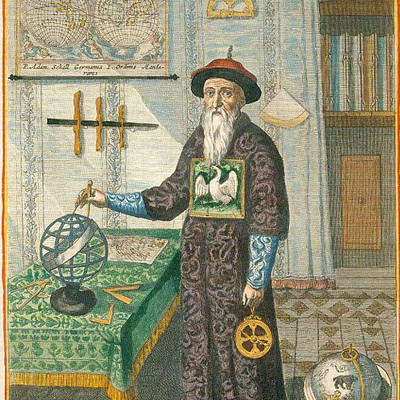
Johann Adam Schall von Bell, 湯若望

근대신문
칼럼
공공
Hansung Sunbo 1883.11.20. [No. 3] 1~2

0
2026. 11. 02
Cap_XII_Regnantium_in_Chinis_Tartarorum_prosapia;_eorundem_in_Astronomiam.pdf

- The Gwanseonggam records meticulously report the solar eclipse of October 1, 1883 (lunar calendar) according to the Siheon Calendar, demonstrating Joseon's active adoption of Western astronomical knowledge at the time.
- On the same day, a large-scale personnel reshuffle across various official positions was carried out by royal decree, reflecting the complex political situation of Joseon during the Enlightenment period and its commitment to establishing and operating new institutions.
- The Pyeongan-do Governor's report details a poor harvest due to climate change, including a prolonged drought, hail, and early frost, suggesting that the lives of the common people at the time were heavily dependent on natural disasters.
- The incident where Sungkyunkwan students protested a colleague's unjust detention by raiding the Podocheong, breaking down prison gates, and releasing prisoners, vividly reveals the social chaos and the discontent of the intellectual class at the time.
- The text points out the influence of foreign powers and public hostility hidden behind Hanseongsunbo's "first" status, emphasizing the need to read beyond superficial facts to understand the complex context in historical narratives.
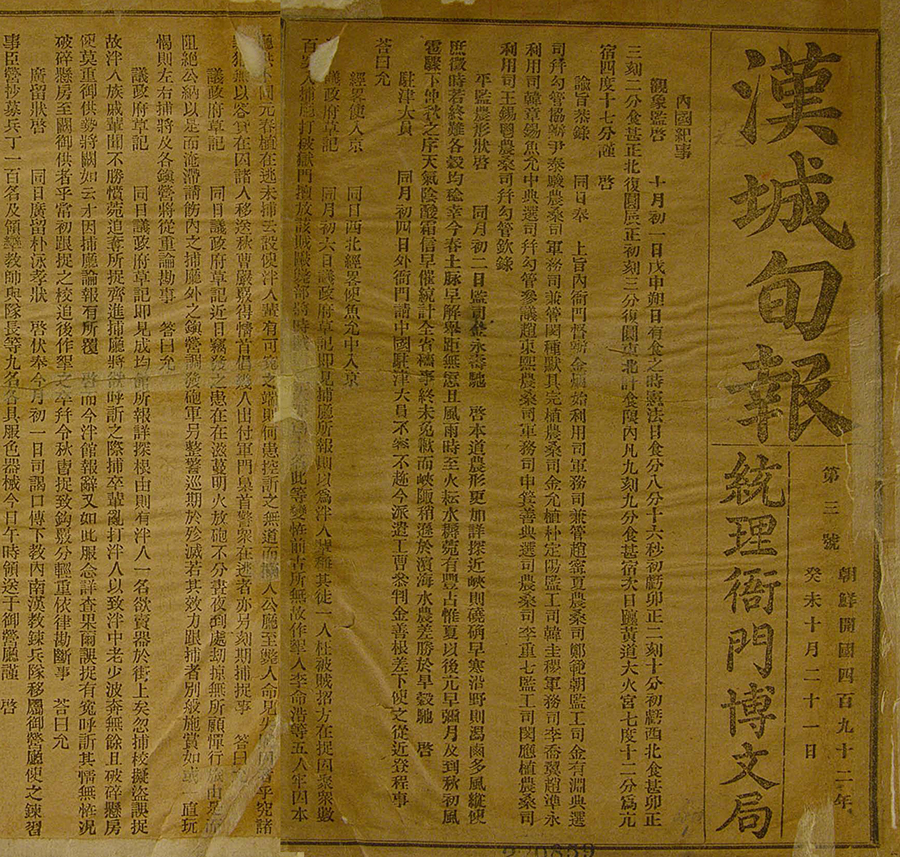
○Domestic Affairs
Report from Gwanseonggam (Office of Astronomy)
On the first day of the 10th lunar month, Musin (戊申), there was a solar eclipse. According to the Siheon Calendar (a lunisolar calendar developed in the Qing Dynasty under the influence of Western astronomy, implemented in Joseon from 1653, led by Jesuit missionaries like Adam Schall, focusing on applying Western astronomical knowledge to the Chinese calendar system, accurately calculating the 24 solar terms, and precisely describing the movements of the sun and moon), the magnitude of the solar eclipse was 8 minutes and 16 seconds. The initial obscuration (the moment the moon begins to cover the sun) was at 2 gak and 10 bun of Myeojeong (卯正), in the northwest. The maximum obscuration (when the sun or moon is most covered during an eclipse) was at 3 gak and 2 bun of Myeojeong, directly north. The restoration (the phenomenon of the sun or moon returning to its original round shape during an eclipse) was at 3 bun of Chogak (初刻) of Jinjeong (辰正), in the northeast. The total duration of the eclipse was calculated to be 9 gak and 9 bun (approximately 2 hours and 14 minutes). At the time of maximum obscuration, the position of the sun in the constellations was 7 degrees and 12 minutes in the Daewhagung (大火宮) of the ecliptic, corresponding to 4 degrees and 17 minutes in the Hangsu (亢宿). Respectfully submitted.
Royal Edict (Respectfully recorded royal commands)
On the same day, according to the royal decree, Kim Byeong-si, the Dokpan (Director) of Naewimun, was appointed to concurrently manage the Riyongsa (Office of Utilization) and Gunmusa (Office of Military Affairs). Jo Yeong-ha was appointed to Nongsan-sa (Office of Agriculture and Sericulture), Jeong Beom-jo to Gamgongsa (Office of Supervision of Public Works), and Kim Yu-yeon to Jeonseonsa (Office of Selection), all serving as Hyeop-pan (Assistant Ministers). Yun Tae-jun was appointed to concurrently manage Nongsan-sa and Gunmusa. Min Jong-muk and Gu Wan-sik were appointed to Nongsan-sa. Kim Yun-sik and Park Jeong-yang were appointed to Gamgongsa. Han Gyu-jik was appointed to Gunmusa. Yi Gyo-ik and Jo Jun-yeong were appointed to Riyongsa. Han Jang-seok and Eo Yun-jung were appointed to Jeonseonsa, all serving as Cham-ui (Councilors). Jo Dong-hui was appointed to Nongsan-sa and Gunmusa. Sin Gi-seon was appointed to Jeonseonsa and Nongsan-sa. Yi Jung-chil was appointed to Gamgongsa. Min Eung-sik was appointed to Nongsan-sa and Riyongsa. Wang Seok-chang was appointed to Nongsan-sa, all to oversee their respective offices. Respectfully recorded.
Pyeongam Nonghyeong Janggye (平監農形狀啓: Report on Agricultural Conditions by the Governor of Pyeongan-do)
On the 2nd of the same month, Governor Kim Yeong-su reported, "Upon closer examination of the agricultural situation in this province, I found that the nearby mountainous regions are barren and experience early cold, while the plains are dry, barren, and windy. Even if rain falls appropriately, it seems difficult for all crops to ripen well. Fortunately, this spring, the ground thawed early, allowing all farming tasks to proceed without interruption, and timely wind and rain brought signs of a good harvest for both rice paddies and dry fields. However, since summer, the drought has continued for over a month, and in early autumn, wind and hail suddenly fell. As autumn deepened, the weather became cloudy and cold, leading to early frost. Looking at the entire province, the harvest ultimately could not escape a poor yield, with mountainous regions being worse than coastal areas, and rice paddies being somewhat better than dry fields."
Resident Official in Tianjin
On the 4th of the same month, the Oeyamun (Foreign Affairs Office) reported, “The Chinese envoy stationed in Tianjin (駐津大員: an official stationed in Tianjin, China, responsible for trade affairs) cannot be delayed any longer. We request that Kim Seon-geun, the Vice Minister of Public Works (工曹參判), be selected and depart in the near future.” The decree was, “So be it.”
Gyeongnyaksa enters the capital
On the same day, Eo Yun-jung, the Northwest Gyeongnyaksa (西北經略使), entered the capital.
Uijeongbu Chogi (State Council Report)
On the 6th of the same month, the Uijeongbu (State Council) reported, “We have received a report from the Podocheong (Police Bureau) stating that ‘the students (泮人) of Sungkyunkwan (成均館), claiming that one of their colleagues was unjustly named in a confession of a thief/rebel (賊招) and is currently imprisoned, gathered hundreds of people, stormed the Podocheong, broke down the prison gate, arbitrarily released the said thief, and beat a military officer (部將) to death. In the chaos, 10 imprisoned thieves also disappeared. Such an anomaly is unprecedented, so we have imprisoned Lee Myeong-ho and 5 others who caused the disturbance in this office, and Hong Bok-dong and Won Chun-sik are currently at large and have not been apprehended.’ Even if their group had a legitimate grievance, there were ample avenues for appeal. How could they brazenly enter a public office, beat someone to death, and allow imprisoned thieves to escape? Their criminal acts are unforgivable. Therefore, we request that those currently imprisoned be transferred to the Chujo (秋曹, Ministry of Punishments) for strict investigation to ascertain the facts. After that, a few ringleaders should be handed over to the military authorities (軍門) to be beheaded (梟首) as a warning, and a deadline should be set to quickly apprehend those who have fled.” The decree was, “So be it.”
Uijeongbu Chogi (State Council Report)
On the same day, early in Uijeongbu, it was stated, “Recently, the trouble of thieves appearing is increasingly widespread. Even in the Gijeon (畿甸: the capital region) area, they openly set fires and fire cannons, committing robbery and plunder everywhere without hesitation, making it impossible for travelers to use the roads and delaying public tributes. Therefore, we humbly request that strict orders be issued to the Podocheong (police bureau) internally and to each military camp externally, to mobilize artillery forces and specially strengthen patrols to eradicate them completely. Those who exert themselves to make arrests will be separately rewarded, and if anyone is slow to act, the 좌우포장 (chiefs of the Podocheong) or the 영장 (commanding officers) of each camp should be severely punished.” The King replied, “Granted.”
Uijeongbu Chogi (Draft Record of the State Council)
On the same day, Uijeongbu reported, “Having reviewed the current report from Sungkyunkwan, it states: ‘Upon detailed investigation into the cause, one of the Sungkyunkwan students (泮人) was attempting to set up goods on the street when a police officer (捕校) suddenly arrested him on suspicion of theft. Hearing this news, the student’s family, unable to contain their anger, pursued them, rescued the arrested individual, and were about to rush to the Podocheong to file a complaint. At that moment, police officers (捕卒) rushed in and beat the students, causing them, old and young alike, to scatter in all directions. The report also states that the butcher shop (懸房) was destroyed, making it difficult to present the crucial royal offerings (御供). Although we have already submitted a report based on the Podocheong’s statement, the Sungkyunkwan’s report is now similar. We believe that if a thorough investigation confirms the facts, it is natural to complain about an unjust arrest. However, how could it escalate to the point of destroying the butcher shop and disrupting the royal offerings? We propose that the police officer who initially pursued and arrested the student, and the police officers who later caused the disturbance, should all be arrested and imprisoned by the Ministry of Justice for a thorough investigation, and punished according to the law based on the severity of their crimes.” The King replied, “Do so.”
*If we set aside the title of 'first modern newspaper' for Hansung Sunbo, we might overlook the fact that it fizzled out when the Bakmun-guk (Printing Office) was destroyed during the Gapsin Coup, making it merely the first newspaper whose history, reflecting foreign propaganda, was buried. Today, even if Chosun Ilbo, JoongAng Ilbo, and Dong-A Ilbo are media solidified by anti-national reporting and defending vested interests, it's hard to imagine people rushing to set fire to their newspaper offices. How intense, then, must have been the hostility and social crisis when Bakmun-guk was attacked?
Conversely, precisely because Hansung Sunbo was granted the grand status of the first modern newspaper, just as Chosun Ilbo and Dong-A Ilbo have solidified their firewalls today, neither Koreans of the past nor modern Koreans possess the imagination to conceive how subtly the enemies might have planned their self-defense when the nation's sovereignty was usurped by colonial rule. While arson itself doesn't prove the nature or responsibility of a newspaper, historical narratives that only celebrate its 'first' status without examining the background of its destruction are seriously problematic. It's also necessary to consider the view that Hansung Sunbo is a newspaper that has taken on a false status, having lost its original purpose of birth, and that countless other types of books and publications were issued under innumerable purposes and intentions.
144 years ago in 1882, during the Imo Incident, an event for which Koreans were held responsible in history, this Hansung Sunbo was created by introducing a modern pedal-operated letterpress printing machine from Japan. Inoue Kakugoro (井上角五郎, 1859~1938) was involved from its founding to the fire and reconstruction of the Bakmun-guk printing office. Inoue is known as the planner of the Gapsin Coup. The Chinese character newspaper, which focused on official gazettes and domestic and international current affairs, targeted intellectuals who could read Chinese characters, but it can only be presumed that the public was enraged primarily because of problems with its article content.
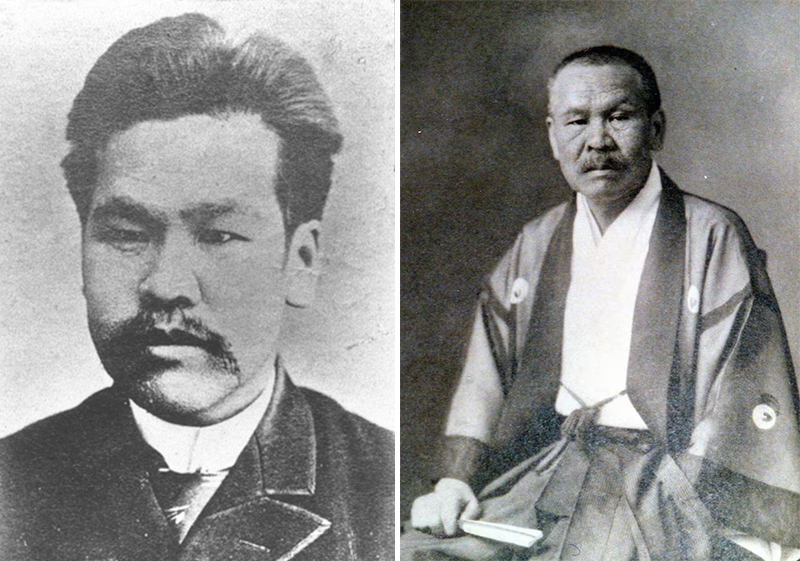
Inoue Kakugoro
The annular solar eclipse phenomenon on the first day of the tenth lunar month in 1883 (Gye-mi year, Gye-hae month, Mu-sin day) is an astronomical coordinate observable not only on the Korean Peninsula but also in the Northern Hemisphere outside the Korean Peninsula. The 56 total solar eclipses recorded in the Samguk Sagi can also be traced to coordinates in India, Tibet, Russia's Amur region, Siberia, Tuva, China's Xinjiang Province, Fujian Province, and other places. This is evidence that not only history but even science has never escaped colonial historiography, yet no institution delves into this issue. The history that insists Koreans were born and died repeatedly only within the Korean Peninsula, a civilization theory, has led not only Koreans but all of humanity to a collectively lowered standard of history (Crime doesn’t pay).
On the first day when the solar eclipse was observed, the following personnel changes were recorded in the Yuji Gongrok (諭旨恭錄).
1 | Kim Byeong-si (金炳始) | 1832~1898 | Father: Kim Eung-geun (金應根) |
2 | Jo Yeong-ha (趙寧夏, 趙甯夏) | 1845~1884 | Biological father: Jo Byeong-seok (趙秉錫) → Adopted by adoptive father Jo Byeong-gyu (趙秉虁) |
3 | Jeong Beom-jo (鄭範朝) | 1833~1897 | Grandfather: Jeong Won-yong (鄭元容) → Father: Jeong Gi-se (鄭基世) → Jeong Beom-jo → Son: Jeong In-seung (鄭寅昇) |
4 | Kim Yu-yeon (金有淵) | 1819~1887 | Grandfather: Kim Jae-ok (金載玉), Biological father: Kim Yeong (金鍈). Adoptive father: Kim Hong (金鑅) |
5 | Yun Tae-jun (尹泰駿) | 1839~1884 | Biological father: Yun Tae-myeon (尹泰冕) → Adopted son: Yun U-sik (尹禹植) |
6 | Kim Yun-sik (金允植) | 1835~1922 | Father: Kim Ik-tae (金益泰), Mother: Jeonju Yi clan |
7 | Park Jeong-yang (朴定陽) | 1841~1905 | Father: Park Je-geun (朴齊近) |
8 | Han Gyu-jik (韓圭稷) | 1845~1884 | Father: Han Seung-ryeol (韓承烈) |
9 | Yi Gyo-ik (李喬翼) | Birth and death years unconfirmed | Direct lineage unconfirmed |
10 | Jo Jun-yeong (趙準永) | 1833~1886 | Direct lineage unconfirmed |
11 | Han Jang-seok (韓章錫) | 1832~1894 | Father: Han Pil-gyo (韓弼敎) |
12 | Eo Yun-jung (魚允中) | 1848~1896 | Father: Eo Yak-u (魚若愚) |
13 | Jo Dong-hui (趙同熙) | 1856~1934 | Paternal grandfather: Jo Du-sun (趙斗淳) → Biological father: Jo Byeong-seop (趙秉燮). Adoptive father: Jo Byeong-jip (趙秉集), Adopted son: Jo Jung-heon (趙重獻) |
14 | Sin Gi-seon (申箕善) | 1851~1909 | Father: Sin Hui-jo (申羲朝) |
15 | Yi Jung-chil (李重七) | Birth and death years unconfirmed | Father recorded as Yi Yong-jin (李容進) in the Bangmok (list of successful candidates) introduction. Verification of the original Bangmok is required. |
16 | Min Eung-sik (閔應植) | 1844~? | Biological father: Min Yeong-u (閔泳愚) → Adopted by adoptive father Min Han-jun (閔漢俊) |
17 | Wang Seok-chang (王錫鬯) | Birth and death years unconfirmed | From Qing Dynasty. Direct lineage unconfirmed |
The last person among these, Wang Xichang (王錫鬯, 1857?~1921?, birth and death years uncertain, no photo available), was a Qing dynasty official who entered Joseon as a subordinate of Wu Changqing (吳長慶, 1834~1884) during the suppression of the Imo Incident. He served as a councilor in the Military Affairs Office and gained recognition in 1883 for his memorial advocating for the abolition of the Dangojun currency and the problems of currency circulation, as well as the abolition of the system of guilt by association. He was a Chinese advisor who participated in Joseon administration during a period of increasing Qing influence, and there are indications that he interfered in royal and internal affairs even after the Gapsin Coup. However, with a complete interpretation of the Imo Incident and Gapsin Coup currently impossible, the full extent of his activities remains unknown.
Wu Changqing
The Nongsan-sa (農桑司), to which Wang Xichang was appointed, was a department for agriculture and sericulture, but the Korean Peninsula is currently too cold for sericulture to be an industry. It is also important to remember for historical understanding that policies that 'reproduced' modern industries like hwamunseok (rush mats) and sericulture until the Park Chung-hee era have long since disappeared. The Nongsan-sa (農桑司) was also written as Nongsan-sa (農商司) and was abolished in 1884 due to the Gapsin Coup. The argument that the era when a Qing official was involved in everything from currency reform to guilt by association and sericulture, and that the sericulture facilities within the palace, Jamsil in Seoul, Jamwon-dong, and Seonjamdan in Seongbuk-dong were all the same space in modern geopolitics, seems unreasonable. Just as 'different' and 'wrong' have different meanings, it is also necessary to have the discernment to distinguish whether the same history occurred in the same space or in different spaces.
Similarly, it is puzzling that Eo Yun-jung (魚允中, 1848~1896), who was appointed to the Jeonseon-sa (典選司) on the first day of the month, became the Seobuk Gyeongnyaksa (西北經略使) and entered the capital four days later. History views Eo Yun-jung's death as a result of a dispute over a burial site. In the fall of a nation, neither participants, nor those responsible, nor traitors are recorded; only King Gojong, Queen Min, and Heungseon Daewongun are on the stage. I wonder what values those who have only learned this damned Korean history through a colonialist perspective hold while living in this land.
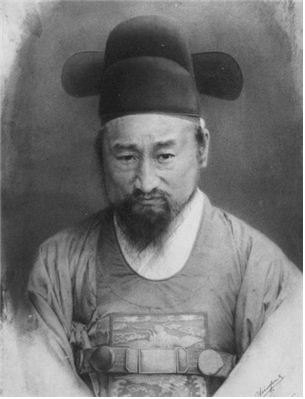
Eo Yun-jung
On the 6th day of the 10th lunar month, a shooting incident occurred in the streets (it's unclear whether it was a pistol, cannon, or machine gun), leading to looting, arson, and theft. Were the Banin (contractors living in Ban-chon, the area around Sungkyunkwan, who made a living selling beef) so foolish and complacent as to come out to do business, only to be arrested by the Podocheong? Firearms are not something civilians can purchase. The anti-Japanese movement began, and individuals liquidated their assets and scattered to Manchuria because the mainland was taken by foreigners. The Hanseongsunbo article, which dismissed this as a mere dispute among merchants, shows how today's judicial rulings deviate from the norm, stemming from such history.
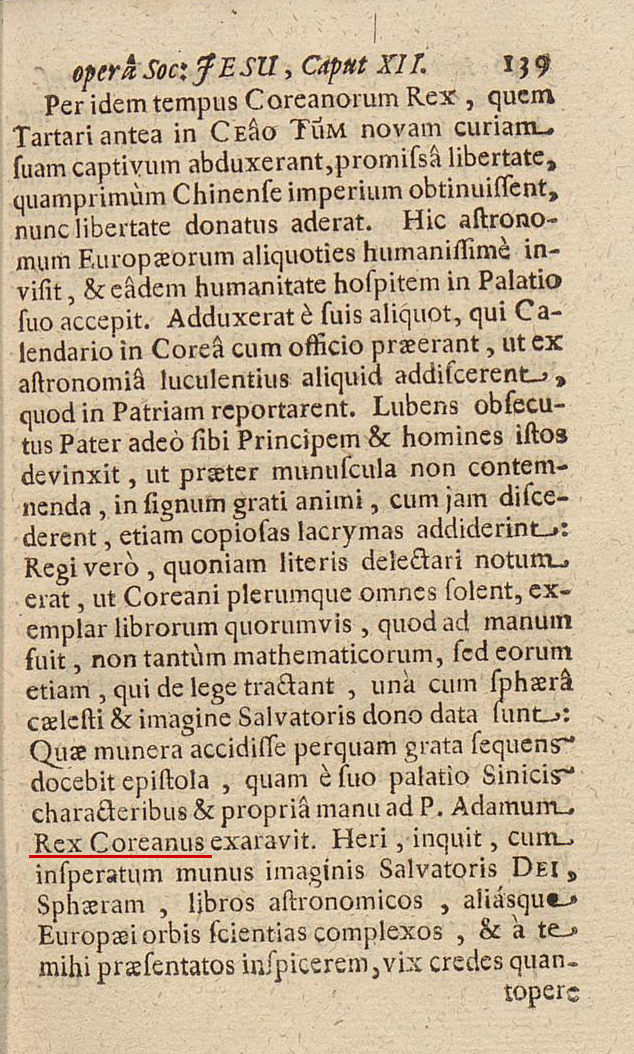
It is said that the Gregorian calendar, led by the Jesuit missionary Adam Schall (Johann Adam Schall von Bell, 湯若望, 1591~1666), who was in Qing China, was implemented in Joseon early on. I wonder why the lunar calendar was still used until the publication of Hanseongsunbo, and if there are any records of where the Gregorian calendar was used. The history that Crown Prince Sohyeon (昭顯世子, 1612~1645) returned to Korea, was hated by his father, poisoned, and his entourage disappeared from the stage of history, is also a pattern of defeat narrative that attributes the cause to the traitors of a fallen nation. However, Crown Prince Sohyeon's original letter in classical Chinese sent to Adam Schall does not remain. It is ironic how Western Europe's decline, which concealed that era, led to the question of who translated classical Chinese into Latin, and why Latin is now a dead language. The books Adam Schall gifted to Crown Prince Sohyeon, whom he knew as the King of Joseon, were, in principle, books translated from Latin into classical Chinese. If the originals exist, disclose them. There is nothing new under the sun, but there is also no falsehood.
댓글
( 0 / 500 )
五感滿足
8
한성순보를 근대 최초의 신문이라는 이유만으로 기념하는 데 그쳐서는 안 된다는 지적에 공감합니다. 중요한 것은 언제 창간되었느냐보다 누가 어떤 목적을 가지고 만들었으며, 누구의 시각과 이해관계를 대변했느냐는 문제일 것입니다. 언론의 역사를 발행 연혁만으로 평가해서는 안 된다는 점을 다시 생각하게 합니다
( 0 / 500 )
Hybridman
6
역사는 왕과 권력자 몇 사람의 행적만으로 만들어지지 않습니다. 관직을 맡았던 사람들의 가계와 정치적 관계, 외국인 고문들의 활동까지 추적하다 보면 기존 역사 서술에서 놓친 부분이 드러날 수 있습니다. 인물 하나의 생애를 제대로 복원하는 작업이 때로는 한 시대 전체를 다시 이해하는 출발점이 됩니다.
( 0 / 500 )
minho
6
왕석창, 어윤중, 김윤식 등 당시 관직에 임명된 인물들의 관계와 행적을 하나씩 추적한 대목이 인상적입니다. 역사책에서는 몇 줄로 정리되는 인물들이 실제로는 복잡한 국내외 관계와 권력의 이동 속에서 활동했습니다. 왕과 몇몇 중심인물만으로 역사를 설명하는 방식에서 벗어나 당시 행정과 외교를 움직인 사람들의 실체를 복원할 필요가 있습니다.
( 0 / 500 )
순정
4
일식 관측 기록과 서양 천문학, 청나라의 역법, 소현세자와 아담 샬의 교류를 함께 다룬 대목이 특히 흥미롭습니다. 한반도에서 일어난 사건이라고 해서 그 원인과 영향까지 한반도 안에만 있었던 것은 아닙니다. 사람과 지식, 기술과 권력은 국경을 넘어 움직였습니다. 한국사를 세계사의 흐름 속에서 다시 읽어야 한다는 문제의식을 생각하게 합니다.
( 0 / 500 )
blue77
4
정설이라고 배워 온 역사도 결국 누군가의 기록과 해석을 거쳐 만들어진 것입니다. 한성순보의 창간을 근대 언론의 출발점으로만 기념할 것이 아니라, 창간을 주도한 사람들과 당시 국제정세, 발행 목적까지 함께 살펴야 한다는 지적에 공감합니다. 역사를 다시 읽는다는 것은 기존 지식에 질문을 던지는 일입니다.
( 0 / 500 )
이철민
4
역사는 기록된 사실만큼이나 기록되지 않은 사실도 중요합니다. 박문국의 화재와 갑신정변을 단순한 사건의 연장선에서 이해할 것이 아니라 당시 조선 사회의 갈등과 외세의 이해관계 속에서 살펴야 한다는 문제 제기가 의미 있습니다. 익숙하게 배운 역사일수록 원자료와 다른 관점에서 다시 검증할 필요가 있습니다
( 0 / 500 )
kangnam
4
1883년의 한성순보와 오늘날의 언론을 연결해 살펴보는 관점이 흥미롭습니다. 신문은 단순히 사실을 전달하는 매체가 아니라 시대의 권력관계와 정치적 이해가 투영되는 공간이기도 합니다. 언론의 탄생과 성장 과정에 어떤 세력이 관여했는지 추적하는 작업은 오늘날 언론을 이해하는 데도 중요한 시사점을 줍니다.
( 0 / 500 )
hongjo
3
이번 글에서 가장 주목한 것은 역사적 통념을 그대로 받아들이지 않고 일식의 관측 좌표, 인물의 계보, 관직의 변동, 외국인의 조선 내 활동까지 서로 연결해 질문을 던진다는 점입니다. 다만 기존 역사 해석을 뒤집는 주장일수록 사료의 출처와 교차 검증이 더욱 중요할 것입니다. 역사는 권위에 대한 믿음이 아니라 끊임없는 질문과 검증을 통해 깊어집니다.
( 0 / 500 )
kaka
1
임오군란 이후 청과 일본이 조선의 정치와 행정에 미친 영향은 단순한 외교관계로 설명하기 어렵습니다. 특히 언론과 인쇄기술의 도입 과정에 외국인이 깊숙이 관여했다면 그 배경과 목적도 역사적 검증의 대상이 되어야 합니다. 근대화라는 이름으로 포장된 외세의 영향력을 좀 더 입체적으로 볼 필요가 있습니다
( 0 / 500 )
신고내용
신고내용을 선택해주세요
회원비난/비하/욕설글 및 댓글도배성 게시물저작권 침해/불법자료 유출허위사실유포개인정보 유출.사생활 침해무단광고/홍보음란물 및 도박 불법 광고물범죄행위 관련 글불법행위 관련 소개물품 판매 및 사기글악성코드 및 스파이웨어 유포기타 사유 및 운영진 판단


비밀번호를 잊으셨나요?
Sign in with Google


All information provided by us is free of charge and is for the public good.