品

Corea든 Korea든, 품격이 먼저다
Whether Corea or Korea, dignity comes first.
Whether Corea or Korea, dignity comes first.
Now
지금
751 Diaspora
Heritage
유산
Humanity
인문
Mirengsi
未冷尸
Politics
정치
Media
언론
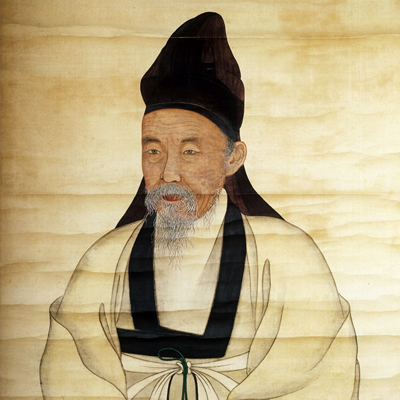
고흥 류씨, 의암(毅菴) 류인석(柳麟錫, 1841~1915)

의병역사
칼럼
古韻書生
Ryu In-seok (柳麟錫, 1841~1915), a righteous army commander who defended righteousness and rejected evil

0
2026. 08. 05
About 20 years ago, a friend came to me asking for an appraisal of old items found in the wall of a small, old Japanese-style house in a narrow alley in Myeongdong, Seoul, which he had inherited and was tearing down. I heard that my friend's parents had worked in the film industry in Myeongdong, and there were dozens of documents from the Japanese colonial period and several Japanese swords. I vaguely remember that some modern documents were included, but my memory is not clear, and without time to determine if they were genuine or replicas, I quickly took pictures and returned them. Afterward, my computer broke down, and the data was lost.
Ryu In-seok (柳麟錫, 1841~1915), also known as Uiam (毅菴), from the Goheung Ryu clan, whom I will introduce today, is precisely that history that vanished like a mirage. He was a local yangban scholar and an anti-Japanese righteous army leader who witnessed and experienced the Japanese invasion firsthand. When Empress Min was assassinated in the Eulmi Incident (乙未事變), Ryu In-seok issued a proclamation urging scholars nationwide to form righteous armies, leading the vanguard of the first righteous army. In 1910, he was elected as the Grand Commander (都總裁) of the '13-Province Righteous Army (13道 倡義軍)' in Vladivostok. Two days before the Gyeongseul National Humiliation (庚戌國恥: the seizure of national sovereignty on August 29, 1910), he gathered Koreans (韓族) in the Maritime Province and Gando and, with Yi Sang-seol (李相卨, 1870~1917), organized the Seongmyeonghoe (聲鳴會) to work for the restoration of national sovereignty.
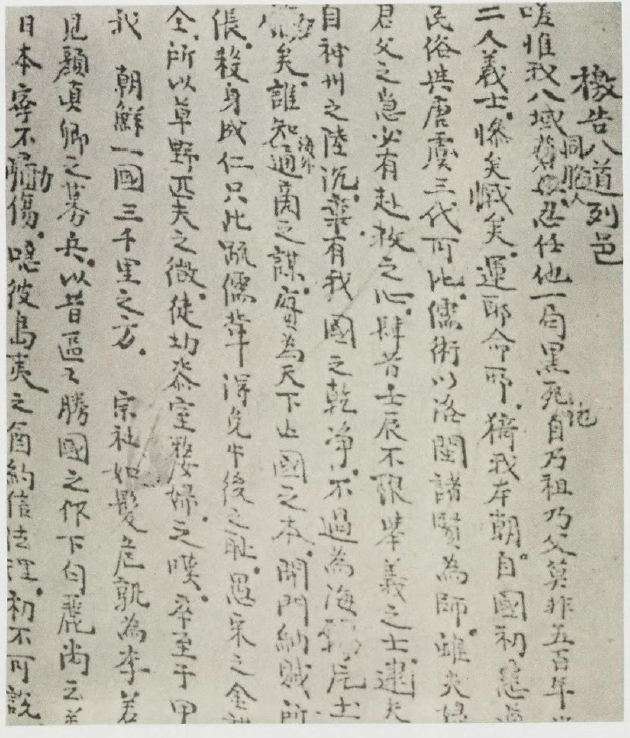
Ryu In-seok's handwritten proclamation urging the formation of righteous armies in all eight provinces (needs to be compared with other surviving handwritten documents)
Originally, Joseon's administrative divisions were based on an 8-province system. During the Gabo Reform, the country was reorganized into 23 bu and 337 gun, which was used for about a year. Then, in August 1896, it was changed back to a 13-province system, based on the 8 provinces but divided north and south. The fact that the country was divided into hundreds of gun simultaneously with the Gabo Reform in 1895 suggests that there must have been administrative division work done even before that. The 3,000-ri territory of Joseon's 8 provinces is all we know, and we cannot be sure if all of it is true.
Ryu In-seok advised Confucian scholars to discuss 'Cheobyeon Sam-sa, Geoui, Suui, Sunui' (three courses of action a scholar should choose when the nation and morality collapse: fighting the enemy, upholding righteousness and moral principles, and finally sacrificing one's life) and choose according to their respective situations. At a time when righteous army uprisings were beginning to erupt across the country amidst the chaos of the Eulmi Incident and the Haircut Edict, he was a pioneering figure of the early anti-Japanese righteous army, active mainly in Jecheon, but when circumstances became unfavorable, he moved his base to the northwestern region at the suggestion of Jeong Hwa-yong (鄭華鎔, 1878-1898). However, the process of his move from Jecheon to Manchuria will not be covered here. I will briefly introduce blurred photos of Ryu In-seok's house in Chuncheon, Gangwon-do, where he lived, and the atrocities committed by the Japanese, where villages were devastated whenever the righteous army passed through.
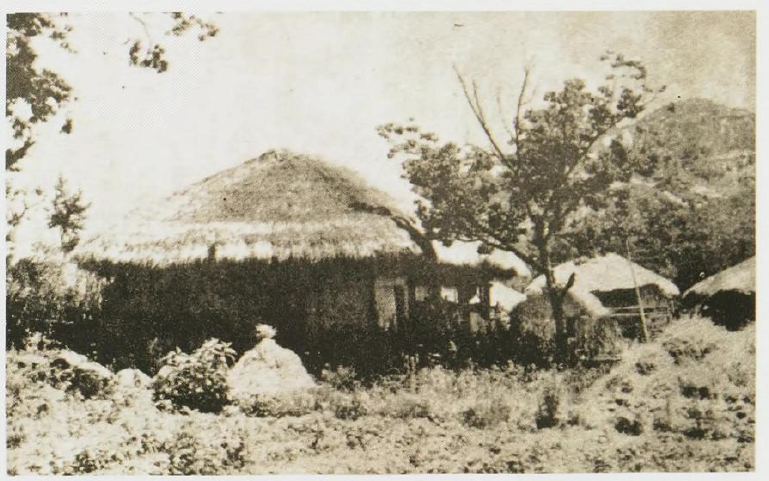
Ryu In-seok's house in Chuncheon
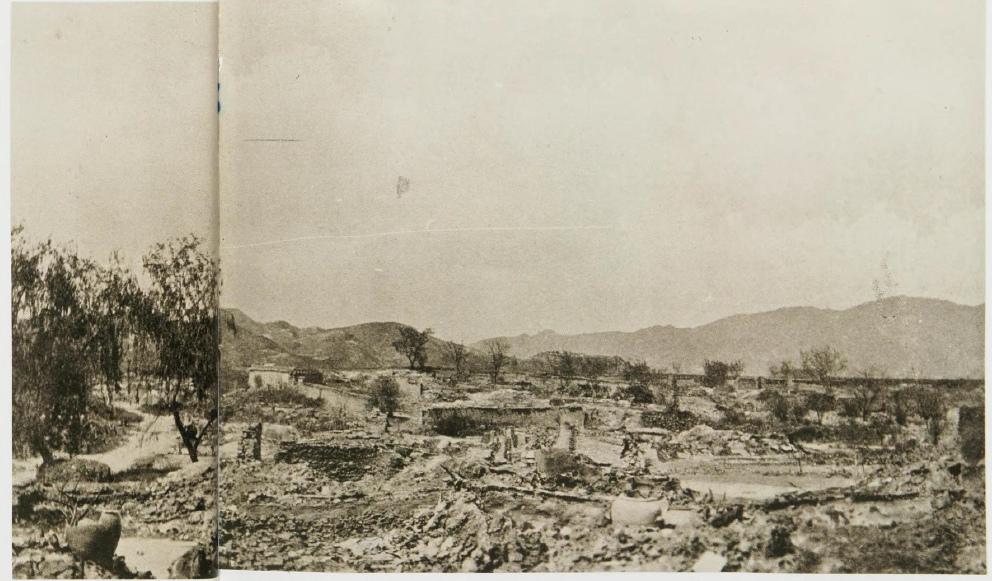
Civilian houses that were massacred whenever the righteous army passed by
However, it is known that he was prevented from acting in the places he moved to, so he requested reinforcements from the Qing Dynasty and also sought aid and weapons purchases from Russia, intending to attack Japan, which was weakened by the Russo-Japanese War. Records of Ryu In-seok's actions, shared with Myeonam Choi Ik-hyeon (崔益鉉, 1833-1906), remain, and he left behind the righteous army records <Soeui Sinpyeon> and <Euiamjip>. In the history of the righteous army, it is said that due to the situation where governors and magistrates had already been occupied by the Japanese, they killed local pro-Japanese officials, and there is also an evaluation that he showed the limitations of the traditional value system of the status system by executing low-status individuals who, though also righteous army members, defied his will. However, since the position of governor was already abolished by the Gabo Reform, the evaluation that Ryu In-seok arbitrarily killed people is not unconditionally reliable.
He was a relatively rational figure who, upon witnessing the establishment of the Republic of China in 1910, sought to explore solidarity among the three East Asian nations—Joseon, Qing, and Japan—and attempted to transform and adapt from the classical Sinocentric view (華夷觀) of a racist who treated Qing and Japan as barbarians (禽獸). This assessment describes him as a nobleman who sought a compromise at a crossroads between Sinocentrism and pragmatism. The records of his movements are not detailed, making them unclear, and evaluations based primarily on his external actions are also open to suspicion. It is necessary to imagine the colonial period, where administrative districts constantly changed as righteous armies moved through the mountains to Manchuria, because the lands occupied by Imperial Japan were no longer called by the place names we knew.
Ryu In-seok moved to Fangcuigou (芳翠溝) in Kuandian County (寛甸県), Liaoning Province (遼寧省), then called Fengtian Province (奉天省), in 1914, and died there of illness at the age of 74 in 1915. Two years later, it is said that his followers secretly published Uiamjip, named after his pen name, using movable type, by collecting scattered manuscripts in Huaiyin (懷仁), now called Huanren (桓仁). It is also said that in 1918, the Japanese imperial forces raided the site where Ryu In-seok's collection of poems and essays, <毅庵集>, was being produced and seized the documents. Furthermore, it is rumored that after the March 1st Movement in 1919, the Japanese imperial forces confiscated and burned some of the completed publications, so a thorough review of its detailed authenticity is required.
In 2010, the Independence Hall of Korea published a complete translation of Ryu In-seok's collection of poems and essays, Uiamjip, in a five-volume, hardcover Korean edition (approximately 5,000 pages), which needs to be compared with Ryu In-seok's various remaining handwriting styles. However, in the summer of 2024, 13 documents written by Ryu In-seok from 1851 to 1909 were brought into Korea. These materials, which were held by a Japanese antique dealer, were purchased with lottery funds and brought into the country. These documents, consisting of official letters and correspondence from those who were active in the 13-Province Righteous Army organized in Yangju, Gyeonggi Province, and letters from Choi Ik-hyeon, include a record that Akutagawa Nagaharu (芥川長治, birth and death dates unknown, real name unknown, origin unknown), a Japanese imperial military police officer, raided the site where Uiamjip was being produced in 1918 and seized the documents.
Therefore, if the documents being published in Liaoning Province, Manchuria, were seized, it must be clarified what served as the basis for the 2010 publication. Akutagawa stated (in 1939) that he wrote about the aforementioned seizure process on these scrolls or hanging scrolls' annotations. If this is true, then the 2010 Korean translation of Uiamjip may have been damaged for the first time in 1918 or 1919, around the time of its initial posthumous publication. A comparison of the handwriting in the materials Akutagawa backed up in scroll or hanging scroll form in 1939 and the Korean translation of Uiamjip is also necessary.
In short, it can be assumed that this Uiamjip proves the author's hypothesis that all pre-modern historical materials were forcibly plundered according to Japan's collection plan and returned at some point as variant or revised editions. Under the assumption that Japan tampered with the manuscript, I would like to examine Ryu In-seok's actions and see if his elusive career can be explained a little more.
It is said that Ryu In-seok read Cheonjamun at the age of three and Sipalsa-ryak at the age of six, which means he was among the geniuses of his time and a worthy successor to his teacher, Yi Hang-ro (李恒老, 1792-1868). We do not know from what source the record that our ancestors understood literature at least by the age of three originated. However, since all historical materials were released after being censored by Japan, it is impossible to assume that the theories of the geniuses of that era remained entirely intact. Therefore, it is difficult to discern any alterations in the content itself, let alone the depth of scholarship. This is a tragedy for the current generation, who do not know Chinese characters, as they do not even have the right to reflect on history. However, only through research, even if it takes a hundred years, with the mindset of replaying a game, can we guarantee the future of our community and the geopolitics of our descendants.
Yi Hang-ro and the surrounding Confucian scholars were Sinocentric theorists who clung to righteousness rather than current trends. The fact that Sinocentric thought was already being shaken by foreign powers during Yi Hang-ro's time suggests that the Sinocentric world was greatly shaken at a very early stage. Given Ryu In-seok's attitude of petitioning the Qing for soldiers, it is assessed that with the outbreak of the righteous army due to the Eulmi Incident and facing the reality of national ruin, he considered obtaining practical help from barbarians (夷敵 or 異敵).
The geopolitics of Hwairon, which no one would believe now, was a philosophy that strictly distinguished and demarcated between civilized people with a Confucian ethic and culture centered on China and the surrounding ethnic minorities, or barbarians, respecting Hwa (華: civilization) and rejecting Yi (夷: barbarism). However, this ideology, which has been criticized by many intellectuals in connection with racism and Sadaejuui (serving the great), is also a claim made by imperial Japan. Since this is an era without intellectuals, I think it's fine to discuss it freely, and I wonder where all the professors who taught the history forced upon us in those days are and what they are doing.
Even at the time of the Qing Dynasty's collapse and the establishment of the Republic of China, no significant independent politics of the Qing were apparent. If one can consider "Zhonghua" not as "jjajangmyeon" but as the essence of a highly advanced spiritual civilization, then one can infer that it is completely different from the "Zhonghua" of the current CCP. I will leave room for the interpretation that they were "Zhonghua" itself, not for thousands of years of Sinocentric civilization, but even up to the time of Ryu In-seok.
For example, during the Qing dynasty, after the Arrow Incident (1856-1860), which was the Second Opium War (1840-1842), only the Beiyang Minister and the Zongli Yamen remained as trade organizations in historical records. The Zongli Yamen was established in Qing in 1861 and existed for three years in Joseon during King Gojong's reign in 1880. If one relies on the colonialist view that simply explains the two institutions having the same name because Joseon was a tributary state of Qing, there would be no need to learn history or question anything. However, Robert Hart (1835-1911), a British customs official who was involved in the establishment of this Zongli Yamen, was in charge of customs affairs in the Chinese sphere for 40 years. Opium is a drug, and Arrow is the name of a British pirate ship. In such an era, I believe there is no need to grant legitimacy to the Zongli Yamen, which was created with the participation of a customs official, as a legitimate institution for trade affairs established to invade the Chinese sphere for thousands of years.
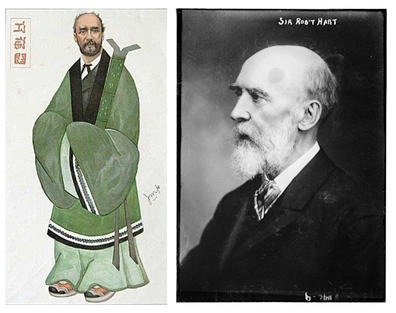
(좌) ‘Chinese Customs’ Hart as caricatured in <Vanity Fair> December 1894
(우) Robert Hart, GCMG
Next, the repeated appearance of 'cheongwon' (petition for aid), requesting soldiers from the Qing Dynasty, is suspicious. It is doubtful whether Ryu In-seok, a native of Chuncheon, Gangwon Province, who bravely rose up during the Eulmi Incident and Eulmi Righteous Army between the Gabo Reform (1894-1896), had enough standing as an early righteous army leader to send someone to Yuan Shikai (袁世凱, 1859-1916) to request troops. Furthermore, there is almost no information about the process of him moving his base of operations from Jecheon to the northwestern region. How did Ryu In-seok, who appears at the end of the <Chosun Riot Suppression Journal, 1913> as a leader of anti-Japanese forces near the Korean border, specifically in the Russian Maritime Province, manage to go from Jecheon to the Russian border and then record or fabricate an alibi of contact with Yuan Shikai?
Perhaps the Japanese Empire, to justify the Sino-Japanese War and the Russo-Japanese War, tried to include as many people as possible in related narratives and indirectly supported the righteous armies with funds or weapons needed for their uprising, ultimately leading to their extermination. Isn't the same true for the modern wars between the US/Israel and Iran, and Russia and Ukraine? Wars for arms dealers are only possible if weapons are given to the opponent. I won't go into deeper details.
How did the Joseon yangban righteous army leaders procure weapons to fight in the early days? That is the biggest question. There is almost no data remaining about the suppression of the Donghak Rebellion, and the Hansung Sunbo was not published during this period, but hints suggesting a one-sided massacre can be found everywhere. In other words, it is likely that they made the massacres seem like there was a controversy over relief forces, and even if military personnel or weapons were actually requested, there would be no shortage of exaggerated descriptions portraying an equal relationship.
At the same time, we must also examine the clash of conceptual Sinocentrism among the righteous armies of this period - the petition to the Qing Dynasty and the argument against it. How could those who regarded the Qing and Japanese people as beasts request military aid? Noh Dae-hwan's paper on this matter reveals the following reasons for requesting Qing troops:
‘Generally, in the past, we were the civilized Middle Kingdom, and they were barbarians, so the distinction between barbarians had to be strictly maintained. However, today, although the Qing Dynasty is originally barbarian, Japan and Western powers have become even more degenerate than barbarians, like beasts. To eliminate the calamity of beasts, one may borrow strength from barbarians. (毅庵集 Vol. 24, 「呈同志諸公」 (1897.9) 338-162a: 蓋彼時我華而彼夷 宜守其嚴防 今日淸固夷狄 而倭洋又夷狄之降爲禽獸者也 爲去禽獸之禍 則庶無不可藉力於夷狄也.’
From today's perspective, the stereotype of barbarians, or 'Yi,' is a very shocking assertion, but it brings to mind the theory of 'Waeyang Ilche-ron' (倭洋一體論), which posits that Japanese pirates (倭寇) and Western barbarians (洋夷) are one and the same. This argument, that Japan and the West are of the same ilk and therefore neither should be opened to trade, was raised by the Wi Jeong Cheok Sa Pa (衞正斥邪派) in the late Joseon Dynasty when they opposed foreign trade. It is said that its representative exchanged letters with Choi Ik-hyeon, Ryu In-seok, and Qing soldiers, but there is no guarantee that Choi Ik-hyeon's manuscripts were not tampered with after his death on Tsushima Island. The forced development of yangban righteous armies, who had made the strongest arguments against foreign powers, suddenly discussing military issues with the barbarian Qing, is a typical narrative technique of colonial historiography that distorts the timeline.
Hong Jik-pil (洪直弼, 1776~1852), a scholar who led the Noron faction at the time and was well-versed in everything from the Hundred Schools of Thought to the yin and yang of heaven and earth and spirits, distinguished the division between Hwa (華) and Yi (夷) as a great boundary for all ages. (‘夫華夷之分 天下萬世之大閑也.’ <Mae San Jip> Vol. 27 「Gyeong Sok (警俗)」) This strong Hwa-Yi distinction completely erased the fact that we were the Middle Kingdom, and I believe it changed the interpretation to an abstract Sinocentrism, considering the Qing as a foreign people and barbarians. It's the same way the word 'red' (빨갱이), a derogatory term symbolizing Japanese imperialism, was used to brand anti-Japanese nationalists as left-wing communists. Today, it's the 'tit-for-tat arguments' of ruling and opposition party lawmakers, the so-called 'counter-frame.' While one of them lives off completely bad intentions, only innocent citizens waste their lives.
The above theory of Japan-Korea unity and the distinction between China and barbarians is one of the important mechanisms by which Japan blurs perspectives. The relationship between Japanese pirates and Western pirates is implied in this argument, and I believe that a strategic narrative that misrepresents the fact that we were China was involved. If you have even a little interest in history, the phenomenon of Koreans calling themselves Dongyi (東夷族) is already prevalent, but if we are Dongyi, is it easy to explain Xirong (西戎), Nanman (南蠻), and Beidi (北狄)? No. It will be helpful for understanding world history in this period to break away from the fatalistic colonial view of history that we are Dongyi and thus justified.
The old world, where the world revolved around a Confucian order, and the struggle with the forces that led to the end of that world, were clearly ongoing events, but this deeply ingrained concept of civilization can be interpreted to mean that something existed that transcended the biological and anthropological universality of humans. Hong Jik-pil then discusses his stance during the Byeongja Horan (Qing invasion of Joseon) and his arguments for honoring the Ming and opposing the Qing (尊明反淸), but during the period of repeated requests for Qing reinforcements as argued in Uiamrok, Yuan Shikai was busy with other matters, so Ryu In-seok's claims cannot be taken at face value.
Finally, in Gwanjeonhyeon, near Ryu In-seok, a historical education institution Baedal Uisuk (倍達義塾) was operated, and with funding from Hong Beom-do (1868~1943) and Oh Dong-jin (吳東振, 1889~?), Gye Yeon-su (桂延壽, ?~1920) published the <Hwandan Gogi, 1911>. I did not believe in the existence of the 1911 edition, but by chance, I once saw the cover of a Hwandan Gogi book presumed to be the 1911 edition. The owner did not wish to reveal it and ultimately did not tell me, but it was clearly an old Hwandan Gogi.
At that time, Manchuria's Liaoning Province was neither the Manchuria nor the Liaoning Province of today. One must go much further west. It is unimaginable that someone would publish a collection of writings while risking their life in a war in such a distant place. Is it because there was a time when people, born as humans, had to write, read, and train for decades before taking the civil service examination? We were a people of records, but all our records were stolen. Around the time the secret police officer Akutagawa, whose identity is unknown, was seizing the manuscripts of these old civilized people, on August 15, 1920, the Japanese imperialists brutally murdered Gye Yeon-su (桂延壽) with Korean spies in the vicinity. Japan then diligently researched Hwandan Gogi and incorporated it into their own history, but for us, it is a history book we ourselves have hidden. Whether it's the forces trying to conceal the fact that we lost our history and territory, even if it means branding it as a forged book, or the forces that fabricated the theory of Ryu In-seok's request for Qing reinforcements at the time, their goal is one: to prevent Koreans from awakening to their true history…
댓글
( 0 / 500 )
Sarangbang
8
류인석이라는 인물을 단순한 위정척사 의병장이 아니라 사료와 기록의 문제까지 연결해서 바라본 점이 흥미롭습니다. 특히 의암집의 전승 과정과 일제의 문서 수거 문제는 실제로 더 깊은 연구가 필요한 주제라고 생각합니다.
( 0 / 500 )
Andrew91
8
글을 읽으며 가장 인상 깊었던 것은 '기록을 누가 남겼는가'라는 질문이었습니다. 역사 해석은 결국 사료에 의존할 수밖에 없는데, 그 사료가 식민지 시기를 거쳤다면 비판적으로 검토해야 한다는 문제의식에는 공감합니다.
( 0 / 500 )
Sally
6
류인석의 청원병 요청 문제를 단순히 '친청'으로 해석하지 않고 당시 화이관과 현실 정치의 충돌 속에서 보려는 시도는 의미가 있습니다. 조선 말기 유림의 사고방식은 현대인의 기준으로만 재단하기 어려운 측면이 있지요.
( 0 / 500 )
南海
6
이런 글이 좋은 이유는 결론보다 질문을 던지기 때문입니다. 우리가 알고 있는 조선 말기와 의병사의 서술이 어떤 과정을 거쳐 형성되었는지, 그리고 남아 있는 원본 자료는 얼마나 되는지 다시 찾아보게 만드는 글이었습니다.
( 0 / 500 )
sunbin
5
류인석을 둘러싼 기록의 공백과 단절을 따라가다 보니, 독립운동사는 인물사만이 아니라 기록사라는 생각이 듭니다. 사료가 어떻게 전해졌는지 추적하는 작업 자체가 중요한 역사 연구입니다.
( 0 / 500 )
민우
5
의암집의 간행과 압수, 이본 문제는 실제로 문헌학적으로도 충분히 검토할 가치가 있습니다. 일제 강점기를 거친 문헌이라면 원본과 후대본의 차이를 따지는 작업은 기본 중의 기본이라고 봅니다.
( 0 / 500 )
kang79
3
글을 읽으며 동아시아 질서가 무너지는 시기를 살았던 유림의 혼란이 조금은 이해되었습니다. 현실과 의리 사이에서 어떤 선택을 했는지를 함께 봐야 인물을 입체적으로 이해할 수 있겠지요.
( 0 / 500 )
同志愛
2
모든 가설에 동의하는 것은 아니지만, 익숙한 통설을 그대로 받아들이지 말고 사료를 다시 보자는 제안에는 공감합니다. 역사학은 의심에서 시작되고, 검증으로 완성되는 학문이라고 생각합니다.
( 0 / 500 )
신고내용
신고내용을 선택해주세요
회원비난/비하/욕설글 및 댓글도배성 게시물저작권 침해/불법자료 유출허위사실유포개인정보 유출.사생활 침해무단광고/홍보음란물 및 도박 불법 광고물범죄행위 관련 글불법행위 관련 소개물품 판매 및 사기글악성코드 및 스파이웨어 유포기타 사유 및 운영진 판단


비밀번호를 잊으셨나요?
Sign in with Google


All information provided by us is free of charge and is for the public good.