品

Corea든 Korea든, 품격이 먼저다
Whether Corea or Korea, dignity comes first.
Whether Corea or Korea, dignity comes first.
Now
지금
751 Diaspora
Heritage
유산
Humanity
인문
Mirengsi
未冷尸
Politics
정치
Media
언론
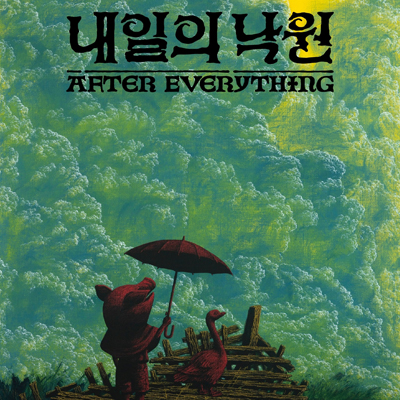
이기훈 원화전: 내일의 낙원 : 26.07.17 - 26.11.29

문화평론
칼럼
深山
The Future Seen by Lee Ki-hoon's Red Mask

0
2026. 10. 30
- Lee Ki-hoon's first original drawing exhibition in Korea celebrates the emergence of a young artist gaining global art world attention for his solid fundamentals and distinctive painterly language.
- His work projects the future of humanity through masked animal figures, criticizing the atmosphere of genius suppression in Korean society where past art was reduced to a political tool, and hoping for the rise of a new generation.
- The intense textures and colors of the works go beyond mere visual appreciation, inducing a tactile experience as if the viewer is 'touching' the artwork, and narrating the journey of the last survivors of a lost world seeking hope.
- The masks and surveillance reminiscent of George Orwell's worldview emphasize the uncertainty of the title 'Paradise of Tomorrow,' prompting reflection on human selfishness and contradictions amidst climate crisis and the remnants of industrial civilization.
- Rather than directly criticizing social and environmental issues, the works lead viewers to deeply contemplate the present, future, and human desires through sensory experiences and questions.
Recent Exhibitions from a Latte-Chung Perspective
〈Tomorrow's Paradise LEE GIHUN: After Everything〉 at Groundseesaw East, a gallery in a multi-complex mall in Gwangjin-gu, Seoul, is the first original painting exhibition in Korea by artist Lee Gihun, who is gaining attention from some art circles and overseas galleries. It's gratifying to see young artists using their unique painting language based on solid fundamentals and gaining recognition in the global market.
In the past, art was a handmaiden of culture, mobilized as a means to propagate the legitimacy of political power and glorify dominant ideologies. This was especially true in Korea. While such practices led to all sorts of corruption, inverted values, and low-quality art in the art world, it's welcome to see young generations steadfastly unfolding their own worlds. There's a phenomenon where works are only re-examined in the domestic market after being recognized overseas, and also a trend where something ignored overseas spreads globally if Koreans prefer it. It's natural for people's minds to be swayed by conformity to others' perspectives or internalization of others' views as their own, but everything becomes a tragedy when taken to extremes.
Trends come and go, but the 'Mask Play' series, which projects future humans through masked animals, didn't give me the feeling of a terrifying prophecy or the desire to own a prophecy. While I could easily express my likes and dislikes, the price of the works was beyond imagination. I was pleased that Lee Gihun's genius seemed to be fully appreciated. Korea is a country that has long fostered a social atmosphere that eradicates genius. I hope for a future where all hidden masters can proudly raise their heads and command their true worth.
Review of the artwork
Was it a dark background and a heavy-hearted painting, or a print? It didn't come into clear focus. Only after I went closer and looked intently did I realize the immense brushstrokes, an unbelievable effort, and I could see the young artist striving for high concentration and expression. The background color, which contrasted with the red figures but didn't make them stand out, appeared repeatedly and caught my eye. These figures are not just striking colors. Contrasting with the dark and murky background, factory debris, power lines, hazy sky, surging waves, and eyeless pupils, the last survivors of an already vanished world help each other. The sight of those yet to come, holding umbrellas and waiting for the remnants of hope that have not yet disappeared, was a long-awaited emotional experience that brought tears to my eyes as I viewed the exhibition.
The texture created by watercolor and acrylic first laying down broad areas, with oil pastels layered on top, was much more intense than expected. The soft yet rough lines of the oil pastels didn't so much fix the forms clearly as they seemed to catch them just as they were about to dissipate. The surface, which seemed to retain the pressure and warmth of fingertips, had a completely different weight from digital images, and this weight, combined with the color red, made the artwork feel physically impactful beyond mere visual stimulation. While acrylic created flat, dry surfaces, oil pastels added a tactile layer on top. As lines overlapped, surfaces were rubbed, and sometimes marks were almost scratched on, the canvas transformed from a simple image into a material imbued with the traces of time and labor.
The materiality made the act of 'seeing' the work closer to the act of 'touching' it for the viewer. As one approached, the oil pastel particles became visible, and from a distance, these particles condensed into a single mass, pushing the red form more clearly. The red forms are mostly children wearing animal masks, or beings where animals and humans are intertwined. They walk through streets filled with water or ruined landscapes, holding fire, and embracing each other. The masks cover their faces, but at the same time, the gaze of those wearing the masks as they look at each other is sharp. The sight of children wearing animal masks feels like a camouflage technique for beings who must survive in the bizarre order created by the adult world.
The intertwined forms of sheep and rabbits, bears and fish, rabbits and fish, do not appear to be a part of nature, but rather the result of nature and humans devouring and being devoured by each other. The scenes of these forms crossing water, holding embers, and supporting each other's bodies evoke compassion, yet they also make one question what premise that compassion is based on. A narrative reminiscent of Noah's Ark permeated throughout the work, but the ark does not remain merely a symbol of salvation. The sight of children carrying life and walking through a landscape filled with rising water could have been interpreted as hope, but it leaves a suspicion that hope itself is already an institutionalized and manipulated story.
George Orwell was disparaged in his time
The suspicion naturally brought George Orwell to mind. The world Orwell depicted was a society that concealed the truth through surveillance, control, and the distortion of language. The era in which he lived, and the massacres of humanity that occurred before him, could only be expressed through the language of analogy and metaphor. In Lee Ki-hoon's work, it seemed as if masks were brought to life and functioned again. Masks conceal identity, but at the same time, the gaze of those wearing masks looking at each other creates a tension as if they are confirming and monitoring each other. They move forward step by step in a broken world, but it is unclear where that progress is headed. The title 'Tomorrow's Paradise' sounded even heavier amidst that uncertainty, and those walking towards that paradise, which has not yet arrived, stand amidst the ruins of today.
The artist's childhood experience of observing a landscape in the countryside where a national park and a massive cement factory coexisted is an important clue to understanding this ambivalent perspective. I was amazed by the way that landscape, where reverence for nature and the scars left by human development coexisted, was reborn in the work through the contrast between red forms and a dark background. The cohesion of that contrast was not merely a simple color contrast, but a device that revealed the inherent contradiction in how humans view nature. I hope that Lee Ki-hoon will be an artist who actualizes that genius in his artistic world and in reality. I hope he does not remain a misguided Korean, like the geniuses of previous generations who became complacent with their talent, fell for sweet talk, squandered their wealth, and wasted their time. I hope that his many intense brushstrokes become a warning and a window to the world, and a mirror that penetrates human selfishness. Korean society should be a society that welcomes many geniuses and gladly enjoys them. It should allow us to freely mock the ideological old-timers who disparage and sow discord out of envy and jealousy.
Social and environmental issues are not directly shouted out in the works. Instead, they permeate as background landscapes, movements of figures, and contrasts of colors. Children walking in a sky thick with factory smoke, a landscape crisscrossed with power lines, and streets filled with rising water simultaneously evoke the climate crisis and the remnants of industrial civilization. However, this evocation is not fixed in critical language. The texture created by the rough lines of oil pastels and the flat surfaces of acrylics makes viewers 'sense' the landscape rather than 'judge' it. The marks left by the pressure of fingertips are 'real' traces that digital images can never imitate, and these traces remind viewers of their own bodies. Who is the subject we are looking at? Have we never been conscious of the mask we are wearing? Isn't tomorrow's paradise ultimately built upon the remnants created by today's desires? These questions are not directly posed by the artwork but are rather questions that viewers ponder themselves while standing before the work.
Even after leaving the exhibition space, those red figures did not easily fade. The afterimage left behind the freshness and intensity of the technique is the perspective underlying the technique itself. A gaze that looks at society, ideology, and human desires beyond the singularity is refracted through masks and then condensed into red, placed before the viewer. These are works that allow us to re-experience a cross-section of the world we already live in, making us ponder what the faces hidden behind the masks are seeing, and where that gaze ultimately leads. Those questions did not easily disappear even after leaving the exhibition hall. Returning to the city amidst the afterimages left by the red figures that simultaneously offer countless conveniences and solitude, I reflected on how sad the lonely conveniences, indispensable to the daily lives of Koreans, make people. In the chilly weather that made me pull my collar tighter, the mask swayed slightly.
댓글
( 0 / 500 )
genius74
7
예술은 권력이나 유행의 눈치를 볼 때 생명력을 잃습니다. 해외에서 먼저 인정받아야 국내에서 주목받는 현실은 여전히 아쉽지만, 자신의 언어와 기법으로 세계와 소통하는 젊은 작가들이 있다는 사실은 반갑습니다. 재능 있는 예술가를 알아보고 존중하는 사회가 진정한 문화 선진국 아닐까요.
( 0 / 500 )
koa
7
글을 읽고 나니 전시를 직접 보고 싶은 마음이 생겼습니다. 특히 동물 가면을 쓴 아이들과 붉은 형상들이 어떤 이야기를 들려줄지 궁금합니다. 단순히 그림을 감상하는 것을 넘어 우리 시대와 미래를 생각하게 하는 전시라니 기대가 큽니다.
( 0 / 500 )
진달래
6
이기훈 작가의 작품을 단순히 독특한 색채와 기법의 문제로 보지 않고, 인간 문명이 남긴 상처와 미래에 대한 불안으로 읽어낸 대목이 인상적입니다. 가면을 쓴 아이들은 어쩌면 어른들이 망가뜨린 세상을 물려받을 미래 세대의 모습일지도 모르겠습니다. 예술이 던지는 질문은 설명보다 오래 남습니다.
( 0 / 500 )
Sangjoon
6
한국 사회는 성공한 사람에게 열광하면서도 새로운 재능이 등장하면 먼저 의심하고 깎아내리는 이중성이 있습니다. 특히 기존 질서와 다른 길을 걷는 사람에게 유독 인색하지요. 젊은 예술가들이 국내의 평가에 갇히지 않고 자신의 가치를 세계에서 증명하는 현실이 오히려 우리 사회의 낡은 문화부터 돌아보게 합니다.
( 0 / 500 )
dami
4
평소 현대미술은 어렵고 난해하다는 선입견이 있었는데, 작품의 재료와 붓 터치, 색채까지 세심하게 풀어주셔서 관심이 생겼습니다. 작품 앞에 서면 글로 읽은 것과는 또 다른 감동이 있겠지요. 시간을 내어 꼭 찾아가 보고 싶습니다.
( 0 / 500 )
nadaniel
4
오일파스텔의 거친 질감과 수많은 붓 터치에 주목한 감상에 공감합니다. 디지털 기술이 이미지 생산을 손쉽게 만드는 시대일수록 작가의 손끝에서 축적된 시간과 노동은 더욱 특별한 가치를 갖습니다. 예술은 결과물만이 아니라 그것을 완성하기까지의 고뇌와 집중까지 담아내는 일이란 생각이 듭니다
( 0 / 500 )
nathan
2
내일의 낙원이라는 제목이 오히려 오늘의 현실을 되묻게 한다는 해석이 깊이 다가옵니다. 인간은 발전과 편리함을 추구하면서 자연을 파괴하고, 그 결과를 미래 세대에게 남기고 있습니다. 작품 속 붉은 형상들이 희망인지 경고인지 쉽게 단정할 수 없는 이유도 여기에 있겠지요. 예술이 우리에게 필요한 것은 정답이 아니라 스스로를 돌아보게 하는 질문이라는 생각입니다.
( 0 / 500 )
papa
1
처음에는 어둡고 기묘한 그림이라는 인상이었는데, 가까이 다가가 작품 하나하나를 들여다볼수록 붓 터치와 색감에 담긴 작가의 집요함이 느껴졌습니다. 특히 붉은 형상들이 서로 의지하는 모습은 한동안 발길을 멈추게 하더군요. 오랜만에 마음에 잔상이 남는 전시였습니다.
( 0 / 500 )
신고내용
신고내용을 선택해주세요
회원비난/비하/욕설글 및 댓글도배성 게시물저작권 침해/불법자료 유출허위사실유포개인정보 유출.사생활 침해무단광고/홍보음란물 및 도박 불법 광고물범죄행위 관련 글불법행위 관련 소개물품 판매 및 사기글악성코드 및 스파이웨어 유포기타 사유 및 운영진 판단


비밀번호를 잊으셨나요?
Sign in with Google


All information provided by us is free of charge and is for the public good.