品

Corea든 Korea든, 품격은 이름보다 먼저다
Whatever the name—Corea or Korea—dignity comes first.
Whatever the name—Corea or Korea—dignity comes first.
Now
지금
751 Diaspora
Heritage
유산
Humanity
인문
Mirengsi
未冷尸
Politics
정치
Media
언론
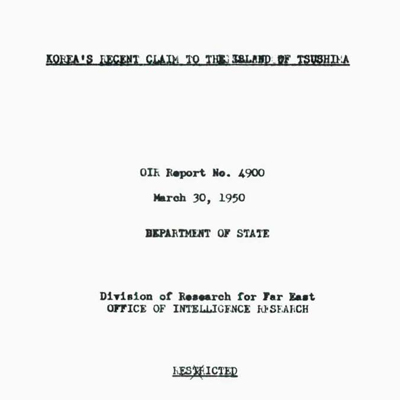
미국 국무부 정보조사국(OIR)의 #4900 보고서(1950년 3월 30일 자) 표지

小說
칼럼
bunny365
The Significance of the Discovery of a 1948 US Military Classified Document Regarding Dokdo's Sovereignty (2)

0
2026. 07. 20
- The 1950 US State Department report on Tsushima, based on Japanese sources, interpreted the island's sovereignty dispute in Japan's favor, dismissing Korea's claims as domestic nationalist demands.
- While emphasizing Japan's effective control over Tsushima, the report deliberately downplayed ancient historical contexts and Korea's historical understanding, advancing a narrative that served US hegemonic interests in the new world order.
- Syngman Rhee's demand for Tsushima's return reflected the strong anti-Japanese sentiment and desire for historical identity restoration among Koreans post-liberation, which the US leveraged as a strategy to manage internal nationalist energies by bringing it into public discourse.
- The 'Patriotic Elders' Association,' which advocated for Tsushima's return at the time, was not merely a right-wing group but a nationalist organization centered around independence activists who resisted Japanese colonial rule and the decision for trusteeship, striving to protect national identity.
- The history of Tsushima presented in the US report contained an intent to legitimize Japanese colonial rule, which exacerbated historical cognitive dissonance among Koreans and obscured the true nature of the territorial issue.
Syngman Rhee's demand for the return of Tsushima was for domestic consumption and soon lost its momentum.
1950 US Report: Logic for Japan
Report #4900 (dated March 30, 1950) by the U.S. Department of State's Office of Intelligence Research (OIR) explained Korea's claim to sovereignty over Tsushima and the past relationship between Tsushima, Korea, and Japan, concluding with a list of references. While I don't often encounter U.S. State Department reports on modern Korean history, the meticulousness of the U.S. intelligence agency in addressing a dispute over a small island between Korea and Japan, even referencing ancient history, is astonishing. However, as the report emphasizes, the references cited are predominantly Japanese sources, and therefore, the overall argument of the report can be seen as prioritizing Japan's position.
Assuming that Japan had effectively occupied Tsushima for 350 years at the time the report was written, it explains that the Korean government, established in 1948, could demand the return of Tsushima, which became Allied territory after Japan's defeat in 1945. This contradictory description, which states that Tsushima, having been effectively controlled for 350 years, could be demanded back in modern times, expanded its narrative by referencing ancient history. It also stated that there was no consistent agreement on sovereignty between Tsushima and the Korean Peninsula from when it became Japanese territory from Silla territory around 500 AD until 1592, implying that Tsushima could be a point of contention for both sides. Furthermore, it noted that there was little concrete evidence that Korea controlled the island from 1592 until the Meiji Restoration, ultimately acknowledging to some extent that Tsushima was a contested space from 500 AD until the Meiji Restoration.
In other words, it stated that Tsushima, which is currently Japanese territory, was definitely owned by the Korean kingdom of Silla before 500 AD, but Japan took possession of it after 500 AD, and it became more firmly Japanese territory after the Meiji Restoration. Then, after losing World War II, it passed into Allied ownership after about 77 years. The United States, which defined an uncertain owner for the sake of the definite owner of the most recent 77 years, ignoring a long history of over a thousand years, can be seen as standing from the perspective of a short-history, world's strongest empire that prioritizes hegemony in the new world order. This perspective of the United States provoked the anger of old-generation Joseon intellectuals, leading to actions such as demanding the return of Tsushima territory. The long years of resistance, which led Korean university students to view the United States as an 'imperialist enemy' until the 1980s, were based on a historical sentiment that cannot be simply attributed to the rise of communism or the left.
If we simply calculate the 350 years of effective control from the time the report was written in 1950, the year Japan began to control Tsushima would be 1600. This creates a contradiction, as there is no clear turning point that can be identified as effective control starting in 1600, considering the Imjin War and Jeongyu War, the role of the successive daimyo of the Sō family of Tsushima, and above all, the history of the Waegwan (Japanese trading post) in Busan. If the aforementioned 500 AD and 1600 AD were facts based on actual historical events, then the narrative of world history would have problems; otherwise, this report would be making false claims.
For reference, the beginning of colonial publications by imperial Japan was the re-publication of Joseon's real estate survey data and classical Chinese texts handed down from ancient times. To facilitate the smooth plunder of human and material resources, which was the essence of colonialism, and to reorganize the traditional cultural heritage of others into Japanese culture, the Joseon Publication Society (朝鮮古書刊行會) was established in Gyeongseong (京城) in 1908. In the <Joseon Gunseo Daegye (朝鮮群書大系): a series of over 79 volumes of historical encyclopedias published in four phases between 1909 and 1916> published there, Joseon's southern border was described as being managed by the So family, who pronounced Tsushima as Sōke, and the northern end by Mao Wenlong (毛文龍) of Uiju. Although Japan's historical narrative, which entrusted the northern and southern borders to two foreigners, has been firmly established as an academic book for over a hundred years, no institution questions it. I believe it is necessary to dispute the facts because the narrative of border security falling into the hands of foreigners obscures the point by making it difficult to even research how we ourselves protected or lost our territory.
The fact that the US government report referred to Silla as a kingdom is significant, but if the Silla Kingdom on the Korean Peninsula is taken for granted in modern times, when it has become a word that only appears in games or dramas, what kind of relationship would be established between the kingdom and Tsushima? The United States consistently spelled Tsushima as 'Tsushima,' following the Japanese pronunciation, while the Korean media and historical community spell it as '대마도(對馬島)' and pronounce it as 'Daemado.' In Japan, it is spelled '對馬島' or '對馬,' and just as there is a difference in spelling 'Osaka' as '大阪' or '大坂,' there is a kind of wordplay implying a secret within Japanese place names.
Most Koreans probably can't even imagine how many years Japan prepared for colonial rule, but historically, Tsushima has a hidden history of being a different island or a different space depending on the era, eventually becoming today's Tsushima. This implies the problem of spatial occupation, which modern humanity most overlooks in history. The immutable territorial stereotype, completely established in world geography, is merely a legacy of the modern era, so to unravel the absurd chaos of modern history, it is necessary to study the history and process of its fabrication.
History that does not discuss territory is not worth learning.
We call the people who effectively control a certain land "indigenous people." The colonial world history of imperialism, instilled by Western hegemony, which neither teaches nor learns about the history of expelling these natives from a specific territory and taking their place, guides us into a world of fantasy and oblivion, making actual events seem like fiction, thus following the logic of literature. And making humanity believe that the Tsushima of 500 years ago, the Tsushima of 1592, and the current Tsushima all contain history that unfolded in the same space is precisely a political act. This US report can be interpreted as an effort to safely(?) and according to their will, implement the geopolitics of the Tsushima place name from the last century, and erase the traces of changed and divided territories. One such implementation is what we call 'war'.
I believe there were two reasons why the United States acknowledged the validity of South Korea's claim to sovereignty over Tsushima Island. One is that the historical consciousness of Koreans, who viewed Tsushima as their territory from a historical perspective before and after liberation, clearly remained. In addition, complex factors such as anti-Japanese sentiment accumulated during the colonial period can be interpreted as having acted as a nationalist public sentiment. However, given the realistic impossibility of territorial return, why was Syngman Rhee's external press conference necessary? This was probably because many elderly people born in the 19th century who survived the liberation period tended to focus on historical issues, mainly territorial issues. Their needs—a resolute demand for the historical and social cognitive dissonance that overlapped with the regret that their lives, which had passed like a dream under Japanese rule, had ended in vain, and memories of the past—and the history in classical Chinese that they had learned and practiced since childhood were so different. They were a generation that inherited the educational system of the past, reading and writing Chinese characters, and carried centuries of history in their minds. For them, the past 350 years were facts compressed into a single comprehensive history, so the ego, in terms of the individual, and national identity, in terms of the nation, which had been latent and suppressed during the chaotic colonial period, finally surfaced.
Another reason why the U.S. pre-approved Syngman Rhee's press conference with foreign correspondents can be seen as an attempt to legitimize the establishment of the South Korean government in 1948 by suppressing the truly indignant energy of Koreans liberated from colonial rule, and to deny the nationalist perspective that takes the establishment of the Provisional Government in Shanghai in 1919 as the starting point of the Republic of Korea. The founding of the nation in 1919 and 1948 conceals narratives of completely different meanings and spatiotemporal contexts, and the reason why the New Right has been so dedicated to the 1948 founding date across generations can be seen as evidence that the territorial issue, which began with the Dokdo incident, is still very much alive. Therefore, this report suggests that the U.S. is deeply involved in Korea's territorial issues, and furthermore, in the division of the Korean Peninsula and the history under Japanese colonial rule, making it a far from trivial report. Thus, one cannot help but point out the blind spot of the Northeast Asia Foundation, which viewed this weighty report lightly.
This includes the existential question of what kind of being humans truly are, encompassing the human soul and its root consciousness, which cannot be explained by materialism alone. The report introduced the group of people born in the 19th century who claimed sovereignty over Tsushima Island as the 'Seoul Old Men's Patriotic Association.' This suspicious elderly group was analyzed as a small right-wing political organization, and this organization, also known as the '憂國老人會' (Patriotic Old Men's Association), was truly a conservative right-wing organization in name and reality, not the degenerated right-wing we see today. This '憂國老人會' or '애국노인회' (Patriotic Old Men's Association) was formed in Seoul in early January 1946, immediately after liberation, and an article with the following title was published in the 'Jungang Shinmun' on January 6, 1946.
'Elders also rise up, form the Patriotic Old Men's Association'
This article was published shortly after the decision for the trusteeship of the Korean Peninsula was announced at the Moscow Tripartite Conference. Therefore, the Patriotic Elders' Association is a right-wing nationalist elderly organization formed to participate in the anti-trusteeship movement and immediate independence movement that unfolded at that time. What thoughts did they have as they looked at the era, having to endure the misfortune of the US military government being re-established after liberation from colonial rule? How many of them could have possibly foreseen the upcoming Korean War? If we were in a politically biased situation like today, we might have shamelessly committed acts of treason and called for war. We must not forget that the wheels of history continue to turn even while everyone is laughing and chatting.
So, instead of suppressing it, the US chose to maximize the problem and expose it to the public for discussion. This is the so-called public escalation strategy. Therefore, it is believed that the US allowed Syngman Rhee to gather public opinion and reflect a nationalist color demanding the recovery of Tsushima. In other words, the press conference demanding the return of Tsushima was for domestic consumption. And the reason why many people questioned the island areas rather than the mainland is that the existence of an island can be somewhat estimated even during ship movements. Although the West is different, map and geography studies were actively conducted both before and after World War II, so we cannot ignore the strong suspicion of the returning instinct that those 19th-century-born elders had, that the sky, forests, memories, and streets of their hometowns in Asia, where they were born, walked, ran, and smelled, did not match.
In a city like Seoul, where the landscape changes day by day, if you visit the neighborhood where you lived as a child, the spaces that match your memories cannot remain intact due to urban development. Human memory and cognitive indoctrination are surprisingly simple. I believe that the fabrication of history and the ambiguity of memory circuits have brought about ecological and cultural learning effects. The historical cognitive dissonance of Koreans is at a psychotic level, but if it is a comfort that other cultures that have made Koreans this way are experiencing more severe social pathologies, the reality is that we are experiencing a civilizational decline of 'we're all going to die like this.'
Cheongsa (晴蓑) Jo Seong-hwan (曺成煥, 1875-October 7, 1948), the president of a patriotic elderly organization that advocated for the return of Tsushima Island, was an independence activist who served as the Minister of Military Affairs for the Provisional Government of the Republic of Korea. In January 1946, he formed an organization advocating for anti-trusteeship and immediate independence, and in 1948, he did not hesitate to petition and make recommendations regarding territorial issues and the Korea-US treaty. In fact, if there had been no chaos in the liberation space and the Korean War had not occurred, there would have been plenty of people to lead the Republic of Korea - a unified North and South Korean government. Excluding Lee Jong-man (1885-1977), Cho So-ang (趙素昻, 1887-1958), and Hong Myung-hee (洪命憙, 1888-1968), who went to the North for reasons unknown, whether by their own will or not, Kim Gu (金九, 1876-June 29, 1949), Hong Jin (洪震, 1877-September 9, 1946), Lyuh Woon-hyung (呂運亨, 1886-July 19, 1947), and Lee Sang-jeong (李相定, 1896-October 27, 1947) were all candidates for the first president. North Korea purged nationalists early on through ideological struggles, and South Korea also had purges, including assassinations, as planned (?). We must look back at the past 81 years, during which those who knew history and spoke about history were relentlessly eliminated.
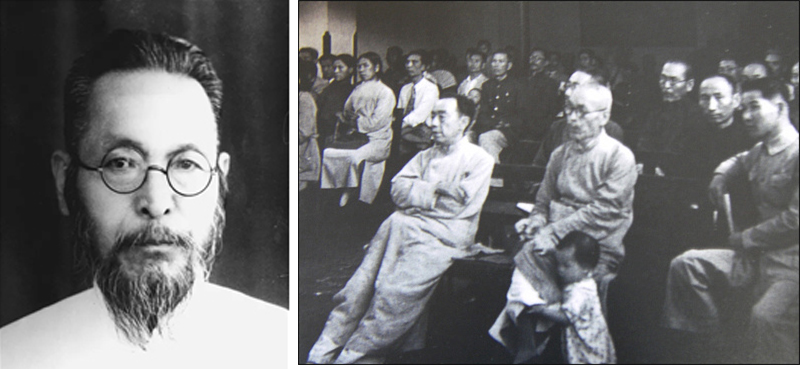
Left) Cheongsa (晴蓑) Jo Seong-hwan (曺成煥, 1875-October 7, 1948)
Right) In the front row center are lawyer Jeong Cheol-seung's mother and maternal grandfather Yoon Ki-seop, and the person wearing glasses in the back row is Jo Seong-hwan.
When can we ever speak of it? That history….
Continues in Part 3.
댓글
( 0 / 500 )
Platon
7
미국의 1950년 보고서를 단순한 외교문서가 아니라 당시 미국의 동북아 전략과 역사 인식을 보여주는 자료로 해석한 점이 인상적입니다. 다만 역사적 사실과 해석의 영역은 구분해서 추가 검증이 함께 이루어진다면 더욱 설득력이 커질 것 같습니다.
( 0 / 500 )
hong_J
10
시리즈를 읽을수록 '역사는 문서를 읽는 사람이 해석을 어떻게 하느냐도 중요하다'는 생각이 듭니다. 미국 문서, 일본 자료, 한국 사료를 함께 대조해 보는 작업이 왜 필요한지 잘 느껴졌습니다. 다음 편도 기대하겠습니다.
( 0 / 500 )
Pink6
8
독도와 대마도 문제를 단순한 영토 분쟁이 아니라 식민지 지배, 냉전, 미군정, 민족주의까지 연결해 바라본 시각이 흥미롭습니다. 역사 문서는 하나만 볼 것이 아니라 서로 다른 국가의 기록을 함께 비교하는 작업이 중요하다는 생각이 듭니다.
( 0 / 500 )
bigBOY
7
1편에서 독도 폭격 사건과 미군 문서를 소개했다면, 2편에서는 그 문서가 가진 역사적·정치적 의미까지 연결해 주셔서 흐름이 훨씬 선명해졌습니다. 다음 편에서는 1948년 기밀문서와 1950년 OIR 보고서를 직접 비교 분석해 주시면 좋겠습니다.
( 0 / 500 )
namunara
5
우국노인회와 조성환 선생의 활동을 다시 조명한 부분이 특히 의미 있었습니다. 해방 직후 독립운동가들이 어떤 문제의식을 가지고 있었는지를 살펴보면 오늘날 영토 문제를 바라보는 시각도 훨씬 입체적으로 이해할 수 있을 것 같습니다.
( 0 / 500 )
Hangi7
5
1편을 읽고도 궁금한 점이 많았는데, 2편에서 우국노인회와 조성환 선생 이야기까지 이어지니 해방공간의 분위기가 조금은 이해되는 것 같습니다. 일반 역사책에서는 접하기 어려운 자료라 계속 읽게 됩니다.
( 0 / 500 )
파수꾼
4
2편까지 읽었는데 단순히 영유권 주장만 하는 글이 아니라 당시 국제정세와 역사 인식까지 함께 다루려는 점이 인상적입니다. 앞으로 이어질 내용에서는 당시 미국의 정책 결정 과정과 관련 기밀문서들도 더 소개해 주시면 좋겠습니다.
( 0 / 500 )
김재인
4
역사는 결국 누가 기록하고 어떤 자료가 살아남느냐에 따라 후대의 인식이 달라집니다. 그래서 미국, 일본, 한국의 사료를 모두 교차 검토하는 작업이 중요하며, 새로운 기밀문서 발굴이 계속 이루어져야 역사 논쟁도 보다 객관적으로 접근할 수 있다고 생각합니다.
( 0 / 500 )
sara
4
1편에서는 독도 문제인 줄 알았는데, 2편에서는 대마도와 해방정국, 미군정, 냉전까지 연결되면서 시야가 훨씬 넓어졌습니다. 내용이 쉽지는 않지만 여러 번 읽을수록 새로운 부분이 보이는 글입니다.
( 0 / 500 )
Rosario
2
영토 문제는 감정만으로 해결되지도 않고, 한두 개의 문서만으로 결론을 내릴 수도 없습니다. 하지만 이런 자료들을 꾸준히 발굴하고 공개하는 과정 자체가 우리 역사 연구의 폭을 넓히는 계기가 된다는 점에서 충분히 의미 있는 문제 제기라고 생각합니다.
( 0 / 500 )
신고내용
신고내용을 선택해주세요
회원비난/비하/욕설글 및 댓글도배성 게시물저작권 침해/불법자료 유출허위사실유포개인정보 유출.사생활 침해무단광고/홍보음란물 및 도박 불법 광고물범죄행위 관련 글불법행위 관련 소개물품 판매 및 사기글악성코드 및 스파이웨어 유포기타 사유 및 운영진 판단


비밀번호를 잊으셨나요?
Sign in with Google
All information provided by us is free of charge and is for the public good.