品

Corea든 Korea든, 품격은 이름보다 먼저다
Whatever the name—Corea or Korea—dignity comes first.
Whatever the name—Corea or Korea—dignity comes first.
Now
지금
751 Diaspora
Heritage
유산
Humanity
인문
Mirengsi
未冷尸
Politics
정치
Media
언론
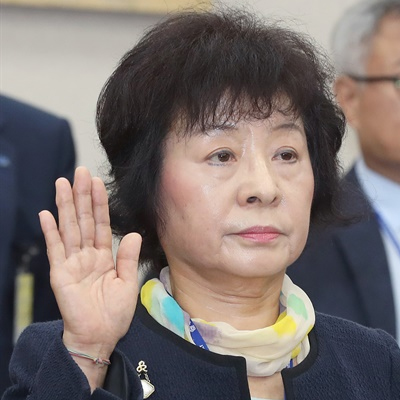
박지향 동북아역사재단 이사장(1953년생)

小說
칼럼
bunny365
The Significance of the Discovery of a 1948 US Military Classified Document Regarding Dokdo's Sovereignty (1)

0
2026. 07. 14
OIR_Report No4900 〈대마도에 대한 한국의 최근 주장〉.pdf

- The Northeast Asian History Foundation's emphasis on the US's recognition of Dokdo as Korean territory, via the Dokdo bombing report, appears to be an attempt to bolster Dokdo's sovereignty claims in line with the current government's New Right historical perspective.
- The Foundation's focus solely on the territorial issue, rather than the tragic context of the Dokdo bombing incident, could be criticized as a pro-American, sycophantic interpretation that goes beyond colonial historiography, simplifying the complex history of the liberation period.
- Syngman Rhee's demand for the return of Tsushima can be interpreted as part of America's proxy rule, where they intervened in Korean politics to manipulate nationalist sentiment for their own agenda.
- The assertion that the Dokdo and Tsushima territorial disputes were a prelude to the suppression of Korean nationalism leading to the Korean War suggests a close link between tragic events in post-liberation Korean modern history and US intervention.
- America's awareness of the Korean people's desire for Tsushima's return and their orchestration of Syngman Rhee to voice this demand reveals America's strategic move to exploit Korean national sentiment for its own interests at the time.
Why now, at this moment, the historical truth of Dokdo's sovereignty and America's hidden intentions...
The level of historical awareness of the Northeast Asian Foundation, whose head is a New Rightist
On July 6, 2026, the Northeast Asian History Foundation released the 'Dokdo Bombing Incident Report' dated June 24, 1948, from the US Far East Air Force (FEAF). I'm not sure about the circumstances of its discovery, but it appears to be a classified document prepared while investigating the tragedy of the Dokdo bombing incident, in which 14 Korean fishermen were killed and many injured while fishing near Dokdo during a US Air Force bombing exercise on June 8, 1948. The FEAF, the entity that prepared this document, is an acronym for 'Far East Air Force.' In its singular form, it refers to the US Army Air Corps organization stationed in the Philippines, established in 1941. In its plural form, 'Far East Air Forces,' it refers to the air force command unit for the Southwest Pacific region, created in 1944. The fighter command headquarters that devastated the Korean Peninsula during the Korean War came from this plural FEAF, the Far East Command, and its location was in Tokyo, Japan. The singular or plural form is not important. Why were the US forces in the Philippines and the US forces in Japan linked together, and why were they used as a base during the Korean War?
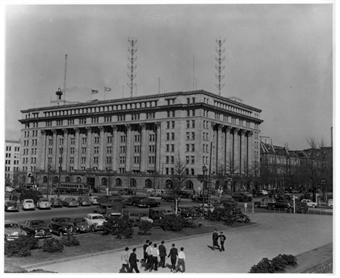
Meiji Seimeikan (明治生命館, Meiji Building), an imperialist-style building resembling a Greek temple, photographed by the US military in 1951
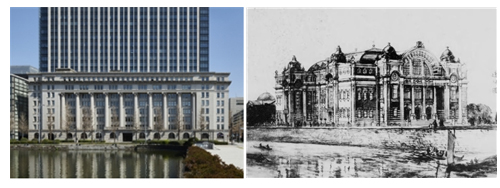
Current Meiji Seimeikan / Early sketch by architect Shinichiro Okada (1883~1932)
The core point is that the Northeast Asian Foundation, in its report, states that it 'clearly established' that Liancourt Rocks (Dokdo) was 'a part of Korea' in September 1947, thus focusing the report on the 'territorial issue.' The Northeast Asian Foundation is a government-funded institution created during the Roh Moo-hyun administration to counter China's Northeast Project and Japan's distortion of history textbooks, but I have never heard of any researchers there raising issues with colonial historiography. Park Ji-hyang (1953~), who was flustered when the 'Hwandangogi' was mentioned early in the Lee Jae-myung administration, is its head, and it seems she tried to create a 'Dokdo is our land' atmosphere in line with the government's character. Park Ji-hyang was appointed during Yoon Suk-yeol's tenure and is one of the co-authors of <Re-recognition of History Before and After Liberation>, aligning with the New Right.
The Northeast Asia Foundation explained that this record is primary historical evidence that the United States recognized Dokdo as Korean territory immediately after liberation, and said that beyond a historical discovery, it is expected to be a powerful weapon in securing Korea's sovereignty and in international disputes. This is an outrageous statement. In an environment of political disadvantage where no one knew the detailed inside story, the claim by one of the survivors that 150 people died was buried. Furthermore, there was even a bombing of Dokdo during the Korean War, but to conclude that the interpretation of this incident is merely a confirmation of national territory, such an attitude goes beyond colonial historiography and is a modern pro-American sycophancy, typical of the New Right. While it might be understandable during the chaotic period of liberation, how can such an interpretation be made in 2026? I see it as an illogical development, even before academic research opinions or the political judgment of an institution.
Territorial grievances, Syngman Rhee's emergence, the requiem of the Korean War
Nearly two months after June 24, the date the report on the Dokdo bombing incident of June 8, 1948, was written, in August, Syngman Rhee held a press conference with foreign correspondents and demanded the return of Tsushima from Japan. The United States recorded the announcement date as August 17 (KOREA’S RECENT CLAIM TO THE ISLAND OF TSUSHIMA, OIR Report No. 4900, March 30, 1950, DEPARTMENT Of STATE), but the Korean Presidential Archives states it as August 19. From August 19, the next day, domestic media began reporting on it, and within ten days, Japan responded that there was no basis for the return. However, the issue of Tsushima's return was internationally debated in China, the Soviet Union, Hong Kong, and Guangdong, until Syngman Rhee stated at a New Year's press conference in 1950, 'First, let's unify by our own efforts, and then gradually deal with the return of Tsushima.' In other words, as long as the Allied Powers were present, there would be no re-invasion by Japan, so they should not hurt each other's feelings, and the issue of Tsushima's attribution would be decided at the peace conference as justice would prevail. He took a step back.
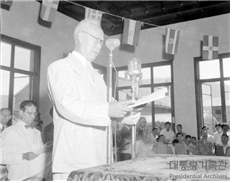
Scene from the 'Tsushima Return Demand Press Conference,' AP interview on August 19, 1948
To evaluate Syngman Rhee as a leader with historical awareness, based on his statement that Tsushima Island is historically Korean territory, is a very dangerous idea. This is one of the achievements of Syngman Rhee that the New Right often emphasizes, but from a national historical perspective, Syngman Rhee was merely a trap that hindered Korea's slow start after liberation. If one were to deeply examine many contemporary nationalist politicians such as Lee Si-yeong, Lee Dong-nyeong, Song Byeong-jo, Cha Yi-seok, Jo Wan-gu, and Kim Gu, it could be argued that the 'nationalism' that was attempted to be erased from modern and contemporary history, at America's behest, left no trace through Syngman Rhee, truly serving as a conduit for national betrayal. In this context, Syngman Rhee's remarks about the subjugation of Tsushima Island can be interpreted from two perspectives.
First, it is a practice of proxy rule where the United States provides prior information and guides the Korean Peninsula's politics, especially on territorial issues, in the desired direction. As public opinion for the recovery of lost territories grew after liberation, and various groups, especially elderly people with a history of anti-Japanese activism, began to assert island sovereignty, the US first addressed Dokdo, and Syngman Rhee then addressed Tsushima, engaging in a deception campaign against the public. The US was closely watching which way the national sentiment in the liberated space would flow, and Syngman Rhee was faithfully fulfilling his role as the meticulously cultivated first figure of the American-style '녹화사업' (greenification project). That practice and method have continued to mislead public sentiment to this day, and one only needs to recall the role writers like Yoo Si-min have played in politics over the past 30 years.
Second, the view that the territorial remarks concerning Dokdo and Tsushima were a prelude to the eradication of Korean Peninsula nationalism, which would later lead to the Korean War.
Let's recall the unprecedented massacre known as the 'Jeju 4.3 Incident,' which lasted for over eight years, starting from the 'commotion' at the March 1st (read as 'Samiljeol,' not 'Samjeomiljeol') commemoration ceremony in 1947 and continuing until the opening of Hallasan Mountain in 1954, after the Korean War. And in October 1948, two months after Syngman Rhee announced the recovery of Tsushima, there was the Yeosu-Suncheon Incident, where the National Defense Guard in Yeosu and Suncheon, who refused to suppress the Jeju 4.3 Incident, were massacred and their actions were dismissed as an armed rebellion. At times, it was even called the 'Yeosu-Suncheon Rebellion,' making it seem like a real rebellion had occurred. The Yeosu-Suncheon Incident, Jeju 4.3, and the Korean War are intertwined with continuous territorial issues and the involvement of the United States behind the scenes. It is very unpleasant to hear the public's national sentiment dismissed as mere unrest or commotion. From the perspective of New Right historians, on the contrary, words related to the Korean people, nation, and nationalism must be grating to their ears. Does a country that distorts the historical context and misleads perspectives to prevent Koreans from speaking about the Korean people in Korea deserve to exist on Earth? The question is, how much longer can we endure with someone else's perspective?
The joy of escaping colonial slavery was short-lived; the chaos of liberation revealed a truth that people's thoughts about the strange territory were finally bursting out. So, Syngman Rhee had the domestic media hold a press conference demanding the return of Tsushima from the United States first. The fact that the U.S. Department of State, Office of Intelligence Research, Division of Research for Far East (OIR) report #4900 in 1950 recorded the date of this interview as August 17, 1948, means that the U.S. instructed Syngman Rhee's foreign press conference two days earlier. Based on the U.S. analysis, 'In the heart of every Korean is a longing for the return of those islands,' the U.S. made Syngman Rhee align with public opinion by claiming Tsushima was originally Korean territory. However, according to the report, Japan had exercised actual control over Tsushima for over 350 years (as of OIR #4900 in 1950), so why did Koreans react this way? This requires further investigation. In the next installment, I will explain the U.S. solution to territorial issues in island regions, including the Dokdo and Tsushima issues.
댓글
( 0 / 500 )
Piter58
9
독도 폭격 사건을 단순히 "미국이 독도를 한국 영토로 인정한 증거" 정도로만 해석하는 건 너무 단편적이라는 지적은 생각해볼 만합니다. 당시 미군정과 냉전 초기의 전략까지 함께 봐야 한다는 주장도 일리가 있네요. 2편이 기대됩니다.
( 0 / 500 )
luckyboy
9
글의 주장 가운데는 상당히 과감한 해석도 있지만, 최소한 1948년 전후 미국의 한반도 정책과 영토 문제를 다시 검토해 보자는 문제 제기는 의미가 있다고 봅니다. 사료는 사실이고, 해석은 계속 검증되어야 하니까요.
( 0 / 500 )
hyunjoon
7
독도 문제를 일본과의 양자 갈등으로만 봤는데, 미국의 점령정책과 냉전 전략까지 연결해서 설명하니 새로운 시각이네요. 우리가 너무 당연하게 받아들였던 역사 해석도 다시 살펴볼 필요는 있어 보입니다.
( 0 / 500 )
kang5
6
이 글은 단순한 독도 이야기가 아니라 해방 공간과 미군정, 제주4·3, 여순사건, 한국전쟁까지 하나의 흐름으로 연결하려는 시도네요. 동의 여부를 떠나 자료와 논리를 계속 제시해 준다면 흥미로운 연재가 될 것 같습니다.
( 0 / 500 )
석훈
6
역사 문제는 정치적 진영을 떠나 최대한 많은 사료를 검토하고 토론해야 합니다. 이 글의 주장에 모두 동의하는 것은 아니지만, 기존에 잘 다루지 않았던 자료와 시각을 소개했다는 점에서는 읽어볼 가치가 있는 글이라고 생각합니다.
( 0 / 500 )
komodo
5
독도 문제를 이야기하면서 정작 독도 폭격으로 희생된 어민들의 비극은 잊혀져 왔다는 점이 가장 마음에 남습니다. 영토도 중요하지만 희생자들의 역사 역시 제대로 조명받아야 합니다.
( 0 / 500 )
革命77
5
미국이 당시 어떤 전략적 계산을 했는지는 충분히 연구 대상이 될 수 있습니다. 다만 역사적 사실과 추론은 구분해서 접근해야 한다고 생각합니다. 후속 편에서 더 많은 1차 사료를 기대합니다.
( 0 / 500 )
김정균
4
동북아역사재단이 사료를 어떻게 해석하는지가 이렇게 중요한 문제라는 걸 새삼 느꼈습니다. 같은 문서라도 어떤 관점으로 읽느냐에 따라 전혀 다른 결론이 나올 수 있다는 점이 인상적입니다.
( 0 / 500 )
철우
2
해방 직후 한반도를 둘러싼 미국, 일본, 소련의 이해관계를 함께 봐야 한다는 주장에는 공감합니다. 독도 역시 냉전이라는 큰 틀 속에서 접근해야 더 입체적으로 이해할 수 있을 것 같습니다.
( 0 / 500 )
신고내용
신고내용을 선택해주세요
회원비난/비하/욕설글 및 댓글도배성 게시물저작권 침해/불법자료 유출허위사실유포개인정보 유출.사생활 침해무단광고/홍보음란물 및 도박 불법 광고물범죄행위 관련 글불법행위 관련 소개물품 판매 및 사기글악성코드 및 스파이웨어 유포기타 사유 및 운영진 판단


비밀번호를 잊으셨나요?
Sign in with Google
All information provided by us is free of charge and is for the public good.