品

Corea든 Korea든, 품격은 이름보다 먼저다
Whatever the name—Corea or Korea—dignity comes first.
Whatever the name—Corea or Korea—dignity comes first.
Now
지금
751 Diaspora
Heritage
유산
Humanity
인문
Mirengsi
未冷尸
Politics
정치
Media
언론
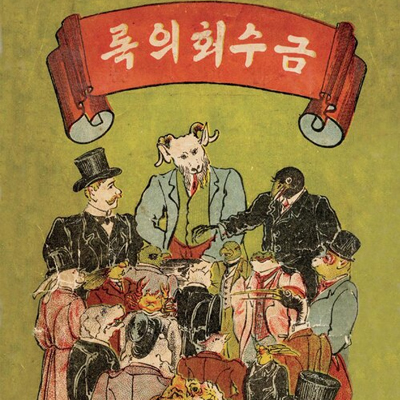
안국선(安國善, 1878~1926)의 <금수회의록(禽獸會議錄)>

小說
칼럼
bunny365
Geumsu Cheonguk

0
2026. 06. 18
- Historically, Korea, having been under the influence of powerful nations, experienced both being prey and predator, which shaped its complex biological diversity and led to a characteristic inability to recognize tragic realities, whether viewed from afar or up close.
- While modern Korean academia critically addressed the issue of 'adaptation' in the process of adopting Western civilization, it applied an exceptionally harsh standard to the adaptation of Japanese culture, trapping itself in the dichotomy of colonial modernization theory versus exploitation theory, thereby hindering the resolution of fundamental issues.
- Specifically, the debate surrounding the adaptation of "Geumsuhoeuirok" (The Council of Animals) mimics Japanese academic research methods, undermining the autonomy of Korean scholarship and failing to properly illuminate the actions of pro-Japanese intellectuals during the colonial period and their contributions to shaping the zeitgeist.
Koreans, likened to a sad animal with a long neck, have, due to their long history, sometimes become experimental subjects and hosts for the desires of some humans. Thus, as a people who have experienced everything from being predators, shields for many humans, to prey, their biological diversity is unexpectedly complex. Because of this, the saying that life is a comedy from afar and a tragedy up close becomes a tragedy both from afar and up close for Koreans, a fact only Koreans are unaware of. Conversely, the history of times that were a comedy both from afar and up close has completely vanished. While the blood and flesh of our ancestors were ground away in the millstone of tragedy, the growth of those who rebounded, along with Koreans who have lost their memory, has now ushered in an era of AI vs. humans. However, a culture that feeds on the flesh of others cannot take root and has the limitation of being superficial, so we must take time to recover by exploring even that marginalized middle ground.
The blind spot of modern publishing culture is its refusal to acknowledge the era of adaptation.
The essence of modern civilization lay in the smooth establishment of Western-style colonialism, and there was an absolute need to package existing traditional thought and civilizational systems as Western civilization to mislead the public. In the accumulated and repeated history of humanity, the realization of the 'New World' envisioned by the West was impossible without annihilating existing civilizations. Their method involved thorough physical destruction and oppression on one side, and brainwashing through text and language on the other, justifying their actions with the term 'enlightenment' (educate) in their own words.
In this era of confusion, there is a debate about whether Ahn Guk-seon's (安國善, 1878~1926) <Geumsuhoeuirok (禽獸會議錄)>, an allegorical novel using animal motifs that sharply criticized the social conditions of the time, is an adaptation of a Japanese novel or not. The discussion about adaptation is an important issue in modern Korean humanities, but if we broaden our perspective, there is no field that is not an adaptation among all the fields that gave birth to New Korea. However, the standards are even harsher when it comes to adapting Japanese culture. Unlike the dichotomy of colonial modernization theory and exploitation theory, which split like the Red Sea, there is a particular sensitivity to adaptations in publications during the enlightenment period. Of course, depending on how one views the criteria and standards for creative works, it changes whether an adapted novel is merely a peripheral intellectual criticism of an ideology-concealing academic discipline that misleads the essence.
In fact, in Korean society, where such a standard has become the norm and absolute, people cannot see the forest for the trees, and academic, social, and personal intellectual activities cannot survey the entire era, leading to a focus on minor details at the expense of the bigger picture. In short, driving this intentional, government-serving academic research method of obsession with adaptation into a controversy is merely a disruptive device that prevents us from deeply examining why that era satirized human society with fables. To give another example, there is Japan's spasmodic slogan, 'Dokdo is Japanese territory.' It is similar to how, every time Dokdo is mentioned, Koreans are made to obsess over Dokdo, an appendage of the Korean Peninsula, preventing them from grasping even a clue to the bigger picture, the bigger map, or the bigger conspiracy. This pattern is also a method often used in political conflicts to eliminate rivals.
The discussion of adaptation is not very meaningful; 19th-century Western fable novels were introduced to Japan, adapted into a Japanese style, and then re-emerged as the mixed Korean-Chinese script <Geumsuhoeuirok> during the rapid growth of publishing culture in the late Joseon Dynasty. Anyone who reads introductory college textbooks from the 1980s knows that the origins of all fields that shaped modern Korea came from Japanese publications. However, the acquired habit of avoiding the core issue with superficial solutions is increasingly leading in an undesirable direction. Of course, if one traces the origins of Western satire and fables, they are also Western adaptations of Eastern narratives, so culture circulates as needed. However, our academic research methods, which focus on trivialities, only further hinder the expansion of Korean thought, making it difficult to grasp these structural principles, and the harm of misplaced priorities simply spreads throughout society.
Verifying researcher lineage is fundamental in Asia
Asia's territory was divided by Western violence, and the lives of the people who had lived in each cultural sphere were scattered overnight and gradually. Even if we set aside the exact territorial boundaries or the history of invasion, the severed traditions are unlikely to be restored, given that they once belonged to the Sinosphere but now use their own scripts. Vietnamese Chữ Nôm, which is based on the Western alphabet, Japanese, including Katakana for transcribing foreign words, and Mandarin Chinese, the standard Chinese language, all allowed words to be input based on Western characters, and materialistic Western thinking became the common denominator between East and West. In particular, Chinese officially adopted simplified characters, a modified version of existing Chinese characters, in 1950, which even led to a mutation of the script. Therefore, the Communist Party and simplified characters are symbols that define the New China, but because they are not doubted, they have solidified into a new discipline without the need for doubt. Why did China, which boasted thousands of years of civilization, destroy its own culture? We have never discussed this. In other words, we have been raised not to see the forest. Asia's modern era thus underwent the dismantling of Chinese civilization and a script transformation influenced by the West, leading to a cessation of communication, neighbors becoming enemies, and compatriots becoming adversaries. Yet, academia pretends otherwise and ignores the disconnections of modernity. This is a serious contradiction, and as humanity's knowledge system has not been made whole, we are now confronting AI, and what remains is humanity's defeat. Therefore, not everyone can be the master of the new world.
In an era when existing civilizations were being destroyed, political satires or cartoons anthropomorphizing animals were one of the very popular genres, regardless of East or West. They were merely a merciful genre that offered a respite to humans struggling with the limits of acceptance in the face of rapidly changing environments, and they were harmful. However, trends always have pioneers. We cannot know whether such trends were spontaneous or whether a force behind them skillfully used sophisticated satire to unite public sentiment. There are theories that Ahn Guk-seon's <Geumsuhoeuirok> is an adaptation of Tajima Shoji's (田島象二, 1852~1909) <Jinryu Kougeki Kinju Kokkai (人類攻擊禽獸國會), 1885>, or an adaptation of the novel <Kinju Kaigi Jinrui Kougeki (禽獸會議人類攻擊), 1904> written by Sato Kurataro (佐藤蔵太郎, 1858~1942, who used pen names such as 菊亭香水, 鶴谷外史). However, in conclusion, the prevailing view in Korean academia is that Ahn Guk-seon did not adapt Japanese fables.
This prevailing view is rooted in a kind of psychological resistance among Koreans, who believe that Korean civilization is older than Japanese civilization. Indeed, it is true that countless Korean fables, such as Bang Jeong-hwan's Eunpari, and traditional fables like the Rabbit's Tale, the Pheasant's Tale, and the Toad's Tale, can be traced back to the Three Kingdoms period, regardless of the era. However, the argument that dismisses the possibility of Ahn Guk-seon's adaptation from the outset is largely influenced by sentiment rather than academic research. I have no intention of disparaging such stereotypes as unacademic, irrational, or unreasonable. The problem, I believe, lies in the unilateral Japan-centric tendency of previous research. Why do we not think of going beyond Japanese research? The bigger problem is that no one questions modern publishing culture itself because no one knows how long Japan has been incorporating Korean culture as its own and artificially reinterpreting it. It is shameful as humans that such a Japan brings up irrationality whenever Koreans' sentiments touch upon their flaws, and academia subtly follows the same pattern.
Serikawa Tetsuyo, who first raised the issue of "Geumsuhoeuirok" in 1975 as an adaptation of a Japanese novel in his master's thesis at Seoul National University, is a Japanese scholar specializing in modern Korean literature. He translated many modern Korean literary works, but no information about his personal life could be found other than that he is an emeritus professor at Nishogakusha University in Japan. The founder of Nishogakusha University was Mishima Chushu (1831-1919), a Chinese literature scholar who contributed to elevating Chinese literature to a certain level in modern Japan. This means that Japanese Chinese literature contributed to fostering the ability to distort history. In 2011, about 40 years after Serikawa, Seo Jae-gil, a professor in the Department of Korean Language and Literature at Kookmin University, presented the opinion that Ahn Guk-seon's "Geumsuhoeuirok" was an adaptation of "Geumsuhoeui Inryu Gonggyeok, 1904." In the same year, Wang Hee-ja's doctoral dissertation at Ewha Womans University further compared Ahn Guk-seon's "Geumsuhoeuirok" and Tajima Shoji's "Inryu Gonggyeok Geumsuhoeui" based on the above prior research, but showed a tendency to give weight to Serikawa's view with an attitude that seemed to ignore the similarity between Ahn Guk-seon's "Geumsuhoeuirok" and the preface of Sato Kurataro's "Geumsuhoeui Inryu Gonggyeok," which Seo Jae-gil claimed.
전후 한국의 인문학은 영혼에 납덩이를 매단 채 시작했으니 당연히 1, 2차 대전 동안의 일본의 연구 성과에 미칠 바가 아니다. 인문학이 지정학의 한 요소라는 엄연한 사실을 외면할 수밖에 없는 한국은 정치가 분단과 식민지를 회고하지 않고 달렸듯, 인문학도 일본의 것을 답습하는 데 급급했다. 그 결과, 식민사관은 세대를 뛰어넘어 뉴라이트라는 날개를 달았고 그것도 진화했다. 그래서 한국의 인문학은 여전히 일본에 종속되어 있고 이것은 하나의 장르가 되어 있다. 번안설 첫 제기 1975년 세리카와 이후 2011년까지의 공백은 물론이고 안국선이라는 인물로 대표되는 그 시대를 조명할 연구 토대와 심리적인 과거사 연구 자세는 여전히 마련되지 않은 게 현실이다.
Dr. Wang Hee-ja's thesis was published as a monograph two years later in 2014. In it, she also expressed opposition to the idea that Ahn Guk-seon adapted the 1904 <Geumsuhoeui Inryu Gonggyeok> into the 1908 <Geumsuhoeuirok>, and instead focused on comparing it with the 1885 <Inryu Gonggyeok Geumsuhoeui>. I couldn't find any other information about Wang Hee-ja besides her being known as an emeritus professor at Sun Moon University, but I've never seen a Sun Moon University professor who didn't try to move to another university. As is well known, the Sun Moon University foundation is a private university of the Unification Church, founded by Moon Sun-myung. The political status of modern and contemporary Korea, where religion and politics are intertwined, is very low, and this customary dogma in academia not only hinders academic research, but Wang Hee-ja's adaptation comparison can be seen as a major mechanism for concealing ideology. In other words, just as the Unification Church is an organization that aims for joint weddings between Koreans and Japanese, and Koreans and people all over the world, academically, the early research and direction of Japan continue to preempt the political arena. It means a role that does not deviate from the boundaries of adaptation, rather than who adapted whose work.
Perhaps the reality that we cannot do anything, even though we are well aware of the development of Japan's publishing culture, which was nurtured by Korean civilization, and its colonial publishing censorship policy, while questioning the attitude of modern scholarship, which is a mixture of the most political and the most religious, is because its scope is much darker than our imagination. It is necessary to first reflect on why Korean academia, which cannot, in principle, be academic research on a fair foundation, does not self-reflect on the practice of following the fragments and landmines laid by Japanese academia and imitating their methods.
The core is tracking the activities of figures in the colonial publishing industry.
Isn't a beast's meeting, or a beast's meeting attacking humanity, or the meaning that beasts meet and attack humanity, all the same? There's a limit to wordplay. Even if the content is different, the criticism of humans remains unchanged. Who was such severe human criticism of humans directed at? The prevailing culture of diligently researching secondary matters while missing the core is precisely how modern Korean publishing culture is mistaken for an indigenous culture and survives in a direction that deviates from its essence. Civilization can develop or regress, but stealing the original and erasing its traces is a separate issue. The fact that the history of modern Japanese publishing culture development is the history of modern colonial publishing censorship policy is an unbearable insult and a sigh-inducing theft, and there must be acts of espionage in academia to hide that very history. Therefore, pro-government scholars who were excluded from censorship during the colonial period as well as the dictatorial era must reflect.
At the time, fables, along with satire and cartoons, were a genre of popular propaganda. It can be inferred that Angukseon borrowed, adapted, and dramatized these fables amidst the influx of 19th-century Western fable novel adaptations that poured into Joseon, or rather Korea, or somewhere in between, through Japan during the late Joseon Dynasty. In a colonial world, Angukseon was not in an environment to suddenly produce original works, nor did he live a life that would allow for it. So why did Wang Hee-ja skip the 1904 Sato-1908 Angukseon connection and instead emphasize Tajima's research from 1885, a generation earlier? I wonder if there was some reason why the 1904 fable novel had to be denied.
An Guk-seon was adopted after the death of his sixth cousin, An Gyeong-su (安駉壽, 1853~1900). He was one of the 200 government-sponsored students sent abroad in 1895 and was a typical figure of the so-called enlightenment period pro-Japanese intellectuals, influenced ideologically by Japan's civilization and enlightenment theory. He was a new novel writer, a demagogic orator in the colonial political arena, an appointed official, and a businessman who failed after transitioning to entrepreneurship. His adoptive father, An Gyeong-su, was the first president of the Independence Association, who was executed after torture following the Chunsaengmun Incident (an event in 1895, immediately after the Eulmi Incident, where an attempt to smuggle King Gojong out through Chunsaengmun to overthrow the pro-Japanese cabinet failed; two months later, in February 1896, the Agwanpacheon occurred). In 1898, An Gyeong-su, who was involved in an incident demanding Emperor Gojong abdicate in favor of Sunjong, fled to Japan and was executed upon his return. Why did the king and queen of a traditional dynasty suffer such fates, and why was the nation to be dismantled?
Let's set aside factual verification and consider whether the historical tendency to emotionally and circumstantially blame rulers, a pattern that has continued from them downwards, has become a chronic disease of distrust and disparagement of rulers within us. History has a fractal structure that produces homogeneity, much like living cells, so if we focus on the lives of individuals, we might see why there is an obsession with adaptation issues.
The family tree of Juksan Ahn and Ahn Guk-seon's adoption in 1893 are full of questions. It is unclear whether Ahn Guk-seon was adopted by Ahn Gyeong-su before or after Ahn Gyeong-su's execution in 1900. Why would he be adopted by the son of an executed man? After Kim Ok-gyun's posthumous decapitation, what do the misfortune of a biological child and the existence of an adopted child signify? Why are we not sensitive to these issues? Ahn Guk-seon's son, Ahn Hoe-nam (安懷南, birth name Pil-seung, 1909~?), was a writer who defected to North Korea, and his six-cousin Ahn Mak (安漠, 1910~?, birth name Pil-seung) was the husband of dancer Choi Seung-hee. The history of Ahn Gyeong-su's three generations, the Ahn Mak couple, and the Juksan Ahn family is the unfortunate life of intellectuals in the late Joseon Dynasty, and a family tree that clearly reveals the truth that an individual's life cannot precede the fate of the nation. However, there are countless such families. The reality that Korean studies treats this history as separate and follows Japanese research methods is concerning, as it suggests that Korean academia cannot be noble, and may only leave behind an artificial and biased research environment, making it difficult for future generations to conduct any research.
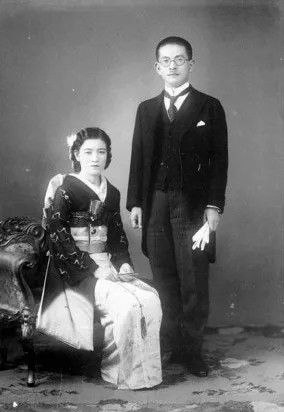
Family photo taken with concubine Lee Young-ja
The known photos of Ahn Guk-seon and Ahn Hoe-nam are similar, but too blurry to make a judgment. In Ahn Gyeong-su's case, a photo of him in a tailcoat, holding white gloves, with his concubine Lee Young-ja in a kimono, is known. If this photo also lacked a description, it would be easy to mistake them for a typical Japanese couple in modern Japanese-style Western attire. I could not find photos of Tajima or Sato. I initially imagine the possibility that the photo of Ahn Gyeong-su is not Ahn Gyeong-su, and that the works of Tajima, Sato, and Ahn Guk-seon are intertwined with the artists for some reason in chronological order. Writers who were active under Japanese colonial rule often played multiple roles and used more than a dozen pen names. Not only writers with pens, but also armed anti-Japanese activists who fought with guns used several aliases. The world gradually changed into one where families, siblings, and friends informed on each other, so if you used today's name tomorrow, it would be difficult to last a month due to informers.
Ahn Guk-seon was merely a collaborator and one of the subjugated people who, after his country's downfall, went to study in the very country that caused its ruin, learned and mastered new civilizations, and was groomed to be an administrator to rule his own people. In other words, in a world where the tables had already turned and the tide had shifted, he chose the path of individual success-seeking. The end of his life was already predetermined; his fate depended on whether he was a Joseon person who would aid Japan's pursuit of continental conquest and territorial acquisition. Just like his adoptive father, Ahn Gyeong-su, said. The vibrant dynamism of Tokyo, a dazzling new world at the time, was a place where all the latest Western technologies and cultures converged. Few would not want a piece of this new world, and it would be strange not to feel the desire to succeed with one's writing skills. Choices are free, but the options are fixed. The reason why information about modern historical figures' families drastically decreases from a certain period is not because we are a people without ancestors, but because we have forgotten the sources of that information. It was the job of the enlightenment thinkers of that time, i.e., propaganda and brainwashing experts, to present narratives tailored to the new world without introducing the era of those ancestors, their literature, and their struggles. Adaptation is a genre and a facade, and the core was probably in the publishing industry's creation of the zeitgeist.
To the young teenage international student Ahn Guk-seon, Fukuzawa Yukichi (福沢諭吉, 1835~1901), who served as an inspiring messenger of the unique Korean spirituality, must have been a hero. The Imo Incident of 1882, which occurred 25 years before the official disbandment of the Joseon army in 1907 and the Battle of Namdaemun, is one of the five major modern events (Imo Incident, Gapsin Coup, Gabo Reform, Eulmi Incident, Agwan Pacheon) that do not accurately convey the facts of Joseon's demise. It is a forced logical event that made both the victims and perpetrators Koreans. Can the outcome of the Donghak Peasant Movement spreading and the Sino-Japanese War breaking out during this period truly be understood through the explanation of colonial historiography? When the army was disbanded, the people became the masses and grew into citizens, setting fire to colonial modern institutions and taking up farming tools instead of weapons, it was because such events had occurred. Fukuzawa was a figure who actively participated in the founding of the Hansung Sunbo newspaper and the introduction of printing presses during that chaotic period at the end of Joseon. Did Fukuzawa ever come to Joseon, or go to China? The academic encouragement that prevents the public from being interested in the history that actually occurred is too anachronistic.
Deer
Oh, sad beast with a long neck
Always so dignified and silent.
You, whose antlers are fragrant,
Must have been of a very noble lineage.
Looking into your own reflection in the water,
Recalling a lost legend,
With an uncontrollable nostalgia,
You gaze at the distant mountains with a sad neck.
Noh Cheon-myeong's poetry collection Sanhorim, Hanseongdoseo 1938
댓글
( 0 / 500 )
jongsoo88
9
안국선 개인의 삶과 가계, 그리고 식민지 출판 문화의 구조를 연결해서 바라본 시각이 흥미롭습니다. 우리는 작품만 읽고 작가를 잊어버리기 쉬운데, 결국 문학도 시대를 살아간 인간들의 선택과 한계 속에서 만들어진다는 사실을 다시 생각하게 됩니다.
( 0 / 500 )
soo9
12
정말 생각할 거리를 많이 던져주는 글입니다. 우리는 늘 번안이냐 창작이냐 같은 표면적인 논쟁에만 매달렸지, 왜 그런 작품이 등장했고 누가 그런 담론을 만들었는지는 깊게 들여다보지 않았던 것 같습니다. 역사를 보는 시야를 넓혀주는 글 잘 읽었습니다.
( 0 / 500 )
민주
10
특히 "숲을 보지 못하도록 길러진 것 아니냐"는 문제의식이 인상적이었습니다. 세부 연구도 중요하지만 큰 흐름과 구조를 함께 보려는 시도가 부족했던 것은 아닌지 돌아보게 됩니다. 이런 시각의 글이 더 많이 나왔으면 좋겠습니다.
( 0 / 500 )
88kim
8
노천명의 「사슴」으로 글을 마무리한 이유를 알 것 같습니다. 식민지와 분단, 근대화의 격랑 속에서 자신의 기억과 정체성을 잃어버린 한국인의 모습이 사슴의 긴 목과 향수에 비유되는 듯합니다. 역사 연구란 결국 잃어버린 전설을 되찾는 과정인지도 모르겠습니다.
( 0 / 500 )
Donald
8
이 글을 읽으며 가장 인상 깊었던 것은 번안 논쟁 자체보다 '왜 우리는 그 논쟁에만 머무는가'라는 질문입니다. 학문이 세부 검증에 집중하는 것은 중요하지만, 때로는 더 큰 역사적 맥락을 놓치게 만드는 것도 사실입니다. 숲과 나무를 함께 봐야 한다는 주장에 공감합니다.
( 0 / 500 )
now59
7
글을 읽으며 근대라는 시대가 얼마나 많은 단절과 왜곡 위에 세워졌는지 다시 생각하게 되었습니다. 우리가 당연하게 받아들였던 학문적 통설조차 검증과 성찰의 대상이 될 수 있다는 점에서 큰 공감을 느낍니다.
( 0 / 500 )
Min_lee
7
글의 주장에 모두 동의하는 것은 아니지만, 적어도 근대 한국 학계가 식민지 시기 지식 생산 구조 자체를 충분히 성찰하지 못했다는 문제 제기는 의미가 있다고 봅니다. 번안 여부만 따질 것이 아니라 왜 그런 작품이 등장했고 어떤 시대적 배경 속에서 소비되었는지 함께 살펴야 한다는 지적은 생각해 볼 만합니다.
( 0 / 500 )
Richard_Park
5
역사는 단순히 과거의 이야기가 아니라 현재를 이해하는 거울이라는 말을 다시 떠올리게 됩니다. 번안 논쟁을 넘어 식민지 시기 출판문화와 지식 생산 구조 자체를 살펴봐야 한다는 주장에 깊이 공감합니다. 많은 사람들이 읽고 토론해 볼 만한 글입니다.
( 0 / 500 )
Alexander
4
안국선이라는 한 인물의 삶을 따라가면서 당시 지식인들이 처했던 복잡한 현실을 새삼 느끼게 됩니다. 친일과 애국, 성공과 생존 같은 단순한 이분법으로 설명할 수 없는 시대였다는 점을 잘 보여주는 글이라고 생각합니다.
( 0 / 500 )
겨울
4
다만 일부 추론은 흥미롭지만 아직 충분한 사료적 근거가 제시되지 않은 부분도 있어 보입니다. 기존 연구를 비판하는 만큼 새로운 가설 역시 더 많은 자료와 검증이 필요할 것 같습니다. 그럼에도 당연하게 받아들였던 통설을 다시 질문하게 만드는 글이라는 점은 높이 평가합니다.
( 0 / 500 )
냥냥이님
3
읽는 내내 불편하면서도 많은 생각이 들었습니다. 우리가 알고 있는 근대 문학사와 학문 체계가 과연 얼마나 객관적인 것인지, 또 누구의 시선으로 정리된 것인지 다시 질문하게 만드는 글이었습니다.
( 0 / 500 )
이민혁
2
번안 여부를 둘러싼 논쟁보다 그 시대 사람들의 삶과 선택, 그리고 식민지 현실이 더 중요하다는 말씀에 공감합니다. 결국 작품도 사람이 만들고, 사람은 시대를 벗어날 수 없다는 사실을 잊고 있었던 것 같습니다.
( 0 / 500 )
신고내용
신고내용을 선택해주세요
회원비난/비하/욕설글 및 댓글도배성 게시물저작권 침해/불법자료 유출허위사실유포개인정보 유출.사생활 침해무단광고/홍보음란물 및 도박 불법 광고물범죄행위 관련 글불법행위 관련 소개물품 판매 및 사기글악성코드 및 스파이웨어 유포기타 사유 및 운영진 판단


비밀번호를 잊으셨나요?
Sign in with Google
All information provided by us is free of charge and is for the public good.