品

Corea든 Korea든, 품격은 이름보다 먼저다
Whatever the name—Corea or Korea—dignity comes first.
Whatever the name—Corea or Korea—dignity comes first.
Now
지금
751 Diaspora
Heritage
유산
Humanity
인문
Mirengsi
未冷尸
Politics
정치
Media
언론


小說
칼럼
bunny365
Jason Lee and Grace Kelly

0
2026. 01. 13
What do humans live by? The title of Tolstoy's short story in 1885 makes me wonder if he predicted the future would be filled with dark days when he was writing the manuscript, and hinted to those who would come after whether or not he could draw out humanity's altruism. I think it would be meaningful to appreciate the life of a 'Corean' in the 20th century to understand the essence of human beings and humanity.
Grace Kelly, born to an Irish father and a German mother, debuted in Hollywood in 1949 at the age of 20. The marriage combination of Irish and German hides the colonial history of modern Western Europe, which became the ancestors of Americans. The history of those who were not treated as white people as 'white blacks' has not been properly identified like the colonial past of other human beings, and it is thought that memory loss has been established for the victims and a culture for the perpetrators, cheering.
Prince Rainier III, who became the Prince of Monaco in the year Grace Kelly debuted as an actress, met her in 1955 when she came to Monaco for filming, and they began dating. The following year, in the spring of 1956, they held a grand wedding in Monaco. The proposal with a 12-carat diamond ring was known as the wedding of the century and greatly raised the dreams of women in the 20th century for upward mobility. However, like a lavish feast that leaves you hungry, her life as an actress, packaged as an expensive gift, ended with the movie 'High Society'. Before the wedding ring she wore in this movie was talked about by many, there was someone else who acted quickly, aiming for an even bigger profit.
He was an American immigrant named Jason (Korean name Lee Min-seok), who, knowing that Grace Kelly was getting married in Monaco, went on a gambling trip to Monaco. Jason Lee, who repeatedly won money in craps with rigged dice and calmly left the casino, appeared in the newspaper the next day in a Saturday Evening (1956) article titled 'Gambling Fraud in Monte Carlo'. He was caught by the French police, arrested at the airport, and detained.
An Associated Press article dated April 28, 1956, reported that Jason Lee, the Monte Carlo gambling fraudster, was arrested in Nice on February 21 and sentenced to imprisonment. Jason Lee's family asked Grace Kelly, an American citizen from Philadelphia, to release Jason Lee, who was also an American citizen. This was because Jason Lee and Grace Kelly had a special relationship. Jason Lee was running an illegal gambling den in Chicago, and it may have been a bold bet that Grace Kelly, whom he owed a debt to due to some kind of contract, sponsorship, or patron relationship to succeed as an actress in Hollywood, would help Jason Lee.
Chicago residents gossiped about Grace and Jason's affair, Jason's relationship with Al Capone, and so on, but who knows. One might think that Jason, who was old enough to be her father, helped Hollywood actresses early on to succeed in America as an Asian, thereby increasing his value in mainstream society. Not only Grace Kelly, but other Hollywood actresses also wanted Jason Lee's amnesty, and he was eventually released after three months.
The development of the story can be completely different depending on who the focus of the narrative is on. If Grace Kelly is the main character, it is easy to attract public attention, but if it starts with the story of an immigrant who was born in Joseon in 1896, a tragic land dotted with novels becoming the Korean Empire, and took an immigration ship to the United States with his father before he could properly learn the language, readers probably won't even bother to look at it. This is because no one pays attention to the history of modern subjugation, which is something they want to avoid and find boring. It is not the author's perspective, but the reader's acceptance of him is already a shabby loser's view of history that has been trampled and tattered by numerous inciting histories and brainwashing education. Even if the truth becomes a lie and the lie becomes a fact, it cannot be easily corrected.
Jason Lee is the protagonist of a legendary, or rather, novel-like story that was passed down among Korean-American reporters and expatriates. He is said to have been one of Al Capone's 12 henchmen and received prime land in Chicago from him. The Secretary-General of the Centennial Anniversary of Korean Immigration to the United States organized and excavated immigration history and appeared on television, and the turbulent life of this unfortunate Korean could become my job or your job someday in the future. That's why Tolstoy may have quietly questioned the sensibilities of the time as the dignity of man that remained until then, in the most logical and beautiful style.
Jason Lee was born in Joseon in 1896 and went to the United States alone with his father, Lee Chang-geon, on an early immigrant ship. Considering that Chinese and Japanese people were already working in sugarcane fields there, it was likely a Hawaiian immigration. In 1903, the first Hawaiian immigrant ship departed from Jemulpo Port with about 100 people on board, but the list has not yet been confirmed as to whether Lee Chang-geon and his son, Lee Min-seok, were included. If he boarded the immigrant ship at around the age of 8, it may have been 1904.
Considering his friendship with the Dosan Ahn Chang-ho family, which will be described later, and the fact that he spoke the same Pyeongan-do dialect as Dosan, Jason Lee was from the same hometown as Dosan. In order to decide to go to Hawaii to board an immigrant ship from Pyongyang, it is difficult to think without the active encouragement of immigration by Protestant missionaries. This was a time when the paths of the common people and collaborators diverged sharply at the scene of national ruin, so no matter what you discuss, it always ends up being about hellish Joseon. Should we highly value the American missionaries who encouraged immigration, or should we see it as officially sanctioned human trafficking? Even that evaluation is not free from colonial historical views.
It is said that the wealthy man, tired of the harsh immigrant life, took a stowaway ship to the mainland United States after three years, going to Chicago via San Francisco, but the truth is unknown. Immigrant life in Hawaii was no different from slavery, with no freedom at all, working under surveillance while being whipped with leather whips, and no data has been found of a young son stowing away on a ship to America. Unable to adapt to life in Chicago, his father decided to return home, but young Jason declared that he would stay, and eventually his father left and his son was left in an orphanage, where he experienced severe racism.
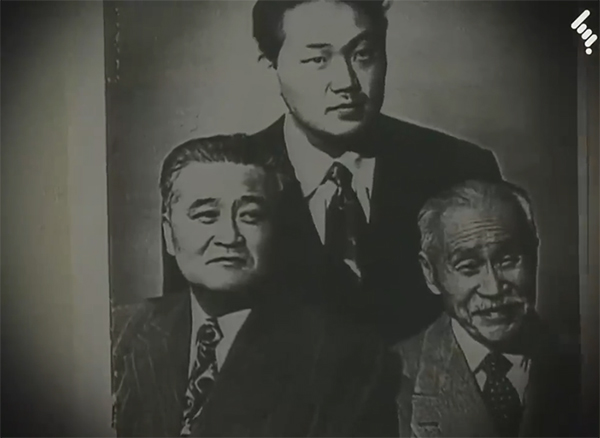
The materials collected by Jason Lee's grandson, Robert Kim (approximately 78 years old if he is still alive), contain photos of his grandfather Jason Lee, his father 이창건, and Jason Lee's son, three generations. Judging from the fact that they are all dressed in suits, 이창건 may have gone to Japan instead of returning to his home country, or he may have returned to Hawaii and endured harsh labor. Because the home country to which they could return had disappeared, they are described as successful cases in foreign countries, but their movements are uncertain and symbolized by the a priori of an unfortunate diaspora.
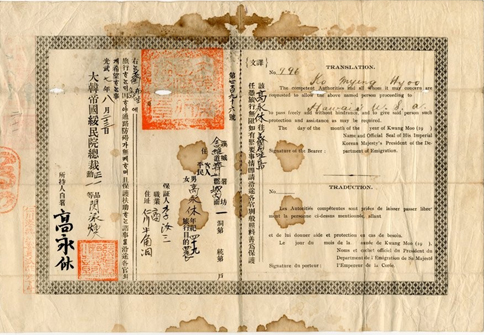
When they left their homeland, their passports, then called "Jipjo," spelled the Korean Empire as "Korea" in English. The issuing agency was Suminwon (綏民院), an agency similar to today's Ministry of Foreign Affairs, but it was a temporary agency that operated from 1902 to the following year before being abolished. The immigration was promoted by American Minister to Korea Allen (H. N Allen) and businessman Deshler. The nature of this human trafficking immigration will become clearer someday. It should also be noted that official diplomatic documents were marked as 'Coera' until much later. The difference in notation between 'Korea' and 'Coera' overlaps in time and implies completely different meanings, but I will not mention it here.
At the time, Chicago was the headquarters of the Mafia, and it was the era of gangsters dominated by Al Capone, so it is hard to imagine that an immigrant of Korean descent was involved in this gap. The life of a Korean in 'Once Upon a Time in America' was full of twists and turns from birth. Jason Lee was running the biggest secret gambling den with a sign of a veterans' rest area at 1358 North Clark ST, which is in the downtown area. The south of Clark Street was directly operated by the Mafia, and the north was leased to individuals. This happened in the mid-1940s.
This place was demolished in the 1960s due to redevelopment into a residential area, and traces of casino operation disappeared. The administrative district has also completely disappeared. Among the Korean family registers, there are cases where addresses that existed during the Japanese colonial period have completely disappeared without a trace. It is mainly a historical place name, but it is similar to that case. However, Jason Lee's gambling den management is not like a mirage-like rumor. There was a racial discrimination law at the time, so how could an individual Asian run an illegal gambling den alongside the Chicago Mafia?
The Chicago Tribune featured numerous articles by Jason Lee. An article dated January 30, 1953, contains testimony from a Japanese employee who established and operated a gambling den as an Asian and was linked to Chicago politics. Alderman Bauler, who was in charge of cracking down on illegal activities, issued a gambling den permit and regularly paid a portion of the business profits in return. However, no definitive mention was found that Lee was a member of the Mafia. However, given that the southern streets were controlled by the Mafia and the northern streets had Jason Lee's gambling den, it is easy to imagine that the largest gambling den, earning $15,000 a month, had some kind of relationship with the Chicago Mafia. The Chicago Tribune reported that 40% of Jason Lee's profits went to Alderman Bauler.
According to the book ‘Chicago Confidential (Jack Lait&Lee Mortimer Crownpublishers 1950)’, Korean Jason Lee oversaw all Asian gambling dens in Chicago and paid profits to the Mafia in return. Therefore, Jason Lee and the Chicago Mafia had a business relationship. The FBI raided the gambling den several times, but each time the Chicago police informed them in advance, and the arrest was thwarted. The casino was eventually closed in 1952 due to a raid. At the time, there were only a few Asians in Chicago, and almost no Koreans. How did he, who grew up being beaten, become a person who did not hesitate to engage in illegal lobbying in the political world? The power of Asians is readjusted from this point on. While the Korean Peninsula was at war and the souls of the people were dying, his business closed and was forcibly adjusted.
We need to consult here. Koreans are the oldest people in human history, but why have they become a degenerate people who have completely lost their national pride or the concept of nation within a forced historical perception? What is a homeland to a human being? What is the same race? Regarding the paralysis of the brain that does not even allow such thoughts, what does the 'old something' really mean, and why should it be the target of attack? If we do not re-examine these racial and ethnic characteristics, the 'Korean dismantling' that the West so desired will be successfully completed. We must keep in mind that the extinction of Koreans could lead to the extinction of human civilization. No matter how smart a plant is, it reaps what it sows. Even after repeated degeneration, the law of preserving the original form is close to the truth, with no exceptions.
Jason Lee went to Riverside around 1911. It was an area where Koreans lived in large numbers, and there he met Dosan Ahn Chang-ho and received care. In 1914, Jason Lee, who was 18 years old, enlisted and was dispatched to Hawaii. He was known to have diverted military supplies from the unit to help Koreans in Hawaii, and used the money he collected at this time to prepare the seed money for the casino business. This young man, who instinctively realized that money was important, pursued a normal life and once bought land in California to run a farm, but failed, and went to Utah to buy and operate a copper mine, but this also failed.
Even after liberation, some people went bankrupt due to mines or ships, and these types of businesses were mainly those that the Japanese exploited in colonial rule areas. As colonialism became a culture and social phenomenon, individuals suffered irreparable material and mental damage due to confusion of values and identity. This damage was passed down through generations and brought misfortune, which may be why colonial historiography so firmly binds our brains. Among the groups who safely cross this swamp of misfortune and act as the privileged class of the current comfortable Republic of Korea, there are genes of dishonest national traitors mixed in, preventing their existence from being revealed.
Susan Ahn, the eldest daughter of Dosan Ahn Chang-ho, recalls Jason Lee, who lived with Dosan's family in Riverside for several years when she was young, as follows. She doesn't know how Jason came to Riverside, but her mother (Mrs. Lee Hye-ryun) acted as a mother to Jason, who didn't have a mother. They lived like a family, and Dosan's second daughter, Sura Ahn, helped Jason for two years by asking him to work as a cashier at a Chicago casino. Even at this time, rumors of an affair spread in the Korean community, but Jason and the Dosan family had a good relationship, and two years later, Sura returned and opened a Chinese restaurant called Moon Gate with Jason's money.
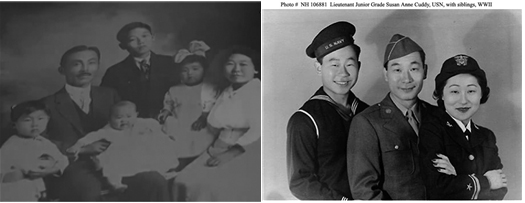
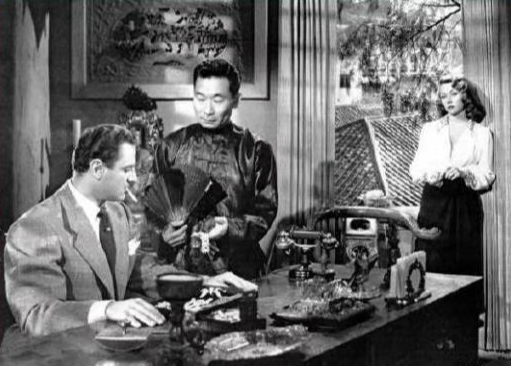
It is known in Beverly Hills that Moon Gate was established by Philip Ahn, but in reality, it was no different from Jason establishing it. Later, it became known that a Chinese partner participated in the restaurant management, and the restaurant became popular by word of mouth using the reputation of her brother, actor Philip Ahn, and Koreans and Chinese became identified. In that way, China and Korea became inverted. The disguise of history is also history. In the author's estimation, Moon Gate was probably Jason's second investment after losing the casino, and it seems that he supported the Dosan family financially while seeking business expansion through the restaurant, which became a hangout for the Korean community, and helped Koreans become economically independent.
Jason's wife, 멀이 리, ran Korea's first antique shop in LA, thanks to which her grandson, Robert Kim, has many Korean antiques left in his house. The household goods that Koreans brought with them when they immigrated, carrying their belongings, range from luxury goods of the noble class to household goods of ordinary people. How do we understand the era in which we had to immigrate to this extent? In LA, there is an antique dealer who is a retired soldier who made his grandchildren's college tuition with war trophies acquired from the palace stationed during the Korean War. The genes and artifacts of Joseon and Korean people are scattered all over the world, becoming the nourishment of life and the foundation of wealth for others. How seriously have we thought about this destiny?
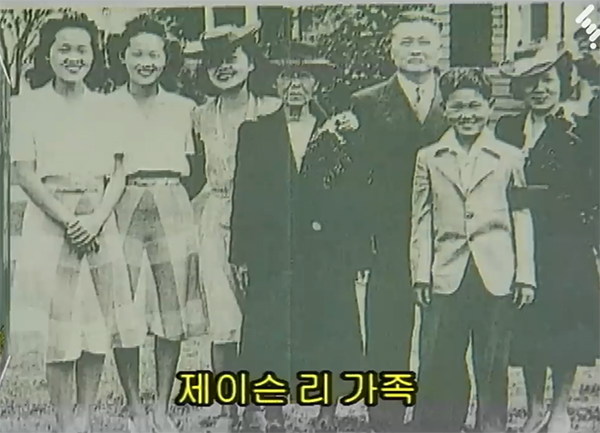
멀이 리, the wife of Jason Lee, who was a member of the 애국부인회 and worked for the Korean community and the independence movement, and a financial supporter of Koreans, cultivated humanity and patriotism through the Dosan couple. In 1949, Jason helped the Korean dance troupe invited by the Chicago Korean Student Association for five Chicago tour performances and even gave stolen watches to the members, so unlike today, material things may have been a means to them. If Jason and his wife or the Dosan family had lived as members who designed the modern era in their home country, what kind of life would their lives have drawn? And what kind of pride and reflection would we, their descendants, be living with today? The revolution of modern history, which did not allow such imagination, cannot be simply explained by colonial historiography.
The November 16, 1997 issue of People News Magazine featured an article commemorating the first Asian mafia, with the grandson reminiscing about his grandfather. He is forgotten not in his homeland, which has lost its history, but in the United States. He is not a legend or gossip, but a real person. He made money through gambling behind Dosan to support independence funds, helped the Korean community of first-generation immigrants, and worked hard for Koreans to enter mainstream society.
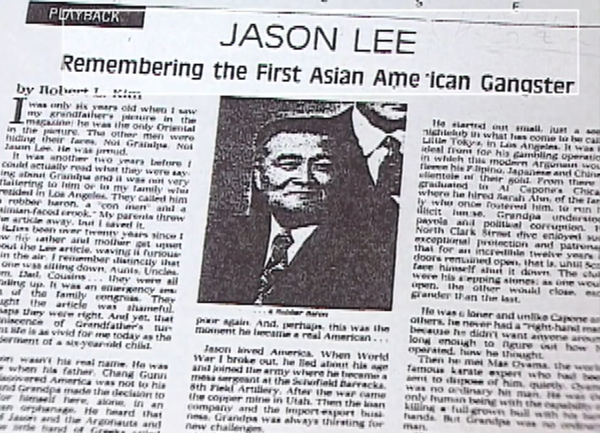
He was buried in the World War I veterans section of the Napa Valley Veterans Cemetery. He enlisted in 1914, served for 10 years, was discharged as a sergeant, and died as an American in a veterans hospital. When he died, three gunshots were fired as a tribute to a veteran who participated in the war for the country. His grandson says that he was proud of these gunshots he would receive in his lifetime, but the evil practice of the state, which elevates the pride of a brainwashed human being by turning shell shock, a stress response to combat, into glorious gunshots, is tyranny and human deception. However, not many people realize that fact and die.
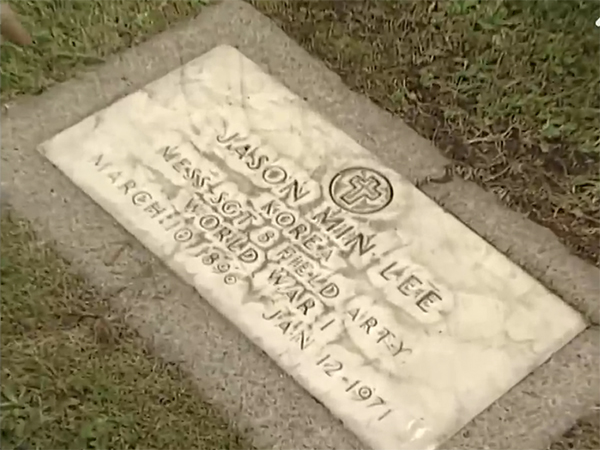
Jason Lee's tombstone is inscribed with Schofield 8th Field Artillery. The area where he served is presumed to be related to the Jeam-ri and Suchon-ri massacres, for which Frank William Schofield wrote a report during the Japanese colonial period. All the data that Schofield, who was also a bacteriologist, obtained from the war is part of the March 1, 1919, Independence Movement. Massacres and reports, and the loyalty of immigrants are major axes of the tragic narrative of humanity, and I do not want to evaluate him as a chivalrous duality who illegally made money. I have no intention of seeing him as a frontier who crossed borders and pioneered his own life, going beyond Korea's misguided historical perception that illegal immigration history is a fait accompli.
I am simply following in his footsteps to see how far the infinite love of humanity is allowed and where it is limited when judged by the yardstick of a nation. The history of World War I - March 1st Movement - Jeam-ri Massacre - World War II US military history, which is connected as one stroke, hides a lot from us. Where was the Hawaiian sugarcane field he immigrated to? Readers will not fully understand the life journeys of Jason Lee, Grace Kelly, and the Dosan family until they know the sloppiness of those who rule the Korean Peninsula and the entities at the top of them. This is a lament about the status of Koreans who do not understand ideal world history.
댓글
( 0 / 500 )
monalisa
6
읽는 내내 마음이 무거웠습니다. 제이슨 리라는 인물을 통해 본 근대 한인의 디아스포라는 교과서 어디에도 없던 역사네요. 불법과 애국, 생존과 배신의 경계에서 인간이 무엇으로 사는지 다시 묻게 됩니다. 이런 글을 남겨주셔서 감사합니다.
( 0 / 500 )
silkroad
7
한 개인의 파란만장한 삶이 이렇게 민족사, 세계사와 겹쳐질 수 있다는 게 놀랍습니다. 영웅도 악인도 아닌 회색의 인간을 통해 인간성과 국가, 충성의 의미를 묻는 방식이 오래 남네요. 쉽게 소비되지 않는 글이라 더 좋았습니다.
( 0 / 500 )
최진수
7
그동안 배워온 이민사·독립운동 서사가 얼마나 단선적이었는지 깨닫게 됩니다. 불편하지만 꼭 필요한 균열을 내는 글입니다. 이런 시선이 더 많이 공유됐으면 좋겠습니다.
( 0 / 500 )
제임스K
6
이 글의 핵심은 불법이냐 합법이냐가 아니라, 인간이 극한 상황에서 어떤 선택을 하며 살아남는가라는 질문 같았습니다. 국가·도덕·민족을 넘어 인간성에 대해 이렇게 진지하게 묻는 글은 드뭅니다.
( 0 / 500 )
M742580
5
한 편의 장편 논픽션을 읽은 느낌입니다. 인물과 시대, 사유가 자연스럽게 이어지면서도 감정에만 기댄 글이 아니라는 점이 인상 깊었습니다. 쉽게 쓰지 않고, 쉽게 읽히지도 않게 쓴 용기가 느껴집니다.
( 0 / 500 )
Jeong Byeon_72828
5
한국인은 인류사에서 가장 오래된 민족이라는 사실에 자부심을 느낍니다. 하지만 온갖 외부 침입과 내란으로 혼이 나간 사람들 왜 어떻게 살아야하는가에 대한 질문도 제대로 못하고 껍데기 인생을 엮어온 자들에게 깊은 연민을 갖게 됩니다. 처음 접하는 미국에 있는 한인 디아스포라 기사에 놀라움을 금치 못합니다.
( 0 / 500 )
pixel89
5
제이슨 리라는 이름을 처음 알게 됐습니다. 역사에서 삭제된 인물을 다시 불러내는 작업 자체가 존엄한 일이라고 생각해요. 이 글은 평가보다 복원이 먼저라는 점에서 의미가 큽니다.
( 0 / 500 )
민준
5
다 읽고 나서 한동안 멍해졌습니다. 제이슨 리의 삶이 특별해서라기보다, 그가 ‘우리일 수도 있었다’는 생각 때문이었어요. 인간은 무엇으로 사는가라는 질문이 결국 지금의 우리에게 던져진 질문처럼 느껴집니다. 불편하지만 외면할 수 없는 글입니다.
( 0 / 500 )
grace45
4
과거 이야기인데도 자꾸 지금의 한국 사회가 겹쳐 보였습니다. 성공과 생존, 애국과 배신을 너무 쉽게 재단해 온 건 아닌지 돌아보게 됩니다. 읽고 나면 생각이 멈추지 않는 글이네요.
( 0 / 500 )
오리온
3
일부 서술은 자료적 근거가 더 보강되었으면 합니다. 제이슨 리와 마피아, 그레이스 켈리와의 관계는 팩트와 추정이 섞여 보여요. 그럼에도 ‘코리안 해체’라는 문제 제기는 충분히 토론할 가치가 있습니다.
( 0 / 500 )
소나무
4
한 개인의 삶을 통해 이민, 식민, 국가, 인간성이라는 거대한 질문을 던지는 글입니다. 역사 서술이 이렇게 문학적이고도 불편할 수 있다는 점에서 오래 생각하게 됩니다.
( 0 / 500 )
萬松
4
사실과 추정, 기억과 기록의 경계를 솔직하게 드러내며 독자에게 판단을 맡기는 태도가 이 글의 가장 큰 미덕이라고 느꼈습니다. 쉽게 읽히지 않지만, 그래서 더 가치 있는 글입니다.
( 0 / 500 )
낭랑18세
3
이 글은 ‘이민 성공담’이나 ‘비극 서사’로 환원되지 않는 디아스포라의 실존을 정확히 짚어냅니다. 뿌리를 잃은 채 살아남아야 했던 삶이 어떻게 윤리와 선택을 뒤틀고 재구성하는지, 제이슨 리의 삶은 그 복합성을 그대로 보여줍니다.
( 0 / 500 )
옛날이야기
3
국가·민족·충성이라는 개념이 아직 정립되기도 전에 국경 밖으로 내몰린 사람들의 정체성 혼란을, 판단 없이 끝까지 따라가 준 글입니다. 디아스포라를 ‘떠난 사람’이 아니라 ‘남겨진 역사’로 읽게 만든다는 점에서 깊은 울림이 있습니다.
( 0 / 500 )
나비
2
제이슨 리라는 인물을 영웅이나 범죄자로 단순화하지 않고, 시대의 균열 속에서 살아간 인간으로 바라본 시선이 인상 깊습니다. 한국 근현대사를 전혀 다른 각도에서 마주하게 되었습니다.
( 0 / 500 )
신고내용
신고내용을 선택해주세요
회원비난/비하/욕설글 및 댓글도배성 게시물저작권 침해/불법자료 유출허위사실유포개인정보 유출.사생활 침해무단광고/홍보음란물 및 도박 불법 광고물범죄행위 관련 글불법행위 관련 소개물품 판매 및 사기글악성코드 및 스파이웨어 유포기타 사유 및 운영진 판단


비밀번호를 잊으셨나요?
Sign in with Google
All information provided by us is free of charge and is for the public good.