品

Corea든 Korea든, 품격이 먼저다
Whether Corea or Korea, dignity comes first.
Whether Corea or Korea, dignity comes first.
Now
지금
751 Diaspora
Heritage
유산
Humanity
인문
Mirengsi
未冷尸
Politics
정치
Media
언론

小說
칼럼
bunny365
Memories that came up while searching for Shim Hyeon (沈 玄), Shim Hyeon (沈 顯)

0
2025. 06. 11
Time passed while searching for a person named Shim Hyun, who wrote the cover poem ‘Illegitimate Child’ in the January 1966 issue of the magazine Freedom. To the 586 generation, this magazine is an anti-communist brainwashing textbook, but this poem resonates deeply. Since there is no trace of him writing anywhere else, and considering that he posted such a polysemous and implicative poem at the beginning of the year, I stopped searching for Shim Hyun, ending with the imagination that it might be the editor's pseudonym.
As much as the title suggests, "Illegitimate Child" contains desperate and shocking content in both the space where its history unfolded and between the lines of the poem. The realization washed over me that the generations who lived through colonialism and dictatorship, who couldn't say what they wanted to say but survived even by saying what they shouldn't have, all lived lives full of things to say as poets, writers, and actors. For the writer who is troubled by modern and contemporary history, I couldn't stop the resentment, anger, sadness, and silent screams of the previous generations who lived through that period from digging into me word by word within the poem, and I fully enjoyed the time being sucked into the era that the poem penetrates.
It seems that this freedom implied a lot to the war generation. Whether it was voluntary or by public authority. There seem to have been two types of magazines with the title "Freedom" published, and the author has obtained two types of "Freedom" magazines. One was published in 1965 by Park Jae-gan (朴在侃 1924?~2020) of the Asia Freedom Research Institute from Jayu Munhwasa, and the other was "Freedom," a magazine published by Park Chang-am (朴蒼巖 1920?~2003), who was from the Gando Special Unit, from Jayusa in 1868. In addition, "Freedom Literature," "Free World," "Friend of Freedom," and "Free Education" were representative anti-communist magazines that sang of freedom for anti-communists under the name of freedom in an era without freedom. This anti-communist freedom gave rise to selected liberal democracy, and this old freedom magazine remains to prove the reality that we still live in limited freedom. It was such a passionate 'A world where freedom exists,' but why did Park Jae-gan's name remain as something other than the publisher of the freedom magazine?
Park Jae-gan worked as the publisher and editor of Jayooji and majored in economics at Waseda University for two years from 1942 during the Japanese colonial period. In 1947, he transferred to the College of Commerce at Seoul National University and graduated from the Department of Business Administration in 1948. He essentially had his two years of undergraduate studies in Japan recognized by Seoul National University after liberation. This is a special educational privilege of an era where the system and principles of recognizing colonial academic systems at other universities after liberation are unknown. I've heard stories of Japanese police officers rushing in after the war and kidnapping officials who graduated from Japanese universities, but it's the first time I've heard of colonial education continuing after liberation.
In fact, all other areas of Korean society are like this. Otherwise, it would not have been possible to endure that period of chaos. However, the misfortune of pro-Japanese collaborators being re-employed in various fields of politics and society by the US military government, regardless of the will of the majority of the people, is a serious historical error that must be addressed. This mistake still holds the nation back, making the living as well as the dead uncomfortable. Why did the United States, which aimed for the downfall of Japanese imperialism that dreamed of colonial hegemony and even dropped the atomic bomb, hand over the division of Joseon to them?
In the early days of the nation's founding, Park Jae-gan engaged in youth movements with the Korean National Youth Association (Jokcheong) led by Lee Beom-seok (李範奭, 1900~1972) and the Korean Youth Association headed by Dr. Ahn Ho-sang (安浩相, 1902~1999), and before the Korean War, he provided commentary on current affairs programs at the Seoul Central Broadcasting Station, the predecessor of KBS. The problem was that after the May 16 Revolution in 1961, he served as the first Secretary-General of the Korea Anti-Communist League, the predecessor of the Korea Freedom League, and as the director of the Institute for Communist Bloc Studies, diligently building his career as a government-patronized official. It was at this time that the Liberty Paper was published. It was created to justify the revolution and dictatorship by instilling anti-communist ideology.
However, Park Jae-gan went one step further and established the Korea Institute for the Study of Aging in 1973 to expand his line. An individual who had sufficiently built a career with anti-communist magazines came to perform the task of suggesting senior welfare policies to the government, taking charge of brainwashing the elderly. Born in the 1920s, what was so urgent in an era of universal poverty that he foresaw the problems of the elderly? Perhaps he foresaw the future that the dissatisfaction of colonial experiencers and the fatigue of dictatorship would bring. Could there be a secret that needs to be hidden between the colonial generation and the Korean War?
It can be criticized that the pure elderly problem is driven by ideology, but ideology is a propaganda deeply embedded in the Korean gene, and seeing the elderly participating in demonstrations with the Taegeukgi, the national flag of their own country, or the flags of other countries, Park Jae-gan's research on the elderly is a completely failed research theme. In a country where almost no one, from young children to the elderly, families, couples, and friends, can be confident of freedom from being swayed by ideology and religion, research on the elderly was just an ideological world that prepared political votes in advance.
Park Jae-gan published over 40 research papers and held over 700 seminars and lectures over 30 years, and his research absolutely went beyond the private sphere, producing the next generation of researchers and opening a new era of dichotomous thinking that made the world see differently. He lived to be 96 years old, but considering what role the older generation plays in Korea today, these government-led projects during the dictatorship period do more harm than good to the people. Still, there were plenty of people who wanted to keep their positions, so Park Jae-gan left a lesson that life may ultimately begin with and end with being a government-sponsored scholar in Korea.
The point is not that Park Jae-gan is a pro-government figure of a dictatorship. It's a lament before introducing a namesake that I found while searching, unable to find the person named Shim Hyun, even though I made bold statements for poetry, illegitimate child impressions, and character evaluations. He is an inventor named Shim Hyun, who appeared in newspapers twice before liberation and was also known to the world in 2021. Perhaps this Shim Hyun or that Shim Hyun is wandering somewhere in the distant universe, waiting for us to recognize them.
The March 22, 1928, edition of the Chosun Ilbo, page 2, features an article titled "Inventor Shim Hyun, His Invention, and Its Model."
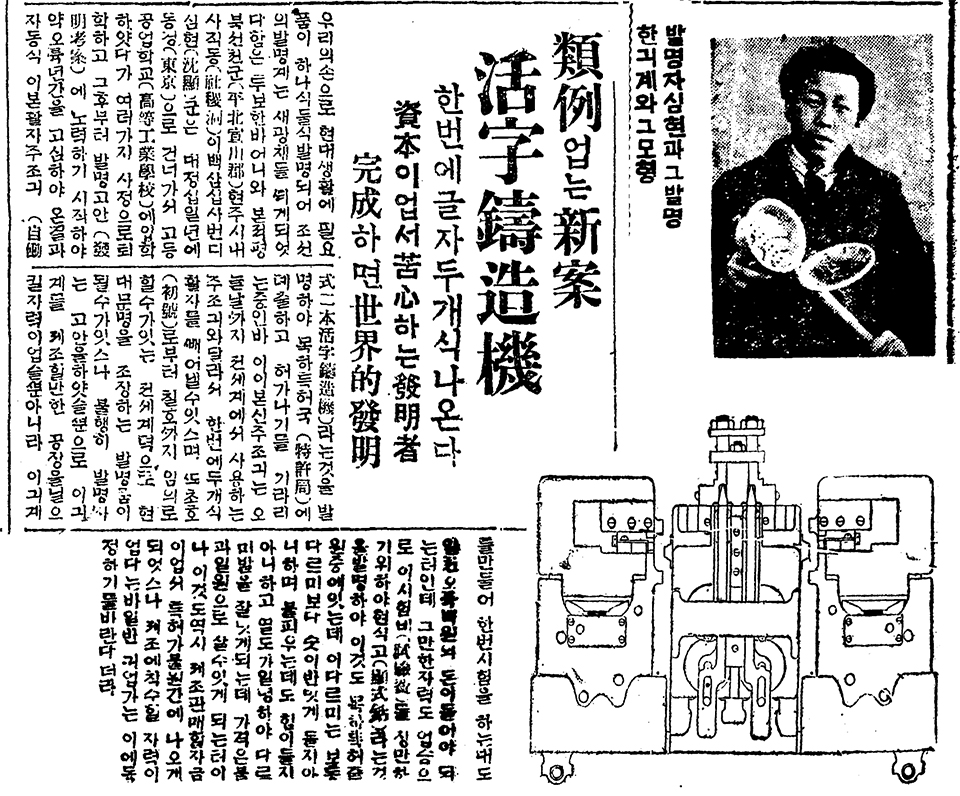
March 22, 1928, page 2 article (edited by the author)
‘Unprecedented Shinan Type Casting Machine
Two letters come out at once.
The inventor is struggling due to lack of capital.
A global invention if completed’
At the time, the world, or rather, the world since centuries ago, was in an era of type revolution. They printed and printed again. Planting trees to make paper, the printing industry for new knowledge and new history was one of the successful businesses. A man named Shim Hyun, living at 234 Sajik-dong, Seoncheon-gun, Pyeonganbuk-do, went to Tokyo, Japan in 1922, dropped out of technical school, and independently developed a typesetting machine called linotype. Linotype is a trademark name for a machine that makes metal type, which has become a common noun, and the article says that he is making something worthy of joining the ranks of global inventions, obtaining a patent, and waiting.
The technology of extracting type two letters at a time is an unprecedented invention worldwide, but there is no way to find a manufacturing plant, and it costs 15 million won for experiments alone. To raise this experiment cost, he is making an iron called Hyunsik Cobalt (顯式鈷), named after himself, and is currently applying for a patent. In order to earn the production cost of the type casting machine, he says that the iron, which is easier to light a fire and has better heat conductivity than existing irons, is cheap at 1 won, so entrepreneurs with good intentions should consider manufacturing it.
I wonder how Shim Hyeon, who dreamed of opening a new horizon in the printing industry and gaining fame as an inventor by selling a 1-won iron and experimenting with a 15 million-won typesetting machine, would evaluate the life of his junior, Park Jae-gan, as a prominent figure in the dictatorial era. Shim Hyeon's article appeared in the newspaper once again in the Free Newspaper on August 22, 1946, with the article 'Inventing Special Typesetting that Makes Typesetting and Typesetting Useless'.
According to the article, 'Mr. Shim Hyeon, who lives at 464 Jeongneung-ri, Sungin-myeon, Goyang-gun, has devised a new typesetting method. It is a method of composing a paper type by typing directly while looking at the manuscript, which can shorten the complicated process of extracting type, typesetting, and composing a plate. It is a machine called Linotype in foreign countries, and this is the first time it is being used in Korea.'
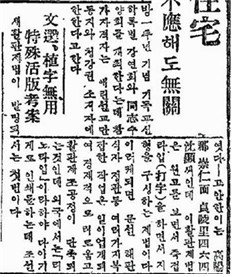
자유신문 1946년 8월 22일자 ‘문선(文選), 식자(植字) 무용 특수활판 고안’ 기사
After liberation, Shim Hyeon moved from North Pyongan Province to Goyang City, Gyeonggi Province. A person who appeared in a newspaper in 1928 during the colonial period could not live at the same address in the liberated space and moved to another place. The liberation from colonial rule and the 6.25 War seem like separate events, but they are actually an extension. Fact-checking specialized news, NewsToF, published an article on June 11, 2021, titled 'Do you know Shim Hyeon, the Korean linotype inventor who was shot?' (Reporter Kim Hyun-kyung).
According to an article by reporter Kim Hyun-kyung, Shim Hyun was born in 1903 or 1905 and is from Seoncheon-gun, North Pyongan Province. As a member of a colonized and dominated people, he devoted himself to invention, and in 1932, he invented a steaming machine for making rubber shoes and applied for a patent. It was introduced as a technology that improves the appearance of rubber shoes, reduces the manufacturing process, and increases production. What effect did the patent of the dominated people have? It has no effect. If he had decided to compromise with the regime or become a spy, his business would have been successful in no time, but he did not choose the easy path to quick success.
However, his inventive mind received the first Invention Encouragement Grant in 1938, organized by the Joseon branch of the Imperial Invention Association and awarded by the Governor-General of Korea. Thus, he single-handedly achieved a global printing innovation. However, Sim Hyeon, who made a name for himself as a young inventor, let alone commercializing it, ran for the National Assembly member for Goyang Gap District, Gyeonggi Province in 1948 but was defeated. It's been an eventful life. From the beginning, those who clung to the regime were desperate to succeed and become rich, regardless of colonial politics or post-liberation dictatorship, but a lonely self-made inventor like Sim Hyeon does not remain silent about the wrong-flowing history and tries to participate in politics, and his life becomes a drama.
Reporter Kim Hyun-kyung introduced Shim Hyun during the Korean War, quoting the book "Before History" by historian Kim Seong-chil (金聖七, 1913~1951), which was widely read in the 1990s.
The contents of the book are introduced as they are.
'September 24, 1950
There's a rumor that Mr. Shim Hyeon (沈顯), who ran a kindergarten next to the police box, was shot. There's also a story that someone died at Cheongsudang (淸水莊).
They say Mr. Shim was dragged out of his house and beaten to death in front of the house by the stream where they spin yarn. His wife followed and tried to stop them, but she was also shot, piercing one of her cheeks. The children are all young, and the villagers are all terrified and don't even try to look out... They say they covered him with a straw mat and left him there overnight. It's a pitiful thing.
Rumor has it that the reason Mr. Shim was killed was because he initially refused the partisans' request to vacate the kindergarten, but it's hard to know for sure. He was said to have graduated from some advanced industrial school in Japan and had a sign that said 'Shim Hyeon Monotype Research Institute,' but I don't know what it was about. Whenever I saw him, he was tending to vegetables and fruit trees in the garden. He was an elderly man who hardly spoke and I never saw him go out, so he couldn't have been playing around as a reactionary.’
(Kim Seong-chil, 『In Front of History』, Changbi, 1993, pp. 227-228)
Kim Seong-chil was a professor of history at Seoul National University during the Korean War, studied Yeolha Ilgi and Yongbieocheonga, and translated Pearl Buck's The Good Earth. If he had not recorded the incident he witnessed in Jeongneung, Seongbuk-gu, Seoul, we might not have remembered the end of Shim Hyun's life. Kim Seong-chil kept a diary from immediately after liberation until his death. He died in 1951 during the Korean War from a gunman's shooting at his home in Yeongcheon. His diary was brought to light by his son Kim Ki-hyeop (金基協, 1950~) who is also a historian, and his wife Lee Nam-deok (李男德, 1920~2012, professor of Korean literature at Ewha Womans University).
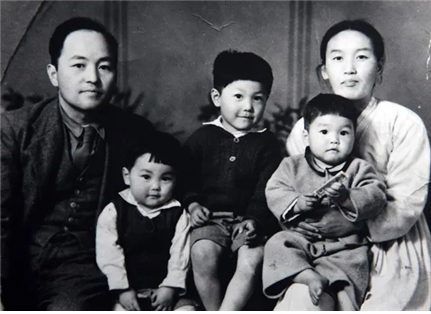
Kim Seong-chil and Lee Nam-deok couple and their children
How can Koreans, who want to live a wonderful life since they only live once, not escape from the dogma of ideology and not even think about the gap between perception and reality, as Kim Ki-hyup worried about? Digging into the fact that Shim Hyun and Kim Seong-chil died by execution is like erupting the lava of history hidden behind anti-communism with bare hands. I want to end the era of disgrace for the countless conscientious and pure souls seeking freedom.
댓글
( 0 / 500 )
NewYork
6
심현이라는 이름 하나로 두 세계—문학과 기술—를 오가며 시대의 단면을 꿰뚫는 글, 정말 흥미롭고도 안타깝습니다.
( 0 / 500 )
hongminsoo
5
자유라는 단어가 가장 억압적이었던 시대의 키워드였다니, 시대가 단어를 어떻게 왜곡하는지 보여주는 좋은 사례네요.
( 0 / 500 )
絶海孤島
8
이 글은 한 시인의 정체를 둘러싼 미스터리 이상의 가치를 갖습니다. 자유와 반공, 발명과 탄압, 주체와 국가라는 복합적 층위를 통섭적으로 풀어낸 점이 돋보입니다.
( 0 / 500 )
Atom
5
총살당한 발명가라니… 자유를 위해 싸운 이의 말로가 이렇게 비극적이라는 사실이 씁쓸합니다.
( 0 / 500 )
장미꽃
6
노인을 위한 연구가 사실상 이념 선전에 이용되었다는 분석이 너무 현실적이고 아프게 다가옵니다.
( 0 / 500 )
yesol
3
박재간이라는 인물의 이력이 이토록 복잡하고도 상징적이었다니, 반공과 자유의 이중성에 대한 고찰이 인상 깊습니다.
( 0 / 500 )
hanjoon
6
심현이란 이름을 통해 ‘개인의 창조성과 존엄’이 시대의 이념에 의해 얼마나 무참히 훼손될 수 있는지를 보여주는 훌륭한 사례 연구입니다. 더 많은 재조명이 필요합니다.
( 0 / 500 )
memo
4
사생아’라는 시와 심현의 삶을 연결시키는 방식은 한 편의 탐사르포에 가깝습니다. 문학 텍스트를 실증적이고도 상상력 있게 추적하는 방식이 인상 깊습니다.
( 0 / 500 )
風雲兒
5
심현의 비극은 단순한 개인사가 아니라, 지식인과 기술자의 주체성이 억압된 냉전기의 구조적 폭력을 고스란히 반영하고 있습니다. 잊힌 이름에 대한 이 회고는 일종의 역사적 정의 구현입니다.
( 0 / 500 )
최병철
5
반공주의자들의 ‘자유’와 심현 같은 이들이 꿈꿨던 ‘자유’는 얼마나 달랐을까, 생각이 많아집니다.
( 0 / 500 )
viva
3
역사적 사소함을 추적해 나가는 글의 태도에 큰 감명을 받았습니다. 심현의 이름이 다시 조명되기를 바랍니다.
( 0 / 500 )
hanna
3
심 현이라는 인물을 통해 우리 근현대사의 복잡함과 아픔을 깊이 있게 조명해주셔서 감사합니다. 잊혀진 이름 뒤에 숨겨진 의미와 삶을 다시 생각하게 만드는 글이네요.
( 0 / 500 )
Michael7kim
3
한 개인의 삶과 발명, 그리고 그 시대의 역사적 흐름이 이렇게 촘촘하게 연결될 수 있다는 점이 인상적입니다. 읽으면서 많은 것을 배우고 느꼈습니다! 잊혀진 이름 뒤에 숨겨진 이야기들이 더 많은 사람들에게 알려졌으면 좋겠어요.
( 0 / 500 )
신고내용
신고내용을 선택해주세요
회원비난/비하/욕설글 및 댓글도배성 게시물저작권 침해/불법자료 유출허위사실유포개인정보 유출.사생활 침해무단광고/홍보음란물 및 도박 불법 광고물범죄행위 관련 글불법행위 관련 소개물품 판매 및 사기글악성코드 및 스파이웨어 유포기타 사유 및 운영진 판단


비밀번호를 잊으셨나요?
Sign in with Google
All information provided by us is free of charge and is for the public good.