品

Corea든 Korea든, 품격이 먼저다
Whether Corea or Korea, dignity comes first.
Whether Corea or Korea, dignity comes first.
Now
지금
751 Diaspora
Heritage
유산
Humanity
인문
Mirengsi
未冷尸
Politics
정치
Media
언론
사주에서 도충(倒沖)은 한쪽의 기세가 강해져 맞은편에 잠재한 작용을 끌어낸다는 점에서 극과 극은 통한다고 할 수 있으며, 물극필반(物極必反)의 이치와 맞닿아 있다.

회고回顧/懷古
칼럼
PinkPepper
Nostalgia 163. The future of the third-rate people of Dochung 1

0
2026. 11. 06
- Despite the 'resolution urging expulsion' passing for lawmakers who deny the May 18th Democratic Uprising and Chun Doo-hwan's conviction for insurrection, the People Power Party shows a passive attitude with no real sanctions.
- The author criticizes this political behavior as 'playing with numbers,' interpreting it as a 'two birds with one stone' strategy aimed at attacking Democratic Party leaders Kim Min-seok and Lee Jae-myung.
- Korean politics is repeating past divisive behaviors and ignoring the demands of future generations, which is attributed to outdated legal principles and political actions that treat the public as 'monkeys in the morning and evening.'
- Furthermore, the entanglement of religion and politics, as seen with issues like Shincheonji and the Unification Church, is a 'politics of destroying common sense' deeply rooted within Korean society, warned to be an intrinsic time bomb threatening the nation.
- In conclusion, the author assesses that Korean society is trapped in politics that foster hatred and division, and within these 'garbage-like procedures,' only Lee Jae-myung is struggling, revealing a strong critical awareness.
People Power Party denying the May 18th Uprising and the rebellion verdict
On November 5th, a little over a month after Kim Tae-gyu, a member of the People Power Party, stated on the JTBC YouTube broadcast “Genreman Yeouido” on September 30th, 2026, that “the actions of Chun Doo-hwan and former President Yoon Suk-yeol do not constitute rebellion,” a “Resolution to Demand Expulsion” was passed against him. The People Power Party naturally abstained from the anonymous vote in the plenary session, but out of a total of 167 votes, there were 166 in favor and 1 invalid vote.
Earlier, on August 26th, a “Resolution to Demand Expulsion” was passed against Lee Jin-sook, a member of the People Power Party. Lee Jin-sook, who co-hosted the forum “Re-examining the May 18th Democratization Movement: A Public Forum at the National Assembly Library” with the New History National Movement on August 13th, was held accountable for a forum participant referring to the May 18th Uprising as a “riot.” Most of the People Power Party members walked out during the vote, and out of a total of 159 votes, there were 157 in favor, 1 against, and 1 invalid vote. This was the second such case in the 22nd National Assembly, and both resolutions were passed under the leadership of Representative Kim Min-seok.
During the time of the incompetent Jeong Cheong-rae, there was no need to play number games with expulsion resolutions, so this clear attempt to undermine Party Leader Kim Min-seok is also an attack on President Lee Jae-myung, aiming for a double kill. However, the only action the ruling bloc can take is a meaningless 'Resolution to Demand Expulsion.' The ecosystem of the political arena, which adopts a response method from the 1980s (Dangi 4288, AD 1955), and the media that broadcasts it live, are laughable.
First, it was the May 18th Uprising, a month later, Yoon's rebellion, and now Joo Jin-woo has questioned the President's wife and son. This is a group determined to increase the probability of succeeding at least once if they keep barking. It has been quite some time since South Korea settled into a society that coexists with such types. Lee Myung-bak's comment brigade played a significant role in this. In modern society, the path to a nation's downfall is not external invasion, but rather political actions that destroy common sense, emerging from within a populace mixed with those sown by the seeds of invasion. Therefore, there will not be a single member of the National Assembly who grieves over the phenomenon of their sophistry being justified and the increase of third-rate voters who defend them.
Some voters include seniors who may not be able to exercise their right in the next general election, and those in their 20s who are just starting out in society and are highly enthusiastic about their vote. The 'political disparity' felt by seniors, young people, and the 'ajumma' and 'ajeossi' in between during elections is an extreme division. The greatest meaning behind the public's decision to elect Kim Min-seok as party leader is to ensure he assists Lee Jae-myung well. This is because, as far as has been revealed, Lee Jae-myung has proven to be the politician with the least personal ambition. So why is Korean politics not ashamed of engaging in political acts from 1955 when dealing with citizens who will experience 2050? The illegality of the procedure, which merely asks us to be satisfied with a resolution for expulsion, must be improved. The past legal principles that treated the public like monkeys in the 'jo-sam-mo-sa' fable must be discarded to improve this disharmonious politics and at least somewhat satisfy the highly political desires of the public.
A country where a party of rebellion holds sway
Citizens wishing to enter the National Assembly must submit identification and state their reason for visiting at the entrance to receive a visitor's pass. Foreigners are no exception. They also pass through a security checkpoint, but I'm not sure if it's working properly. A common expression seen on the faces of people queuing in long lines is, 'What business brings you here?' While physically queuing and taking out their ID, their eyes are busy reading the atmosphere and contemplating their own affairs. Can National Assembly members discern that even though these people are physically in a low posture, their eyes are intense?
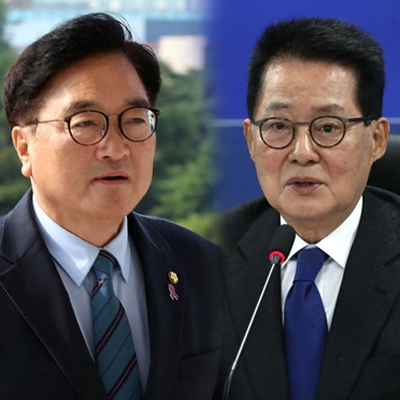
Probably not. On November 3rd, Woo Won-sik, who at least served as a former Speaker of the National Assembly, walked slowly, grinning, to an emergency general meeting held in the main building concerning allegations of mass entry of Shincheonji members into the Democratic Party, which was held behind closed doors at the National Assembly. His face, however, was not filled with thoughts of the country, but rather with uncontrollable personal ambition, making his small mouth stretch wide as if it would tear. Furthermore, it is rumored that the so-called 'Democratic Party watermelons' (a derogatory term for those perceived as disloyal) all arrived later than the scheduled time. The public also wants to participate in the fun business of being the Speaker of the National Assembly and then returning as a member. Are only you, just you, eating?
If Kim Min-seok, who injured his hand trying to crush the 'watermelons' within the Democratic Party during the internal rebellion party's staggered 5.18 build-up, is in trouble, then Lee Jae-myung is in trouble. And if Lee Jae-myung is in trouble, then the dream of an ideal society where the majority of the people secure their future together through political reform collapses. Korean society is a nation that underwent an unprecedented ideal experiment in human history last century. While it may be a form of tempering, it is a dangerous society where the deception of biological genes, born from collaboration with the enemy, taking political precedence has taken root, and people live with different ideals. Koreans who are completely unaware of this history shout '멸공' (destroy communism) while invoking the learned knowledge of the North Korean Communist Party and the Chinese Communist Party, but Koreans themselves are a ticking time bomb, so the real danger lies within Korean society. The energy capable of exploding the genes etched with desire and historical scratches is now at its peak.
In 사주 (four pillars of destiny), 도충 (倒沖, inverse冲) can be understood as extremes meeting, where the strong momentum of one side draws out a latent effect on the opposite side, aligning with the principle of 물극필반 (物極必反, when things reach an extreme, they reverse). When yin reaches its extreme, yang emerges, and when yang reaches its extreme, yin emerges. As a single character gains strength through repetition, the effect of the opposing character, which is not present in the 사주 chart, becomes apparent. This can also be interpreted from the perspective of 다자무자 (多字無字, many characters, no characters).
Today's Shincheonji and Unification Church issues are merely the manifestation of long-standing influences. As the influence of religion grew, the relationships between powerful political figures entrenched behind them and those who profited by relying on their power also came to light. The power that sustained these relationships stemmed from faith determining people's judgment and actions, and politics exploiting that influence. Looking back at the relationship between certain Christian groups and the political establishment in modern Korean history, the controversies surrounding Shincheonji and the Unification Church show how the logic of theocracy transforms from ancient times into modern politics and to what extremes it can go.
Historically, this is the beginning of unraveling the history of historical distortion that has now come to light. When the world is struggling with chaos, to stand firm, one needs to look at the history of Christianity embedded in the Korean DNA. The problem is that a correct understanding of religion entails the difficulty of self-denial, negating the values of one's own life. However, I wonder if there will be time to mourn faith within the Truman Show.
Hate is boring.
On the night of November 3, 2026, when Kim Min-seok suppressed his anger and covered up the Shincheonji list, in Austin, Texas, USA, James Talarico, a Democratic Texas State Senator-elect born in 1989, gave a speech saying, “Hate is boring.” This is a story worth noting, as Korea is a country where politicians born in 1989 cannot emerge, or if they do, they are likely to be flawed.
“Hate is predictable. Hate is boring. Hate can't lower our energy bills. Hate can't teach a child to read. Hate can't build a future.”
He said that hate is predictable and boring. Hate cannot lower energy bills, teach a child to read, or build a future. What about Korea? Politics exists, and will continue to exist, to foment division and conflict.
Korean politics has been at such a low mental level that the public has been swayed by Kim Eo-jun's incitement for over 20 years. The phenomenon of chronic human deception, which became chronic while being manipulated by Lee Myung-bak's comment brigade, was evident. In late December 2022, Park Ji-won, a former director of the National Intelligence Service who had just rejoined the Democratic Party, appeared on News Factory to introduce Kim Eo-jun's new channel, 'Humility is Hard.' The era of Yoon Suk-yeol was such that politics was just a game among themselves, to the extent that a former NIS director could appear on a third-rate wordplay show.
As a result, Park Ji-won probably didn't realize he would be putting a motor on Kim Eo-jun's falling wings, but if the elders of this country, including the two major watermelon figures of the Democratic Party, Woo Won-sik, are only at this level, then this country has no future. In a country where procedures are garbage, Lee Jae-myung is working alone for an ideal nation, receiving criticism. To attack Lee Jae-myung, there are censorship agencies and the pro-American coalition party that allowed the creation and display of placards in Gwangju, paid for, that even glorify the 5.18 massacre. The civil servants who permitted the glorification of the massacre are also fine. All citizens should spit on each other and slip on that spit, fighting until, in each person's view, the heads of the vermin are smashed.
댓글
( 0 / 500 )
想像
9
가장 아프게 다가오는 것은 국민의힘의 역사 왜곡보다도 그런 정치가 가능하도록 방치한 우리 사회의 현실에 대한 통찰입니다. 민주당 역시 예외일 수 없습니다. 정치가 국민의 삶과 미래를 위한 수단이 아니라 권력과 사익을 지키는 도구가 된다면 정당의 이름이 무엇이든 결국 국민을 배신하는 것입니다. 증오를 넘어 상식과 책임이 작동하는 사회를 만들어야 한다는 말씀에 공감합니다.
( 0 / 500 )
wonderland
5
국민의힘의 역사 왜곡과 내란 부정에 분노하는 것만으로 민주당의 책임이 사라지는 것은 아닙니다. 신천지 집단 입당 의혹부터 당내 기득권과 계파정치까지 제대로 정리해야 합니다. 국민이 민주당에 기대하는 것은 상대 당 비판이 아니라 스스로 달라지는 모습입니다.
( 0 / 500 )
lovepoem
7
과거를 바로 세우지 못한 사회는 같은 잘못을 반복하고, 현재의 잘못을 직시하지 못하는 정치는 미래를 말할 자격이 없습니다. 5·18과 내란, 정교유착을 하나의 역사적 흐름 속에서 바라보려는 시선이 인상적입니다. 증오와 편 가르기를 넘어 우리 사회의 근본적인 모순을 성찰해야 할 때입니다.
( 0 / 500 )
萬松
8
이 글은 단순히 특정 정당이나 정치인을 비판하는 글이 아니라 한국 사회가 어디에서 길을 잃었는지를 묻는 글이라고 생각합니다. 역사를 왜곡하는 정치, 종교와 권력이 결탁하는 구조, 국민의 판단을 흐리는 선동이 결국 우리 사회의 미래를 잠식하고 있다는 문제의식에 깊이 공감합니다.
( 0 / 500 )
kimpapa
5
5·18 민주화운동을 폄훼하고 12·3 내란마저 부정하는 정당이 어떻게 대한민국의 미래를 책임지겠다고 나서는가. 민주주의의 기본 가치조차 부정하면서 국민의 선택을 요구하는 것은 정치적 모순이다. 역사 왜곡과 헌정질서 파괴에 대한 책임부터 인정하라.
( 0 / 500 )
열화
5
정치가 국민의 삶을 개선하는 경쟁이 아니라 상대를 무너뜨리기 위한 증오와 선동의 수단으로 전락했다는 지적에 공감합니다. 다만 민주당 역시 내부의 기득권과 계파정치부터 청산해야 합니다. 국민이 원하는 것은 편 가르기가 아니라 책임지는 정치와 실질적인 개혁입니다.
( 0 / 500 )
박성민
4
이재명 정부의 성공을 바란다면 민주당부터 정신 차려야 합니다. 당 대표를 둘러싼 계파 갈등과 의혹 덮기에 시간을 허비할 때가 아닙니다. 국민이 만들어 준 정권교체의 기회를 당내 정치인들의 자리다툼으로 소진한다면 그 책임은 고스란히 민주당에 돌아갈 것입니다.
( 0 / 500 )
最强童顔
4
김민석 대표가 당내 갈등을 수습하는 과정에서 신천지 집단 입당 의혹까지 제대로 다루지 못한다면 민주당의 신뢰 회복은 어려워집니다. 이재명 정부의 성공을 진정으로 바란다면 측근을 보호하는 정치가 아니라 잘못된 관행과 기득권을 과감히 정리하는 정치가 필요합니다.
( 0 / 500 )
parang88
3
신천지와 통일교 문제는 특정 종교에 대한 비판을 넘어 종교 권력이 정치에 개입하고 정치권이 이를 이용해 온 구조적 문제입니다. 여야를 막론하고 관련 의혹을 투명하게 조사해야 합니다. 정치적 유불리에 따라 덮거나 선택적으로 공격한다면 국민의 불신만 커질 것입니다.
( 0 / 500 )
弘益人間
2
증오는 지루하다는 제임스 탈라리코의 말이 한국 정치에도 절실합니다. 과거의 상처와 이념 대립을 정치적 자산으로 삼는 시대는 끝나야 합니다. 2050년의 대한민국을 준비하려면 역사 왜곡에는 단호하게 대응하되, 국민의 에너지를 미래 산업과 민생, 교육과 사회 통합에 집중시키는 정치가 필요합니다.
( 0 / 500 )
민준
1
5·18을 소요 사태로 왜곡하고 12·3 내란을 부정하는 세력이 여전히 제도권 정당의 이름으로 정치를 한다는 사실 자체가 대한민국 민주주의의 취약성을 보여줍니다. 민주주의는 선거로만 지켜지는 것이 아니라 역사적 사실과 헌정질서에 대한 최소한의 합의 위에서 유지됩니다.
( 0 / 500 )
신고내용
신고내용을 선택해주세요
회원비난/비하/욕설글 및 댓글도배성 게시물저작권 침해/불법자료 유출허위사실유포개인정보 유출.사생활 침해무단광고/홍보음란물 및 도박 불법 광고물범죄행위 관련 글불법행위 관련 소개물품 판매 및 사기글악성코드 및 스파이웨어 유포기타 사유 및 운영진 판단


비밀번호를 잊으셨나요?
Sign in with Google
All information provided by us is free of charge and is for the public good.