品

Corea든 Korea든, 품격이 먼저다
Whether Corea or Korea, dignity comes first.
Whether Corea or Korea, dignity comes first.
Now
지금
751 Diaspora
Heritage
유산
Humanity
인문
Mirengsi
未冷尸
Politics
정치
Media
언론
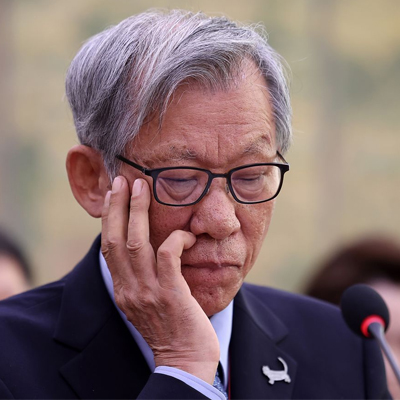
유홍준이 대단한 사람처럼 그려진 학술적 이력은 식민지 지배 이념의 학문적 유산을 청산하지 못한 서울대학교의 구조적 한계가 자리하고 있다.

회고回顧/懷古
칼럼
PinkPepper
Nostalgia 160. Yoo Hong-jun, the end of a seasoned elite

0
2026. 10. 22
Interference of a sense of privilege that disregards public service
A disciple lost his master. Yoo Hong-jun, upon achieving success, let go of an employee he had hired, and the head of a household became unemployed. This is the fate of a researcher in Korea's typical top-down humanities environment, a country without true masters. Foreign students flock to this land, thinking it's great, where no one nurtures disciples and no one wants to be one, but they too will eventually realize. Koreans don't hide their curses, insults, envy, and jealousy among themselves, but they show warmth to foreigners—a perverse form of Sadaejuui (servility to great powers) so deeply ingrained that it can't even be called a slave mentality.
Rather than employing Koreans as assistants, there's a habit of not taking on Korean disciples. If I can't get research funding for my own children or myself, I absolutely won't share information with others. Yoo Hong-jun probably knows all these academic practices better than anyone. Moreover, since his major is art history, the value of artworks often lacks clear evaluation criteria, making them susceptible to arbitrary assessment based on interpretation and vested interests. Artworks of colonized peoples, to put it extremely, are akin to stolen goods. He had easy access to artifacts bearing the scars of the past through various channels, so he would have felt proud if the exhibits at the National Museum of Korea and the Jeju Chusa Museum were genuine, and unashamed if they were replicas, donated items, or personal collections.
Yoo Hong-jun is famous for the rumor that once he grabs a microphone, he doesn't let go, regardless of time or place. He reportedly ignores master's and doctoral students and assistants, endlessly boasting about his knowledge. This is likely due to never having cultivated scholarly humility as part of his character, and perhaps because he has never felt the need to be humble. The broadcasting stations that promoted him are also groups that should reflect. The cultural identity that unassertive Koreans seek to gain through Yoo Hong-jun, in a climate where people cling like pigs and dogs to anything popular and profitable, should not be sought from graduates of Seoul National University, which cultivates talent with a colonialist historical perspective.
Although he rose to prominence with the 'My Cultural Heritage Exploration' series, there are rumors that not all of it was his own writing. It would be good to investigate whether it's acceptable for a writer to have ghostwritten for him, much like a painter might have an assistant. If true, this would be a public deception against Koreans who mistakenly believe themselves to be cultured citizens. Alternatively, it could be a conspiracy born out of anti-intellectual jealousy, similar to the rumor that Yu In-chon, who served twice as Minister of Culture, Sports and Tourism under the pro-Japanese, anti-national figures Lee Myung-bak and Yoon Suk-yeol, is homosexual.
Why does Korean society fail to confront the fact that politics, culture, and art have been formed and connected within a single context? Thoughts become institutions, institutions shape the way politics and society function, and within that, tangible products, including books and household items, are created. Objects that people hold, use, and wear out accumulate the life, joys, and sorrows of their time, and some of them gain artistic and cultural value over time. If we call those who were born and lived in the past our ancestors, shouldn't we first shed light on the historical processes through which their lives, contained in books, household items, and artworks, were scattered and disappeared, in order to recover lost and distorted history? It is a betrayal of human social responsibility for those who deal with art and art history to avoid these fundamental questions by riding on the coattails of the establishment's expansion of power. If the cultural sector ignores criticism and self-reflection even as the space for those with proper values and responsibility in public office shrinks and opportunism prevails, then that silence, too, must become an object of reflection.
At the time of the Sungnyemun fire in 2008, he was on an overseas trip with his wife. Oh Se-hoon also went on an overseas trip with his wife as the mayor of Seoul, but the media did not make an issue of it, and Seoul citizens ignored it to renew their real estate declarations. The fact that Yoo Hong-jun, who was the head of the Cultural Heritage Administration when Sungnyemun burned down, resigned was because the political sentiment of the people at the time was at rock bottom. A standard is needed for how the expenses for overseas business trips of Korean politicians and high-ranking officials with their spouses are managed. If there is uncertainty in rewards and punishments and a principle in merit-based appointments, then the embezzlement of taxes that is glossed over can be prevented in advance.
In the United States, some high-earning corporate employees are provided with spouse-accompanied expenses for incentive trips, but even then, it's only possible if the wife pays for her flight and accompanies her husband, and he holds a fairly high position and has contributed significantly to the company. The habit of not refusing even lye if it's free is a result of the compensation psychology for material deprivation born from colonialism and war, but I wonder if it's not time to question and reflect on this ecosystem itself, which only aims for box office success with shallow tricks without cultural depth.
Looking back, Roh Moo-hyun was a patriot and a good leader, but he was branded with the fierce fate of having an evil person like Moon Jae-in as a close associate. His tragedy cannot be seen as merely a personal misfortune. I see the political hostility that drives a national leader to death as a tragic trend in the Korean world, a result of a powerful clash of civilizations and its aftermath. In a political landscape without a reflective conservative force and a capable progressive force, Yoo Hong-jun is a figure who skillfully slipped through the cracks of controversy and responsibility, much like the slippery Ban Ki-moon. The fact that he was involved in the creation of the presidential tomb site he served also remains an uncomfortable question. What were the roles of Moon Jae-in, Yoo Hong-jun, and Seung Hyo-sang, and how faithfully did that space embody the aspirations of the people to commemorate and remember the deceased's life?
Has Korea truly become a society where a self-reliant president faces threats to their political survival and even biological safety, and where neither leaders nor citizens can protect their lives and dignity? Korean society must now bring these fundamental questions into everyday life. This issue was sparked by the irony of Yoo Hong-jun from the National Museum of Korea, who planned the 'Rice Table' exhibition, being involved in the creation of the peculiar Roh Moo-hyun tomb and exhibiting his personal collection, claiming that even a single meal is a nation's grace. The origin of this phrase is believed to be a slogan used by the Buddhist monk-general Giheo (騎虛) Yeonggyu (靈圭) (?-1592) during the Imjin War when he raised a righteous army in Chungcheong Province and recruited monk soldiers. It originated from a report by royal family member and Hyeongseonggam (湖城監) Yi Ju (李柱) to King Seonjo on August 26, the 25th year of King Seonjo's reign (1592), stating, '有僧擧義於忠淸曰, 一飯皆是國恩' (A monk raised a righteous army in Chungcheong, saying, 'Even a single bowl of rice is all the nation's grace').
In a country that doesn't even teach Chinese characters, discussing forgeries, the process of concluding that it was written by the pro-Japanese Park Jung-yang, who held the conviction that 'even a single meal is the nation's grace,' is not transparent. Without comparing it to the calligraphy and遗墨 of the anti-Japanese activist Park Won-geun (朴源根, 1912~1950), even if Yoo Hong-jun collected it believing it to be the work of an anti-Japanese activist, the namesake Park Won-geun has been posthumously insulted. Even though Yoo Hong-jun has resigned, it would be good if he disclosed the acquisition path of his collection.
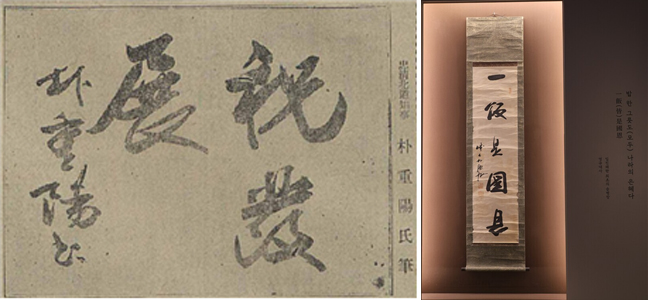
(Left) Chosun Ilbo, June 22, 1923, front page, commemorative issue, congratulatory message from Park Jung-yang. (Right) The controversial Yoo Hong-jun collection displayed at the National Museum of Korea exhibition.
Although Park Jung-yang's writing is more skillful than expected, there is no definite guarantee that the phrase '一飯是國恩' (A meal is a national grace) under the name Park Won-geun, which Park Jung-yang allegedly used, is in Park Jung-yang's handwriting, considering the style of the postcards he sent to Japan after liberation. This implies a wide variety of handwriting styles, but in the current Korean Hanja (Chinese characters) ecosystem, where literacy in reading and writing Hanja is remarkably low, who truly has the right to discuss forgeries? It's suspicious who hands over artworks to Yoo Hong-joon in the art market, sets prices, and conducts transactions. Colonialism destroyed everything traditional, from the intangible values of ideology, philosophy, and institutions to the tangible tools that supported life, and cultural heritage became stolen goods. It's questionable whether antique art can be considered different from dealing in stolen goods.
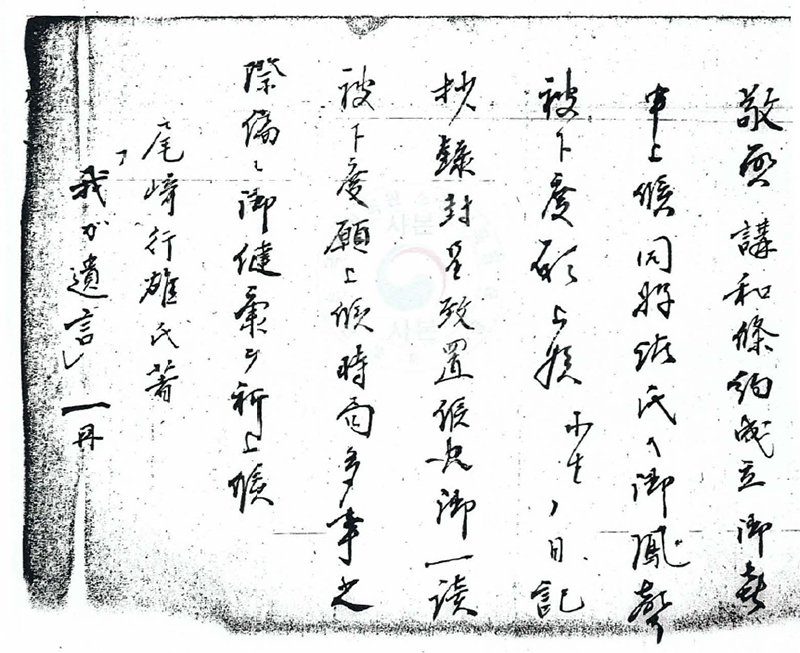
A postcard Park Jung-yang sent to an acquaintance in Japan during the Korean War. For some, it was war; for others, it seems to have been a time of utter peace, cleaning up the remnants of colonialism.
Yoo Hong-joon's actions, which are unrelated to the public's desire for a culturally rich nation, have not been controversial until now. However, with the current situation where he was criticized at the National Assembly audit over the issue of his forged (?) collection and subsequently resigned, what exactly is the point of contention? Is the problem that he owned the calligraphy of a pro-Japanese collaborator, believing it to be that of an anti-Japanese independence activist? Is the problem that he used the National Museum of Korea as an opportunity to boost his personal recognition by exhibiting his private collection? If it's not the calligraphy of a pro-Japanese collaborator, or even if it is, how is that itself a problem? In this land, mixed-race descendants of pro-Japanese collaborators have monopolized wealth and honor for generations; is solving the problem by just removing Yoo Hong-joon enough? If a list of Yoo Hong-joon's children's father's artworks circulates, how will they handle inheritance taxes? As long as antique art is traded in the market as high-value goods, controversies over the authenticity of artworks can spread widely.
Yoo Hong-jun, a scholar knowledgeable in art, rose to public office, gaining wealth and honor. He may have ended up in Lee Jae-myung's election camp in his old age, perhaps securing the position of Director of the National Museum of Korea to avoid a confirmation hearing, but ultimately, he failed to conclude gracefully. It seems he challenged for this role, believing it to be a stage he could dominate in the art history community, which lacks suitable personnel, but he is truly a seasoned scholar. It's questionable whether young people can consider him a role model in that field, and if one dreams of working in museums and art galleries, Yoo Hong-jun's career path will be of no help at all. The issue of how transparently and cleanly jobs are filled in the overflowing number of various memorial halls, and the problems with their systems and structures, are not unrelated to a history mired in a deep swamp. Even convenience stores or cafes opening in these institutions are subject to accusations of favoritism. News articles claiming South Korea is a cultural powerhouse are embarrassing.
Beyond the power that has avoided copyright disputes
If you go to Jeju Island, there is a Chusa Memorial Hall. It's questionable whether that memorial hall was established without special favors. I wonder how the land acquisition budget, exhibition hall design and construction costs, and the professionalism of the curators (including the transparency of their hiring) were ensured for building a memorial hall in such a strange place, where one can often see Yoo Hong-jun's collection despite its lack of fundamental basis. Since Yoo Hong-jun, a leader among South Korean cultural heritage and art historians, is at this level, it has become a kind of custom to build memorial halls and museums with local government budgets, and it's a major project to provide a livelihood for retired public officials. Art projects that drain national coffers, with not only domestic but also overseas Koreans participating, lead to a significant waste of national resources due to tax waste, damaging the quality of culture and the value of heritage with meager common sense, without proper historical verification of past figures.
Joseon, during the lifetime of the four Dasan brothers, was on the brink of collapse. An article in the Annals of King Jeongjo, dated October 26, 1793 (the 17th year of Jeongjo's reign), records that before George Macartney (1737-1806), the head of the British delegation, met Emperor Qianlong (1711-1799) and then traveled to Guangdong to meet the governor-general, Yi Ui-jik, the mayor of Uiju, reported to King Jeongjo a list of gifts from the British delegation, which was prepared by Hong Taek-bok (1749-?), a Joseon interpreter. King Jeongjo died seven years after this report. This article is a significant document, offering many implications when considering the direct causes of Joseon's downfall. Whether this article remained in the Annals by sheer luck or by design, without being omitted, is unknown. The Dasan family was at the center of various tragedies that arose when Catholic faith was defined as a challenge to the national order. When it becomes possible to assume that the Annals of the Joseon Dynasty are a primary source altered by Japanese hands, Macartney, the Dasan family, and Jeongjo will be re-examined, and Yu Hong-jun's worldview will fall, leaving its ignominy in history.
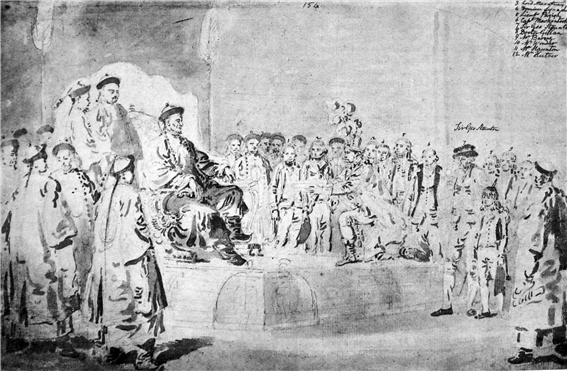
Lord Macartney Embassy To China 1793
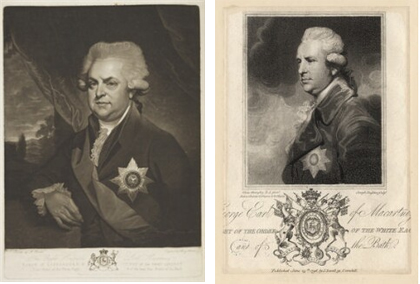
(Left) George Macartney, 1st Earl Macartney, 1790, (Right) George Macartney, 1st Earl Macartney, 1796
National Portrait Gallery
He graduated with a Bachelor's degree in Aesthetics from Seoul National University (1980), earned a Master's degree in Art History from Hongik University (thesis: "The Life and Art of Neunghogwan Yi In-sang," 1983), and received a Ph.D. in Oriental Philosophy from Sungkyunkwan University (1997) with his dissertation, "A Study on Painting Theories in the Late Joseon Dynasty: Focusing on Jeonsin-ron and Sasill-on." The painting theory (화론) of the late Joseon Dynasty, for which Yu Hong-jun received his Ph.D., integrated the classical painting principle of 'Ihyung-sasin' (以形寫神) by Gu Kaizhi (344?-405?), a painting theorist of the Eastern Jin Dynasty, into Joseon Dynasty painting. Ihyung-sasin asserts that while accurately depicting the subject, it should not merely resemble the external form but also reveal the spirit and inner truth of the subject. Originally, it was an abbreviation of 'Jeonsin' (傳神), or 'Jeonsin-sajo' (傳神寫照), in portrait painting, meaning that when painting a portrait, not only the external appearance but also the personality and inner world of the figure should be expressed.
However, art history is a pretentious discipline that conceals its inherent limitations with obscurity, and globally, it has played a subservient role in diluting or concealing the violence of colonial rule and the history of massacres and exploitation. Strictly speaking, its value as an academic discipline is questionable. It is a typical example of 'Misguided Pedantry,' a focus on trivial matters that ignores the essence of humanity and the purity of tangible and intangible artworks created by humans, thus reversing priorities. It's as if pedantry has gone too far, rolling along by inertia without academic reflection or self-criticism. While academia is more focused on maintaining its self-established authority and forms than on uncovering the truth, the means have overwhelmed the ends, and the trivial has replaced the essential. Although Yu Hong-jun, following Ko Yu-seop, Choi Wan-su, and Lee Tae-ho, enjoys wealth and fame at its peak, academic self-reflection that this cannot continue should have emerged already if one had properly reviewed the research history.
The academic career that portrays Yu Hong-jun as a great figure is rooted in the structural limitations of Seoul National University, which has failed to liquidate the academic legacy of colonial rule's ideology. He has not deviated from the academic framework that Japan tailored, solidified, and filtered according to its colonial logic, and has formed his skills and values based only on selected, hollow data within that system as the foundation of his knowledge. Consequently, he has lived his life mistaking a successful career for escaping the unfortunate swamp of one-dimensional knowledge, where his breadth of thought and critical insight are limited, trapped in the dead end set by colonial academia.
Japan's historical distortions go back so far that they cannot be imagined within the common sense of Koreans. Just a hundred years? Not at all. The methods of distortion, accumulated over hundreds of years, were mobilized to portray Japan as the hegemon of Asia. The ambition to occupy vast territories by advocating Hakkō ichiu (八紘一宇) as a logic of imperialist expansion was revealed through wars of aggression. If one believes that research materials encountered in schools that cultivated talent in line with the Nae-seon Il-che (內鮮一體) policy are raw data, without any selection or processing, then that naivety contradicts the sense of superiority that considers oneself an intellectual elite.
Here, Koreans, whose genes for broad-mindedness disappeared due to war and colonization, have transformed into a naive disposition full of stubbornness and desire for material possessions. A value system has become prevalent where people mistakenly believe that the entire study of colonial historiography, which dichotomized history and art history into two extreme knowledge systems, is all there is. This fragmented knowledge has become like a license for advancement and success. The Korean art history community has thus grown into a functional tool for historical distortion led by Japan, and its privileges are also deeply rooted. As long as we forget the past history where the Republic of Korea's art research history began with the cultivation of colonial figures according to the colonial system, our ability to uncover the full extent of oblivion will not improve.
You might ask what I am, criticizing Yu Hong-jun. I am someone who believes that all universities in the Republic of Korea that write and pass academic theses for busy people who don't have time to 'Julie' and grant degrees should disappear. I am a dull person of shallow learning, who spends a whole day searching for a single character. The Republic of Korea will find it difficult to grow as long as it remains buried in the academic values created by imperial Japan, which erased and fabricated its previous history.
댓글
( 0 / 500 )
kth69
7
문화유산을 다루는 사람에게 필요한 것은 명성이나 권위가 아니라 역사적 진실 앞에서의 겸손과 책임감입니다. 개인의 소장품이 공공 전시에 활용됐다면 입수 경위와 진위 감정 과정부터 투명하게 공개해야 합니다.
( 0 / 500 )
백현이
7
식민지 잔재 청산은 친일 인물 몇 명을 비판한다고 완성되는 일이 아닙니다. 그들이 남긴 자료를 누가 수집하고 해석하며 어떤 기준으로 역사적 가치를 부여하는지까지 살펴야 합니다. 식민지 시대의 학문적 틀을 비판 없이 답습하고 있다면 독립 이후에도 정신적 식민 상태에서 벗어나지 못한 것입니다.
( 0 / 500 )
backhyun
6
문화재를 국민의 역사라고 말하면서 정작 그 가치를 판단하는 권한과 정보가 소수의 전문가에게 집중돼 있다면 문제가 아닐 수 없습니다. 유홍준을 둘러싼 논란도 개인의 유명세로 덮을 일이 아닙니다. 공공기관은 누구의 소장품이냐가 아니라 무엇이 사실이냐를 기준으로 판단해야 합니다.
( 0 / 500 )
ganghyug
5
문화유산은 개인의 명성을 높이기 위한 장식품이 아니라 국민 모두가 함께 보존하고 해석해야 할 역사적 자산입니다. 특히 공공 박물관의 전시에 개인 소장품을 활용했다면 작품의 진위와 출처, 전시 선정 기준에 대해 합리적인 설명이 뒤따라야 합니다.
( 0 / 500 )
a72kim
4
이번 논란을 한 사람의 거취로 끝낼 것이 아니라 문화계의 권력 구조와 검증 시스템 전반을 돌아보는 계기로 삼아야 합니다. 이제는 자료 자체를 검증하는 주체적인 역사 연구가 필요합니다.
( 0 / 500 )
moonjoon
5
의혹은 감정이나 추측이 아니라 자료 공개와 독립적인 검증으로 해소해야 합니다. 그것이 공공기관에 대한 국민의 신뢰를 지키는 길입니다. 유명 학자의 이름값보다 연구의 독창성과 검증 가능성을 우선하고, 젊은 연구자들이 공정하게 기회를 얻을 수 있는 구조를 만드는 것이 진정한 학문 개혁입니다.
( 0 / 500 )
동준84
3
학자의 진정한 유산은 자신이 차지한 자리나 대중적 명성이 아니라 후학에게 남긴 지식과 학문적 양심입니다. 작품의 진위와 소장 경위에 의문이 제기됐다면 변명이나 침묵보다 객관적인 자료로 해명하는 것이 순서입니다. 문화유산을 말하는 사람부터 역사 앞에 겸손해야 합니다.
( 0 / 500 )
Endorphin
2
학문은 지식을 독점하는 사람이 아니라 다음 세대에 지식을 나누고 연구자를 키우는 사람에 의해 발전합니다. 스승은 많아도 제자가 성장하기 어렵고, 연구 성과와 정보가 특정 인맥 안에서만 유통된다면 학계의 미래는 어두울 수밖에 없습니다.
( 0 / 500 )
honghong
1
문화유산을 다루는 학자라면 명성보다 진실을, 권위보다 책임을 앞세워야 합니다. 개인 소장품을 국립박물관 전시에 내놓았다면 작품의 진위와 입수 경위부터 투명하게 밝혀야 합니다. 평생 쌓은 학문적 명성도 검증 앞에서는 예외가 될 수 없습니다.
( 0 / 500 )
puma
0
유관장이 취임할 땝
( 0 / 500 )
puma
0
유관장이 취임할 때부터 노욕이라는 업계 얘기가 많았습니다. 청장과 관장의 직함을 가진 분이 주변인들로부터 노뇩이라는 평을 듣는 것은 본인에게 꽤 모욕이라는 생각이 듭니다. 유관장은 이제 모든 것을 내려 놓고 조용한 삶을 사는 것이 바람직해 보입니다.
( 0 / 500 )
신고내용
신고내용을 선택해주세요
회원비난/비하/욕설글 및 댓글도배성 게시물저작권 침해/불법자료 유출허위사실유포개인정보 유출.사생활 침해무단광고/홍보음란물 및 도박 불법 광고물범죄행위 관련 글불법행위 관련 소개물품 판매 및 사기글악성코드 및 스파이웨어 유포기타 사유 및 운영진 판단


비밀번호를 잊으셨나요?
Sign in with Google
All information provided by us is free of charge and is for the public good.