品

Corea든 Korea든, 품격은 이름보다 먼저다
Whatever the name—Corea or Korea—dignity comes first.
Whatever the name—Corea or Korea—dignity comes first.
Now
지금
751 Diaspora
Heritage
유산
Humanity
인문
Mirengsi
未冷尸
Politics
정치
Media
언론
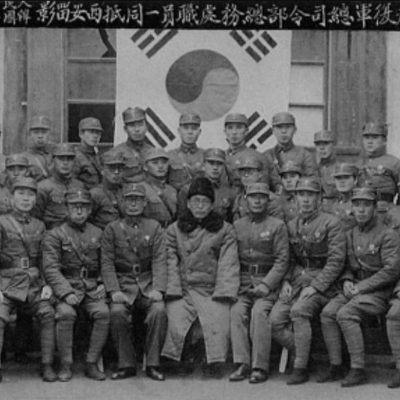
1940년 12월 26일 西安에서 촬영된 한국광복군 총사령부 총무처 직원들

회고回顧/懷古
칼럼
PinkPepper
Nostalgia 152. Ha-yeong's great-grandfather, Ahn Sang-ho (安商浩) 2

0
2026. 08. 17
The essence of colonialism is the exploitation of resources. Resources are divided into human and material resources, but only resources excluding territory are the subject of description, which is a strange worldview established under the leadership of the West, which occupied most of the world's land. Meanwhile, Koreans, who are still unable to escape from the time of liberation, war, and division, know nothing about the past Japanese colonial period. As an older generation, I want to tell the younger generation, who regard Ha Young's fantasy as their life's creed, and the young Koreans, who, for the sole reason of being young, must live in anxiety about an unexperienced future, that the essence of colonialism lies in the territory itself. Only then can they live with their feet on the ground. It is time for the history of colonial exploitation, which has blocked the eyes and ears of the previous generations and the generations before them, preventing them from seeing history correctly, to unfold as it was forced upon the people.
Until electric lights came to An-yang
Ahn Sang-ho, the great-grandfather of actress Ha Young, died on December 31, 1927. In 1929, for the construction of electric poles in An-yang, permission was needed from Ahn Sang-ho Farm (安商浩農場) and Takase Farm (高瀨農場), which is presumed to be adjacent to it, two representative farms in An-yang during the Japanese colonial period. Takase Farm was managed by Takase Seitaro (高瀨政太郞, 1863~1919), a prominent merchant from Busan who hailed from Omi (近江), a city of merchants. Ahn Sang-ho Farm operated about 100,000 pyeong of land, and Takase Farm operated about 500,000 pyeong. Ahn Sang-ho was in the position of a royal physician who could not be unrelated to the poisoning of Emperor Gojong, and Takase, at the age of 17 in 1880, came to Busan and started with textiles and general merchandise, then became the richest man in Busan by getting involved in real estate development (including Dongnae Hot Springs), gas, railways, and electricity. Although the two farm owners, who were neighbors or nearby, were no longer alive in 1929, if we can understand the succession structure, we can clearly grasp the scale and changes in the assets of these two individuals: one a Joseon person who accumulated colonial territory, and the other a Japanese person who was obsessed with exploitative businesses. I hope that the younger generation will find the historical origins of their relative deprivation and correct the modern history of illegal expropriation across generations, thereby rightfully claiming what is theirs.
Two years before his death in 1917, Takase, along with his nephew Fukunaga Seijiro (福永政治郎, 1864~1935, 23 years old), established a partnership company called '高瀨合名會社' at the Busan headquarters. He then moved the headquarters to Yeosu in the 1920s, bringing with him the know-how gained from successfully managing farm businesses such as reclamation, farming, afforestation, and sericulture. This is a strange market expansion, but I will not discuss it now. He then expanded his business from Yeosu to Anyang. In <Park Cheol-ha's Modern National Movement and Anyang, https://ngoanyang.or.kr/2590>, it states that Takase Farm 'reclaimed about 900,000 pyeong of wasteland in the 1910s, and as of 1932, managed 500,000 pyeong of fields and rice paddies, excluding 230,000 pyeong of forest, 100,000 pyeong of weeds, 100,000 pyeong of chestnut fields, and 18,000 pyeong of residential land, by leasing it to 200 Korean tenant farmers and 17 Japanese tenant farmers.' Moving the headquarters while the business, which reclaimed about 900,000 pyeong until the 1910s and then shrunk to about 500,000 pyeong in the 1930s, is closer to business contraction than growth.
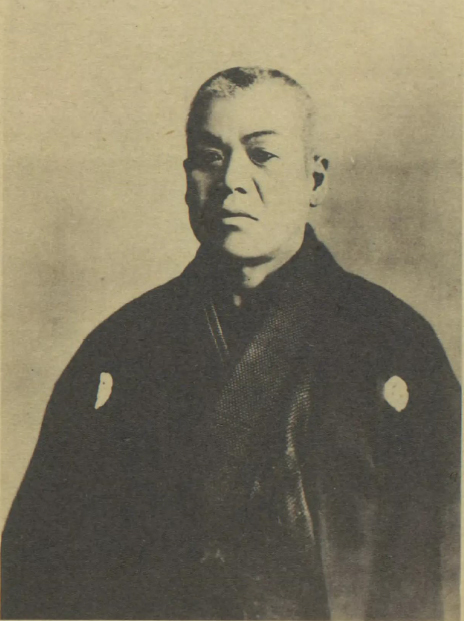
Portrait of Takase Masataro, 近江商人事績写真帖, 1930
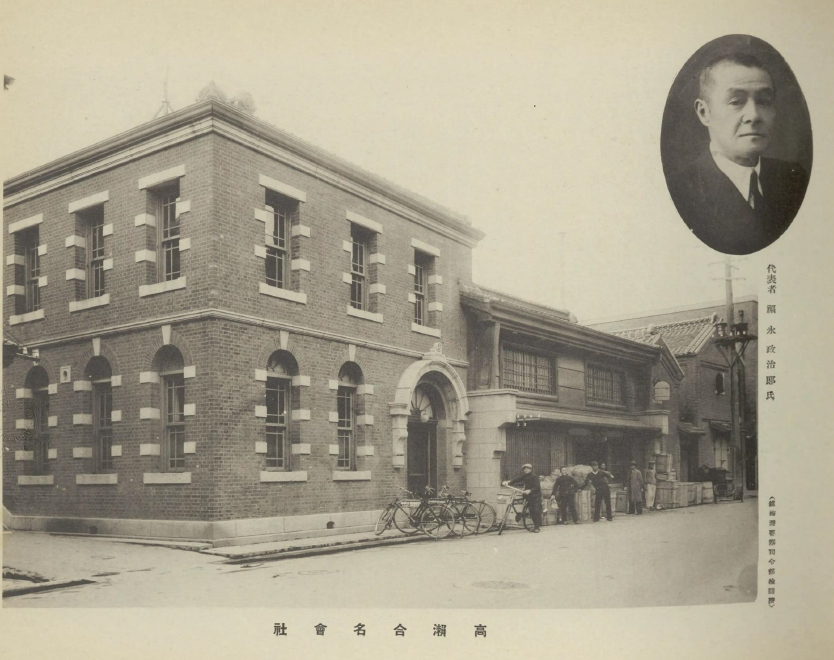
高瀨合名會社 <新釜山大觀 1934> In the parentheses at the bottom right of the photo, it says '鎭海灣要塞司令部檢問濟', which gives a glimpse into the controlled colonial publishing culture.
At this point, we can agree that there is a growing need to know who the heirs of the Japanese Takase partnership and the An Sang-ho farm were, and how they were passed down to the next generation. It is first necessary to realize that the materialistic privileges of anti-national acts enjoyed by pro-Japanese collaborators in present-day South Korea, stemming from the fact that approximately one million pyeong of land was passed down by only two people, have long exceeded a critical point. In addition, to break through this reality where privilege has become custom and custom has become status, we must uncover the principles of its operation. Only then can we correct the history of illegality, fabrication, and massacre by pro-Japanese collaborators that the colonial generation failed to achieve.
Takase Gōshi Kaisha sold British cotton products, specifically Western calico, as internal consumption goods in Busan from 1886, bringing them in via Shanghai. It's a bitter thought that by 1886, Busan was already overflowing with Koreans and outsiders who favored luxury goods. Takase Company, which continued to develop through the Sino-Japanese and Russo-Japanese Wars, prospered and, in accordance with the 'Buy National Products' policy, began selling Japanese products to Koreans instead of British imports. In a time when the nation was lost and even the preference for luxury was dictated by Japan, isn't it clear that luxury is one of the inherent traits of Koreans? In an era when territorial redistribution by others was forced, this increase in luxury imports was a disruptive policy that established new social statuses, immersing the public in consumption and luxury to divert their attention. The dual hardship of doctors and patriots dying in armed anti-Japanese movements both inside and outside, while new women and new men, intoxicated by Western civilization, enthusiastically followed the policies of the Government-General, became deeply entrenched in colonial Joseon society.
In an era of plunder, individuals like Ahn Sang-ho, who profited as a war doctor, or Takase, who came to the colonial territory to make a fortune through business, cannot be considered true success stories, as they enriched themselves by exploiting the colonial system and policies. However, in reality, one became revered as a successful entrepreneur by making money in places where others died or were displaced. It was the newspapers and magazines of the time, the media, that portrayed such figures as examples of success. Japanese records praise this plunderer, who at 17 moved to Busan and started a textile shop, then expanded octopus-like by opening branches in six locations including Gyeongseong (which became the capital of Japanese colonial rule from Hanyang), Seoul, Pyongyang, Daegu, Yeosu, Gunsan, and Wonsan, as having pioneering insight, orderly work, and innate talent for business, even refusing honorary positions to focus solely on his enterprise. This clearly shows the stark difference in attitudes between Korea and Japan regarding the colonial period.
Seitaro Takase was one of the most prominent businessmen in colonial Busan, but not much information about him remains. Japan is typically a nation that meticulously records its colonial history, down to the smallest detail, yet there is little record of this individual. The fact that there isn't much information about a person who was the wealthiest man in Busan and actively involved in colonial Joseon suggests two possibilities. First, it's possible he was a secret operative, unknown in the history of the Japanese colonial period. While such individuals were not uncommon in various fields like industry and academia, it's unlikely for the wealthiest man in Busan to operate in hiding, so this doesn't seem to fit. Second, he might have been someone who settled in Joseon in the late colonial period, specifically right after the defeat. However, Takase died in 1919, so neither of these applies. He wasn't part of the generation that couldn't board the repatriation ships to Japan after the defeat because all their accumulated capital and business foundations remained in Joseon. Therefore, I suspect that the lack of records might be due to his poor reputation, despite the immense wealth he accumulated in Joseon.
Takase exploited tenant farmers, and when the tenants united and took action, news articles reported that he retaliated by revoking their tenancy rights during the busy farming season. Yet, seeing him brazenly advertise his farm in the newspaper during the New Year suggests that colonial exploitation, while difficult for an ordinary person to stomach, was made possible by Japanese policies and the prevailing attitudes of the time, which were an extension of Western colonial plunder systems and policies. The Dong-A Ilbo on December 17, 1931, also reported on Japanese tenant farmers' opposition to a farm that raised land usage fees during an economic downturn. Joseon people either became tenant farmers alongside them or worked like slaves under them. It's painful to even imagine how anyone could have remained sane after having their ancestral land, cultivated for thousands of years, taken away.
The unique Japanese perspective that twists wealth accumulated from others' land, resources, and labor into a narrative of business acumen and takes it for granted, is deeply rooted in the plundering mentality of the Wokou (Japanese pirates) who normalized the criminal act of stealing others' property. The problem is that this was not the general public sentiment, but rather the mindset of bureaucrats and scholars who shaped national identity, underpinning imperialist Japan's militarism, and it remains the fundamental ideology driving Japanese politics. The reason the Japanese public is powerless is that the capacity for colonial exploitation is being applied to their own citizens. We can simply call this the 'cabinet system.'
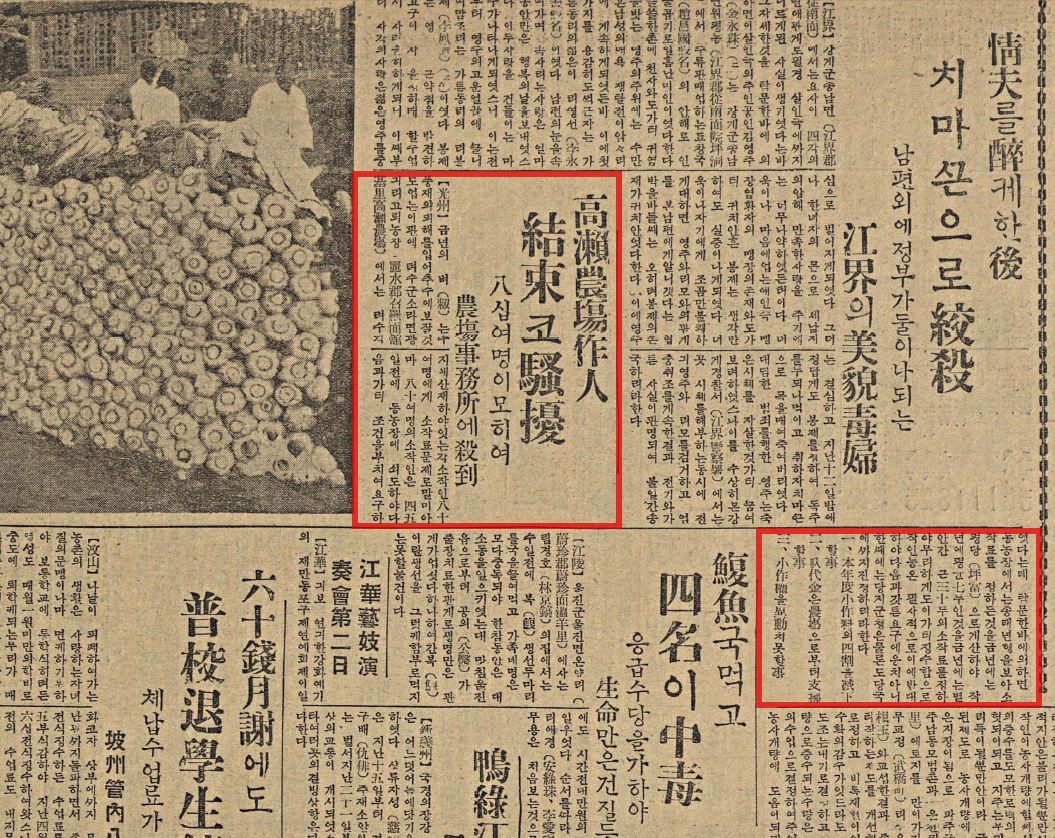
Article stating that about 80 tenant farmers gathered and went to Takase Farm to cause a disturbance, Maeil Sinbo, November 26, 1931, page 7
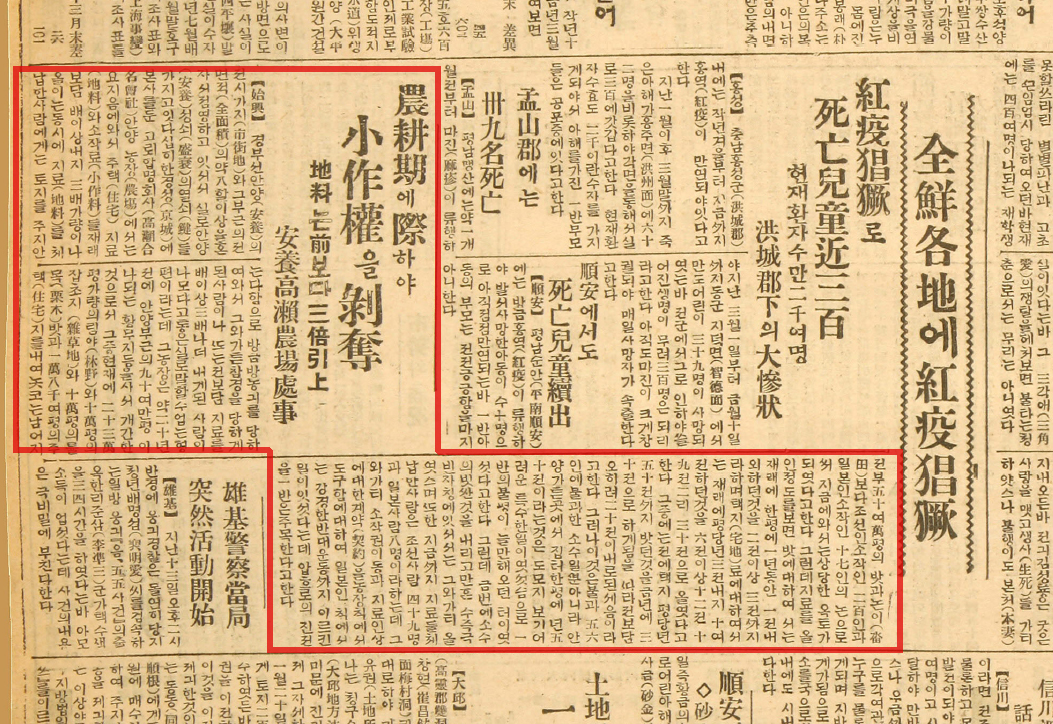
Deprivation of tenancy rights during farming season - Triple increase in land tax, Treatment at Anyang Takase Farm, JoongAng Ilbo, April 17, 1932, page 5
Flower of the Colony, Model of Naeseon Ilche, Ahn Sang-ho
Ahn Sang-ho also experienced an incident where a Japanese servant was murdered on his farm, an event reported in the Maeil Sinbo on October 8, 1926, page 3, titled 'Elderly Farmer Brutally Murdered with a Weapon in the Mountains Between Anyang and Gunpojang - The Deceased is Ahn Sang-ho's Servant.' The various crimes and daily life of colonial society that filled page 3 are painful to read. The full text of the article is as follows:
'-Elderly farmer brutally murdered with a weapon in the mountains between Anyang and Gunpojang, the victim died instantly at the scene, and the perpetrator disappeared without a trace, the deceased is Ahn Ho-sang's servant-'
Around 9 AM on the 6th, Tanioka Sentaro (61), residing in Anyang-ri, Seo-myeon, Siheung-gun, was deeply stabbed in the throat by someone in the forest near Gunpojang (a five-day market near Anyangcheon Stream) and died on the spot. The Gyeonggi Provincial Police Department, which had not yet apprehended the culprit in the Anseong incident, suspected a similar case. Lee, the section chief, and Nomura, the police inspector, rushed to the scene by car to investigate, but the culprit's traces remain elusive. As mentioned earlier, 17 years ago, when he came to that place, he was entrusted with managing about 100,000 pyeong of An Sang-ho's forest in Jongno 3-ga due to some connection. Originally, that mountain was a muddy hill with no trees, but after Tanioka took over, he lived almost on that mountain, rain or shine, day and night. As a memorial to him until his tragic death, the mountain is now densely covered with trees (author's note: interpretation limited). An Sang-ho, who rushed to the scene upon hearing the urgent news that Tanioka was tragically killed on the 6th while carrying pine branches to the mountain to pay for his labor, shed tears and said, 'He was my benefactor. The benefactor of the Joseon people has died.' The head of the criminal division of the Gyeonggi Provincial Police Department said he lamented.
-Utterly baffling! No clues-
Regarding the killing of such a person, there must be some suspicion, or it must be the work of a robber. However, no matter how much they investigated, there was no suspicious connection. Even if it were the work of a robber, the 60 won he had was still on his body after his death. If it were a robber, they would have taken the money, but without any such trace, the culprit disappeared, leading the case into a realm of mystery. The police are unable to find any clues in their search for the culprit. Furthermore, what is suspicious is that it is not a suicide, as there are no signs of it, and it is clearly a murder. There also appears to be no reason for him to have committed suicide.
-Prosecutor Motohashi dispatched. Accompanied by Secretary Saito-
Upon receiving this urgent report, the Gyeongseong District Court Prosecutor's Office dispatched Prosecutor Motohashi, accompanied by Secretary Saito and a doctor from the Red Cross Hospital, to investigate the scene by car at 4 PM.
-The victim was a true farmer, praised by those in his vicinity-
As mentioned earlier, Tanioka Sentaro, who became the startled blade's spirit in the forest in front of Gunpojang, came to An-yang 17 years ago and has lived there ever since. He has never learned a single word of Korean, is a faithful farmer, and is highly praised by those around him. He also maintains close relationships with the Koreans in the vicinity, such that no one in the village disobeys his words. If anyone in the village has an urgent matter, they invariably go to him, and he became a true friend to the farmers in An-yang.
-Criminal immediately arrested-
The aforementioned murderer was identified and arrested as Han Seong-chil, 32, residing at 140 Jinjeong-ri, Nammyeon, Siheung-gu, after an extensive search. It is said that he killed the victim with a sickle he possessed, with the intention of robbing him.
The summary of the incident in Maeil Sinbo appears conspicuously shoddy at first glance, making it hard to believe that a puppet media outlet, dancing in the palm of the Governor-General's office, would have accurately reported the facts. Maeil Sinbo was a Korean-language organ of the Governor-General's office, established by the Japanese imperialists after seizing Daehan Maeil Sinbo with the annexation in 1910. By 1926, along with Keijo Nippo, it served as a propaganda newspaper loyal to the colonial economic and political agenda. At the time, the president of Maeil Sinbo was Soejima Michimasa (副島道正, 1871~1948), the editor-in-chief was Kakuta Koji (角田廣司, 1886~?), and below them were Korean reporters. Considering the backgrounds of the president and editor-in-chief, the fact that the article concluded by easily capturing a person named Han Seong-chil as the culprit, despite the whereabouts of the Korean perpetrator who killed a Japanese person being unknown, suggests that the dispute between tenant farmers and Japanese landlords at the time was transformed into some kind of scheme disguised as a robbery and murder. However, there is no way to know for certain at present.
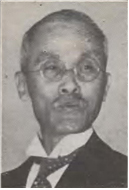
Soejima Michimasa
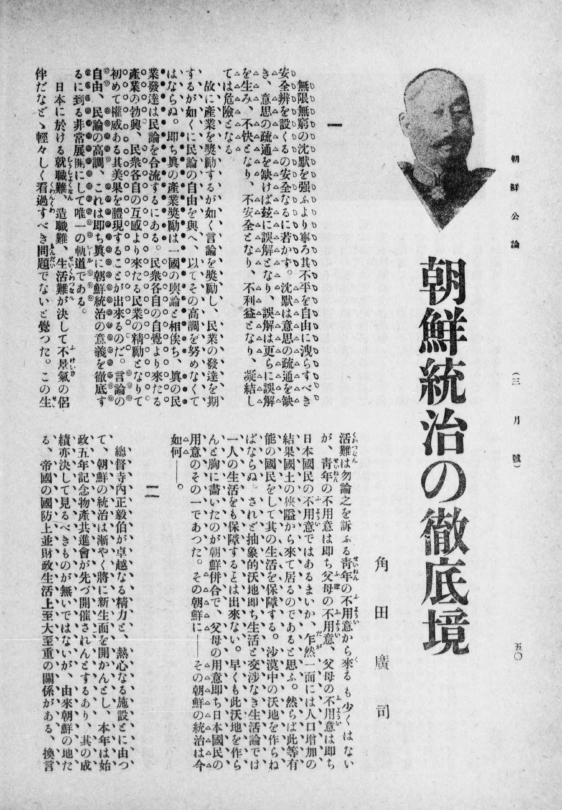
Kakuta Koji, Chosun Kongron, March 1915 issue
What power could a Korean police executive accompanying a Japanese police officer have? In a society where anyone caught could be labeled a criminal, can we expect a fair trial? In a colonial society, it's highly probable that conspiratorial blame-shifting or fabricated crimes disguised as murder cases were commonplace. It's also quite possible that the assassinations of many anti-Japanese activists were attributed to such incidents, reported as such, and recorded in history. From the invasion of the Sino-Japanese War until the Korean War, dozens of politically and socially influential figures were assassinated, murdered, or abducted, and during the war, over 100,000 people were abducted. As a result of the North-South confrontation diluting the issue of exploitation by imperial Japan and pro-Japanese collaborators, perhaps we are witnessing the irony of judicial justice not being realized in what is arguably the most honest and diligent Korean society on Earth, even to this day.
As the traces of the past—the physical and psychological pressure exerted by rulers on the ruled—accumulated, Koreans themselves killed the eggs in their own nests, adopted and nurtured the offspring of others as their own, and lived completely unaware of the mixed heritage of brood parasitism. The chaos entangled in the anti-national politics of pro-Japanese collaborators, which continues to drag on to this day, reverses cause and effect and becomes foolish acts of following them, crushing the youth and lives of the next generation. Those in power must recognize this fact.
When his servant died, Ahn Sang-ho lamented, 'My benefactor, the benefactor of the Korean people, has died,' which raises questions about Ahn Sang-ho's national identity. A Maeil Sinbo article from December 10, 1918, on page 3, is an example of this, introducing the household of Dr. Ahn Sang-ho as a model case of a 'Naeseon Ilche' (Japan and Korea as one body) family, which can be seen as the culmination of Japan's colonization of Korea. The full article is as follows:
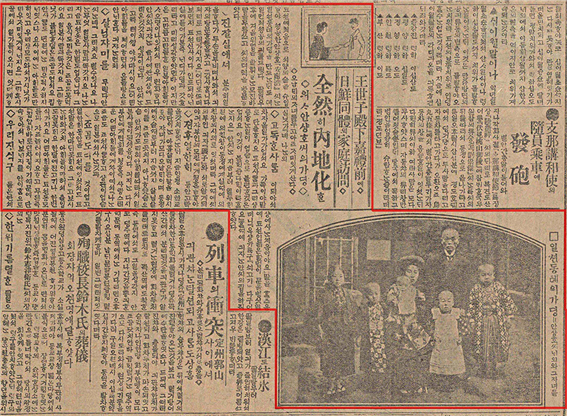
Maeil Sinbo, December 10, 1918, page 3
'-Visit to a family embodying 'Japan and Korea as one body' before the Crown Prince's wedding ceremony, Dr. Ahn Sang-ho's family, completely Japanized. They live very happily with their five children-'
Mr. Ahn Sang-ho, who successfully introduced Western medicine to Joseon for the first time, was also the first to succeed in creating a family of equal status. On the afternoon of the 8th, braving the harsh wind that showed the severity of winter, I visited Mr. Ahn's residence. He was busy in the examination room, but came out rubbing his hands, listened to the reporter's purpose for visiting, and said, “Thank you. Please go in there.” No matter where you look, he is a Joseon gentleman.
Upon being led into the inner room, I had expected it to be like an ordinary Japanese household, but there were five or six Japanese children, making it very lively. Mr. Ahn and the reporter felt as if they had entered a different world. Mr. Ahn said, “Kora, Rei-chan, yakamashii yo,” controlling the children as he guided us to the ondol room.
The reporter first asked about the joys of family life. Mr. Ahn replied, “Yes, that’s right. What else can I do? I am just like a Japanese person. I don't even own a single Joseon outfit now. And I can't eat spicy food at all. I'm just like a Japanese person. So, there are no inconveniences at all. My family members used to live very quietly in previous years, but these days, there are many children and my mother-in-law has also come to stay, so we live very happily.”
“So, what do you do if relatives from the countryside happen to visit?”
“Well, I am a lonely person, so I don't have any relatives who would come to visit. My family is quite small. I don't interact much with Joseon people, so there are no inconveniences. Perhaps this is a blessing in disguise.”
Mr. Ahn was the personal physician to Prince Ui when he was in Tokyo twelve years ago. At that time, he met Mr. Ahn's wife, Kiko (磯子), and proposed to Kiko's mother. They shared joys and sorrows for eleven years, and now they have five children, including their eldest daughter, who is nine years old and attends Sakuragi (櫻井) Elementary School. He has not changed his lifestyle at all since he was in Tokyo. It seems Mr. Ahn has become Japanese by following his wife.
When the reporter again requested to see the wife, she said, “Surrounded by my lovely children, I have absolutely no connection with Koreans, so living here is no different from living in Japan. Even though I have been in Joseon for eleven years, I cannot speak a single word of Korean. And as you can see, I have many children, so I can’t go out much. I only go to Jingogae once a month.”
When asked, “Do the children often play with their Joseon friends?” she replied, “Because the tram tracks are right in front of the house, I keep them under strict control and don’t let them out, so my family lives in a different world.” Just as she was speaking, an old Korean woman opened the door slightly and said, “Oksang, the gyuniku (beef) is all grilled.” At that, the reporter took his leave of Ms. An’s house.
Even in a colony, a family has its unique functions and roles. But why did the parents forming a mixed-race family self-censor themselves to such an extent, emphasizing self-control in their words and actions, as reported? This was because immediately after the annexation in 1910, the justification for governing Joseon was '一視同仁' (treating everyone equally with benevolence), and the formation of mixed Korean-Japanese families was a condition for a new social and political status order. The premise of benevolence is that one should not create colonies, which, from a Korean emotional perspective, is an absurd Japanese way of thinking at its core. However, Japan is a nation that has upgraded its biological collective intelligence through mixed-race individuals since the medieval Wokou. Japan, with its deeply ingrained inferiority complex of hierarchy, promoted Korean-Japanese mixed marriages with nearly 50 slogans using brainwashing terms such as 'Il-si-dong-in' (treating Koreans and Japanese equally), 'Il-seon-dong-hwa' (assimilation of Koreans and Japanese), and 'Nae-seon-il-che' (Japan and Korea as one body), while simultaneously pursuing assimilation and extermination policies. I wonder if this is not the power of the Japanese gene, where only distorted and cruel traits have become dominant. This is a question about human nature and an existential philosophical stance. Korean men and women of childbearing age would do well to reflect on what the reasons and objectives of the mixed-race policy, which has been solidified, trampled, hammered, and reconfirmed, truly were.
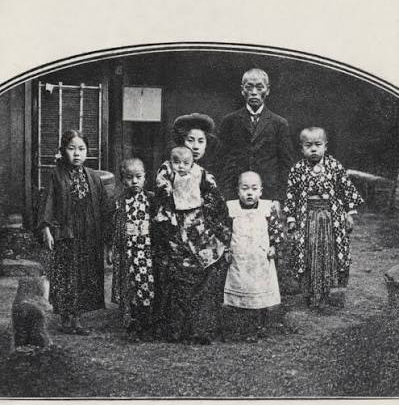
In the family photo of Ahn Sang-ho above, the eldest daughter Kinuko (絹子) on the far left, who entered the first grade of Sakurai (櫻井) Elementary School, appeared in an article titled 'The Education of Children Being Purified, Korean Children Studying in Japanese Schools' on page 3 of the Maeil Shinbo on October 21, 1916, and is presumed to have been born in 1908. At that time, Sakurai Elementary School was attended by the children of newly emerging aristocrats born under the new world order. The eldest son Jeong-ho (正浩) on the far right of the photo was two years old at the time, according to an article titled 'The Pioneer of Japanese-Korean Harmony, A Reputable Account of a Korean Husband and Japanese Wife' in the September 1913 issue of Joseon Gongron, making him born in 1912. Sang-ho's sons Jeong-ho, Bu-ho, and Deok-ho are not named according to Korean family registry naming conventions. The naming convention of using a common character (通字) passed down without avoiding taboo characters (避諱) is a Japanese naming style. Since Ha-yeong's great-grandfather Sang-ho's father was Geon-yeong and his grandfather was Dong-heon, the Japanese naming style began with Ahn Sang-ho's generation. Ahn Sang-ho's wife was Japanese and from a prominent family, some say she was the daughter of a Japanese soldier who came to Joseon. The inferiority complex Ahn Sang-ho felt in the social circles of the vast colonial city is unimaginable with modern sensibilities. The way he emphasizes that he has no relatives, cannot eat spicy food, is only outwardly Korean, and his tendencies have become Japanized, shows how terrifying brainwashing the colonial system itself was.
However, Ahn Sang-ho's physiognomy is not that of a Korean. With a pockmarked and small stature, and an expression that never brightened even after earning money, it is believed that he had a considerable complex about his social status, even though he was the first Japanese-licensed doctor in modern times. Born as the son of a low-ranking official in the late Joseon Dynasty, he married a Japanese woman after much hardship, but if his wife's family had high social standing, he would have wanted to somehow demonstrate his abilities.
Lee Geon (李鍵, 1909~1990), grandson of Gojong and son of Yi Kang (李堈), whose Japanese name was Momoyama Kenichi (桃山 虔一), recalled An Sang-ho. He mentioned that An Sang-ho's sociable and cheerful wife naturally introduced her husband to treating Japanese officials and their families, suggesting that An Sang-ho might have become their subordinate and possibly been involved in the assassination of his grandfather, Gojong, though he stated the truth was unknown. There is another unknown. Both Lee Geon and Yi Kang died of malnutrition, living lives without their own will. All history of the royal and imperial families up to Gojong has been erased, and I am not confident in explaining this. Documenting cruel human acts is sad and overwhelming. In an era where history usurps human identity, those at the top are inevitably pushed to the bottom, so I wonder for whom a dispassionate historical verification would be.
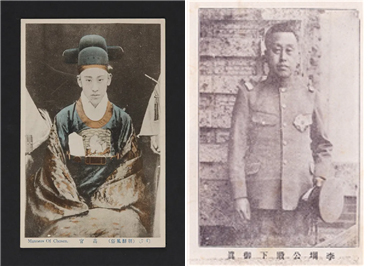
Yi Kang (李堈, 1877~1955)
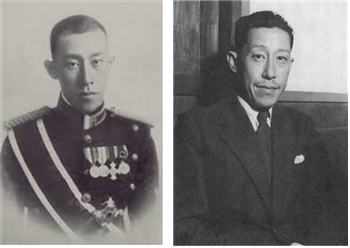
Lee Geon (李鍵, 1909~1990)
Overcome inferiority complex about status and the limits of materialism
It is unknown whether An Sang-ho was a Joseon person who married the daughter of a powerful Japanese military officer, or a Japanese person seeking advancement. Lee Jeong-eun's paper, <The Life and Activities of An Sang-ho, the First Practicing Physician, 2007>, relies solely on the records of his wife, Kawaguchi Isoko (川口磯子). It is questionable how she, being Japanese, could have left records about her husband's family lineage and genealogy. It is likely that there was additional material from Jeong Gu-chung, born in 1895, who served as president of the Korean Medical Association and published <Pioneers of Korean Medicine (I), 1985>, but this is yet to be confirmed. Regarding the Sunheung An clan genealogy, there are differing accounts, such as the Munsukgongpa and Gyoseogongpa branches, so the only way is to check the <Sunheung An Clan Third Branch Genealogy> published in 1929. The genealogy is also yet to be confirmed, but a genealogy published during the height of the colonial period is suspicious. Even if one were to believe the audacious words of An Sang-ho's wife, who boasted about not speaking Korean, a genealogy published two years after An Sang-ho's death is as strange as the genealogy of that rebel Yoon Suk-yeol, no matter how closely it is examined.
It seems that the identity complex of Koreans, which has become a tangled family tree, is evolving into a form of crime. Both those who try to get into the family tree and those who put them in it will likely find it difficult to live with a clear conscience, as they are committing a crime. If the historical view that disguised modernity as civilization and enlightenment is legitimate, then why has Korean society secretly changed Kim to Lee and Im to Lee? The modern North Korean region was devastated for a longer period, and it has the regional characteristic of being enlightened early by Christianity. There would be even fewer people who know the broken lineages and family trees than in South Korea. In today's world, where the value of human roots has been forgotten, the implications of the Ahn Sang-ho family are very significant.
Further investigation is needed regarding Ahn Sang-ho's wife, Kawaguchi Isoko's father, but it is questionable whether a complete understanding can be achieved even with time. The fact of being born in that era meant that it was easy and necessary to launder one's history by changing one's birthplace, birth year, and name. What is the alarm bell ringing in this era for those living today, a family tree complex where everyone was born and even died in complicity with history, and the limitations of mixed-race policies? Biologically, human evolution presents an expanded theory, but the theory that evolution necessarily leads to progress and superiority has been shattered. How can we make people understand that humanity, whose historical records for looking back and looking forward have been fabricated, has lost the means to predict the future?
I would like to conclude by introducing an article from the JoongAng Ilbo dated April 8, 2002, written by Ha-young's father, Ahn Byeong-mun. The article, titled 'Ahn Byeong-mun, a Finger Specialist Who Steadfastly Raised His Daughter with a Finger Disability, His Name is Father,' was a contribution in the form of a letter to his eldest daughter, openly revealing his deep paternal love for his ailing child. While this detailed family history filled me with both self-esteem and pride, such tendencies are precisely the root cause of Ha-young's verbal gaffes. Anti-national acts are inherited. Nationalism is also inherited. It is difficult to choose righteousness in the face of violence. Because they understood virtue, courage, and dignity, they went to the mountains for the pride of the nation. It was not because they did not love their wives and children that they embarked on that long journey to engage in armed resistance against Japan. Few believed that the lost land could be recovered. How can this nation, which has been maintained by shaming the independence activists who voluntarily chose that path of death, facing the entire world, and their descendants, be respected by anyone?
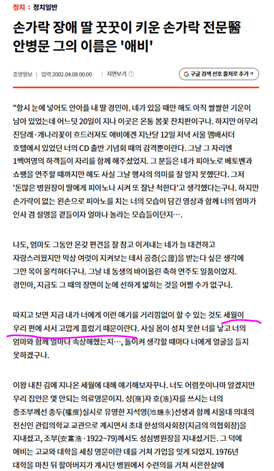
JoongAng Ilbo, April 8, 2002 https://www.joongang.co.kr/article/4256744
댓글
( 0 / 500 )
문상준
10
안상호 개인의 행적을 넘어 식민지 시대의 신분·자본·동화정책이 어떻게 한 사람의 삶을 바꾸었는지를 추적한 점이 흥미롭습니다. 특히 당시 신문 원문을 통해 지금의 시각으로 쉽게 단정하기 어려운 문제를 보여준 부분이 인상적입니다.
( 0 / 500 )
m504
10
식민지 역사를 단순히 과거의 사건으로 묻어두지 않고, 당시의 토지와 자본, 신분이 어떻게 다음 세대로 이어졌는지를 추적한 점에 깊이 공감합니다. 불편하더라도 이런 역사를 제대로 들여다봐야 오늘의 현실도 제대로 이해할 수 있다고 생각합니다.
( 0 / 500 )
중섭
8
자료를 하나씩 찾아 당시 신문과 기록을 대조하며 이야기를 풀어가는 정성이 대단합니다. 특히 식민지배가 사람들의 재산뿐 아니라 생각과 정체성까지 바꾸어 놓았다는 지적은 오래 생각하게 합니다.
( 0 / 500 )
革命77
7
우리가 배운 근현대사는 너무 자주 결과만 이야기하고 그 과정에서 누가 무엇을 얻었는지는 제대로 묻지 않았습니다. 토지와 재산의 이동, 친일 세력의 사회적 재생산을 추적해야 한다는 문제의식에 적극 공감합니다.
( 0 / 500 )
萬福
7
식민지배를 단순히 ‘수탈’이라는 추상적인 개념으로만 보지 않고 토지와 농장, 소작인, 상속, 혼인과 자녀 교육까지 구체적인 삶의 현장에서 들여다본 것이 좋았습니다. 역사는 결국 사람들의 실제 삶 속에서 작동했다는 사실을 다시 생각하게 합니다.
( 0 / 500 )
Piter58
6
과거를 파헤치는 이유는 누군가를 욕하기 위해서가 아니라 오늘의 대한민국이 어떻게 만들어졌는지를 제대로 알기 위해서라고 봅니다. 특히 식민지 시대의 부와 신분이 해방 이후 어떻게 이어졌는지에 대한 문제 제기는 앞으로도 계속 이어졌으면 합니다.
( 0 / 500 )
yeon85
5
역사는 미화해서도 안 되고 편리하게 지워서도 안 된다고 생각합니다. 당시의 기록을 통해 우리가 외면했던 식민지 사회의 모습을 다시 들여다보게 하는 이런 작업은 누군가는 반드시 해야 할 일입니다.
( 0 / 500 )
pkpk62
5
다만 안상호의 친일성이나 고종 독살 연루 가능성처럼 자료만으로 확정하기 어려운 부분은 조금 더 엄격하게 구분했으면 좋겠습니다. 오히려 ‘확인된 사실’과 ‘자료에 근거한 추론’을 분리하면 글 전체의 설득력이 더 커질 것 같습니다.
( 0 / 500 )
mok77
4
과거를 파헤치는 이유는 누군가를 욕하기 위해서가 아니라 오늘의 대한민국이 어떻게 만들어졌는지를 제대로 알기 위해서라고 봅니다. 특히 식민지 시대의 부와 신분이 해방 이후 어떻게 이어졌는지에 대한 문제 제기는 앞으로도 계속 이어졌으면 합니다.
( 0 / 500 )
jungtae
3
가장 씁쓸한 대목은 식민지 체제에 적응하고 일본화되는 것이 개인에게는 출세와 안정의 길이 될 수 있었다는 사실입니다. 한 개인을 단순히 친일파냐 아니냐로 재단하기보다, 그런 선택을 만들어낸 시대의 구조까지 함께 봐야 한다는 생각이 듭니다.
( 0 / 500 )
동방삼협
2
결국 이 글이 던지는 질문은 과거의 친일 여부만이 아니라 ‘그 시대에 만들어진 부와 신분이 이후 세대에 어떻게 이어졌는가’인 것 같습니다. 과거를 들추는 일이 목적이 아니라 현재의 불평등과 기득권의 뿌리를 확인하기 위한 역사 공부라면 충분히 의미 있는 작업이라고 봅니다.
( 0 / 500 )
신고내용
신고내용을 선택해주세요
회원비난/비하/욕설글 및 댓글도배성 게시물저작권 침해/불법자료 유출허위사실유포개인정보 유출.사생활 침해무단광고/홍보음란물 및 도박 불법 광고물범죄행위 관련 글불법행위 관련 소개물품 판매 및 사기글악성코드 및 스파이웨어 유포기타 사유 및 운영진 판단


비밀번호를 잊으셨나요?
Sign in with Google
All information provided by us is free of charge and is for the public good.