品

Corea든 Korea든, 품격은 이름보다 먼저다
Whatever the name—Corea or Korea—dignity comes first.
Whatever the name—Corea or Korea—dignity comes first.
Now
지금
751 Diaspora
Heritage
유산
Humanity
인문
Mirengsi
未冷尸
Politics
정치
Media
언론
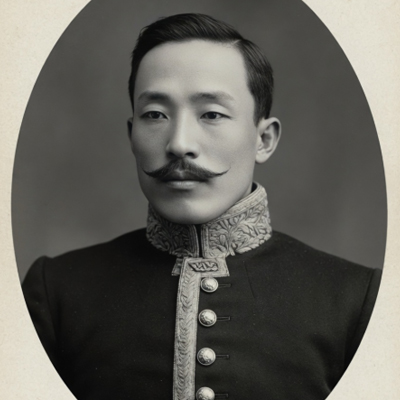
박중양은 유명한 친일 거두로 당시 일본 정계의 제1인자인 이토 히로부미의 양아들이었다.

사람人物
칼럼
bunny365
1800s Figures (14) Park Jung-yang (朴重陽) 1872 (Gojong 9) ~ 1959

0
2026. 09. 25
- The Anti-National Traitor Special Committee (Banminteukwi) aimed to restore national integrity by punishing pro-Japanese collaborators, but was thwarted by counterattacks from pro-Japanese forces and the Rhee Syng-man government's "red-baiting."
- Pro-Japanese collaborator Park Jung-yang displayed blind loyalty to imperial Japan, denying his Korean identity; while his success was built on intense effort, it ultimately led to national betrayal.
- The failure of Banminteukwi and the Korean War enabled pro-Japanese forces to gain economic benefits and hereditary power, becoming the root cause of division and distorted historical perception in modern Korean society.
- Cases like Park Jung-yang, who used ambiguous identities and multiple names to conceal his pro-Japanese activities, connect to the hypocritical attitudes still seen in some politicians in Korean society today.
The failure of the Anti-National Traitor Special Committee was inevitable
In 2004, OhmyNews interviewed Jeong Cheol-yong (鄭徹溶, 1925-2006), the last surviving investigator of the Anti-National Traitor Special Committee, and published his five-part memoir (reporter Jeong Woon-hyun). Born in Yeongdong, Chungcheongbuk-do in 1925, Jeong Cheol-yong was 79 years old at the time of the interview. After graduating from Cheongju Commercial High School, a five-year program, in 1944, he was conscripted by the Japanese and was stationed in the 20th Division of the Japanese Army in Yongsan, Seoul, where he experienced the liberation on August 15th. In May 1946, he joined the Daejeon branch of Shinhan Corporation (新韓公社), which was managed by the US military government at the time, and worked there for about two years. In the fall of 1948, he joined the Anti-National Traitor Special Committee as an investigator, recommended by Constituent Assembly member Park Woo-kyung, and participated in the arrest of pro-Japanese writer Lee Gwang-su in February 1949.
Shinhan Corporation, where Jeong Cheol-yong worked, was a public enterprise established on February 21, 1946, by Military Government Ordinance No. 52, and began operations on March 3. It was a company established by the US military government to manage agricultural land owned by Japanese people and land of the Oriental Development Company after liberation. In other words, it was a real estate management corporation that plundered during the colonial period. However, the English name of Shinhan Corporation was 'New Korea Company, Limited.' It was not just Korea, but New Korea. So, what about Old Korea? What is the meaning of the history in which the United States, which made Joseon people and Syngman Rhee heroes of independence, led the land issues of old Korea and new Korea in the new country on the Korean Peninsula, and to what extent will its impact be? This might be an unimaginable problem, but modern Koreans cannot predict it at all, so it will not be discussed here. Shinhan Corporation managed the agricultural land left by the former Oriental Development Company and Japanese landlords, and after August 15, 1948, it was transferred to the Ministry of Agriculture and Forestry. However, with the outbreak of the war, the most important pre-colonial personal and national property, land issues, of the nation liberated from colonialism, were completely pushed aside.
The investigators of the Anti-National Traitor Special Committee (Banminteukwi) were not ordinary police officers selected through examinations, but rather young, practical individuals chosen primarily from independence activists, officials of the Provisional Government of the Republic of Korea, members of the Korean Liberation Army, anti-Japanese organizations, or those active in nationalist circles and the Kim Gu faction after liberation, who were capable of conducting investigations, drafting documents, and making arrests. There were a total of 15 investigators, and the entire Banminteukwi was estimated to have around 45 members, though it is uncertain if the complete list remains. The backlash against the arrests of prominent pro-Japanese collaborators such as Park Heung-sik, Bae Jeong-ja, Lee Gwang-su, Choi Nam-seon, and Park Jung-yang, which were the initial achievements of Banminteukwi's activities, did not come solely from the anti-national traitors themselves. Japan, which had a significant role in colonizing Joseon, and the Western powers behind it, had to prevent the counterattack of Korean nationalism seeking to revisit the past.
In that process, the Banminteukwi, which lost momentum following the pro-Japanese police's raid on the committee on June 6, 1949, closed its doors at the end of August that year. Jeong Cheol-yong's brief career as a Banminteukwi investigator led to him being branded a communist, forcing the investigator himself to go into hiding. The labeling of individuals as 'communists and leftists' thus became a catchphrase to condemn those who sought to punish pro-Japanese anti-national traitors after liberation, becoming a cause for the era of division that South Korea experiences today.
Mr. Jeong Cheol-yong recalled the following about Park Jung-yang:
'Around April 1949, the famous pro-Japanese magnate Park Jung-yang was transferred from Daegu to the special committee headquarters. Park Jung-yang was the vice-chairman of the Jungchuwon under Japanese colonial rule and a famous pro-Japanese magnate who received a count title from Japan. He was also the adopted son of Ito Hirobumi, the most powerful figure in Japanese politics at the time (who served as the Resident-General of Korea and Prime Minister, and was assassinated by Ahn Jung-geun at Harbin Station in Manchuria in 1909). The car carrying him stopped in front of the special committee's main gate. He was a tall man, about six feet, with a slightly bent back. He looked at the special committee's main gate and said, “あ、ここが昔の第一銀行だね、そう、そう。(Ah, this is the old First Bank, yes, yes!)”. His words and actions were completely Japanese. It seemed that Japanese lifestyle and culture were ingrained in him. I approached him and asked, “백작 영감, 今でも昔が懐かしいですか?(Count, do you still miss the old days?)” He hesitated for a moment and then went up to the prosecution department on the second floor.
It was truly absurd. Although Park Jung-yang was Korean by birth, his mind and actions were completely Japanese. He was a person from whom no change of heart or remorse could be expected. One thing that impressed me was that among the evidence confiscated from his house, there were as many as 20 boxes of diaries. I couldn't read all of them, but I roughly flipped through them, and they contained the life story of Park Jung-yang, who went to Japan as an illiterate person without a penny. It seemed that he had kept a diary every single day for decades until the day before he was brought to the special committee's Daegu branch. And all of them were written neatly. Although he was a pro-Japanese anti-nationalist, I thought that there must have been tremendous effort behind his success. Park Jung-yang was also released with the dissolution of the special committee.'
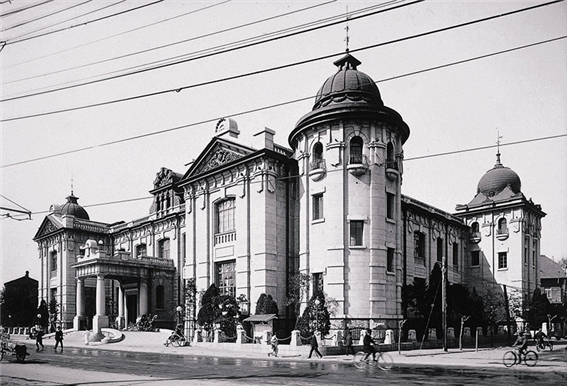
The current Bank of Korea building in Seoul, completed in 1912. 第一銀行, designed by Tatsuno Kingo, Kasai Manji
What kind of resolve did the public of the liberated era feel regarding the pro-Japanese anti-national acts committed during the colonial period? Perhaps the majority of the oppressed people believed that the national traitors would be completely punished, and they might have strengthened their will for reconstruction both personally and socially. However, it is impossible to know now whether they did not anticipate the possibility of failure of the Anti-National Traitors Committee, which was difficult to establish due to the very chaotic political situation at the time, or whether they knew but had no time to defend or deal with it.
Consequently, an extended logic is needed that the reason for being embroiled in another war (the Korean War) while bearing the full brunt of the colonial subjugation was the very existence of the Anti-National Traitors Committee. The method to put a brake on the nationalist movement to clear the past through the Anti-National Traitors Committee is war. If the tragedy of 'colonial oppression - liberation - Anti-National Traitors Committee - Korean War' unfolds in this way, then the annual repetition of listing the names and careers of pro-Japanese anti-national actors is a meaningless empty ritual and a mere formality.
The core of resolving past issues in modern Korea is not the false act of branding them as criminals, but rather the return to society of the economic benefits they have already gained and the incalculable wealth passed down to their descendants. Conversely, anti-Japanese activists suffered political persecution and neglect, inheriting poverty, disease, and lack of education, which they passed on to their children. The aftermath of modern Korea covering up its colonial history is that the dreams of those who perfectly reverse-engineered the class system came true, while the ideological scapegoating of 'yangban-intellectual-anti-Japanese movement-communist-leftist' was the direction of state affairs for successive dictatorial regimes after liberation. Now, the descendants of past yangban landlords have either completely died out, or their family registries have become the exclusive property of pro-Japanese anti-national actors through usurpation, and they have become a socially marginalized class. It is unclear where to begin to restore the nation's discipline, but at a time when false history is being revealed, the issue of social leaders who have infiltrated others' family registries is a point where the government needs to impose legal sanctions.
When the investigators of the Anti-National Traitor Committee were reduced to being hunted, the number of nationalist intellectuals kidnapped and assassinated during the four years of the Korean War is countless. Let's not resign ourselves to the idea that it happened by chance in the aftermath of the war. Talented individuals needed in all sectors of society that constitute the nation were dragged to the North, and it was a war that was waged to make that possible. The word 'ppalgaengi' (communist) first appeared in the magazine <Gaebyeok> (October 1921, Issue 10) with the nuance of 'socialist,' but its first political use was in a letter from Syngman Rhee to US President Truman during the Korean War (The Ambassador in Korea (Muccio) to the Secretary of State, Pusan, July 28, 1951—noon, see file). The meaning was, 'A split has occurred between Russia and 'Red China,' so if we try a little harder, we will get the results we want.' China became Red China and established itself as the color of the Communist Party, but after the dissolution of the Anti-National Traitor Committee, the nationalist camp and anti-Japanese forces became 'ppalgaengi.' Syngman Rhee's English letter is an old-fashioned, formal, and loose flattering letter, but domestically, it can be a conviction and evidence that he would pursue a policy of ideological division rather than creating a unified national front. The older generation who experienced an era where Syngman Rhee, who killed many people, was educated as a hero, and the war where children were sent out to wave white bedsheets to avoid artillery shells... It is a natural misfortune that those who experienced it glorify dictatorship and harbor fear and hatred towards 'ppalgaengi.'
The Republic of Korea that concealed Park Jung-yang's actions
Let's look at the article about Park Jung-yang that appears in Go Won-seop's (高元燮?~?) <Record of Anti-National Traitors' Crimes, 1949>, which documented the crimes and trial proceedings of national traitors (the author disappeared after writing this book).
'As a civilian, I met with Hara Takashi (1856-1921), the Prime Minister of Japan, who was assassinated by a Japanese man. For five hours, I passionately argued that if Japan truly wanted to fully possess Joseon and promote the sacred work of treating all people equally, half of the provincial governors and county magistrates should be appointed from among Joseon people. This fervent speech moved Hara, and while Park was on his way to Seoul on the Gyeongbu Line, the Japanese cabinet appointed Park Jung-yang as the governor of Hwanghae Province. Thus, he instantly became a provincial governor (Do-baek: inspector), and it is already a well-known fact that he became the adopted son of Ito Hirobumi because he spoke Japanese well. When the Japanese army occupied Singapore at the beginning of the so-called Greater East Asia War, he, despite his old age, went to Singapore to comfort the Imperial Army. All expenses for this trip were provided by Kim Gap-sun (1872-1961) of Gongju, who was also implicated by the Special Committee for the Investigation of Anti-National Activities. Kim was a colonial-era capitalist bureaucrat and the father-in-law of Yoon Chi-oh, who owned two-thirds of the land in Daejeon.'
Park Jung-yang's career then continues, and when compiled, including positions not mentioned in the record of anti-national criminals, it is as follows:
Born in Dalseong-gun, Gyeongbuk Province, at the age of 75
Studied abroad at Aoyama Gakuin in Japan with government funding
4238 (1905) Chief of Police at the Korean Imperial Household Department (below Chief of Public Security, above Superintendent)
Dispatched to Daegu as a clerk for the Ministry of Agriculture, Commerce, and Industry, also served as Jinju magistrate, during which time he oversaw the demolition of the Jinju Fortress walls
4239 (1906) Reappointed as Daegu County Magistrate, oversaw the demolition and dismantling of Daegu Eupseong Fortress
4240 (1907) Inspector of Pyeongnam Province, Korea, and Tax Commissioner
4241 (1908) Inspector of Gyeongsangbuk-do Province, during which time he forcibly implemented the short haircut order
4243 (1910) Governor of Chungnam (Inspector)
4248 (1915) Councilor of the Central Council
4254 (1921) Governor of Hwanghae Province
4276 (1943) Vice Chairman of the Central Council
4277 (1944) First Class Order of Merit
4278 (1945) Member of the House of Peers
It is said that Park Jung-yang's destruction of Daegu Eupseong and Jinjuseong was a consideration to allow Japanese people to enter the castle and do business. Like Seo Jae-pil, he is said to have taken the initiative to destroy military facilities without being ordered to do so, as he came to despise Joseon due to the government's harsh guilt-by-association system during the Gapsin Coup. However, it is impossible to know the original scale of the castle or whether Park Jung-yang was solely responsible for its destruction. Given that the castle served important military, economic, and defensive functions, it can only be imagined that its scale was difficult to conceive of, unlike the current models such as the Seoul City Wall. However, the Joseon government lost its functions long before the Gapsin Coup, and it is necessary to re-interpret the repeated rumors of King Gojong and Empress Myeongseong's deaths, and various popular uprisings and disturbances, but this will be omitted here.
If the Anti-National Traitor Investigation Committee (Banminteukwi) had succeeded and dozens of boxes of Park Jung-yang's diaries, which showed his efforts to become a pro-Japanese collaborator to the core, had been revealed to the public, the true meaning of '35 years of Japanese colonial rule' and the authenticity of history might have become common knowledge shared by all citizens. If that had happened, intelligent Koreans would not have had to live in such agony and wandering, designing their lives in pain contrary to their nature. This bold (?) attempt to connect past history with modern values is because humans must know the past. Humans are healthiest when individuals and society live a life to understand and develop human nature within social evolution and create solutions for coexistence. The political world, which loves to create committees, should release the interrogation records from the Banminteukwi era.
The photo below shows Park Jung-yang being escorted to Seoul. Unlike his younger days when he sported a Kaiser mustache and lived a successful life as a Japanese, his appearance, having aged so hideously, is shocking. Park Jung-yang was a conviction-based pro-Japanese figure who truly believed that the Japanese and Japan were superior to Koreans and Joseon. He was a person who easily exploited an era where the average Korean's appearance and abilities were far superior to the Japanese, making it easy to please Japanese officials with just a little effort. The reason for mentioning race and appearance in history is, in fact, because the essence of history is entirely 'race and politics.' The superficial education of Koreans, armed only with theories and ideologies while ignoring the nature of history, completely fails to consider the pre-modern era when the perspective on things and the foundation of critical thinking led to a reversal of values due to materialistic values. Park Jung-yang's life, which blossomed by selling the identity of his homeland and the suffering of his compatriots, and his thorough Japanization process, is an example of how much a human being, accustomed to war and whose tragedy has become chronic, can be transformed in a harsh environment.
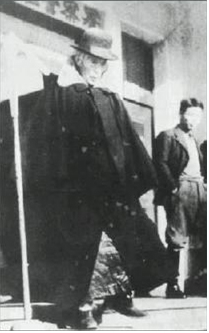
Arriving at Seoul Station and being escorted to appear before the Anti-Nationalist Special Committee in January 1949.
<Report of Lost Memories: Testimony of the Anti-Nationalist Special Committee> Jung Woon-hyun 1999
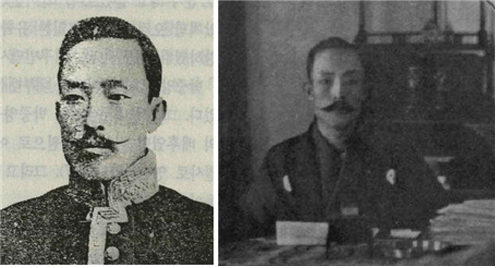
Park Jung-yang in the early 1900s / During his tenure as Governor of Hwanghae Province in 1922
At the root of his hatred for Joseon and his compatriots was a deep-seated self-loathing and self-abasement, even though he had drastically elevated his social status by riding on the wave of modern awakening that overturned Joseon's history, which had been solidified by a millennia-old class system. Although he was a different person, the prosperity he enjoyed by exploiting the pain of his compatriots could not have been honorable. Park Jung-yang and Syngman Rhee, born in the same period, were born in 1872 (or 1874) and 1875 respectively. They shared the commonality of having unclear social statuses but never met. Syngman Rhee built his career overseas, while Park Jung-yang was cultivated for domestic purposes.
The same goes for anti-Japanese patriots. From Manchuria, Shanghai, Hawaii, France, to Russia, they all tried to fulfill their duties in different places. Isn't it worth considering why the diaspora of people scattered during the process of national disintegration spread to such a wide range of regions? Since the mid-1800s, the descendants of Koreans scattered across the world have become a diaspora nation with over 7.5 million overseas Koreans, an unprecedented phenomenon in human history. Why, oh why, do people refuse to even look at the causes of the tragedy that befell Koreans?
In the Japanese Ministry of Finance publication <議會制度七十年史1, 1960>, Park Jung-yang is listed as born in 1974, with the Japanese name Bokutada Jūyō (朴忠重陽). Whether he was loyal to Japan with this strange name is unknown, but the way the characters are used is so simple and baseless that it's impossible to tell when or where he wrote the phrase '一飯是國恩' (even a single meal is a blessing from the nation), which will be discussed later. The full disclosure of the <述懷> from the Anti-Nationalist Special Committee investigation, as presented by the National Museum of Korea, is necessary to ascertain the true facts.
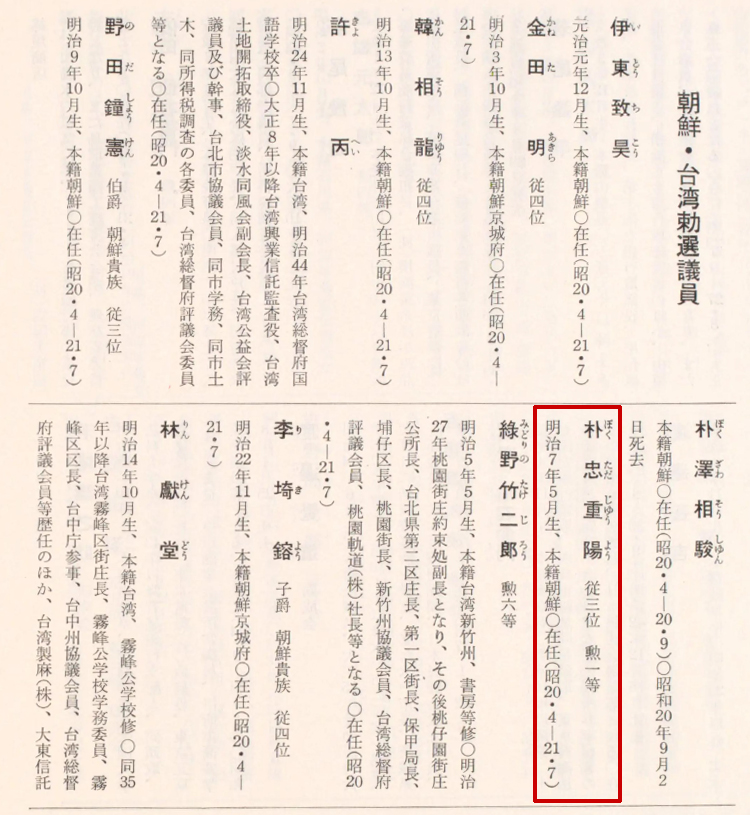
You know a person's worth by the object of their loyalty.
Park Jung-yang's hometown was Yangju, Gyeonggi Province. He served as governor of Chungcheong and Gyeongsang Provinces, and twice as governor of Hwanghae Province. He lived by commuting to Daegu to secure an escape route at any time on the way from Japan to Seoul, but Daegu was not the only route from Japan to Seoul. One must understand the territory of that era to understand his excuses. At that time, Daegu had such circumstances. If one were to know the reason why Daegu became the city of the most brutal oppression in Korean political history, and its desperate process, then the current right-wing extremism in Daegu is a historical pathological phenomenon of oppression and brainwashing that has spread throughout the city. There is no city with more left-wing (intellectuals) than Daegu, but there is also no place where residual Japanese influence maintains its power as much as Daegu. The history that breathes and vividly looks down on Daegu is also looking down on those who praised the hateful Japanese influence.
It is uncertain whether Park Jung-yang was from the Bannam Park clan or the Miryang Park clan, making it unclear how he was listed as a government-sponsored student in 1896 and went to Japan. Furthermore, among Park Jung-yang's two sons, Mun-ung and Mu-ung, only the eldest son is listed in the family registry, and even his name is different. This would not have been an issue known to the world if they were not politicians. Those who needed to be included in someone else's family registry were mainly remaining Japanese, indigenous Japanese collaborators, or those of humble origins. While breaking down social status was one of the goals of enlightenment that overturned tradition, why was status laundering, which involved searching for the past, necessary?
The desire for upward mobility, which sought to borrow another's ancestral seat (bon-gwan) and surname (seong-ssi) and hide within their lineage, might have been a yearning for legitimacy deeply ingrained in human instinct as an envy of the past class system, and a spiritual longing to secure biological and social identity. This phenomenon, where people sought social advancement while simultaneously engaging in war, is rarely seen in other societies and was likely a unique phenomenon that prominently appeared in relation to Japan, which had a close historical relationship with Korea.
Itō Hirobumi's adopted daughter was Bae Jeong-ja (裵貞子, 1870-1951), and his adopted son was Park Jung-yang. Park Jung-yang's pro-Japanese activities, comparable to those of Bae Jeong-ja who was involved in unimaginable crimes, show that he was completely emotionally inclined towards Japan. In an article he contributed to a magazine during his time as Hwanghae-do Governor, he emphasized active support for transportation, irrigation facilities, and technical education, funded by the Government-General in addition to private funds, as a method to 'cook' Joseon (<朝鮮, (91) 1922> -産業に對する積極的施設を望む-). For Park Jung-yang, Joseon was an ingredient to be cooked, and the ones savoring that dish were the Japanese people and Japan. Given that he raped a Buddhist nun at a temple, leading her to suicide, and even the pro-government newspapers attacked him for several months, it is clear that he was fundamentally a person of corrupt character, and it is entirely natural that such a person led the way in betraying his country. This is a truth that still holds today: the belief that their time will come, held by those who conspire to overthrow the nation for their own selfish gain, is the result of the collective minds of many individuals.
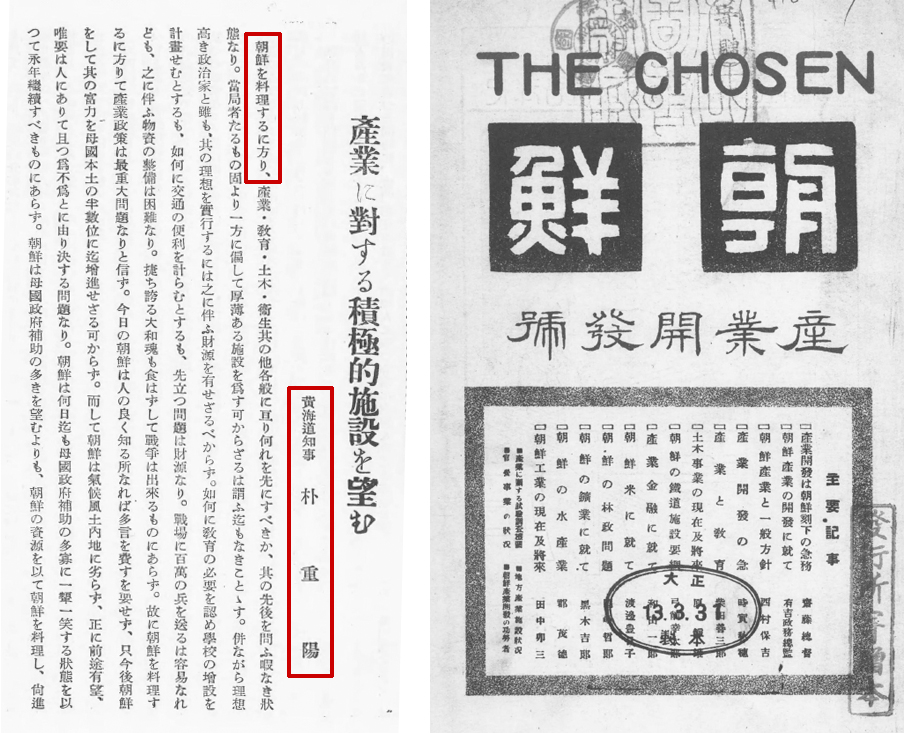
The <駐韓日本公使館記錄 10, 1994> contains the '朝鮮人動靜探聞報告, 兵發秘第280號' by Hyogo (兵庫) Prefecture Governor Sufu Kohei (周布公平, 1851-1921), submitted to Japanese Foreign Minister Okuma Shigenobu (大隈重信, 1838-1922) in 1896. Although the National Institute of Korean History usually makes this data public, I cannot currently access the Korean History Database to confirm if this is temporary, but according to the report on the movements of Koreans, Park Jung-yang was recorded under the name 'Park Won-geun (朴源根)' when he first went to Japan, and his purpose was stated as entering Keio Gijuku.
'尹致苑, 金元福, 朴源根ノ三名十一日明石丸ニテ來リ十二日上京セリ … 朴ハ慶應義塾入學ノ爲メト唱道セリ (Yun Chi-won, Kim Won-bok, and Park Won-geun arrived on the Akashi Maru on the 11th and went to Tokyo on the 12th. ... Park stated that his purpose was to enter Keio Gijuku.)'
It is known that 'Won-geun' was Park Jung-yang's given name or courtesy name, but this story is as uncertain as his birth and family tree. However, it is clear that he had no taboo against drastic changes in identity and transformation, as he used the Japanese name Yamamoto after going to Japan, and then changed his name to Jung-yang.
However, if his first trip to Japan in 1896 was under the name Park Won-geun, and if the school he attended was Aoyama (青山学院) and not Keio, then he would have attended Aoyama Junior High School (a 5-year program for ages 12-17) in his mid-20s. We have not been able to verify either 'Park Won-geun' or 'Park Jung-yang' at Aoyama, partly because the exact year of his admission and graduation is uncertain. Furthermore, the school he supposedly attended, Aoyama, is a general term for schools founded by three different American missionaries at different times and locations, so it is possible that the campus location and school name were different. However, he is a person whose academic background and career in Joseon before going to Japan need to be re-examined from the beginning, as they are unclear.
In '旧韓末と併合初期における韓国人の日本留' (Park Ki-hwan, 『近代日本研究』 (14) 1998), a paper on Korean students studying in Japan in the late Joseon Dynasty, Aoyama was not included in the research, and it quantitatively investigated Korean students, especially those attending major higher education institutions such as Meiji, Waseda, Chuo, Nihon, and Keio, in the 1910s. In 'The Reality Perception of Korean Students Studying in Japan in the Late 1890s - Focusing on Student Friendship Associations -' in <History and Reality, Vol. 31> in 1999, Park Chan-seung depicted the friendship organizations of 151 government-sponsored students dispatched by the Joseon government in 1895, their perception of reality, and their divisions (financial problems), but Park Jung-yang's name does not appear. In the 2004 paper '青山学院と戦前の台湾・朝鮮からの留学生' (Yumi Sato, 『日本の教育史学』 47), the number of Korean students admitted to Aoyama was tallied as 205, but students before 1906 were excluded from the research, so the explanation for Park Jung-yang's time studying in Japan can be considered insufficient.
The National Museum of Korea's incident, where the phrase 'Ilban Siguk Eun (一飯是國恩)' was initially attributed to the patriot 'Hanin Park Won-geun (朴源根, 1912~1950)' but later corrected to be Park Jung-yang's calligraphy, disgraced the independence activist Park Won-geun. Although the correction was reportedly based on a comparison with Park Jung-yang's records at the National Archives, I regret that the records themselves have not been disclosed, limiting our understanding.
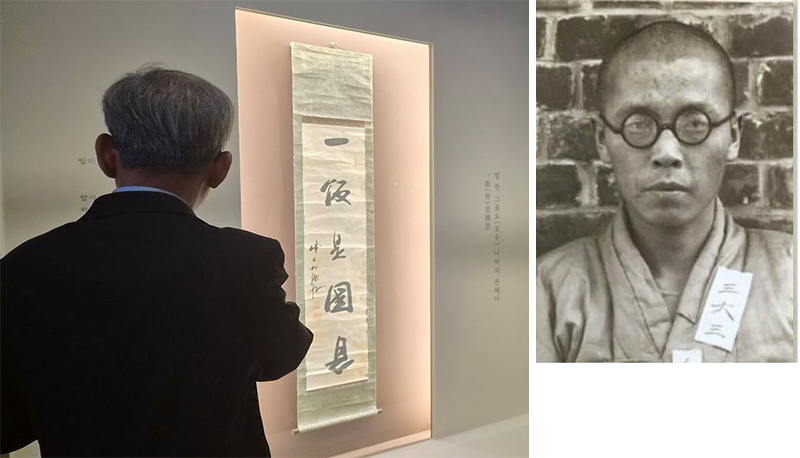
In the National Museum's special exhibition 'Our Dining Table,' Director Yoo Hong-jun connected 'Ilban Siguk Eun' with 'rice' as food, demonstrating his level of understanding, while the actual activist Park Won-geun (朴源根, 1912~1950)
Park Jung-yang's history, marked by the use of multiple names, discrepancies in his official registry name, and uncertain birth year, reveals an ambiguous identity, similar to the political identities seen in some contemporary South Korean politicians. Unlike his firm pro-Japanese ideology, his past, where he was so desperate to hide his personal disgrace that he even glorified the meaning of a single meal, a single spoonful of rice, as loyalty to the Japanese Emperor, was not created overnight. The controversy surrounding Park Jung-yang's calligraphy will be resolved as soon as relevant data becomes available.
댓글
( 0 / 500 )
m504
6
반민특위의 실패는 단순히 한 위원회의 좌절로 끝난 사건이 아니라 해방 이후 대한민국이 어떤 과거를 선택했는지를 보여주는 중요한 분기점이었다고 생각합니다. 특히 조사관들의 증언과 당시 자료를 다시 살펴보자는 글의 문제의식이 의미 있게 다가옵니다.
( 0 / 500 )
jindong
8
박중양이라는 한 인물의 행적을 따라가다 보면 친일 문제를 단순히 몇몇 인물의 이름을 기억하는 것으로 끝낼 수 없다는 생각이 듭니다. 당시의 기록과 재산, 사회적 영향력이 어떻게 이어졌는지까지 살펴봐야 과거사 청산의 의미를 제대로 이해할 수 있을 것 같습니다.
( 0 / 500 )
花無十日紅
6
특히 반민특위 자료를 더 공개하고 검증해야 한다는 주장에 공감합니다. 역사 문제일수록 후대의 해석보다 당시의 조서와 증언, 문서가 중요합니다. 자료가 충분히 공개되어야 서로 다른 해석도 사실을 바탕으로 토론할 수 있습니다.
( 0 / 500 )
DinDin
5
이 글에서 가장 생각하게 되는 부분은 과거를 기억하는 방식입니다. 친일 행위자의 이름을 반복해서 나열하는 것만으로는 충분하지 않고, 그들이 어떤 구조 속에서 권력을 얻었으며 해방 이후 그 구조가 어떻게 이어졌는지를 살펴봐야 한다는 문제의식이 인상적입니다.
( 0 / 500 )
뽀빠이
5
역사는 과거의 사람을 심판하기 위한 기록만은 아니라고 생각합니다. 무엇이 잘못되었고 왜 그것을 바로잡지 못했는지를 알아야 현재의 사회가 같은 문제를 반복하지 않을 수 있습니다. 반민특위와 박중양에 관한 자료를 다시 들여다보자는 글의 취지에 공감합니다.
( 0 / 500 )
모모짱
5
박중양의 행적을 통해 개인의 친일 행위만이 아니라 식민지 권력에 편승해 형성된 사회적 구조까지 들여다보게 됩니다. 결국 과거사 문제는 특정 인물을 욕하는 것으로 끝날 것이 아니라 권력과 부가 어떻게 이어졌는지를 추적하는 작업이어야 할 것 같습니다.
( 0 / 500 )
Rose
3
무엇보다 기록의 공개가 중요하다고 봅니다. 반민특위 당시의 조서와 조사자료, 관련 인물들의 기록이 충분히 공개된다면 감정이나 정치적 해석보다 사료를 중심으로 역사적 사실을 확인할 수 있을 것입니다.
( 0 / 500 )
madness
3
반민특위가 왜 실패했는지를 이해하려면 당시의 정치적 상황과 권력관계까지 함께 살펴봐야 한다는 생각이 듭니다. 단순한 과거의 사건이 아니라 해방 이후 한국 사회의 방향을 결정한 중요한 역사적 장면이었다는 점에서 다시 읽어볼 가치가 충분합니다.
( 0 / 500 )
제국
2
해방 직후 친일 청산이 좌절된 과정이 이후 한국 사회의 이념적 갈등과 어떤 관계를 맺었는지를 생각하게 하는 글입니다. 역사를 현재의 정치적 구호로 소비하기보다 당시 사람들이 남긴 기록을 통해 차분하게 복원하는 작업이 더 많이 이루어졌으면 합니다.
( 0 / 500 )
신고내용
신고내용을 선택해주세요
회원비난/비하/욕설글 및 댓글도배성 게시물저작권 침해/불법자료 유출허위사실유포개인정보 유출.사생활 침해무단광고/홍보음란물 및 도박 불법 광고물범죄행위 관련 글불법행위 관련 소개물품 판매 및 사기글악성코드 및 스파이웨어 유포기타 사유 및 운영진 판단


비밀번호를 잊으셨나요?
Sign in with Google
All information provided by us is free of charge and is for the public good.