品

Corea든 Korea든, 품격은 이름보다 먼저다
Whatever the name—Corea or Korea—dignity comes first.
Whatever the name—Corea or Korea—dignity comes first.
Now
지금
751 Diaspora
Heritage
유산
Humanity
인문
Mirengsi
未冷尸
Politics
정치
Media
언론
이완용에게 물어봐...

사람人物
칼럼
bunny365
1800s Figures (13) Kim Ga-jin (金嘉鎭), 1846 (Heonjong 12) - 1922

0
2026. 08. 09
- Kim Ga-jin was branded a pro-Japanese collaborator for accepting a baronetcy from Imperial Japan, but his life demands a nuanced understanding beyond simple binary judgments.
- As an official of the Korean Empire, he participated in modern reforms and joined the Independence Club, later exiling himself to the Provisional Government in Shanghai to dedicate himself to the anti-Japanese independence movement.
- The poems he wrote during his exile in Shanghai, in particular, reveal his strong will to reclaim the nation, offering insight into the complex dilemmas and choices faced by intellectuals of that era.
- This highlights the need to meticulously re-examine the historical context and an individual's entire life when evaluating historical figures, rather than relying on superficial facts or binary criteria.
Kim Ga-jin, a name exploited
Dongnong Kim Ga-jin (金嘉鎭) is one of the representative figures branded as a pro-Japanese collaborator, whose national merit award for independence activists from the Ministry of Patriots and Veterans Affairs of the Republic of Korea was withheld. This was due to his receiving the title of Baron among the five ranks of nobility (Duke, Marquis, Count, Viscount, Baron) according to the Joseon Nobility Ordinance (Imperial Ordinance No. 14 of the Japanese Government-General of Korea, enacted on August 29, 1910, and enforced on September 6, 1910). It is impossible to find anyone who was not branded as a pro-Japanese collaborator, except for those who committed suicide or died fighting against foreign invaders. Human relationships involve communication or lack thereof between living people. Therefore, contact between Koreans, who had their entire civilization of thousands of years taken away, and the enemy who invaded to seize it all, was inevitable and the only path.
Colonial historical views cannot be overcome by superficial and formalistic dichotomies such as the government's independence merit awards or inclusion in pro-Japanese collaborator dictionaries. Even this dichotomy can be misused, so it would be much more beneficial for national interests to re-examine the events and outcomes from the beginning, rather than merely performing ceremonial acts of reward and punishment. Humans are moved and motivated by abstract literature, but they are creatures who feel much more comfortable with the establishment of factual relationships. Just as a destroyed natural environment adversely affects the habitat of plants and animals, a false history is a bad habit that causes mental confusion in humans. This confusion is not limited to a one-time prank; given that lies must be created across generations, society is bound to be steeped in gloomy, conspiratorial rumors that are organically and complexly generated. In an era where the world obscures the truth, people lose interest in the truth and become engrossed in the world of games. History is not on the side of justice, but rather the result of those who reordered stolen historical records.
Therefore, we should approach historical figures whose narrative advantages and disadvantages are clear with suspicion. In that sense, I would like to evaluate Kim Ga-jin as an official of the Korean Empire who, like a whale caught in a net, was powerless and remained only as a symbol. Joseon and the Korean Empire were different national names in the same place, but were both narratives human affairs that unfolded on the Korean Peninsula? Was it here that Dongnong served as Minister to Japan, Minister of Agriculture, Commerce, and Industry, and Chairman of the Jungchuwon, participating in diplomatic affairs and the reform of modern institutions? I present a few points, excluding the taboo question of doubting this spatio-temporal unity.
The more confusing the narrative, the better.
First, the authenticity of the conferment of titles and the Joseon Peerage Ordinance. The hierarchy of titles (爵位) or enfeoffment (冊封) is a principle of civilization that originated in China, but it disappeared without a trace from the earth with the establishment of the Republic of China in 1912, and related research was inherited by Britain and Japan. This was not an academic inheritance of research, but rather an application to the actual hierarchy in their own world, which is a comedy only humans are capable of. Since <The Cambridge History of China>, which elites who studied in the West would likely have heard of, instead organized Chinese history, it is the logic of the aggressor. Japan, portraying itself as having succeeded in reform and opening with the full support and strong pressure of the West, created the unheard-of 'Kazoku' (華族) system in 1884, demoting the Korean imperial family to royalty and committing the atrocity of bringing Japanese people into their families. However, neither modern China nor Japan mentions any significant history of a title system.
Kim Ga-jin was a diplomat, but his whereabouts during the Gapsin Coup are unknown. It is also unknown where King Gojong and Queen Min were and what they were doing. Since the characters in each incident are different, it feels like watching plays with different actors on the same stage. However, after the Gabo Reform, Kim Ga-jin actively participated in central politics and was involved in the establishment of the Sangmuhoeui-so (Commercial Council), Geonyang Hyeophoe (Geonyang Association), Dongnip Hyeophoe (Independence Association), Dongnimmun (Independence Gate), Dongnip Gongwon (Independence Park), and Manmin Gongdonghoe (People's Joint Assembly), gradually leading his career to be classified as pro-Japanese. Between 1896 and 1898, Yeongeunmun was demolished and Dongnimmun was built in its place. Yeongeunmun was originally Yeongjomun and was built in 1537, destroyed during the Imjin War, and rebuilt in 1606. It means a gate that welcomes the imperial edicts of the Chinese emperor, and it is interpreted as a symbolic gate for the reception ceremony of Ming envoys in the middle of Seoul, not on the border. Another interpretation, dissatisfied with this interpretation, emerged, destroying the gate and building Dongnimmun. This is also interpreted as meaning liberation from the bondage of the Chinese empire.
Behind the construction of the Independence Gate was Homer Bezaleel Hulbert (1863-1949), who helped Seo Jae-pil, who had been exiled to the United States due to the Gapsin Coup, return to Korea, establish the Independence Association (founded on July 2, 1896), and build the Independence Gate to reject Sinocentrism and promote American-style religion and politics. Hulbert was the editor-in-chief of the English edition of The Independent and a provider of printing presses. At that time, printing presses were for the purpose of public enlightenment, and in the sense that enlightenment taught a specific historical view, it was a form of brainwashing.
The inscription on the Independence Gate was initially believed to be written by Lee Wan-yong, but it is now widely accepted that it was written by Seo Jae-pil. In 2025, the Gyeonggi Provincial Museum also classified it as Kim Ga-jin's calligraphy in its exhibition. This was largely influenced by the autobiography <Changjiang Diary> of Jeong Jeong-hwa (鄭靖和, 1900-1991), the daughter-in-law who fled to Shanghai with her father-in-law Kim Ga-jin and her husband Kim Ui-hwan (金毅煥, 金載漢, 1900-1964), who was abducted during the Korean War. However, the first edition of Changjiang Diary, <Nokdukkot>, does not state that her father-in-law wrote the Independence Gate inscription. A comparison between the first and revised editions is necessary in such cases. If Seo Jae-pil or Kim Ga-jin, who were involved in the construction of the Independence Gate, wrote it, it would be understandable, but if Lee Wan-yong wrote it, the situation changes. If Hulbert's 'independence' and Lee Wan-yong's 'independence' are consistent, it would be a failure for colonial historiography. It would be an even greater problem if it reminds us of Syngman Rhee's life goal of 'independence'.
Perhaps the opposing interpretation of the existence of Yeongeunmun, and the idea that it should be a monument of joy for breaking free from China's tributary system, led to the belief that Kim Ga-jin, a prominent public official, was a better choice. Seo Jae-pil's pro-American image was too strong and could have backfired, and Lee Wan-yong was a calligrapher whose pro-Japanese image had fallen to the level of dirt. Even now, if one wishes, local antique dealers can procure Lee Wan-yong's calligraphy. He was a skilled calligrapher, but history spits on him, so no one buys his calligraphy. I will not deny that people are lenient towards those with strong genetic homogeneity, as blood is thicker than water, and there is a feeling of aversion towards the original nature of the Japanese race and their mixed-blood descendants. However, if Kim Ga-jin's entire actions are misrepresented by editing that he wrote the Independence Gate inscription, then the times cannot be properly understood.
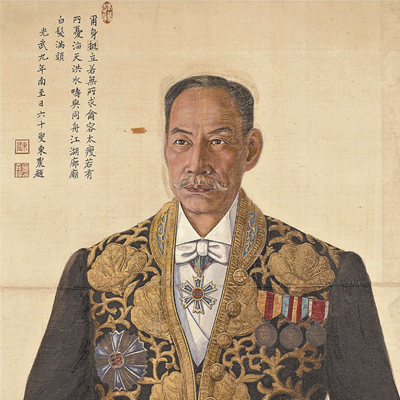
So why did Dongnong accept various official positions instead of committing suicide during the rise of the Qing Dynasty and Japan? The foreign powers before the Sino-Japanese War were not what they seemed, with Western forces hidden, so the tug-of-war narrative strategy between Qing and Japan, often exploited by historians, could be a fake technique. The painter and writer Arnold Henry Savage Landor (1865-1924), in his book <Corea or Cho-Sen, 1895>, described Kim Ga-jin as very intelligent in an interview while painting a portrait of Dongnong wearing a horsehair gat. It can be said that after the Gapsin Coup, the abolition of discrimination based on birth allowed people to enter official positions, which might have brought a sense of relief from thousands of years of social hierarchy. However, it is possible that the mass deaths of numerous public officials as retaliation for the Gapsin Coup (if we consider zombies as foreign powers, think of the Netflix Korean drama Kingdom series, a massacre that took place within the four gates and the nine-tiered palace) led to the abolition of the seoeol system. If Landor painted the portrait after seeing the real person, his meetings with Kim Ga-jin would have been numerous, but if he painted it from a photograph, the meeting period would have been shortened.
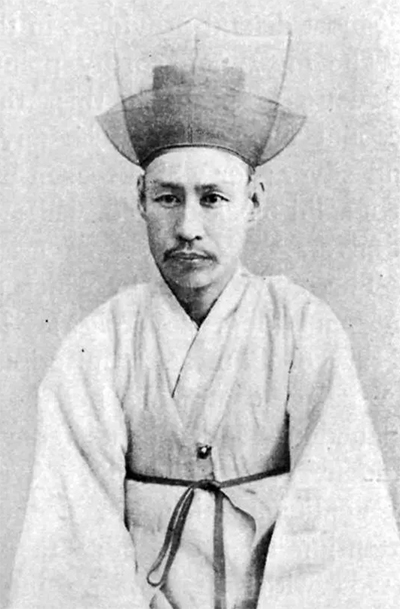
Dongnong's portrait painted by Savage
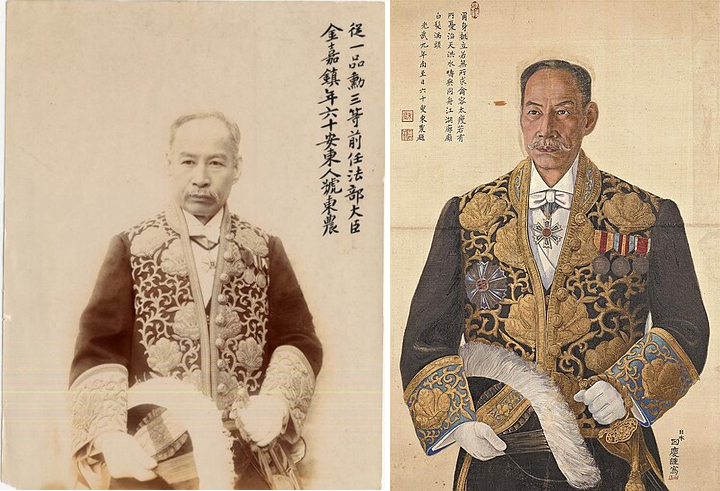
(Left) There is another portrait. A portrait presumed to have been painted from a photograph taken in 1906 (Gwangmu 10), when Kim Ga-jin was sixty years old, was exhibited at the Gyeonggi Provincial Museum's special exhibition in 2025.
(Right) In the upper right corner, in Chinese characters: 'Jong 1-pum, Hun 3-deung, former Minister of Justice Kim Ga-jin, 60 years old, Andong-in, Ho Dongnong'
This portrait depicts the Daehan Empire's civilian ceremonial robe and ceremonial hat. The hat style, with both sides folded up, is a bicorn, a Western-style hat. The changes over time, from Joseon, the kingdom of hats, transitioning from topknots to bald heads, and the last minister carrying a bicorn like Napoleon's under his arm—the dramatic changes of this period, how human customs and perceptions collapse and adapt, cannot all be explained by this single portrait. It is highly probable that Kim Ga-jin himself wrote the eulogy for this portrait, but this claim is insufficient in many ways if based solely on the handwriting. The inscription states that the painting was done by a Japanese artist named 'Denkei' (田慶), but there is no painter with this name. The Gyeonggi Provincial Museum should disclose verifiable information about who this painter Jeon-gyeong is.
It is plausible to infer that Landor also painted Emperor Gojong's portrait and met Minbi's relatives. During this period, when the empire was seemingly functioning and the West and Japan were buying time, Kim Ga-jin was likely a necessary figure, symbolizing a high-ranking official of the Korean Empire. He, who served as a high-ranking official of the Korean Empire in his sixties, carrying a Napoleon hat under his arm, might have been proof to the world that the Joseon court was operating under the name of an empire, and a mascot for legitimizing the system. Although he might have considered it patriotism and fulfilling a necessary mission, the world completely deceived this brilliant man.
The poems of independence activists were not fabricated because they could be memorized.
Secondly, on November 17, 1905, 13 days after the Eulsa Treaty was signed, Min Yeong-hwan (1861-1905) committed suicide. Kim Ga-jin, upon assuming the presidency of the Daehan Association, advocated for the recovery of national sovereignty and opposed the Iljinhoe, which argued for the annexation of Korea and Japan. At 59 years old, days of humiliation and regret unfolded for him. On August 29, 1910, the fourth year of the Korean Empire, pro-Japanese factions within Korea signed the Japan-Korea Annexation Treaty, leading to the downfall of the Korean Empire. Despite the futility of his official uniform and position, he accepted a baronetcy bestowed upon him just a few days later. Some individuals refused such titles. I would like to argue that Kim Ga-jin did not yet understand how the world truly worked. I want to believe that his earnest desire was not merely for success or material wealth, but to regain the nation, even if it meant acquiring power. His actions in his later years indeed reflected this, and his will was carried on by his son and daughter-in-law.
After the March 1st Movement in 1919, Kim Ga-jin planned a second independence demonstration and formed a secret organization called Daedongdan (大同團, Joseon Minjok Daedongdan), where he was elected as its president. However, in October, he and his family fled to the Provisional Government in Shanghai. He became an advisor to General Kim Chwa-chin's (金佐鎭, 1889~1930) Northern Military Administration Office (北路軍政署). Daedongdan attempted to help Prince Ui-chin Yi Kang (李堈, 1877~1955) defect to Shanghai, but it is said that they were discovered by the Japanese imperialists in Andong, China (present-day Dandong), and failed. In March 1920, proclamations and notices were distributed in the name of President Kim Ga-jin, and he, along with Go Gwang-won (高光元), Na Chang-heon (羅昌憲), Park Yong-man (朴容萬), and Son Yeong-jik (孫永稷) of Daedongdan, issued a fundraising appeal (醵金勸告文). This marked the beginning of fundraising for the full-scale anti-Japanese movement. The Governor-General's Office sent secret agents to Shanghai to appease or assassinate him, but they were rejected. Kim Ga-jin's actions, which regarded Prince Ui-chin as the legitimate heir to Joseon, are considered to be worth noting for a long time to come.
A secret agent is a spy in English, and the 19th century was also an era when spies were a profession worldwide. The following 20th century was an era when all spies were killed, an era when various organizations, institutions, and individuals around the world who employed spies erased their pasts. It was a century when those who made a living as spies falsely accused innocent people of being spies to obscure their own pasts. Although one might think it would be forgotten over time, humans are beings whose brains remember their actions, and we call that conscience. Kim Ga-jin, a Joseon person who preferred official positions, despite the limitations and societal norms that prevented him from escaping his status and lineage, ultimately risked his life on a difficult and doomed path. As an official who failed to protect the ancestral shrines and altars for thousands of years, Min Yeong-hwan atoned through suicide, but Kim Ga-jin chose a path of asceticism. I would like to interview them to find out who took the more difficult path.
A part of the poem written by Kim Ga-jin when he left for Shanghai (October 1919) remains. The reason it is only a part is that the transmission and preservation of classical Chinese poems were not easy in those days. It is difficult for a social career to remain like a panorama in photographs, as it did for Syngman Rhee. It's like there's a difference between whether historical figures were set up and created like a movie according to a script or not. Dongnong was not so naive as to not realize their schemes. Indeed, even modern Koreans have almost no standard for judging their schemes. Brainwashing has the effect of thoroughly cleansing the brain, and the price of accepting their enlightenment, which reorganized letters, thoughts, history, and records, is horrific.
The following two classical Chinese poems were first published in the <Dongnip Sinmun> on November 4, 1919, under the title '金嘉鎭翁來滬', where Ho (滬) is the name of a river flowing through old Shanghai.
The nation is ruined, the king has passed away, and the altars of state are in decline.
Embracing shame and enduring death, I have lived until today.
Even in my old heart, there is still a will to pierce the sky.
Once I soar powerfully, I will travel ten thousand li.
When the nation's life and death are at stake, how can I spare my own body?
I escaped the net of heaven and earth like a spirit.
Who would know that this shabby passenger, hidden in a third-class carriage,
was an old minister wearing a worn-out bamboo hat and coarse clothes?
The distance between Shanghai and Seoul is currently about 870 km in a straight line. If the poetic expression of 10,000 li is converted to actual distance, it becomes about 18,500 km, which is half the length of the Earth's oceans. Why did Kim Ga-jin specifically use the expression '10,000 li', and why has this poem become unavailable for free access to its original text?
The following classical Chinese poem, said to have been left by Kim Ga-jin just before his death in Shanghai on July 4, 1922, is often cited as the best representation of his will for liberation, but it shows the meanness of limiting Kim Ga-jin's poem, written at a crossroads of life and death, to mere transmission. Fakes are circulated and reign as if they were real, while the truth is buried and no one remembers it. Institutions and universities that possess the Shanghai edition of the Dongnip Sinmun should allow free access.
Though my hair is white, my red loyalty remains.
A dream of returning to the underworld, returning to Hwangcheon is but a dream.
On the day of national restoration in a future year,
I shall surely see the old mountains and rivers again.
Dongnong vowed to surely see the old mountains and rivers again, which is to say he wished to be reborn in his hometown. If you plant beans, beans grow, but if a person dies, does a person grow? I do not know. If you die in India, are you reborn in India, and if you die in Australia, are you reborn in Australia? Where is Kim Ga-jin now, and what is he singing? Even though his son was kidnapped and his daughter-in-law endured all hardships alone, this country has not yet awakened from its slumber. Stop the reward-and-punishment mentality, formalism, and childish acts. With that tax money, history would have already been unraveled.
댓글
( 0 / 500 )
萬福
8
김가진을 남작 작위를 받았다는 한 줄로만 규정할 수 있을까 하는 문제의식에 공감합니다. 역사적 인물은 어느 한 시점의 행위가 아니라 그 사람이 살아온 전체 궤적 속에서 평가해야 합니다. 특히 말년의 상해 망명과 독립운동까지 함께 놓고 보면 훨씬 복합적인 인물이라는 생각이 듭니다.
( 0 / 500 )
Buddha77
8
역사는 사람을 선인과 악인으로 분류하는 작업이 아니라 당시의 선택과 결과를 복원하는 작업이어야 합니다. 김가진처럼 전반기와 후반기의 행적이 크게 달라지는 인물을 기존의 친일·독립이라는 이분법으로 재단하면 오히려 역사의 실체를 놓칠 수 있습니다.
( 0 / 500 )
표영식
6
김가진의 경우 가장 흥미로운 대목은 1910년의 남작 작위와 1919년 이후의 항일 행적이 한 사람 안에 동시에 존재한다는 사실입니다. 바로 이런 모순과 변화를 제대로 연구하는 것이 역사학의 역할 아닐까요. 불편한 인물일수록 더 정확하게 들여다봐야 한다는 주장에 공감합니다.
( 0 / 500 )
Happy_C
6
민영환처럼 자결한 사람만 애국자이고, 살아남아 다른 선택을 한 사람은 모두 친일파라는 식의 평가는 지나치게 단순합니다. 물론 작위 수여와 식민지배 협력 여부는 엄중하게 따져야 하지만, 이후 어떤 삶을 살았는지도 동일한 무게로 검토해야 합니다. 상해 망명과 대동단 활동은 결코 가볍게 볼 수 없는 행적입니다.
( 0 / 500 )
창수74
5
누구를 독립유공자로 만들고 누구를 친일파로 낙인찍느냐보다, 그 시대에 실제로 무슨 일이 벌어졌는지를 끝까지 추적하는 것이라고 생각합니다. 김가진이라는 한 인물을 통해 대한제국 말기와 식민지 전환기의 복잡한 권력관계까지 다시 들여다보자는 글의 취지가 인상적입니다.
( 0 / 500 )
바람
5
역사에서 가장 경계해야 할 것은 지나치게 깔끔한 서사인 것 같습니다. 현실의 인간은 그렇게 단순하게 애국과 매국, 저항과 협력으로 나뉘지 않습니다. 김가진의 삶처럼 모순과 변곡점이 많은 인물을 그대로 바라보는 것이 오히려 역사에 대한 예의라고 생각합니다.
( 0 / 500 )
2000ksh
4
역사는 승자의 기록이 아니라 기록을 끊임없이 검증하는 과정이어야 한다는 생각이 듭니다. 특히 독립문 편액이나 김가진의 한시처럼 자료의 전승 과정에 의문이 있다면 기존의 정설을 반복하기보다 원자료와 초판·개정판을 비교하고 다시 확인하는 작업이 우선되어야 합니다.
( 0 / 500 )
donghyug
4
김가진에게 남작 작위가 주어졌다는 사실은 분명 기록하고 평가해야 할 일입니다. 그러나 그 한 가지 사실이 1919년 상해 망명 이후의 행적까지 지워버릴 수는 없습니다. 과거의 잘못을 면죄하자는 것이 아니라, 한 사람의 전 생애를 하나의 잣대로 재단하지 말자는 주장에 공감합니다.
( 0 / 500 )
허리케인
3
김가진의 마지막 선택은 여러 생각을 하게 합니다. 나라가 망한 뒤에도 편안한 삶을 버리고 상해로 건너가 독립운동에 뛰어든 사람을 어떻게 평가할 것인가. 그가 과거에 어떤 선택을 했든, 말년의 행동까지 지워버리는 것은 또 다른 형태의 역사적 왜곡일 수 있습니다.
( 0 / 500 )
moon82
2
김가진이 왜 작위를 받았는지, 왜 끝내 상해로 떠났는지, 그 사이에 어떤 국제정세와 인간관계가 있었는지를 밝혀야 합니다. 상벌의 명패를 붙이는 것보다 훨씬 어렵지만, 바로 그런 작업이 우리가 역사에서 배워야 할 진짜 공부가 아닐까요.
( 0 / 500 )
신고내용
신고내용을 선택해주세요
회원비난/비하/욕설글 및 댓글도배성 게시물저작권 침해/불법자료 유출허위사실유포개인정보 유출.사생활 침해무단광고/홍보음란물 및 도박 불법 광고물범죄행위 관련 글불법행위 관련 소개물품 판매 및 사기글악성코드 및 스파이웨어 유포기타 사유 및 운영진 판단


비밀번호를 잊으셨나요?
Sign in with Google
All information provided by us is free of charge and is for the public good.