品

Corea든 Korea든, 품격이 먼저다
Whether Corea or Korea, dignity comes first.
Whether Corea or Korea, dignity comes first.
Now
지금
751 Diaspora
Heritage
유산
Humanity
인문
Mirengsi
未冷尸
Politics
정치
Media
언론

사람人物
칼럼
bunny365
Figures from the 1800s (9) Hong Myeong-hui (洪命憙), 1888 (Gojong 25) ~ 1968 (Dangi 4301)

0
2025. 08. 07
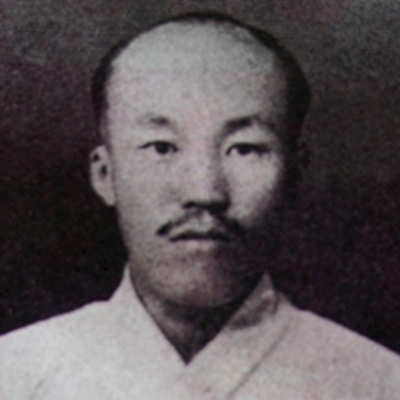
Albert Camus, the author of The Myth of Sisyphus and resembling Humphrey Bogart, and Byeokcho Hong Myeong-hee, who wore a white durumagi even after having his hair cut due to the short hair ordinance, lived in completely different spaces and cultures, so much so that it is hard to believe they lived in the same era. However, Hong Myeong-hee knew August Strindberg's short stories, Emperor Yan, and Shao Hao, and was a genius writer who encompassed both East and West, even recommending Tolstoy to Lee Kwang-soo. Hong Myeong-hee, who lived longer in terms of age and career, had a more difficult and longer suffering life, and lived a chaotic life both politically and personally. However, in an era where civilization degenerated at the same time as it flourished, both writers clearly show traces of contemplating their respective eras. It is not certain whether Camus's short life was a natural death, and Hong Myeong-hee's defection to North Korea is also questionable. How terrible was the world from the 19th to the 20th century, driving humanity into war and turning intellectuals into puppets?
At the end of the declining Joseon Dynasty, Hong Myeong-hee, Choi Nam-seon, and Lee Kwang-soo, known as the three geniuses of Tokyo, represent writers who were extremely unlucky. All three were unlucky from a young age. There is only one lucky path when a country collapses. Hong Myeong-hee went north for a meeting and could not return, so in South Korea, he was branded as a defector to the North, and none of his achievements were properly evaluated. During those years, fake intellectuals and fake scholars who occupied all the key positions treated genuine cultural heritage like dirt.
Tokyo Three Geniuses | ||
홍명희 (洪命憙) | May 23, 1888 (Gojong 25) ~ March 5, 1968 (Dangi 4301) | 1907 ~ 1910 Daesung Middle School |
최남선 (崔南善) | April 26, 1890 (Gojong 27) ~ October 10, 1957 (Dangi 4290) | 1904 ~ 1907 Waseda University |
이광수 (李光洙) | March 4, 1892 (Gojong 29) ~ October 25, 1950 (Dangi 4301) | 1905~1910Daesung Middle School, Meiji Academy |
Hong Myeong-hee's father committed suicide on August 29, 1910, when the Japan-Korea Annexation Treaty took effect. It is said that even a few letters of his will were confiscated by the Japanese, which shows how persistent they were. What was the reason for shaking the roots of the Joseon aristocracy to such an extent and erasing their traces? Hwang Hyeon of Maechen also committed suicide by swallowing opium 16 days after the treaty was signed. Prior to this, Min Young-hwan committed suicide in November 1905, two weeks after the signing of the Eulsa Treaty. Chang'an, which was full of talent and affection, was becoming a land of living corpses and dead corpses day by day, and the lives of intelligent intellectuals were rushing towards despair in a world where suicide or conversion were the only answers.
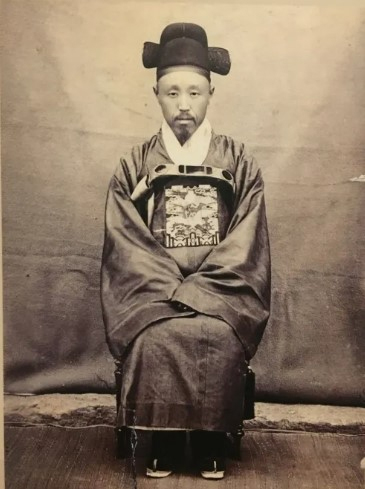
Hong Myeong-hee's father, Hong Beom-sik
Looking at Hong Myeong-hee's family, his 11th generation ancestor Hong Man-hyeong is the second son of Hong Ju-won of the Pungsan Hong clan, who is the son-in-law of King Seonjo. Hye-gyeonggung Hong is among the great-grandchildren of Hong Man-yong, the eldest son of Hong Ju-won, and the family of Dasan Jeong Yak-yong, and Hong Guk-yeong, the royal secretary who helped King Jeongjo ascend to the throne and is described as a symbol of the Seodo politics due to his abuse of power, is also a collateral relative. Hong Myeong-hee's biological mother, Lady Song of Eun-jin, was the daughter of Song Eun-ro, the county governor, and a 9th generation descendant of Song Jun-gil of the Westerners, like Uam Song Si-yeol. His stepmother, Ms. Jo, was dragged away and killed during the Korean War because there was a defector to North Korea among her family members. When the North Korean army captured Seoul on June 28, 1950, the Chosun Ilbo, which issued an extra edition saying, "The People's Army liberates Seoul, Long live General Kim Il-sung," was kidnapped on July 6 and died in a U.S. air raid because its owner, Bang Eung-mo, had not evacuated. The poet Noh Cheon-myeong also did not evacuate and participated in the Korean Writers' Alliance, and after the recapture of Seoul, she was sentenced to 20 years in prison for collaborating with the enemy, but was pardoned in 1951.
The transition from the liberation space to the Korean War was just a fuse that became the direction of the war for war, but in fact, it was a stage for world politics set up for division and discord. The whereabouts of these smart geniuses were based on calm and gentle personalities that could not detect the top predators, so they could not read the framework of big plans such as communists and spies, and were sucked into the ideological frenzy as it was. I don't want to mention much about the reversal of fortunes and deaths of Hong Myeong-hee's daughters, and the relationship of in-laws with Kim Il-sung. It is impossible for our general public to know all the facts that happened in North Korea just by reciting the contents claimed in South Korea. However, the fact that Kim Il-sung is fake is a well-known fact in the Korean political world. Counting only Japanese materials, there are as many as four people impersonating Kim Il-sung. I don't know which Kim Il-sung became in-laws with Byeokcho, but that June 25th was a war fireworks display that solidified the division between the two Koreas. People died and troops from all over the world remained as casualties, injuries, and evidence in a globally prepared show. Pro-Japanese were killed, leftists were killed, and all were killed to remove witnesses who knew history. Making North Korea an independent country, and having smart talents kidnapped or defect to North Korea, that was the stage left for our people who had escaped colonialism.
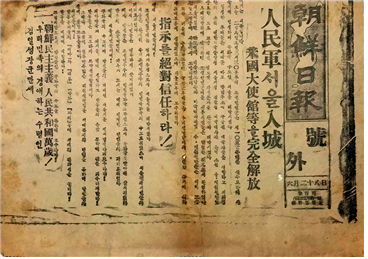
Source: Chosun Ilbo, extra edition dated June 28, 1950, Media Today (https://www.mediatoday.co.kr)
홍명희's aunt, 고모 홍정식, who was the wife of independence activist 조완구, was also from the prestigious 풍산 홍씨, ‘豊洪’. 홍명희 married 민순영, the daughter of 참판 민영만, in 1900. His father-in-law was the grandson of 민치대, the brother of 민치구, who was the maternal grandfather of King Gojong, and the son of 민선호, making him close to the 여흥민씨, the family of Empress Myeongseong. His son, 홍기문, who made a name for himself as a nationalist and scholar of Korean studies, was born in 1903 and was like an alter ego and friend to 홍명희, who was 15 years old at the time. Unlike his father, 홍명희, who studied in Japan, he learned Chinese classics and history under his grandfather and mastered new learning through self-study. His grandfather was a pro-Japanese collaborator, but he taught history while raising his grandson, 홍기문. This part needs further investigation. 홍기문 made a living doing all sorts of things that a humanities scholar could do, such as working for the Chosun Ilbo editorial department and as a local culture research committee member. In April 1948, when 홍명희 went to North Korea to attend the 남북연석회의 and was forced to defect, 홍기문 also defected to North Korea. Based on his knowledge of Chinese classics, he researched and published Korean historical grammar, Hyangga interpretation, and the Annals of the Joseon Dynasty. 홍기문's son, 홍명희's grandson, 홍석중, was born in Seoul and defected to North Korea in the liberated space, changing his space. In 2002, his novel '황진이' won the Manhae Literature Prize in South Korea in 2004, the first time a North Korean writer had received the award. I vividly remember being overwhelmed by the tragedy of the division and the genius's writing. Achievements that only a genius could achieve, or was it research that was possible with effort even if you weren't a genius? If there was no division, what kind of improvements, progress, and coexistence of human civilization would we be preparing for now?
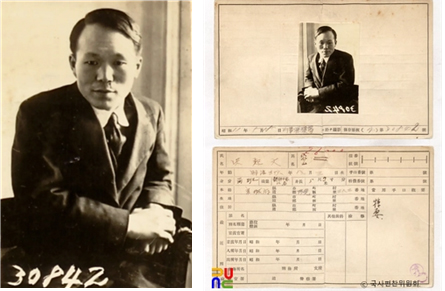
홍기문's Main Surveillance Target Figure Card during the Japanese Colonial Period
According to Kim Gu's memoirs, his return from the North was almost an 'escape.' The reason why Hong Myeong-hee could not return was due to his sense of responsibility for the ongoing international conferences and the plan to take already-determined talents to North Korea. The operation to take Widang Jeong In-bo is also interpreted in that context. Countless intellectuals, including Lee Kwang-soo, Son Jin-tae, Lee Geuk-ro, and Park No-gap, were selected from each class. Statistics are just numbers and cannot be the basis of credit, but hundreds of thousands of people went missing or were abducted during the Korean War, and the massacre of civilians is countless. Was this truly an inevitable war, or was it an intentional, prepared war?
If you add up all the direct and collateral lines of Hong Myeong-hee's maternal and paternal families, you can't help but be amazed at how great the prestigious Joseon families were, and how their genealogies quickly become history after only a few generations, a nation where the trajectory of human civilization has accumulated. Nevertheless, why did they have to eliminate the word 'nation,' belittle its meaning, and distort history with red-baiting? With all sorts of tricks and propaganda, our society now does not trust any adults and treats any ancestors worse than dogs. Only Syngman Rhee, backed by the United States, moved well according to the script. Kim Il-sung and Syngman Rhee were figures instigated by the Soviet Union and the United States, and an operation to weed out countless intellectuals who knew that fact. Now, we must break free from the ghost of a justified war.
The Chosun Ilbo extra edition stated, "The citizens of Seoul welcomed the Korean People's Army, which they had long yearned for, with enthusiastic cheers." It also stated, "The eternally treacherous Lee Seung-man clique, the U.S. Embassy, and the U.N. Commission, who were in Seoul, had already fled Seoul on the morning of the 27th." "Seoul has completely become the capital of our Democratic People's Republic of Korea and has become a street for all citizens of Seoul. Now the citizens will live happily." This contains the honest and naive hope. Until then, intellectuals in civil society, who longed for a unified North-South Korean government, included in the extra edition the idea of creating a purely Korean government, not a communist Joseon. However, this is not the only reason for the war.
I am extremely sorry and feel like I am committing a sin by carelessly wielding my pen about Byeokcho. Looking at the figures in each family, I am doubtful as to how the civilization that had continued such an outstanding family could have been devoured by the descendants of the vile Japanese pirates.
The original intention of introducing Hong Myeong-hee was because I was curious about how his genius worked in a time when the nation was unfortunately destroyed. As readers of Im Kkeok-jeong will acknowledge, once born as a human, one cannot help but wonder why the lives of such intelligent people are not uprightly becoming the norms of life today, the basis of research, and praised as one of the anti-Japanese activists. The discourse of literature and history, poetry and novels disappears, and I am skeptical of the uniformity of the public who have become spectators, as to why this society is dominated by dull and clumsy people. If we look at Hong Myeong-hee as a novelist, Park Kyung-ri, Park Wan-seo, Cho Jung-rae, and Choi Myung-hee are also feasts of geniuses. Regardless of whether they are defectors or abductees, the writings of generations who experienced before and after liberation have great yokes and abyssal sadness. They portrayed the Japanese colonial period in a completely different color and on a completely different scale than it is now. However, like the return of salmon, we cannot embrace the historical background of resisting artificial division and having to go to North Korea, or the parts that were missed privately and publicly at the crossroads of choice, and we do not know how to escape from dogma. What should be criticized is not the conversion of intellectuals, but the criticism of the lack of research into why they made such choices.
Hong Myeong-hee's firm, flint-like pen name, Byeokcho (碧初), is said to mean that he was the first Korean to learn the artificial language called Esperanto. Why did an artificial language become necessary when the nation was reorganized and the rise and fall of the country was torn apart by Western European colonial empires? Why did the language genius Hong Myeong-hee have to learn this artificial language first? Why did Vietnam use Chu Nom to record old Chinese characters in the alphabet, and why did China only formalize simplified Chinese characters in 1964? Why is Joseon divided into North and South, abandoning Hanja, a writing system with thousands of years of history, and only using Hangeul, a phonetic symbol? If you are a descendant of geniuses, you can understand if you think about it a little. Alas.
댓글
( 0 / 500 )
Donghak
5
“임꺽정”을 쓴 벽초의 문학성과 역사 의식은 지금 다시 조명받아야 마땅합니다. 시대의 혼란 속에서도 민족혼을 지키려 했던 진짜 지식인의 고뇌가 느껴지는 글입니다.
( 0 / 500 )
expressK
8
역사를 통째로 잊고 사는 지금, 이런 글은 우리 스스로의 근대를 되돌아보게 만드네요. 천재들이 선택한 길을 단순히 이념으로 재단하지 말자는 말에 깊이 공감합니다.
( 0 / 500 )
想像
7
해방 전후의 혼란기에 ‘월북’이라는 단어 하나로 평생의 업적을 묻어버리는 지금의 분위기를 반성하게 됩니다. 다만 글이 너무 서사적이라 학문적 검증이 더해졌으면 좋겠네요.
( 0 / 500 )
Oxford
6
벽초가 에스페란토를 최초로 익힌 한국인이라는 사실은 놀라웠습니다. 민족주의와 국제주의를 모두 사유한 인물이란 점에서 한국 지식인사에서 유일무이한 존재 아닐까요?
( 0 / 500 )
지윤선생
삭제된 내용입니다
( 0 / 500 )
지윤선생
6
최남선과 이광수는 교과서에서라도 만났지만, 벽초 홍명희는 낯선 인물인데, 글을 읽으며 그가 살았던 시대를 새로운 시각으로 환기해 보는 기회를 가집니다.
"나라가 망하는데 운이 좋은 길은 하나의 길밖에 없다." 라는 문장이 가슴을 치네요.
역사는 결국 깨어 있는 몇 사람이 먼저 움직여 만드는 것일텐데, 그의 선택이 정치적으로 복잡하게 평가받더라도, 그가 추구했던 정신, 천재성을 개인의 영달이 아닌 민족과 인류를 위해 바치는 헌신이라는 가치는 조선에서 이어진 대한민국의 역사 한 페이지를 살아 나가고 있는 우리 개개인에게 여전히 유효하다 생각됩니다.
( 0 / 500 )
andrea72
7
“지식인의 전향을 비판할 게 아니라 그 이유를 연구해야 한다”는 문장은 오늘날의 모든 비판적 지식인에게 던지는 질문 같았습니다. 이념의 감옥에서 벗어날 때입니다.
( 0 / 500 )
ariana90
5
글 전반에서 느껴지는 울분과 애정, 그리고 홍명희 가문에 대한 존중이 진심으로 다가왔습니다. 지식인이란 무엇인가를 다시 묻게 됩니다.
( 0 / 500 )
sevenstar
4
조선일보 호외를 인용한 부분은 흥미롭지만, 그걸 곧이곧대로 받아들이는 건 시대 정황에 대한 과잉 해석일 수도 있습니다. 당시 시민들이 북한을 ‘해방군’으로 본 건 과도한 환상 아닌가요?
( 0 / 500 )
신고내용
신고내용을 선택해주세요
회원비난/비하/욕설글 및 댓글도배성 게시물저작권 침해/불법자료 유출허위사실유포개인정보 유출.사생활 침해무단광고/홍보음란물 및 도박 불법 광고물범죄행위 관련 글불법행위 관련 소개물품 판매 및 사기글악성코드 및 스파이웨어 유포기타 사유 및 운영진 판단


비밀번호를 잊으셨나요?
Sign in with Google
All information provided by us is free of charge and is for the public good.