品

Corea든 Korea든, 품격이 먼저다
Whether Corea or Korea, dignity comes first.
Whether Corea or Korea, dignity comes first.
Now
지금
751 Diaspora
Heritage
유산
Humanity
인문
Mirengsi
未冷尸
Politics
정치
Media
언론

사람人物
칼럼
bunny365
Person from the 1800s (7) 이용익(李容翊), 1854(哲宗 5)~1907(光武11)

0
2025. 03. 11
Some generations may not even remember the name 이용익, but readers will remember him as a peddler and water carrier who rose to the only position trusted by Gojong. 이용익, who managed the imperial family's assets through businesses such as mining rights and ginseng monopoly while wandering around his birthplace in the Hamgyeong Province, is known to have helped Empress Myeongseong, who had fled to Janghowon during the Imo Incident, and took charge of communication with Gojong, which served as the beginning of his promotion.
However, most modern figures are depicted as being exiled for their poor behavior or as being unscrupulous, so it is not clear what actually happened at the time and what process led to the downfall of the country. Of course, they would not have allowed the Japanese to write it as it was, but due to the distorted history education during the anti-communist military dictatorship, expectations for modern figures themselves were not high as time passed. No matter how much history is a celebration contest for the victors, it is not a normal view of the nation to leave everything to the Japanese colonial view of history that it was destined to fail and to have no voluntary recollection. If they were all figures who embezzled taxes that would go into the national treasury or were exiled for disgraceful charges, how could civilian righteous armies and independence activists have continued the seeds of independence for generations? Do you think that even a hundred years ago, high-ranking officials turned a blind eye to illegal activities and only the general public worked hard and sacrificed their lives for the country? If you look closely, it is a series of events that are not known to the general public.
In June 1888, while serving as a local official, Lee Yong-ik was identified as the cause of a civil revolt in Bukcheong, Hamgyeong Province, and was dismissed from his position as the Byeongma Jeoldosa of Hamgyeongnam-do and exiled to Jido, Jeollanam-do. In 1896, he was reappointed as an official in the Hamgyeong Province region as the governor of Pyeonganbuk-do, but was exiled again due to a civil revolt. In the following year, 1897, he appears to have become an official of the Jungchuwon, showing a pattern of repeated exile and appointment. Until this point, it seems that the power struggles within the court and the interference of the Japanese continued. From the time the Japanese began to gain power, there was no more exile. It seems that somewhere in the court was still trying to function properly.
In the same year, he was sentenced to another 10 years of exile for plotting to kill Lee Yun-yong. Lee Yun-yong is the half-brother of Lee Wan-yong. Lee Ho-jun, the biological father of Lee Yun-yong, adopted Lee Wan-yong in 1867 instead of his illegitimate son Lee Yun-yong. Lee Seok-jun, the biological father of Lee Wan-yong, and Lee Ho-jun are said to be 32nd cousins in the family tree, so they are no different from strangers, but Lee Ho-jun was also adopted. The property was given to Lee Yun-yong, who was an illegitimate son but a biological child, and Lee Wan-yong, who was adopted as an heir to perform ancestral rites, was satisfied with his status, but the basis for this anecdote has not been found. I don't know the order of the family tree at the time, but it is not easy to understand that Lee Wan-yong, who is an adopted son and younger brother rather than a biological illegitimate son, was in charge of the ancestral rites of a family that was almost like strangers.
Like the Min Yeong-hwi family we discussed in the last episode, it seems that the family trees were twisted and the social order was messed up at some point in the late Joseon Dynasty. In fact, many Yangban aristocrats disappeared with guns and swords, like harvesting rice in the fall, and the smell of blood from the Japanese Empire that penetrated their family trees is strong. It seems that the Japanese Empire's manipulation started earlier than known. What does the shadow of the Japanese Empire that penetrated the Joseon people's family trees mean, even in the colonial rule system and the exploitation of human and material resources?

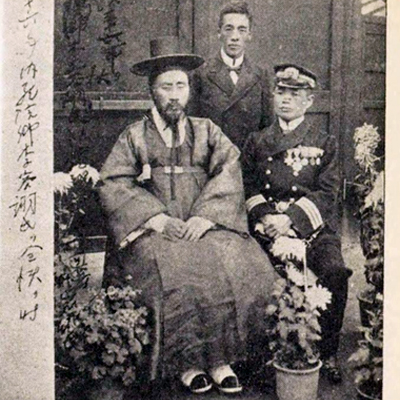
李允用
The photo above is of Lee Yun-yong, who died at the age of 83 with the title of Baron. His attire and gestures are reminiscent of the end of the Yeolseong Dynasty, or the Enlightenment period in the New Right style, and he is striking the same pose as the members of the Gapsin Coup who made gestures corresponding to the Freemason's mark. The pose with his hand inside his clothes can also be seen in Napoleon's portraits, and Marx, Lenin, Stalin, Son Byong-hee, Obama, and even Jeon Kwang-hoon have taken pictures in this pose. It's a very artificial gesture, but even if we consider it a part of conspiracy theories, history is history. Conspiracy theories also have a long history. In order for a conspiracy theory to become an established theory, a lot of research is needed, but no one invests as much in conspiracy theory research as they do in established theories. Even now, the hands of influential politicians around the world sometimes enjoy certain marks. Yoon Seok-yeol's hand once imitated this. There is such clear evidence, but why are the public volunteering to be easy prey and not thinking about fighting back? If the conspiracy theory has continued to this extent, it would no longer be a conspiracy.

Lee Yun-yong was the son-in-law who married the illegitimate daughter of Heungseon Daewongun, and he was excellent at making money, living in Gahoe-dong No. 9, possessing tens of thousands of assets (no unit), and living a leisurely life. Lee Yun-yong was the main culprit who caused the Russian legation affair with his half-brother Lee Wan-yong, organized a pro-Russian cabinet, and rose to the position of Minister of Military Affairs, the person in charge of the military, but the aspects of this pro-Russian cabinet do not appear to be pro-Russian but pro-Japanese. It is hard to grasp what kind of politics King Gojong, trapped in the pro-Russian frame, would have been like.
Lee Yun-yong received the Japanese Order of the Rising Sun Paulownia Flowers Grand Cordon on January 10, 1908, long after the end of the Russo-Japanese War. The original medal of this Order of the Rising Sun Paulownia Flowers Grand Cordon is the Grand Cordon of the Order of the Rising Sun, 1st Class (勲一等旭日大綬章) received by Ito Hirobumi in 1877. I wonder what Lee Yun-yong's contribution was to receiving a medal comparable to Ito Hirobumi. If Ito Hirobumi made a significant contribution to handing over Joseon to Japan, Lee Yun-yong would have played a similar role. Lee Yong-ik was the one who tried to kill Lee Yun-yong. So history portrays Lee Yun-yong badly, and we grow up listening to such character assessments.
The following is one of a series of photo postcards taken by French missionary Charles Alévêque in February 1904, when 이용익 was 50 years old. It is a photograph of Alévêque's original postcard, so it is clearer than any known postcard, and compared to the photos remaining in later generations, his face is fleshy and his physique is large. Regarding the appearance of 이용익, there is a photo in the record of the Japanese military doctor who treated him, but in this photo alone, his face and body are so thin that it is doubtful whether he is the same person. The attire taken by Alévêque is a relic of the same attire displayed in the museum, and its size and style can be roughly estimated, and it is estimated that he was a quite large figure.

Photo of 이용익 taken by Alévêque, 1904
Erwin von Bälz (1849-1913), a German physician who was a hired foreigner in Meiji Japan, was invited to Tokyo Medical School in 1876 and contributed greatly to the development of Japanese medicine for nearly 30 years until he returned to his country in 1906. If Koreans need to know about Bälz, it is because he is the one who named the Mongolian spot (蒙古斑, 1885). He served as the director of Oriental Affairs at the Anthropological Society and the president of the Tropical Medicine Society. In 1905, Bälz received the Order of the Rising Sun, First Class, like Ito Hirobumi, and returned to his country. Bälz must have been awarded for his achievements comparable to Ito Hirobumi or Lee Yoon-yong, and since he is a physician, it seems to be related to colonial Joseon. It is presumed that this was the reason why the publication of part 1 of his diary in 1951, which will be described later, was prohibited.
Bälz left a diary of his 26 years of life in Japan, which was edited and published in Japanese by his son Toku (Japanese pronunciation of the Chinese character 德) in 1939. In 1943, it was released in two paperback volumes, with more diaries added after 1903, increasing the volume. It was released again in 1951 after the defeat, but as the translator said, the authorities pointed out that the original diary could not be published as it was due to issues related to the imperial family, the military, and Joseon. Even after editing and allocation, the authorities demanded the deletion of some content after publication, and eventually gave up publishing Part 1. In 1979, it was revised and republished with about 80 pages of supplementary explanations added to the diary part, but the deleted parts of the previous edition were also removed from the world. This diary of Bälz is not just a glimpse of modern Japan by a foreigner. In some ways, it is worth reading just for the perspective of an outsider living inside Japan, as a doctor, and for his unwavering attitude of supporting Japan as a German.
Bälz's Diary, June 24, 1903 (Published in 1952, the first edition in 1939 starts with the diary of his stay in Japan from September 15.) In his diary in Seoul, he wrote, "An interesting consultation today. 이용익 is the most powerful person in Korea, and has just as many enemies." He introduces 이용익 as having been pro-Russian in the past. The following content does not clearly state whether Bälz examined 이용익, and whether Japanese naval surgeon Wada Yachiho和田八千穂 (1870~?), the director of Hanseong Hospital at the time, assisted him. Wada's impressions of visiting 이용익's house were, "The streets near the house are so narrow that two carriages cannot pass at the same time, and there is a mountain full of pollutants near the house. He said that soldiers with guns were guarding his house. We cannot know if he is under house arrest. He was lying on a mattress on the floor. He is a man of very healthy build. He used to be very plump, but now he is thin and weakened by a serious illness. His face is long and narrow, long and narrow and dignified, and almost European, especially because his nose is high and narrow. His nose is high and narrow, and his beard, mixed with white hair, covers his face. His hands are noticeable and noticeably beautiful, long and white. It feels completely aristocratic. It's hard to believe the rumor that he used to be a coolie. His appearance, his condition, is not reassuring..."
According to Wada's records, the disease that 이용익 contracted around May 1903 was a disease called 丹毒 (erysipelas). However, this disease is rare today. Since the environment in which viruses occur varies depending on the era and region, it is necessary to carefully examine this in relation to the fact that numerous historical figures are recorded to have died from poisoning during the rise and fall of Joseon. There are many mysterious parts to 이용익's actions, from his personal life to his public duties. What was it that he, with his white, aristocratic appearance like a European, wanted to protect even while being exposed to the threat of assassination, struggling through the rough road to national ruin, not just a temporary national crisis? Why was he able to become Gojong's closest aide while being remembered as a man of low status, from a coolie doing manual labor, a water seller, and a peddler, and why is it known that he established schools and devoted himself to fostering talent...? There are so many lost histories, and the clues are limited and blocked. 이용익 was assassinated in Vladivostok or St. Petersburg in 1907. How should we unravel the national destiny that he had to go all the way to that distant place to be killed for? We await the reader's insight.
댓글
( 0 / 500 )
사랑
2
이런 인물에 대해 처음 알았습니다. 자료 조사하시느라 애쓰셨을 듯, 좋은 자료 감사합니다
( 0 / 500 )
토토로
8
이런 자료를 만드시는 분은 어떤 자료들을 보시고 하시는지 궁금합니다. 전부 모르던 새로운 내용이고 깊이가 있어 놀랍니다
( 0 / 500 )
┖ sunbin
1
저도 이곳 자료들을 보면서 정말 많이 배우고 있어요
( 0 / 500 )
Dokdo
4
좋은정보, 우리가 알아야 하는 역사지식을 이렇게까지 정리해 주심에 정말 감사드립니다
( 0 / 500 )
byoungkook
2
늘 좋은자료 좋은 글을 통해 배우고 있네요. 감사합니다
( 0 / 500 )
Oxford
3
우리 역사에 대해 너무나 진진하게 그리고 성실하게 연구하시는 모습에 그저 감탄과 존경이... 감사합니다
( 0 / 500 )
Buddha77
5
일제와 서구에 의한 역사왜곡 문제는 반듯이 바로잡아야 합니다. 저들이 감정기 동안 왜곡시킨 우리 역사가 얼마나 많을지 상상도 불가합니다. 부디 많은 연구를 통해 많은 사실을 밝혀주시길
( 0 / 500 )
┖ 옛날이야기
2
과거 학교에서 배웠던 역사의 모순과 그 치졸한 왜곡에 화가나네요
( 0 / 500 )
minjoon
2
이 당시 우리에 대한 역사자료는 우리가 기록한 것보다 일본이나 서구에 의한 기록이 더 많이 남아있는건가?
( 0 / 500 )
mancity
2
이런 인물에 대한 조사와 분석을 보게되니 참으로 연구하는 사람들의 중요성이 대단하게 느껴집니다
( 0 / 500 )
park_SJ
2
여기있는 인물들 자료로 책을 만들어도 아주 좋을 듯 하다는 생각을 해봅니다. 친일파와 잔존일본인들에 대해 아주 소상히 다루면 좋을것 같아요
( 0 / 500 )
┖ hanjoon
1
저도 찬성입니다.
( 0 / 500 )
신고내용
신고내용을 선택해주세요
회원비난/비하/욕설글 및 댓글도배성 게시물저작권 침해/불법자료 유출허위사실유포개인정보 유출.사생활 침해무단광고/홍보음란물 및 도박 불법 광고물범죄행위 관련 글불법행위 관련 소개물품 판매 및 사기글악성코드 및 스파이웨어 유포기타 사유 및 운영진 판단


비밀번호를 잊으셨나요?
Sign in with Google
All information provided by us is free of charge and is for the public good.