品

Corea든 Korea든, 품격은 이름보다 먼저다
Whatever the name—Corea or Korea—dignity comes first.
Whatever the name—Corea or Korea—dignity comes first.
Now
지금
751 Diaspora
Heritage
유산
Humanity
인문
Mirengsi
未冷尸
Politics
정치
Media
언론
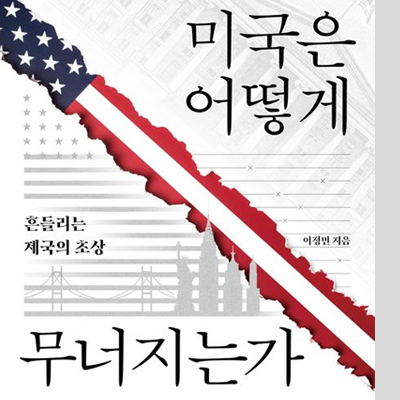
이정민 기자의 『미국은 어떻게 무너지는가: 흔들리는 제국의 초상』

책冊
칼럼
chris_Jung
Lee Jung-min's "How America Collapses"

0
2026. 07. 24
- This book diagnoses that the U.S. is no longer the "world's police," but is undergoing a structural transition where its hegemony is shaken by internal divisions and a reduction in external strategy.
- The author interprets the Trump phenomenon not as a mere anomaly, but as a fundamental change reflecting the collective will of the American people, foreshadowing deepening U.S. isolationism and a realignment of alliances.
- The analysis suggests that the U.S. shift to a "hemispheric strategy" and reliance on technological hegemony is an attempt to maintain its weakened dominance, but it has clear limitations, which will create a vacuum in the international order and accelerate China's rise.
- In conclusion, the book emphasizes that America's transformation is a significant challenge requiring new strategic thinking beyond reliance on the U.S. for allies, including South Korea.
Lee Jung-min's 『How America Collapses: A Portrait of a Shaking Empire』 is a book published in June 2026. Beyond criticizing America or evaluating Trump personally, it directly addresses the structural changes that have led to America no longer being able to function as the 'world's policeman' or the absolute guardian of liberal democracy as it once was. The author, a 24-year veteran KBS reporter who served as a Washington correspondent for three years starting in 2021, directly witnessed the withdrawal from Afghanistan, the war in Ukraine, the war in Gaza, and the 2024 US presidential election. Based on those experiences, he asks: What is happening to America, now that it has shed its crown? What has made America run so wildly out of control? This question is not born of curiosity, but from a serious inquiry into the reality that the order America itself created is cracking both internally and externally.
The author's core argument is clear. The changes America is exhibiting today are not temporary phenomena stemming from Trump personally or his whims. It is a fundamental paradigm shift created by the collective will of the American people, who chose Trump twice. The superpower that once championed itself as the 'world's policeman' and defended liberal democracy no longer exists. Americans themselves no longer consider their country an absolute superpower, and an atmosphere of focusing on domestic issues and reducing global roles has become dominant. The author emphasizes that to understand this change, one must read the deep terrain underlying the surface of Trump. Through long observation, including his time as a Washington correspondent, he confirmed that a widespread psychological and political shift, where people are unwilling to bear the burden of hegemony, is already underway within American society. This was not a resurgence of isolationism, but a sign that the very identity of an empire was beginning to waver.
Part 1 deals with the twilight of hegemony.
Particularly symbolic is the interview with Elbridge Colby, introduced in Chapter 1. Colby, a key figure in the Trump administration's defense policy, frankly states that the interests of the ROK-US alliance do not necessarily align, and that South Korea should bear more of the defense burden. This reflects the perception already widespread among strategic elites that the US can no longer manage alliances indefinitely with 'leeway.' This statement is not a threat, but rather shows that the US has begun to redefine its allies not as 'protected entities' but as 'cost-sharing partners.'
Chapter 2 identifies the 2021 withdrawal from Afghanistan as a turning point. This event demonstrated to the world that the US lacked the will and capacity for long-term occupation and nation-building. The sudden withdrawal after decades of intervention sent a signal to both allies and adversaries that the US was no longer a 'superpower that takes responsibility to the end.'
Chapter 3 analyzes how the Russia-Ukraine war created deep cracks in the international order led by the United States. While continuing to provide support, the US revealed the limits of direct intervention, and differences in opinion with European allies, along with public fatigue at home, emerged simultaneously. The war showed that the US could still mobilize resources, but at the same time, it exposed the limits of those resources and the fragility of its political will.
Part 2 depicts an empire crumbling from within.
The United States is burdened by astronomical national debt, and its military power, once dubbed the 'Empire of Ten Thousand Armies,' is now riddled with holes. Weakening defense industrial base, difficulties in recruiting personnel, and limitations in maintaining simultaneous fronts are becoming apparent. Socially, the end of the 'American Dream' has reached a critical point. Deindustrialization, the collapse of the middle class, economic decline in rural areas and small towns, extreme polarization, and political division have fueled anger and frustration. This anger is analyzed as a significant driving force behind Trump's election. The author points out that these internal vulnerabilities are not merely domestic issues but fundamentally constrain the sustainability of foreign policy. For an empire to project power externally, it must be supported by internal cohesion and resources, but that foundation is crumbling. The decline of the middle class and regional disparities have deepened political polarization, and as a result, the United States is becoming a nation where even domestic consensus is difficult to achieve. In this situation, maintaining global leadership is becoming an increasingly unrealistic goal.
Part 3 deals with the competitive dynamic with China.
The United States no longer seeks to manage the entire world. Instead, it is scaling back to a 'hemispheric strategy.' An example of this is the move to prioritize the defense of the Western Hemisphere and establish a dual defense line including Greenland, northern Canada, and the Panama Canal. This is akin to a modern revival of the classic Monroe Doctrine. In the Middle East, the U.S. is caught in a maelstrom, having lost both power, justification, and leadership. Military tensions related to Iran or aggressive moves against Venezuela around 2026 are not merely regional conflicts but occur within the larger strategic context of containing China and maintaining energy and dollar hegemony. However, such limited intervention is actually widening the vacuum in the world order, a vacuum that China is filling. China is challenging the petrodollar order by dominating renewable energy, strategic minerals, and supply chains. While the U.S. is reducing its fronts, China is systematically filling those empty spaces, and this is taking the form of a long-term competition across economics, technology, and resources, rather than a military confrontation.
Part 4 deals with America's last desperate gamble.
Big Tech and cryptocurrencies, especially stablecoins, could serve as technological and financial means to extend weakened hegemony. They are attracting attention as new tools that complement or replace the existing dollar order, but their effectiveness will inevitably be limited if fundamental trust and institutional foundations are shaken. No matter how advanced technology is, it cannot be a force to sustain hegemony if it is not supported by political and social cohesion. In the epilogue, the author concludes that the nature of alliances has already changed. Alliances that once shared values and trust are now degenerating into 'transactional relationships' that weigh benefits and costs. The ROK-U.S. alliance is no exception. The core warning is that the level of defense cost sharing, technological and industrial cooperation, and geopolitical contributions demanded by the U.S. will inevitably increase, and Korea must establish its own proactive strategy for this. If alliances no longer mean an automatic protective shield, Korea must fundamentally rethink how it will define and pursue its own security and interests.
The strength of this book lies in the combination of its on-the-ground reporting and analytical power. The author captured vivid voices through interviews with key figures such as the Deputy Prime Minister of Ukraine, a Hamas spokesperson, and a Russian exiled diplomat, and added academic depth based on over 400 references. The vision that connects internal divisions within the U.S. and the reduction of external strategies not as separate issues but as a single structure is impressive. In particular, the fact that a Korean author captured the core of the divisions that can only be seen 'outside of America' differentiates this book from existing theories on the U.S. While Americans are engrossed in their internal debates, an external perspective more clearly reveals that the decline of hegemony is already well underway.
Ultimately, 『How America Falls Apart』 declares that an era has arrived where the United States creates its own battle lines and expands its battlefields. While America remains a powerful military and economic nation, internal divisions and the consequences of strategic choices have made it difficult to maintain its past hegemonic status. This change poses a significant challenge to allies, including South Korea. It is a time that demands new strategic thinking beyond dependence on the United States. The questions the author poses in this book ultimately return to ourselves. What choices will we make in the face of a wavering empire? If America's changes are not temporary but a structural transformation, how will South Korea survive and protect its interests amidst the waves of that transformation? This book does not directly provide answers to these questions, but it makes the questions themselves an unavoidable reality.
댓글
( 0 / 500 )
namhee
11
미국을 무조건 찬양하거나 무조건 비난하는 책이 아니라, 왜 미국이 예전과 달라졌는지를 구조적으로 설명했다는 점이 인상적입니다. 한국도 '미국이 알아서 지켜주겠지'라는 사고에서 벗어나 스스로의 전략을 고민해야 할 때라는 생각이 듭니다.
( 0 / 500 )
大虎
9
아프가니스탄 철군부터 우크라이나, 중동, 중국 견제까지 하나의 흐름으로 연결한 분석이 설득력 있네요. 트럼프 개인의 문제가 아니라 미국 사회 전체의 변화라는 시각은 충분히 생각해볼 만한 부분이라고 봅니다.
( 0 / 500 )
nadaniel
8
결국 동맹도 이제는 가치보다 이해관계가 우선되는 시대라는 말이 가장 와닿았습니다. 한국도 감정이나 이념이 아니라 국익 중심으로 외교와 안보 전략을 다시 설계해야 한다는 경고처럼 읽혔습니다.
( 0 / 500 )
puma
7
현재 미국은 글로벌 리더쉽에서 자국만의 이익을 위한 패권주의 강화 움직임에 가속을 하고 있다. 트럼프의 거친 정치적 색깔로 이해하는 사람들이 있겠으나 민주당이 차기 정권을 가져가도 이러한 정책 기조는 더하면 더해지지 트럼프 재임 기간 벌어지는 시한적 움직임이라 생각하면 안된다. 민주당은 더 강한 정책을 다만 세련되고 예의바른 매너로 포장하며 진행할 것이다. 대한민국의 경제안보와 국방은 우리 자신이 지킨다는 국민적 각성이 필요하다.
( 0 / 500 )
sr84
7
미국의 국가부채, 중산층 붕괴, 정치적 양극화가 대외 패권까지 흔들고 있다는 분석이 흥미롭습니다. 제국은 외부의 적보다 내부의 균열 때문에 무너진다는 역사적 교훈을 다시 떠올리게 하는 내용입니다.
( 0 / 500 )
상용78
4
400여 개의 참고문헌과 현장 인터뷰를 바탕으로 했다는 점에서 단순한 시사평론과는 확실히 다르다는 느낌입니다. 미국 내부의 변화를 현장에서 직접 관찰한 기자의 시선이라 더욱 현실감 있게 다가옵니다.
( 0 / 500 )
chuljoong
6
이 책이 던지는 핵심 질문은 '미국이 무너지느냐'보다 '미국이 변하는 시대에 한국은 무엇을 준비해야 하느냐'인 것 같습니다. 미국만 바라보는 외교에서 벗어나 우리의 선택지를 넓혀야 한다는 점을 다시 생각하게 만드는 서평이었습니다.
( 0 / 500 )
79kim
5
미국이 쇠퇴했다고 단정하기보다는 패권을 유지하는 방식이 바뀌고 있다는 점을 잘 짚은 것 같습니다. 군사력만으로 세계를 이끌던 시대에서 경제·기술·금융이 더 중요한 경쟁 수단이 되고 있다는 분석이 인상적이네요.
( 0 / 500 )
SugarBoy
3
미국의 변화가 일시적인 정치 이벤트가 아니라 인구, 재정, 산업, 사회통합 등 구조적인 문제에서 비롯됐다는 분석이 가장 설득력 있었습니다. 앞으로 10년, 20년을 내다보는 사람이라면 한 번쯤 읽고 토론해볼 가치가 있는 책이라고 생각합니다.
( 0 / 500 )
신고내용
신고내용을 선택해주세요
회원비난/비하/욕설글 및 댓글도배성 게시물저작권 침해/불법자료 유출허위사실유포개인정보 유출.사생활 침해무단광고/홍보음란물 및 도박 불법 광고물범죄행위 관련 글불법행위 관련 소개물품 판매 및 사기글악성코드 및 스파이웨어 유포기타 사유 및 운영진 판단


비밀번호를 잊으셨나요?
Sign in with Google
All information provided by us is free of charge and is for the public good.