品

Corea든 Korea든, 품격이 먼저다
Whether Corea or Korea, dignity comes first.
Whether Corea or Korea, dignity comes first.
Now
지금
751 Diaspora
Heritage
유산
Humanity
인문
Mirengsi
未冷尸
Politics
정치
Media
언론

책冊
칼럼
chris_Jung
Lee Deok-il's True Restoration of Korean History, 'Korea Tongsa'

0
2025. 11. 09
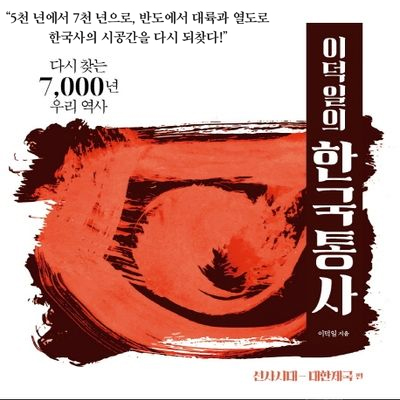
Lee Deok-il's 《A Comprehensive History of Korea: Rediscovering Our 7,000-Year History》 is not just a history book. It is a desperate cry to reclaim the lost memories of a nation, and a record of a scholar's intense pursuit of truth. This book shakes the framework of Korean history that we have learned in textbooks, and is a courageous attempt to break the distorted framework of academia that has continued with the remnants of Japanese colonial historiography. Lee Deok-il expands his life as a historian beyond the realm of simple academic research, into a field of practice to regain national pride and identity. This book is the result of that struggle.
In modern Korean history, the most devastating intellectual colonization was the 'colonization of history'. Before invading the territory of Joseon, Japanese imperialism first distorted history in order to dominate the minds of Koreans. The so-called 'colonial historiography' played a role in structurally blocking the Korean people from independently writing their own history. At its core are the 'theory of heteronomy' and the 'theory of stagnation'. The logic was that Joseon's history was driven by foreign powers and had no ability to develop on its own. This distorted view took root deeply in academia under the name of academic historiography even after liberation. Lee Deok-il starts his fight from this point. He asserts, "Our history has never been self-deprecating. It was only made small by someone else," and redraws the starting point of Korean history. If existing historiography has confined Gojoseon to the realm of myth, Lee Deok-il restores Gojoseon as an existing civilization. His gaze extends to Manchuria, Liaodong, and the Luan River basin in China. In other words, Gojoseon was not simply a myth of the Korean Peninsula, but the center of a civilization encompassing the entire Northeast Asia.
In the introduction to 《한국통사: 다시 찾는 7,000년 우리 역사》 (Korean History: Rediscovering Our 7,000-Year History), the author mentions the Hongshan Culture from around 4,500 BC, arguing that the culture is deeply connected to the origins of the Korean people. While mainstream academia classifies the Hongshan Culture as a preliminary stage of 'ancient Chinese civilization,' Lee Deok-il argues, through archaeological artifacts and anthropological evidence, that it can be interpreted not merely as an ancestor of Chinese civilization, but as the primordial culture of the Korean people. He analyzes the jade artifacts, the Goddess Temple, and the altar remains of the Hongshan Culture, explaining that "the spiritual and cultural code continues to Gojoseon, the Dangun myth, and the Three Kingdoms." In other words, the structure of the Hongshan Culture's ritual ceremonies, symbolizing 'the unity of heaven, earth, and humanity,' is aligned with the 'Hongik Ingan' (benefit all mankind) ideology of the Dangun myth. This perspective allows us to view Korean civilization not as a simple latecomer, but as a creative center of ancient Northeast Asian civilization.
The most prominent aspect of Lee Deok-il's writing is the reinterpretation of the territories of Gojoseon and the Three Kingdoms, and their relationship with Japan. He criticizes the mainstream academic claim that limits Gojoseon's territory to the south of the Amnok River, and argues, after carefully reviewing Chinese historical records such as 『삼국지』 (Records of the Three Kingdoms), 『사기』 (Records of the Grand Historian), and 『후한서』 (Book of the Later Han), that Gojoseon's border extended to the Luan River basin. This implies that Gojoseon existed not as a simple tribal state, but as a powerful political entity in Northeast Asia at the time. Furthermore, he presents records as historical evidence that Goguryeo, Baekje, Silla, and Gaya established branch states in the Japanese archipelago, emphasizing that the Korean Peninsula had a significant influence on the formation of ancient Japanese states. This reaffirms the fact that 'the origin of Japanese culture came from the Korean Peninsula,' while also challenging distorted perceptions of ancient Korean-Japanese history. Lee Deok-il's argument is by no means a product of emotional nationalism. Rather, he adheres to the basic attitude of history, stating that "the truth must be restored through accurate analysis of historical materials."
When 《한국통사: 다시 찾는 7,000년 우리 역사》 (A History of Korea: Rediscovering Our 7,000-Year History) was published, the mainstream historical academia in Korea reacted fiercely. Criticisms ranged from accusations of 'conspiracy-theory nationalism' to attacks of 'unacademic claims.' However, the readers were different. Instead of a historical perception trapped within the framework of academic vested interests, the desire to read history through the eyes of the people exploded. Lee Deok-il accuses the distorted academic power structure, criticizing that "the forces that inherited the colonial historical view have seized the initiative in our history even after liberation." According to him, the fact that Lee In-jik, who was Lee Wan-yong's secretary, was taught as a 'modern intellectual' and even a 'pioneer' during the colonial period is a representative example. This contradiction continued even after liberation, and the Japanese historical view became the fundamental framework of Korean education. He believed in the power of truth rather than academic authority. Therefore, 《한국통사: 다시 찾는 7,000년 우리 역사》 (A History of Korea: Rediscovering Our 7,000-Year History) is not just a history book, but a struggle of an intellectual to restore 'historical justice.'
This book contains about 300 illustrations. It is richly filled with archaeological relics, old maps, and photos of historical sites, allowing readers to visually experience history, not just read it in writing. Lee Deok-il reminds readers that 'history is not a record, but a site.' Each map and relic he presents acts as evidence that shakes existing interpretations. His explanations are vivid and meticulous. For example, when dealing with the issue of the capital of Gojoseon, he uses not only the symbolic meaning of the Dangun myth but also geographical and linguistic analysis to present the conclusion that "Dangun Joseon was a real civilization."
Lee Deok-il's critical mind goes beyond mere academic debate. He says, "If we cannot write our own history, others will define us instead." Indeed, China's Northeast Project and Japan's historical distortion have exploited the gap created by Korea's failure to establish an independent historical perspective. Therefore, 《한국통사: 다시 찾는 7,000년 우리 역사》 (Korean History: Rediscovering Our 7,000-Year History) is both an academic research book and a declaration urging national awakening. Through his book, the people regained their long-suppressed self-esteem. This is why many readers who questioned the remnants of colonial historiography evaluated Lee Deok-il's research as 'national salvation history.' His efforts shine even in academic loneliness. While fighting against the existing empowered academic system, he is never aggressive. Rather, he was a scholar armed with historical materials, logic, and conscience.
Rewriting history is not just about adding new facts. It is about breaking down distorted frameworks of perception and reviving suppressed truths. Lee Deok-il walked that 'lonely path.' His writings contain affection rather than anger, and conviction rather than controversy. He was more saddened by the reality that the people were losing their self-esteem by learning distorted history than by the academic disadvantages or criticisms he faced. Therefore, 《한국통사: 다시 찾는 7,000년 우리 역사》 (Korean History: Rediscovering Our 7,000-Year History) transcends a scholar's personal writing and is elevated to a national task. His research asks us: "Whose history are you learning? By whose hand was the 'fact' you believe written?" This question is not just a matter of the past. It makes us reflect on what kind of people we are living as today.
《한국통사: 다시 찾는 7,000년 우리 역사》 (History of Korea: Rediscovering Our 7,000-Year History) is not about 'rewriting history' but 'rediscovering history.' This is not just a simple linguistic difference. 'Rewriting' means adding new interpretations, while 'rediscovering' means reviving the original truth. Lee Deok-il's history is precisely that history of restoration. The numerous historical researches and interpretations of historical materials he presented were attempts to go beyond the framework of the existing historical academia, and his courage deeply resonated with the people. For generations who have gone through the era of distorted textbooks, his book is a record of regaining 'forgotten self-esteem.' In order for Korean society to stand as a true historical entity today, we must remember the hard work of scholars like Lee Deok-il. Although he walked a lonely and rough path, his research was a torch that revived the historical consciousness of Koreans. 《한국통사: 다시 찾는 7,000년 우리 역사》 (History of Korea: Rediscovering Our 7,000-Year History) is the starting point of a journey where we all find our way back, illuminated by the light of that torch.
댓글
( 0 / 500 )
파수꾼
4
교과서로 배운 역사가 얼마나 협소했는지 깨닫게 되네요. 한국사의 지평을 한반도 안에 가두어 놓았던 기존 인식이 얼마나 큰 한계였는지 새삼 느낍니다.
( 0 / 500 )
sunbin
6
역사는 전문가들만의 것이 아니라 모두의 것입니다. 시민이 역사에 무관심하면 결국 타국의 서술에 우리 정체성을 넘겨주는 셈이죠.
( 0 / 500 )
최진수
6
해방된 지 80년이 넘었는데도 우리 교과서에는 여전히 ‘일제의 그림자’가 남아 있죠. 이런 책이야말로 국민이 역사 주체로 서기 위한 출발점이라고 생각합니다.
( 0 / 500 )
Jasmine
5
홍산 문화와 고조선의 관계에 대한 설명이 흥미롭습니다. 그동안 너무 ‘중국의 변방 문화’ 정도로만 알고 있었는데, 이렇게 다른 관점을 접하니 학계의 통설만 믿어서는 안 되겠다는 생각이 듭니다.
( 0 / 500 )
minstrel
5
강단 사학의 폐쇄성과 권위주의에 대한 문제 제기가 필요합니다. 학계의 견고한 장벽 때문에 새로운 해석이 제대로 논의조차 되지 못하는 현실이 안타깝습니다. 누가 옳은가보다 어떻게 토론할 것인가가 더 중요하다고 봅니다.
( 0 / 500 )
Aurora
4
강단 사학 비판이 왜 이렇게 큰 반향을 일으켰는지 알 것 같습니다. ‘학문’이라는 이름으로 유지된 권위가 과연 진실을 향해 있었는지, 이 글이 근본적인 질문을 던지네요.
( 0 / 500 )
jina
3
잘못된 역사관이 국민의 자존과 미래까지 흔들 수 있다는 사실을 너무 오래 잊고 살았던 것 같습니다. 이 책은 그런 무감각함을 깨우는 역할을 하네요.
( 0 / 500 )
닥터82
4
사료와 유물을 근거로 새로운 시각을 제시했다는 점에서 충분히 학문적 가치가 있다고 생각합니다. “다시 쓰는 역사”가 아닌 “다시 찾는 역사”라는 표현이 정말 마음에 와닿습니다.
( 0 / 500 )
sun
4
이덕일 선생의 책을 단순한 역사서가 아니라 ‘정신의 복원 작업’으로 바라본 시각이 인상적입니다. 잃어버린 기억을 되찾는 과정이야말로 진정한 독립의 완성이라는 말에 공감합니다.
( 0 / 500 )
마음
3
역사란 고정된 진리가 아니라 해석의 투쟁이라는 점에서, 그는 정말 중요한 역할을 했다고 봅니다. 기존 사학계의 권위에 균열을 낸 것만으로도 큰 의미가 있습니다.
( 0 / 500 )
신고내용
신고내용을 선택해주세요
회원비난/비하/욕설글 및 댓글도배성 게시물저작권 침해/불법자료 유출허위사실유포개인정보 유출.사생활 침해무단광고/홍보음란물 및 도박 불법 광고물범죄행위 관련 글불법행위 관련 소개물품 판매 및 사기글악성코드 및 스파이웨어 유포기타 사유 및 운영진 판단


비밀번호를 잊으셨나요?
Sign in with Google
All information provided by us is free of charge and is for the public good.