品

Corea든 Korea든, 품격은 이름보다 먼저다
Whatever the name—Corea or Korea—dignity comes first.
Whatever the name—Corea or Korea—dignity comes first.
Now
지금
751 Diaspora
Heritage
유산
Humanity
인문
Mirengsi
未冷尸
Politics
정치
Media
언론
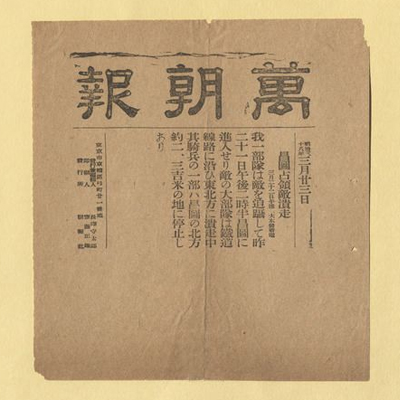
萬朝報 1905년 3월23일

음양陰陽
칼럼
bunny365
Chosun Sangmal Jeonjip Vol. 2, 138, 139, 140

0
2026. 10. 04
138. The Spotted Ox
A cattle dealer bought four or five cows at the market and was returning home when night fell, so he stopped at an inn. The innkeeper's wife, wanting to get one of the cows, decided to use a honey trap on the cattle dealer.
When the cattle dealer asked, “Which cow do you want?” the innkeeper's wife replied, “Give me that spotted ox!” So, in exchange for the spotted ox, the innkeeper's wife agreed to give herself to the cattle dealer. However, when they started, the cattle dealer added a condition, saying that every time he pulled out and reinserted, she had to mumble, “The spotted ox is mine!” He said he would only give her the cow if she said those words, so the innkeeper's wife agreed.
And so the act began, and for the first while, every time there was an 'in and out,' she clearly articulated, “The spotted ox is mine! The spotted ox is mine!” But as the excitement gradually intensified, she eventually couldn't do it anymore, and with heavy breaths, she just made a nasal sound, “Spotted, spotted, spotted, spotted.” And so, because she didn't keep her promise, she neither got the cow nor did anything but ruin her body.
139. Hochi Manchoho
This is a true story that happened at a newspaper office in Seoul. There were two newspapers published in Japan called 'Hochi Shimbun' and 'Manchoho.' One day, these two newspapers were placed half-folded on a desk in the newspaper office. That is, the characters 'Manchoho' were written consecutively below the two characters 'Hochi.' A frivolous reporter who saw this asked a female reporter next to him to read the five characters consecutively. The female reporter, without thinking, blurted out “Bojimanjoho,” and in the next moment, her face turned bright red, and she furiously rushed at the male reporter.
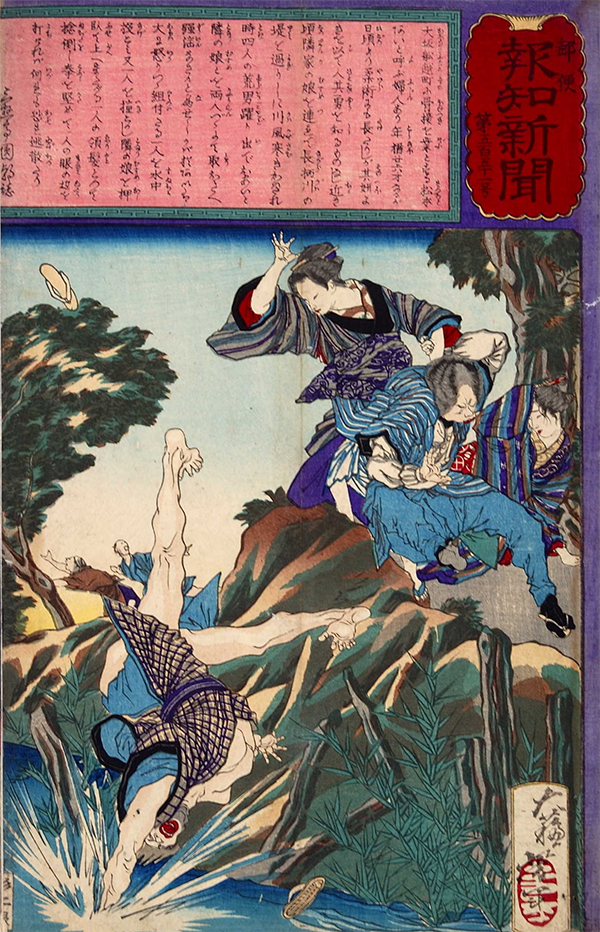
Yubin Hochi Shimbun No. 551
140. A Wise Judgment
Once upon a time, there was a village woman of ill repute. No matter how much her husband admonished her, she not only refused to listen but, on the contrary, defiantly retorted, “What does it matter to you? I'm doing what I want with what's mine!”
Unable to bear it any longer, the husband finally appealed to the authorities. The magistrate summoned the villager and gave him a lengthy lecture, but even then, the villager protested, saying, “What does it matter? I’m doing what I want with what’s mine.” While it was somewhat logical if one considered it that way, it was undeniably morally wrong, so the magistrate was racking his brain over how to resolve the matter.
Just then, he noticed a mouse hole under the wall, with a mouse going in and out. Seeing this, the magistrate quickly asked the villager, “You, what kind of hole is that?”
The villager innocently replied, “It’s a mouse hole!”
“Why is it called a mouse hole and not a bottom hole?”
“Your Honor, since a mouse goes in and out, what else could it be but a mouse hole?”
“Aha! You just said that the hole you have is yours, but if we follow the logic of the mouse hole, it’s not yours just because it’s attached to you. Since your husband uses it, isn’t it clearly your husband’s? From now on, you must always do as your husband tells you. If you take what belongs to another and do as you please again, there will be no forgiveness, so be aware of that,” he thundered.
*'報知新聞' is pronounced 'Hochi Shimbun', and '萬朝報' is pronounced 'Yorozu Choho'. As the colony descended into a low-quality society that self-destructed human dignity, it reached a stage where people joked and played with words in such times. However, these two newspapers recorded the history of wars that occurred in modern pan-Asia. Ishikawa Yasujiro (石川安次郎, pen name Ishikawa Hanzan (石川半山), 1872-1925), the chief editor of Yorozu Choho, stayed in Beijing for five years, covering the Boxer Rebellion (1899-1901), and also had experience as a special correspondent for the Treaty of Portsmouth (September 5, 1905). In an era where there is no distinction between 'my hole' and 'another's hole', people cannot comprehend how significant these newspapers were during this period.
댓글
( 0 / 500 )
낭랑18세
9
상말의 내용을 소개하는 데 그치지 않고, 그 뒤에 놓인 신문과 전쟁의 역사까지 끌어낸 해설이 좋습니다. 특히 ‘보지’와 ‘만조보’의 우연한 말장난이 당시에는 웃음거리였지만, 그 신문들이 근대 동아시아의 격변을 기록했다는 사실을 대비한 시선이 인상적입니다
( 0 / 500 )
옛날이야기
7
이런 자료를 오늘날의 상식만으로 재단하면 당시 사람들의 언어와 사고방식을 놓치기 쉽겠지요. 해설에서는 웃음의 대상이었던 말장난 뒤에 식민지 시대의 신문, 전쟁, 취재와 기록의 역사가 있었다는 사실을 환기합니다. 바로 이런 맥락 읽기가 고전자료를 살려내는 것 같습니다.
( 0 / 500 )
joon71
6
상말이라는 이름 때문에 가볍게 읽기 쉽지만, 그 안에는 당시 사람들이 무엇을 웃음거리로 삼았고 어떤 언어 감각으로 세상을 바라봤는지가 고스란히 남아 있네요. 특히 139화는 단순한 음담을 넘어 당시 신문문화와 일본어 표기의 흔적까지 보여주는 귀중한 자료라는 생각이 듭니다.
( 0 / 500 )
donghoon
4
138과 140은 지금의 기준으로 보면 불편한 대목이 분명하지만, 그것을 오늘의 윤리로만 재단하기보다 당대 민중의 언어와 성 인식, 남녀관계의 관념을 읽는 자료로 볼 필요가 있겠습니다. 옛말의 웃음 뒤에 숨어 있는 사회구조까지 함께 읽어야 상말집의 가치가 살아나는 것 같습니다.
( 0 / 500 )
lalaland
6
마지막 해설이 이 글의 무게를 한층 더해주는 것 같습니다. 음담과 말장난만 보면 하찮은 옛이야기처럼 보이지만, 그 시대를 살아간 사람들이 접했던 신문과 기록까지 살펴보면 전혀 다른 역사적 풍경이 나타납니다. 민속자료를 역사자료로 읽는 좋은 관점입니다.
( 0 / 500 )
弘益人間
4
조선상말전집을 읽는 재미는 바로 이런 데 있는 것 같습니다. 처음에는 저속하고 우스운 이야기로 보이지만, 한 걸음 물러서면 성과 가족관계, 언어생활, 신문문화와 식민지 근대의 모습까지 엿볼 수 있습니다. 해설이 단순한 ‘옛날 농담 모음’을 생활사 자료로 바꾸어 놓았다는 생각이 듭니다.
( 0 / 500 )
madness
3
140화의 ‘내 것’이라는 논리를 뒤집어 쥐구멍에 빗대는 사도의 판결은 웃음을 유발하면서도 당시 여성의 신체와 성적 자기결정권이 얼마나 남편 중심의 질서 속에 놓여 있었는지를 보여줍니다. 웃기는 이야기일수록 그 시대의 권력관계를 더 선명하게 드러내는 경우가 있군요.
( 0 / 500 )
이미순
3
139화가 특히 흥미롭습니다. 당시 사람들에게는 그저 한바탕 웃고 지나갈 말장난이었겠지만, 오늘날 우리는 그 두 신문이 제국주의와 전쟁의 역사를 기록한 매체였다는 사실을 알고 있습니다. 사소한 농담 하나가 거대한 역사와 맞닿아 있다는 점이 묘하게 느껴집니다.
( 0 / 500 )
now59
3
상말은 결국 그 시대 사람들이 남기고 간 생활사의 한 조각이라고 봅니다. 점잖은 역사책에는 나오지 않는 욕망과 농담, 성과 부부관계, 신문을 읽던 방식까지 이런 기록에는 살아 있습니다. 그래서 오늘의 눈으로 웃기만 할 것이 아니라, 왜 그 시대 사람들이 이렇게 웃었는가를 묻는 것이 더 중요해 보입니다.
( 0 / 500 )
김동완
1
‘남의 구멍과 내 구멍의 구분이 없는 시대’라는 표현이 상당히 의미심장합니다. 140화의 우스꽝스러운 판결을 단순한 성적 농담으로 읽지 않고, 인간의 몸과 권리를 소유의 논리로 판단했던 사회의 한계와 연결해 바라본 점이 특히 눈에 들어옵니다.
( 0 / 500 )
신고내용
신고내용을 선택해주세요
회원비난/비하/욕설글 및 댓글도배성 게시물저작권 침해/불법자료 유출허위사실유포개인정보 유출.사생활 침해무단광고/홍보음란물 및 도박 불법 광고물범죄행위 관련 글불법행위 관련 소개물품 판매 및 사기글악성코드 및 스파이웨어 유포기타 사유 및 운영진 판단


비밀번호를 잊으셨나요?
Sign in with Google
All information provided by us is free of charge and is for the public good.