品

Corea든 Korea든, 품격은 이름보다 먼저다
Whatever the name—Corea or Korea—dignity comes first.
Whatever the name—Corea or Korea—dignity comes first.
Now
지금
751 Diaspora
Heritage
유산
Humanity
인문
Mirengsi
未冷尸
Politics
정치
Media
언론
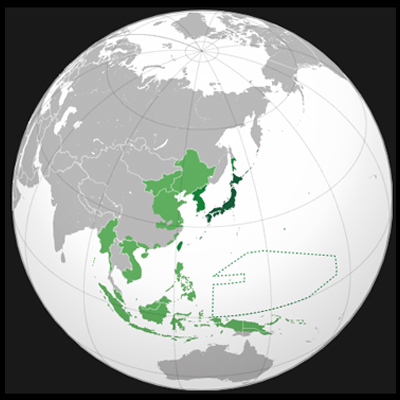
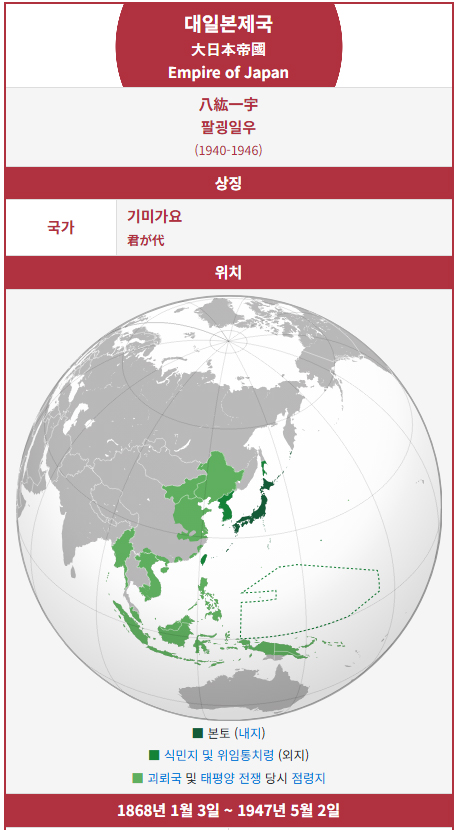
일본 제국 지도, 나무 위키

재일 동포
칼럼
Mizuno
Zainichi 39. Anti-Korean sentiment in Japan is not an emotional provocation, but a message to the world.

0
2026. 09. 22
- Anti-Korean sentiment isn't just emotional provocation; it's a political defense mechanism for Japan to conceal its historical distortions and the truth of its colonial rule.
- Japan hides its piratical origins and its role as a Western proxy, shrinking the spatial scope of its colonial rule to evade geopolitical responsibility.
- Korean dictatorships exploited nationalism to fuel anti-Japanese sentiment, while Japan, through anti-Korean sentiment, has staged political shows to control its populace and maintain its vested interests.
- The past ignorance of Korea by the West and Japan stems largely from Koreans being engrossed in their internal history, failing to grasp external perspectives, and Japan's education system distorting its own history.
Koreans deceived by the apparent simplicity of anti-Korean sentiment
Although anti-Korean sentiment is outdated, the outdated mechanism of colonial hegemony is still at work, and we must address it to avoid experiencing it again. To view anti-Korean sentiment as an emotional provocation against Koreans and preparation for a second invasion is an overly simplistic interpretation. The various prejudices and preconceptions typically held by anti-Korean factions in Japan are mostly false or close to slanderous hate speech, so Koreans, who are not like that in reality, do not bother to engage with arbitrary and malicious insults. Instead of being swayed by their low-level consciousness, Koreans are more inclined towards the many enjoyable cultural aspects of modern Japan. However, it is necessary to consider the 'role theory of anti-Korean sentiment,' which suggests that anti-Korean sentiment exists to instigate and mislead about something far more political and historical, touching people's emotions. In other words, we need to consider that the dirty energy of anti-Korean sentiment is actually functioning as a defense mechanism to hide some other truth.
Normally, one wouldn't think in such a convoluted way. Koreans, who still possess a broad and generous continental spirit, despite the slavish tendencies brought about by numerous colonial oppressions, naturally have this level of tolerance without being taught. However, how long do we need to be dragged along by Japan's shallow tactics and endure the ingrained image of being 'unclean, cowardly, untrustworthy, and lacking in law-abiding spirit' as spewed by anti-Korean factions?
The claim made by anti-Korean groups regarding Koreans' historical awareness, that 'Koreans do not know history, and they arbitrarily fabricate it,' is both the reason for and the goal of the existence of anti-Korean sentiment. The accusation that 'Koreans emphasize themselves as victims to maximize their own interests' is a case of the pot calling the kettle black. In reality, the Korean people who were truly victimized said nothing, and the oppression of their own people by dictatorial governments after liberation and distorted historical awareness policies have actually fueled anti-Korean sentiment in Japan. However, this can actually be seen as a political show orchestrated by both countries. It was Japan that hid its own historical distortions, and Korea, by riding on their historical distortions, needed anti-Korean sentiment for a sustainable political ploy for the benefit of only certain vested interests. However, the result is the defeat of evil.
The reason for fabricating history
So, what history did Japan distort, and why do they reverse their own distortions onto the victims? First, the Japanese imperialists did not just lose a war after colonizing Joseon for 35 years. The colonial view that Japanese imperialism brought about the modernization of Joseon is not only a wrong historical perspective, but they also hid from records the history of their much earlier role as a pawn of Western hegemony, playing a significant part in the West's invasion of Joseon. Japanese imperialism is a culture evolved from pirates (海賊, sea robber) in the history of human crime, who grew through early contact with the West due to centuries of Wokou activities. They evolved as a group through repeated plunder and assimilation, and they have maintained a narrative that proudly describes this history. As long-term intermarriage made racial similarity a weapon, they put forward a policy of intermarriage, which was actively carried out in modern times, as the banner of their colonial policy, and during the colonial oppression, they eradicated Korean traditions and culture.
Second, the spatial scope of their crimes is not limited to the Korean Peninsula. In other words, the core crime is the historical distortion that confined the history of colonial oppression within the Korean Peninsula. If this shackles the present, it escalates into a geopolitical issue. Therefore, they had to continue damaging the feelings of Koreans who are unaware of the historical distortion, using anti-Korean sentiment as a self-destructive mechanism. Currently, as the Korean Wave in Japan is more than just a trend but a mainstream culture, Japan no longer has the means to defend its past. In modern geopolitics, if it is proven that the period of Japanese colonial rule over Koreans extended beyond the Korean Peninsula, Japan would face unbearable and unimaginable diplomatic pressure. Therefore, Japan has an important mission to prevent Korea from advancing its critical thinking beyond colonial historiography, which is why a low-level historical obfuscation operation, culminating in anti-Korean sentiment, was necessary.
Ultimately, Japan did not invade Joseon alone, so Japan's anti-Korean activities and Dokdo provocations are a signal to the international community that 'I will not die alone.' The global crime of annihilating the Korean Liberation Army, which remained active in China until just before liberation, is difficult to fully comprehend in terms of when, where, and how the final massacre occurred, much like it is difficult to fully understand how the war is unfolding in Ukraine, Russia, Iran, and neighboring Arab countries, which are currently the battlefields of World War III. Even modern warfare, broadcast on television, shows only a prepared scenario that they want to present. The global public is cannon fodder on the battlefield and cannot escape the position of a spectator, so war is never someone else's problem, no matter when or where it occurs.
Koreans have no knowledge of the global power struggles surrounding Joseon in the late Joseon Dynasty. All they have internalized is ignorance of the fact that the nation's history and memory were completely erased during those hundred years of chaos, and the colonial view of history instilled based on that ignorance. Meanwhile, Japanese imperialism, which transformed from pirates to scholars, spearheaded the effort to appropriately arrange history politically, economically, socially, and diplomatically and present it to the forefront. As a result, there is not a single book in the National Library of Korea's archives from the past that does not bear the seal of the Joseon Government-General Library director. Redistributed history became common sense and knowledge through censorship and dual publication, and Japan took on the excessive burden of having to bear the world's mess alone.
Since "Japan ruled Joseon" is already the established historical view, the pressure they face when the spatiality of past atrocities is investigated is unimaginable. When they were warmongers, they were probably so excited by the blueprint of conquering all of Asia that they couldn't imagine the impact of defeat and the fabrication of historical records on human history. That's why low-quality anti-Korean sentiment ran rampant. However, as is well known, civilization spreads from top to bottom. The recovering national spirit of Koreans doesn't even care about old anti-Korean sentiment, but the more it does, the more desperate Japan becomes.
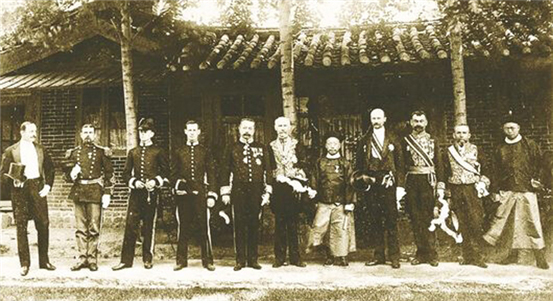
In 1903, American Minister Horace Allen (fourth from the right) invited ministers from various countries stationed in the Korean Empire to the American Legation for a meeting, and this commemorative photo was taken afterward. Ministers from Germany, France, China, the UK, and Belgium attended, but the Japanese minister was absent. What exists does not exist, and what does not exist does exist, so it is necessary to see existence in absence.
The perpetration and suffering of war, a collective crime, ultimately lead only to mutual destruction.
Now let's see how the theory of victims and perpetrators being reversed is established in the battlefield where human crimes are committed collectively. The far-right, who represent Japan's anti-Korean sentiment, believe and act as if the majority of Koreans thinking they suffered great losses to Japan during the 35 years of Japanese colonial rule is 'victim cosplay.' They particularly believe that Korean politicians are constantly reminding the public that 'Korea is a victim' and continuously inducing them to maintain anti-Japanese sentiment. This is the same for both countries. Korea keeps Japan at a distance, and Japan keeps Korea at a distance, drawing an invisible line between them. This way, the vested interests of both Korea and Japan can primarily maintain their power politically, using feelings of hatred towards the other as an appropriate tool for attack. They use hatred as a method to maintain their regimes.
Let's take an example. Anti-Korean factions criticized that since former President Park Geun-hye took office in February 2013, she emphasized that Japan was the perpetrator in the US, Europe, and China, and criticized Japan for not reflecting on its history, thereby trying to establish a favorable position by focusing on Korea being the victim. They argued that Park Geun-hye, among all past Korean administrations, most explicitly 'appealed that Korea was a victim,' and that this significantly stimulated the consciousness of the Japanese people (Ogura Kijo, Han Jeong-seon translation, J&C 2015, 'What do Japan's anti-Korean factions claim?' p53).
However, one must think carefully. Park Geun-hye is the daughter of Park Chung-hee. She is the daughter of a man who, following Syngman Rhee, killed countless anti-Japanese intellectuals and uprooted nationalism through military dictatorship. So, would anyone say such nonsense, claiming that criticizing the daughter of such a person is merely pretending to be a victim? Park Geun-hye's criticism of Japan did not draw condemnation from pro-Japanese factions within Korea. If Lee Jae-myung or Roh Moo-hyun had made Park Geun-hye's remarks, public opinion in Korea would have been in an uproar, and Japan would have already retaliated with political tactics. Primarily, Park Geun-hye does not have the intellect to make self-directed political statements, so her remarks can be seen as a bitter stratagem (苦肉計) orchestrated by someone to deceive the enemy and weaken them through a feigned internal conflict among allies.
This is similar to the show at the end of Lee Myung-bak's term, where he went to Dokdo and declared 'Dokdo is our land' to avoid negative public opinion. The pro-Japanese far-right in Korea welcomed Lee Myung-bak's visit to Dokdo, as it solidified the historical perspective within the Korean Peninsula, leading to a rebound in his approval ratings. If a leftist figure, whose political orientation is nationalism, had made remarks with the same intent, the speaker's personal information and flaws would have been exaggerated and he would have been condemned as a villain the very next day. Nations that have experienced colonial rule find it difficult to escape this divisive tactic where their own government deceives its people in real-world politics.
This kind of deceptive political maneuvering was actually practiced by Syngman Rhee, Park Chung-hee, and Chun Doo-hwan. Although the Republic of Korea Army began as the Joseon Constabulary under the US military government, its early leadership was dominated by former Japanese military and Manchukuo army personnel. Therefore, the emotional foundation of these dictatorships, rather than a tender affection for their compatriots, held a much more natural and even nostalgic embrace of the methods of popular oppression from the Japanese colonial era. One only needs to recall the past role of the so-called Senior Secretary for Civil Affairs, which was to drive those who opposed their lust for power to suicide or create narratives sufficient for social ostracism, all under the pretext of the prevailing sentiment of the time. Thus, those who are now vehemently opposing defense reform can live with a pro-Japanese, pro-American stance rather than advocating for unification of the two Koreas.
Going a step further, anti-Korean factions preemptively defend themselves by calling Koreans' continuous demands for apologies and reparations 'unreasonable claims.' They argue that despite receiving compensation from Japan during the normalization of diplomatic relations in 1965, Korea constantly demands more. They believe that 'political instigation' underlies these demands, leading them to attack Koreans for always whining about colonial reparations. While Japan cannot make such claims in formal diplomacy, giving fodder to low-level anti-Korean factions has, in turn, debased the consciousness of the Japanese people. This suggests that the Japanese government has not abandoned its imperial-era custom of using its own citizens as tools, or rather, it continues even stronger control over its people than before. This is also true for China, but given that half of its citizens are of Korean descent, it can be seen that the Japanese government's double safety net for distrusted citizens was anti-Korean sentiment.
Of course, anti-Korean sentiment has now disappeared. Japan has nothing to gain from emotional battles fought for show, except material and emotional poverty. When one couldn't imagine Tokyo overrun with prostitution and rats, there was no way to even bring up the topic of colonial territories. Anti-Korean sentiment could only exist, and its substandard logic could only prevail, when Korea was ruled by figures like Syngman Rhee, Park Chung-hee, Chun Doo-hwan, Lee Myung-bak, and Park Geun-hye, the daughter of a dictator. Now, Japanese politics, in the face of revealed truths, awaits only explosions, anger, and self-destruction within its own people.
What kind of country is Korea?
It's fair to say that until around 2000, most Japanese people lived their daily lives with little to no awareness of Korea as a country. Even in the mid-1990s, many Japanese university students reportedly didn't know where Korea was located in East Asia. The same was true for the West. Today, when I see white Europeans or North Americans in Korea drinking banana milk from convenience stores, I feel a sense of profound change, but until the 1988 Olympics, they didn't know what kind of country Korea was, its location, or its culture. Here's a question for Koreans: Why do Koreans, with thousands of years of history, not carefully consider the statement that despite their long history, the outside world didn't know where Korea was? If you look closely, the answer is there. The racial discrimination against Koreans in the West and Japan until the 1980s is something only those who experienced it truly understand. I believe Koreans, relying solely on their domestic history, had no idea how to interpret the perspective of others. The fact that Thailand and Taiwan were wealthier than Korea until the 1980s, and that Korea was so focused on overcoming material poverty, meant it was ignoring the spiritual defect of having lost its history.
One of the reasons Japan was largely unaware of Korea is, I believe, due to accumulated historical education that led people to believe and memorize the narratives of Japanese history textbooks as fact, and then take exams based on that content. In Japanese history, there's a significant disconnect between archaeology and written records, with each operating independently. During the imperialist era, while everyone diligently performed their assigned duties, excessive historical fabrications, blurring the lines between fact and fiction, were incorporated into national history. In reality, when history and recorded history fail to reflect the enduring historicity in reality, humans tend to become strange. It's like the duality of a person who grew up believing they were a descendant of a noble family, memorizing genealogies through classical Chinese education, but in reality, they are of ignoble origin, and uncontrolled, unethical words and actions instinctively emerge. The establishment of mutual generation between existence and non-existence (有無相生), where what is not becomes, and what is becomes not, leads to the decline of humanity.
I have actually witnessed graduates of top Japanese universities who do not accurately perceive the positions of China, Korea, and Japan. So, when I spread out a map and asked where China was, they unhesitatingly admitted their uncertain geographical knowledge. Japan has not only distorted Korean history. It has also appropriated the history of other nations, excessively layering civilizations and cultures in its own history, making it like a historical drama with different genres for each era, which cannot be fully digested in the real world. This is becoming an almost universal tragedy for humanity. One should not think that only one country was destroyed when the world deliberately waged territorial wars. All civilizations were destroyed, rewritten, and manipulated.
The introduction to 'Zainichi,' which began with the question of whether Ito Hirobumi and Shinzo Abe might have had Korean blood, concludes here. Returning to the character introductions, I will now examine what the 'Korean' biological genes that constitute Japan signify.
댓글
( 0 / 500 )
joonho
9
혐한을 단순한 감정적 악담으로만 보면 그 배경에 있는 정치적·역사적 맥락을 놓칠 수 있다는 지적이 인상적입니다. 특히 가해와 피해의 프레임을 서로 이용하면서 국민의 감정을 동원해 온 정치의 구조를 함께 바라봐야 한다는 문제의식에 공감합니다.
( 0 / 500 )
8502park
8
일본의 혐한을 한국인에 대한 단순한 적대감으로만 설명하지 않고, 역사 서술과 기억의 문제까지 연결해서 바라본 점이 흥미롭습니다. 결국 중요한 것은 감정적으로 일본을 미워하는 것이 아니라, 누가 어떤 역사를 어떤 목적에서 기록하고 유통했는지를 끊임없이 따져보는 일이라고 생각합니다.
( 0 / 500 )
john89
6
한일 관계를 바라볼 때 너무 오랫동안 양국의 국내 정치가 만들어낸 프레임 안에서만 생각해 온 것은 아닌지 돌아보게 됩니다. 혐오와 반감이 서로를 자극하는 구조에서 벗어나려면 감정적인 대응보다 역사 자료와 국제정세를 함께 살펴보는 시각이 필요하다는 생각이 듭니다.
( 0 / 500 )
백현이
5
특히 마지막 부분의 ‘한국은 어떤 나라인가’라는 질문이 오래 남습니다. 경제적으로 성장하고 세계에 알려진 지금의 한국만 볼 것이 아니라, 왜 오랫동안 한국의 역사와 존재 자체가 외부 세계에 제대로 알려지지 않았는지를 물어야 한다는 지적이 중요해 보입니다.
( 0 / 500 )
77jaemin
5
혐한을 혐오 표현 몇 마디의 문제로 축소하면 왜 그런 담론이 반복해서 등장하는지 설명하기 어렵습니다. 결국 역사 기억과 국가 정체성, 국내 정치가 서로 얽혀 있다는 점을 봐야 합니다. 감정에 반응하기보다 그 구조를 읽어야 한다는 글의 취지가 와닿습니다.
( 0 / 500 )
ganghyug
4
역사를 둘러싼 한일 간의 갈등에서 가장 경계해야 할 것은 서로 상대방 국민 전체를 하나의 이미지로 만들어 버리는 일이라고 생각합니다. 일본의 혐한도, 한국의 반일 감정도 정치적으로 이용될 수 있다는 점을 함께 성찰해야 한다는 대목이 특히 의미 있습니다.
( 0 / 500 )
열화
4
이 글은 결국 일본을 비난하는 글이라기보다 역사 기억을 누가 만들고 누가 이용해 왔는가를 묻는 글로 읽힙니다. 과거의 혐한에 똑같은 감정으로 대응하기보다 그 안에 숨은 역사와 권력의 구조를 제대로 들여다보자는 결론에는 충분히 귀 기울일 필요가 있다고 봅니다.
( 0 / 500 )
박성민
3
‘누가 피해자인가’라는 논쟁에만 머물면 정작 중요한 질문을 놓치게 됩니다. 어떤 사건이 있었고, 그것이 어떤 자료로 기록됐으며, 이후 어떤 방식으로 기억되고 재구성됐는지를 따져야 합니다. 역사 문제를 감정이 아니라 기록과 구조의 문제로 보자는 주장에 공감합니다.
( 0 / 500 )
kkb
2
결국 역사를 제대로 안다는 것은 우리에게 유리한 이야기만 믿는 것이 아니라 우리 자신의 역사 서술까지 의심해 보는 것이라고 생각합니다. 일본의 역사 왜곡을 비판하면서 동시에 한국 사회가 과거를 어떻게 기억하고 정치적으로 이용해 왔는지도 함께 돌아보자는 문제의식이 오래 남습니다.
( 0 / 500 )
papa
0
한류가 일본 사회에서 일상적인 문화 현상이 된 지금도 과거의 역사 인식 문제가 사라진 것은 아니라는 점을 생각하게 됩니다. 문화적 교류가 활발해질수록 오히려 불편한 역사까지 차분하게 검증하고 이야기할 수 있는 성숙한 한일 관계가 필요합니다.
( 0 / 500 )
신고내용
신고내용을 선택해주세요
회원비난/비하/욕설글 및 댓글도배성 게시물저작권 침해/불법자료 유출허위사실유포개인정보 유출.사생활 침해무단광고/홍보음란물 및 도박 불법 광고물범죄행위 관련 글불법행위 관련 소개물품 판매 및 사기글악성코드 및 스파이웨어 유포기타 사유 및 운영진 판단


비밀번호를 잊으셨나요?
Sign in with Google
All information provided by us is free of charge and is for the public good.