品

Corea든 Korea든, 품격은 이름보다 먼저다
Whatever the name—Corea or Korea—dignity comes first.
Whatever the name—Corea or Korea—dignity comes first.
Now
지금
751 Diaspora
Heritage
유산
Humanity
인문
Mirengsi
未冷尸
Politics
정치
Media
언론

재일 동포
칼럼
Mizuno
Zainichi 31. Fukuzawa Yukichi, the originator of the spread of 'anti-Korean sentiment'

0
2025. 12. 21
Reasons for Anti-Korean Sentiment
Koreans' anti-Japanese sentiment towards Japan stems from the long chain of 35 years of humiliating Japanese colonial rule. While Korea's anti-Japanese sentiment is a natural phenomenon arising from the national suffering during the Japanese colonial period, why has anti-Korean sentiment become a kind of social phenomenon in Japan, which has never been ruled by Korea, suffered no losses, and instead exploited Joseon's territory, wealth, and all human resources? It is because Japan instilled hatred for Koreans in its own people regarding the horrific events that occurred during the transition to the modern era. Instead of guilt, they fostered hatred for the victims and encouraged actions that scorned them. In simple terms, it's like the one who made a mess getting angry, but when this becomes a national issue, genocide and war occur, and the aftermath is that the forces of those who contributed to justifying the occurrence and process of such acts inevitably shift to modern ideological warfare to maintain their vested interests.
Colonial historiography is precisely this remnant left by colonialism, which still serves as the spiritual foundation and legacy that sways Korean society today. No matter how much colonial historiography is repeatedly taught to be justified as a legitimate theory, through repeated research, one quickly realizes that their claim of colonial modernization theory is a distorted argument reflecting only the perpetrator's perspective and is not logical at all, due to the continuous unnaturalness of suppressing and eradicating the natural anger of the victims. The epitome of this is the 35 years under Japanese rule. The idea that Japanese imperialism ruled for only a little over a generation confines the ebb and flow of events shown by the figures within 35 years. However, this is absolutely not the case.
The deceptive act of manipulating figures to reduce the actual period of colonial rule and formalizing it is the source of anti-Japanese sentiment that inevitably boils from the deepest core of the Korean psyche. Deceiving with data figures is an easy and fundamental step, making other deceptions simple. If Korea's anti-Japanese sentiment is largely a reaction to the effects of colonial rule, then Japan's anti-Korean sentiment, having originated organically long ago, contrasts with anti-Japanese sentiment and could have far more severe negative repercussions. Why does Japan hate us so much when Korea "didn't even touch" them? Let's explore the roots of that hatred.
The Roots of Joseon Contempt Theory
It is not easy to create a theory worthy of contempt in order to despise someone. If such a theory began in the last century, or even much earlier, then the nation targeted by such contempt, given how shoddy and primitive the theory might be, could face a biological threat to its species. Or perhaps, at the time, such atrocities, based on the most advanced and developed logic, might have led to the extermination of Joseon people according to a predetermined plan. However, like a wave that has already swept by, even if such a conspiracy existed and was executed, there is no way to turn back time and confirm it.
Thus, modernity has become a difficult subject to understand, like a geological era underground, whether it's past conspiracies or future ones. Japan's contempt for Joseon, the origin of modern Japan's anti-Korean sentiment, arose even earlier than our anti-Japanese sentiment, and its roots are much deeper and more firmly embedded, tracing back in historical narratives as far as the 'Imna Nihon-fu설' (任那日本府說: a theory that Japan's Yamato regime established and ruled the Imna region in the southern Korean Peninsula with the Imna Nihon-fu governing body from the 4th to 6th centuries). If Joseon people's autonomy has been disparaged for so long, it is indeed a terrifying conspiracy theory. However, if this hypothesis was not created at that time but in modern times, then it is incitement and brainwashing, truly a result of historical distortion, and thus far more abominable. Did Japan only create the Imna Nihon-fu설? Long before Japan even began to realize its ambition to conquer Joseon, it was a nation that fostered a state grown through revisionist policies, researching and modifying Korean history. What was the driving force that learned and revised the history of others while simultaneously cultivating hatred, and how long can such a nation exist as a state?
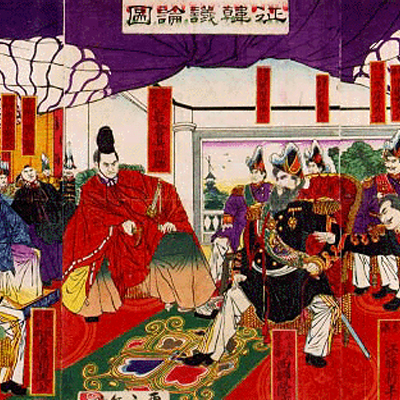
Japan's contempt for Joseon underwent qualitative growth and evolution with the Meiji Restoration (明治維新: a series of modernization processes in Japan starting from 1868, encompassing a broad transformation process from the dismantling of the shogunate system to the establishment of a centralized unified power through the restoration of imperial rule), gradually developing into the form of a 'monster.' The contempt for Joseon, which at best was spread among the public in the form of storyteller's comic dialogues in market places, traditional plays, and books, gradually transformed into a more concrete and precise means of governance. The reason why the profession of an actor, which was public entertainment, was mobilized as a tool of agitation for political propaganda, was to perfectly instill contempt for Joseon even among the illiterate masses. We must also consider why the New Right of colonial historiography defends an era of three-dimensional amplification of hatred, mobilizing writing, theater, speech, and sound.
Enduring the Seikanron (Argument for the Conquest of Korea)
During the Meiji Restoration, Japan's new ruling power expanded the contempt for Joseon into a national strategy called 'Seikanron (Argument for the Conquest of Korea),' actively injecting and instigating it into the Japanese populace through a modern education system. It is a terrifying act that Japan's modernity began with a war plan to kill others and seize their land, and this act was carried out for over 30 years. Modern anti-Korean sentiment has resulted in: first, the invasion of Korea; second, government-led contempt and discrimination based on racial concepts; third, the resulting sacrifices of Koreans; fourth, the internationalization of distorted perceptions through international propaganda; and fifth, the division of Korea, leaving traces of its wounds on Koreans to this day ('Japanese-origin Anti-Korean Virus' p217 by 이현주, 도서출판선인 2021). The fact that parents raising their children with a colonialist view of history do not rebel against this is proof that no one feels the seriousness of this, as they have already been brainwashed since their parents', or even grandparents', generation.
If Japan, which constantly yearned for continental expansion, considered Korea as an object of conquest and subjugation while being conscious of China, and if a narrative of ancient Korean conquest was at the psychological base, wouldn't it have tampered with Chinese history for its ultimate goal of invading Chinese territory? Is it that only the history of the Korean Peninsula, which lies on the path to China, was first dismantled and fabricated, while China's history was left untouched? This is a very serious duet of contradiction and delusion, suggesting that Joseon might have been Japan's intended destination from the beginning. Otherwise, China's history should also have been completely fabricated by Japan to complete the prerequisite theory for territorial ambition.
However, there is currently no talk of Chinese history being fabricated by Japan. The theory of contempt for Joseon had taken root in the hearts of ancient Japanese people, and by creating a nation through the Imjin War and updating historical revisionism for hundreds of years, they made the view of contempt for Joseon a core element of Japan's dominant political ideology. The Seikanron (argument for the conquest of Korea) was the starting point where Japan's historical distortion reached its climax. Japan created a distorted image of itself and its neighbors and entered the era of Meiji Restoration, or reform ('Japan-originated Anti-Korean Virus' p144 by Lee Hyun-joo, Seonin Publishing, 2021).
Is it that Japan pieced together Joseon's ancient history somewhere in the modern era and thus had no capacity to tamper with Chinese history, which was its ultimate goal? That is not the case. Japan eventually participated in the Sino-Japanese War, which began in 1937, and due to its territorial ambitions, it was even hit with atomic bombs by the United States. Currently, with the far-right Takaichi becoming prime minister, domestic approval ratings are being boosted through pressure on China, but if this is karma accumulated from incitement and brainwashing, Japan has crossed a point of no return. If Japan put forward the theory of Mimana Nihon-fu for a Korean Peninsula dozens of times smaller, orchestrated the Imjin War, and actors incited the illiterate masses of the modern era with plays, then what was Japan's ultimate goal? This question needs to be re-examined from scratch.
In particular, the Imjin War was an opportunity for the Japanese to instantly transform their military, economic, and cultural inferiority complex towards Joseon into a view of contempt. Joseon's economy declined, unable to recover from the damage of the Imjin War and the subsequent two Manchu invasions. While research on the Imjin War needs to be re-examined from an expanded worldview, as the economic disparity between the two countries widened, Japan's academic inferiority complex towards Joseon disappeared, rationalizing the view of contempt that had been passed down since ancient times ('Japan-originated Anti-Korean Virus' p117 by Lee Hyun-joo, Seonin Publishing, 2021).
Thus, for the Japanese power holders who steadily built up their scholarship and military strength, the Jeonghanron (argument for conquering Joseon), which embodies the contempt for Joseon, was an important governing asset. Joseon became the "other" that served as an indicator to confirm and prove Japan's superiority. Just as Korea, during the economic development era of the Park Chung-hee regime, imitated 'Japan' and set it as the 'goal' itself to become like them, Japan historically also used Joseon as important 'comparative advantage data' to prove their own superiority.
In this process, Japanese historians and political powers have indiscriminately mixed myths and legends with historical facts to provide a theoretical basis for anti-Korean sentiment. Japanese rulers have constantly pushed their people into a utopia of continental expansion through the contempt for Joseon, represented by anti-Korean sentiment, conveniently managing and dominating them. The Abe administration also subtly fostered and spread anti-Korean sentiment to create tension with Korea and rally public support, which resulted in the 2019 export restrictions on Korea. It is highly ironic that the Korean Ministry of Justice is complicit in a crime that subtly aims for the extinction of Korean genes.
Korea's marriage system is based on the union between heterosexual individuals, and the Civil Act prohibits marriage between blood relatives within eight degrees of kinship. However, a recent Constitutional Court decision has led to discussions about the unconstitutionality and revision of this provision. Currently, the prohibition of marriage between blood relatives within eight degrees of kinship remains legally effective, but the Constitutional Court deemed it an excessive restriction and demanded its revision. The Ministry of Justice is reviewing amendments, such as reducing the restriction to within four degrees of kinship, to reflect this.
Now, like Japan, Korea will be flooded with children born of incest. The fact that 조희대 supported Yoon Suk-yeol's rebellion and that other state institutions, along with the military, contributed to the plot to return Korea to Japan's embrace is not a past legacy, but an ongoing event. Now, the reasons for raising children and for giving birth must be re-examined from scratch. The events that will unfold after a child born of incest and my child become connected will be reorganized not only in terms of national competitiveness, but as a social evil starting with the destruction of a family. Now, it may not be gun barrels, but contaminated sperm and eggs that fight a proxy war.
Fukuzawa Yukichi, the instigator of contempt and invasion
Are Koreans, thus caught up in modern world politics, now to endure, tolerate, and live within the results of the past Jeonghanron and its residual by-product civilization? Will the genetic choice of those who roamed the great plains and rode horses merely be to succumb to their conspiracy, perish, disappear into the annals of history, and leave the descendants of incest on the streets?
So, how did Japan systematize and foster anti-Korean sentiment? Understanding this process almost perfectly aligns with how pro-Japanese collaborators emerged during the late Joseon Dynasty. This will have significant implications for the current Korean political landscape, where national betrayal is disguised as success and family glory. Knowledge is power. Let's learn about the symbolic figure of modern Japan. Shamefully, the Korean humanities academic community treats him as a symbol of modernization who concretized various aspects such as literature, thought, politics, and education, but the attitude of hero-worshipping him is a highly questionable illusion.
He was made to appear as an emblem of modern intellectuals through pre-modern, violent incitement and the fabrication of evidence. Yet, in Korea, repackaging him as a civilized, enlightened, de-Asianized male and teaching that one should have sympathized with Japan's enlightenment and become Japanized is precisely the New Right's colonial view of history. His representative work, "Gakumon no Susume (An Encouragement of Learning)," which sold over 3 million copies at the time of its publication and was used as a manual for brainwashing and incitement, and continues to sell hundreds of thousands of copies to this day, is the fundamental guideline that prevents Japan from escaping this far-right nationalism. As academia degenerated from Eastern thought based on the principles of yin and yang and the five elements into an institution for producing talent to stabilize Western-led imperialist political and social systems, Koreans, who all converted to Western university education for survival and success, have, in effect, imposed Western-style dominant logic upon their academic genes.
Fukuzawa was born in an era of hegemonism when people tried to build national wealth through Chinese studies and military power. He diligently studied and, after passing through Nagasaki, where Western civilization had bloomed early, he came to Edo and taught Rangaku. Rangaku refers to Western studies derived from the Kanji spellings of Oranda (オランダ), the Japanese word for the Netherlands, such as 和蘭, 和蘭陀, and 阿蘭陀. The Netherlands, Germany, France, and the UK introduced new cultures to Japan over a long period. Eventually, after being dispatched to conclude a trade treaty with the United States and returning from the US as part of a shogunate delegation, he began to advocate for Asian hegemonism, promoting nationalism regardless of nationality.
This "nationality-agnosticism" included Joseon. This raises the question of why the West, despite transmitting the latest knowledge and technology to Japan, did not directly open Joseon's doors but merely sent missionaries to impose religion through a human wave strategy. Although Fukuzawa fulfilled his historical mission to prevent such questions from arising in the public's mind, objective research is needed to determine what role he truly played.
Nationalism is almost a taboo word in Korea. Having been colonized, it's not enough to research the past by drawing on all possible arguments, but in Korea, even voluntary research is difficult outside of anti-communism, making it impossible to even question Fukuzawa's early actions, handwriting, and the process of Japan's modernization.
Can we truly believe the 1905 Taft-Katsura Agreement, which states that the West focused solely on Japan while Korea and Japan were so close, allowing Japan to invade and colonize Joseon? It's worth questioning whether Japan became the vanguard of the West. If we are so brainwashed that we cannot make any assumptions in history, it's impossible to even question ancient history, let alone replace corrupt politicians from both ruling and opposition parties in modern times. Politics and propaganda, which prevent us from properly unraveling human affairs, are essential elements for waging war. Both Korea and Japan are trapped in past ideologies and are unable to create self-directed nations. It remains to be seen who will escape this wheel of history and stand before the door of truth.
The True Purpose of Academia
To properly understand anti-Korean sentiment, it is necessary to accurately comprehend the thoughts and sophistry of Fukuzawa Yukichi. Until early 2024, he was revered as a national hero, being the figure on the 10,000 yen Japanese banknote.
Fukuzawa traveled to advanced Europe and America and is credited as the founder of Keio University. He also had his disciple, Inoue Kakugoro, establish the Hansung Sunbo. Who was Inoue? He was the person who induced the publication of the Hansung Sunbo, which catered to the tastes of imperial Japan. His appearance, rather than that of an intellectual, is, to put it mildly, that of a modern political rōnin or a common ruffian. Just as he was a politician, the practice of officials or collaborators appointed during the late Joseon Dynasty becoming politicians is a tragic scene in the political history of both Korea and Japan.
Although the university and newspaper, symbols of modernity, are said to have borrowed the voice of Fukuzawa Yukichi, his direct contact with Joseon was not through a central state institution, but through the branch temple of Higashi Hongan-ji, a Japanese temple established in Busan in 1877. In 1880, he made contact through a reformist monk named Lee Dong-in (李東仁, 1849?~1881) from Beomeosa Temple. Furthermore, Lee Dong-in, who adopted the Japanese name Asano Tojin (朝野東仁), acted as a secret envoy and is known to have been assassinated in Hanseongbu in 1881. It is an absurd situation.
To say that Japanese-style enlightenment politics influenced the central government through an unknown monk from Busan, and that the publication of Hansung Sunbo was carried out under King Gojong's permission, implies that the state's operation was already paralyzed at that time. In 1875, a ship that invaded Ganghwa Island caused numerous casualties and even led to an epidemic. We must consider whether it is reasonable to believe that a modern newspaper was encouraged and a Japanese-style temple was built in Busan under such circumstances.
Why does history explain that Fukuzawa, who is revered in Japan as a master of political thought and education worthy of international praise, did not openly persuade for enlightenment but instead put forward a religious figure of unknown origin from behind the scenes? From today's perspective, the historical narrative's artifice of concealing that Fukuzawa's expansion of modernization awareness and his theory of conquering Korea were part of the same package can only be seen as an extremely clumsy level of media and journalism at the time. All universities in the modern world have destruction and chaos embedded in their founding. I wonder how long that power can exert influence in the rapidly changing 21st century.
Yukichi Fukuzawa gained fame by contributing an article titled "Datsu-A Ron" (Leaving Asia) to the March 16, 1885, issue of Jiji Shimpo, which he published. The content can be summarized as follows:
It is an undeniable fact that the winds of Westernization are blowing towards the East, and all nations have no choice but to join this movement with Western societies and taste the fruits of civilization. Civilization is like measles, but it is more beneficial than measles in that it brings many advantages. Therefore, nations cannot resist civilization and must accept it. In the process of civilization, a conservative government (the Tokugawa Shogunate) is merely an obstacle and must be overthrown for civilization to be achieved in Japan. The most crucial aspect of abandoning the old and embracing the new is 'leaving Asia' (脫亞). Although Japan has already mentally left Asia, its two neighboring countries (Korea and China) cannot even conceive of reform. The Confucian teachings of these countries are all hypocritical and shameless. If reforms in China and Japan fail, they will soon be seized by the world powers. Westerners always consider Japan, China, and Korea to be similar countries with the same culture, which is merely an obstacle for Japan. Just as a person who associates with bad friends gives others a similarly bad impression, Japan must sever ties with its bad Asian neighbors.
Fukuzawa incited that the problems with Japan's civilization should not be sought internally, but rather by severing ties with "foolish" neighboring countries like Korea and China. The current rise of anti-Korean sentiment also conceals a base and despicable national strategy that seeks to resolve Japan's domestic problems by attacking and slandering neighboring countries. The truth hidden behind the image of Fukuzawa as a splendid modern man might have been a different issue altogether. It is regrettable that Koreans, entrenched in colonial historiography, have their eyes and ears closed to encountering that truth.
댓글
( 0 / 500 )
hanna_Kim
7
혐한을 단순한 감정 문제로 보지 않고, 국가 차원의 역사 교육·선동 구조로 짚은 점이 인상적입니다. 특히 정한론과 탈아론을 연결해 설명한 부분은 지금 일본 극우 정치의 뿌리를 이해하는 데 큰 도움이 됩니다. 불편하지만 피할 수 없는 이야기네요.
( 0 / 500 )
나비
7
임나일본부설, 후쿠자와 유키치, 탈아론을 하나의 사상적 계보로 묶은 서술은 흥미롭습니다. 다만 인용과 사료 구분이 더 명확해진다면 학술적 논쟁에서도 충분히 다뤄질 수 있는 글이 될 것 같습니다. 보완된 후속 글을 기대합니다.
( 0 / 500 )
songsunmin
6
이 글이 불편한 이유는 우리가 학교에서 배운 역사 서술의 공백을 정면으로 드러내기 때문입니다. 후쿠자와를 ‘근대 계몽가’로만 외웠던 기억이 부끄러워지네요.
( 0 / 500 )
Jane
6
일본의 조선 멸시론과 역사 왜곡이 체계적이었다는 점에는 동의합니다. 다만 현대 일본 사회 전체를 하나의 의도로 묶어 설명하는 부분은 조금 더 신중할 필요가 있어 보입니다. 구조 비판과 집단 일반화는 구분되어야 설득력이 더 커질 것 같습니다.
( 0 / 500 )
minjung
5
읽는 내내 불쾌함과 분노가 동시에 치밀었습니다. 그만큼 이 글이 건드린 지점이 진짜라는 뜻이겠죠. 일본의 혐한은 감정이 아니라 통치 기술이었다는 말이 가장 정확한 요약 같습니다.
( 0 / 500 )
아리
4
이 글을 읽으면서 혐한이 과거의 문제가 아니라 현재 진행형 정치 전략이라는 점을 다시 느꼈습니다. 일본뿐 아니라 한국 내부의 식민사관 잔재와 권력 구조를 함께 짚지 않으면 문제는 반복될 수밖에 없다는 지적에 공감합니다.
( 0 / 500 )
불꽃
4
일본이 왜 그랬는지를 아무리 분석해도, 문제는 지금 한국 사회가 그 서사를 스스로 재생산하고 있다는 점 아닐까요. 혐한의 기원이 아니라, 그 혐한을 오늘날 누가 이용하고 있는지가 더 중요해 보입니다.
( 0 / 500 )
silkroad
4
이 글은 특히 젊은 세대가 꼭 읽어야 한다고 생각합니다. 혐한과 반일을 단순히 ‘감정 싸움’으로 소비하는 프레임에서 벗어나, 왜 이런 감정이 만들어졌는지를 이해하지 못하면 같은 역사가 반복될 수밖에 없습니다.
( 0 / 500 )
장미꽃
3
표현은 다소 강하지만, 일본의 혐한이 일시적 감정이 아니라 오랜 국가 이데올로기 속에서 형성되었다는 지적에는 공감하게 됩니다. 특히 정한론과 탈아론을 하나의 흐름으로 연결한 분석이 인상 깊었습니다.
( 0 / 500 )
minzzang
4
식민사관을 과거의 문제로만 치부해 온 인식에 경종을 울리는 글입니다. 감정적 분노를 넘어 구조적 문제를 지적하고 있다는 점이 중요합니다.
( 0 / 500 )
hong_J
3
식민사관이 이미 종결된 논쟁이라고 생각해 왔던 분들께는 상당히 불편할 수 있으나, 역사 인식이 오늘날의 교육과 제도, 사회 인식에까지 어떻게 영향을 미치는지를 다시 생각하게 합니다.
( 0 / 500 )
이민호
1
후쿠자와 유키치에 대한 재평가가 왜 필요한지 잘 보여주는 글입니다. 그를 단순한 근대화의 상징으로만 소비하는 태도가 얼마나 편의적인지 짚어주고 있으며, 탈아론과 정한론을 분리할 수 없다는 지적은 충분히 숙고할 가치가 있다고 봅니다.
( 0 / 500 )
신고내용
신고내용을 선택해주세요
회원비난/비하/욕설글 및 댓글도배성 게시물저작권 침해/불법자료 유출허위사실유포개인정보 유출.사생활 침해무단광고/홍보음란물 및 도박 불법 광고물범죄행위 관련 글불법행위 관련 소개물품 판매 및 사기글악성코드 및 스파이웨어 유포기타 사유 및 운영진 판단


비밀번호를 잊으셨나요?
Sign in with Google
All information provided by us is free of charge and is for the public good.