品

Corea든 Korea든, 품격은 이름보다 먼저다
Whatever the name—Corea or Korea—dignity comes first.
Whatever the name—Corea or Korea—dignity comes first.
Now
지금
751 Diaspora
Heritage
유산
Humanity
인문
Mirengsi
未冷尸
Politics
정치
Media
언론

재일 동포
칼럼
Mizuno
Zainichi 30. Historical origins of anti-Korean sentiment

0
2025. 11. 14
A very old cliché. When talking about Japan, the stale expression "a country that is near and yet far" is indispensable. Geographically, it is so close that the straight-line distance between Busan and Tsushima Island is only 49.5 km. However, the emotional and psychological distance feels like 495,000 km. Why is that? Japan is often described as having an island mentality, being exclusive to outsiders, having a very strong sense of unity among themselves, and being a country optimized for a vertical society centered on the Emperor.
Of course, Koreans also have an island mentality, but we seem to have a tendency to think of them as a particularly heterogeneous people and push them away. At the root of this deep-rooted animosity is probably the victim mentality of the Japanese colonial period. For Koreans, Japan is synonymous with "anti-Japan." Most Koreans have a strong antipathy toward the island nation of Japan to the extent that they equate Japan with anti-Japan. When distinguishing between conservatives and progressives in politics, they are divided into pro-Japanese and overcoming-Japan factions, and all value standards in Korean society flow along the river of "anti-Japan." Perhaps this is because of the historical sense of superiority that Koreans have over Japan.
Our ancestors called Japan ‘倭寇’ (Wokou) and thought of it as an uncivilized country far behind us in culture and economy. The fact that we lost our country to such an 'uncivilized country' Japan was not just a scratch on our pride, but it became an 'object of overthrow' that we must win in competition in any field. In 2025, the 80th anniversary of Liberation Day in 1945, we are still trapped in historical confusion and internal strife over Japanese colonial rule.
It is true that Japan's occupation of Joseon and its various uncivilized exploitation and economic plunder caused enormous damage to us, but more than that, the tenacious and tenacious historical legacy and aftereffects of colonial rule still weigh heavily on our society and feel more frightening as they have become a 'chain of ghosts'. Anti-Japanese sentiment still reigns as a ruthless ruler of history that penetrates Korean society.
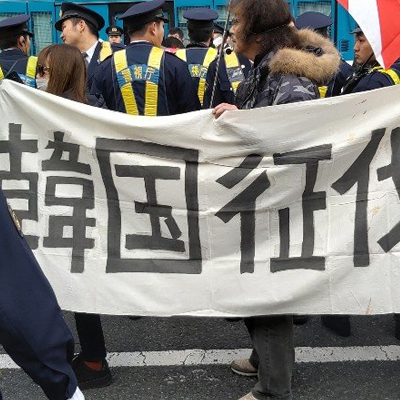
Just as Koreans have anti-Japanese sentiment, the Japanese have a similar "anti-Korean" sentiment called '혐한' (dislike of Korea), although it is not equivalent. Japanese people show an easygoing and self-serving perception of the Korean "anti-Japanese sentiment," saying, "I don't understand why they hate and loathe Japan so much." However, Koreans also express extreme antipathy and anger toward the "혐한" held by Japanese people.
Usually, when we say "혐한," we tend to dismiss it as "fake news" based on groundless historical facts combined with the exclusive thinking and distortion of facts by the Japanese. Koreans' expression of "anti-Japanese sentiment" is tolerated and taken for granted because it is rooted in anger and antipathy toward the Japanese colonial period. However, Japan's hatred of Korea and expression of "혐한" may be regarded as the actions of some extreme right-wingers and may be considered insignificant.
However, Japan's "anti-Korean sentiment" is becoming a social trend that dominates and penetrates Japanese society much more deeply than Koreans think. It should be noted that this is not just a matter of some right-wing groups burning with patriotism "unconditionally criticizing Korea," but a concrete social phenomenon based on historical origins.
The reason why Japanese people accept "anti-Korean sentiment" not as a unilateral claim of the far right but as a more universal issue lies in its "historical origin." Therefore, the first starting point for finding the anti-Korean virus hidden in Japanese society should be to clarify its historical origin. In fact, Koreans have maintained a vague psychological state of "mental victory" that we are superior to the Japanese based on the historical fact that "Baekje transferred its excellent culture to uncivilized Japan." However, this transfer of Baekje culture is also the result of Japanese research. Japan is uncomfortable when it sees Korea bringing out fabricated historical discourses tailored to Japan's taste. That uncomfortable original sin and the guilt of being backstabbed will continue to stimulate their guilt and neglected self-consciousness until Korea knows the history as it is.
But surprisingly, Japan has also had a sense of superiority of 'Korean contempt, Joseon contempt' for a very long time. Japan's tendency to despise Joseon appeared as Seikanron, which became the philosophical driving force of the Imjin War, and later became the basis for justifying the invasion of Joseon, such as the theory of colonial modernization. Seikanron is a ritual to celebrate Japan, which has mastered the skill of fabricating hundreds of years, opening a new chapter of civilization. It is a civilization celebration that says that they washed away the blood of pirates after taking other people's things and making them their own. But this is a delusion. Scholarship obtained by killing someone for civilization cannot be scholarship, and it cannot be history.
In this respect, anti-Korean sentiment could be a decisive variable that will redefine Korea-Japan relations in the future. If Seikanron, which Japan used as the philosophical background for the invasion of Joseon, became the basis for colonial rule, this anti-Korean sentiment could be a 'hidden claw' for Japan to reveal its ambition to advance into the continent and invade again, which will be confirmed in this series.
Lee Hyun-joo, a former diplomat and author of "Anti-Korean Virus from Japan" (subtitle: Twisted Political Engineering of the Japanese Ruling Class, Seonin Publishing, 2021), introduced an episode from a Waseda University Japanese language class in his book. In a Japanese history class, a Japanese teacher explained Japan's ancient culture, saying that while people from the Korean Peninsula brought ironware and other technologies, Japan mainly transmitted civilization to and ruled the Korean Peninsula. He cited the "Mimana Nihon-fu Theory" (任那日本府說: the theory that the Yamato regime of Japan established and ruled the Mimana Nihon-fu, a governing body, in the Mimana region of southern Korea in the 4th to 6th centuries) as evidence.
In fact, the Mimana Nihon-fu Theory is suspected of being fabricated and has contradictions in historical materials that could not have occurred in international relations at the time. Therefore, both Korea and Japan today do not believe in the Mimana Nihon-fu in the "Nihon Shoki" as it is, and recognize it as having a limited role. Given this situation, how should we interpret the tendency to teach the Mimana Nihon-fu Theory as a historical fact to foreigners in history classes at prestigious Japanese universities?
This cannot be simply dismissed as the 'excessive ambition' of one Japanese teacher. It is astonishing that Japanese people still regard themselves as a 'superior race' who transmitted their excellent civilization to the Korean Peninsula and even ruled part of the Korean Peninsula long ago. In fact, the theory of Mimana Nihon-fu is a 'theory' whose credibility and factuality are questionable when based on the theory of the conquest of Japan by continental equestrian people, where many archaeological excavations have been made, and the historical description that ancient China and Silla recognized all the people who lived scattered in the western region of Japan as 'Wa' (倭). However, we must not overlook the fact that the very point of 'mental victory' of claiming that their ancestors once ruled the Korean Peninsula by presenting the theory of Mimana Nihon-fu is connected to the anti-Korean virus and its DNA that have been manifested since 2005. Looking deeper, there is a history that the Korean Peninsula was Japan's territory from early on. A history that cannot be spoken of, but was effectively controlled, whether it was the ancient history of Mimana Nihon-fu or the modern Joseon Peninsula, the key is that in the present, where all history has become narrative, it is meaningless to fight over what is true. In a word, it is a messed up history.
Japanese people tend to deny the historical fact that Korea transmitted ancient superior culture to them. This is a similar feeling to the vague sense of superiority that Koreans feel towards Japanese people. It is said that Japanese intellectuals in modern times set China as an inferior 'unforgettable other' and began to find Japan's superiority and excessive praise for Japan. But in fact, the 'unforgettable other' for Japanese people since ancient times has been Joseonjin. The act of extracting the essence of whatever history we went through, Japanizing it, and aiming for the continent along with the invasion of modern China was carried out simultaneously with the invasion of Joseon.
Due to such a complex, the ancient 'Wa people' cleverly altered things to make it seem as though they directly imported advanced civilization and institutions from China. They disguised place names or people's names with different Chinese characters that had similar pronunciations to the original, such as writing 唐 (Tang) or 漢 (Han) for Kara (韓), which means Gaya, and reading it as 'Kara' ('Japan's Anti-Korean Virus' p34 Lee Hyun-joo, Seonin Publishing, 2021). Once the disguised image, territory, institutional history, and administrative history of China were embedded in their minds.
From ancient times, the undeniable and unforgettable other, 'Joseon,' has been hidden deep within the Japanese psyche, but even now, they refuse to acknowledge and deny that historical fact. They even unhesitatingly display a tendency to distort and twist it, and the manifestation of such a historical-psychological complex is the root of 'anti-Korean sentiment.' They have corrected, fabricated, and added to it, and now they have fallen into their own loopholes. However, it is not incomprehensible that they hate the lack of historical awareness of Koreans who have accepted Japan's logic. It's like the anger of a pseudo-religious leader seeing a believer who believes in and follows his lies well. Why are they angry at a perfect alibi that is not refuted? The bad habits of the era that praised dogma are the disharmony of historical perception that lies dormant beneath Japan's anti-Korean sentiment.
Japan's complex about Korea and the 'resistance' psychology towards the perception of historical facts have been firmly 이어져 to the theory of despising Joseon. In fact, Joseon enjoyed a superior position over 'Wae' in the early days, such as General 이종무's conquest of Tsushima Island. From the early 15th century to the late 15th century, the Muromachi Shogunate was in its final stages and the weakened shogunate was not in a position to confront Joseon. However, during this period, the world began to fluctuate, and the Age of Exploration opened, destined to break the old order.
It is said that the economic gap between Joseon and Japan widened from the mid-15th century, and the difference began to expand rapidly from the period just before the Imjin War at the end of the 16th century. It was defined that reading, writing, and abacus were popularized among the common people in Japanese society, commerce and finance developed, and Japan's national power gradually strengthened, resulting in a reversal of power between the two countries.
Joseon's unilateral contempt by Japan was a natural consequence of the widening gap in national power with Japan. Through the Imjin War, the perception that 'Joseon is a target of Japanese conquest' became established. From the end of the Goryeo Dynasty to the early Joseon Dynasty, and just before the Imjin War, Joseon intellectuals who went to Japan as envoys and saw the situation in Japan with their own eyes left records that they were surprised and admired by Japan's economic prosperity and the splendor of the cities.
In particular, after confirming that Japan was far superior to Joseon in terms of military and economic power, Japan's perception of Joseon's contempt became a more self-affirming stereotype. The story of Empress Jingū of Japan's conquest of Silla, the archetype of the Seikanron, is a fictional story, but it evolved into an ideology that justified the invasion of Joseon. The Japanese ruling class continued to paint over the myths about the conquest of the Korean Peninsula, which contained the archetypes of exclusivity and anti-Korean sentiment. This overpainting worked as the modern Japanese imperialist view of history.
And modern historians unhesitatingly commit the 'outrage' of distorting anecdotes and myths into historical facts. And the Japanese government instilled it in the Japanese people. In this way, the exclusive image of Korea, which had been painted over the past 1,500 years, became a 'hate Korea virus' ('Japan-originated Hate Korea Virus' p51 Lee Hyun-joo, Seonin Publishing, 2021).
The upcoming Japanese 'hate Korea' series will reveal that it is not just about introducing the vague hostility and antipathy that far-right Japanese people feel towards Korea, but rather the specific and general emotions of Japanese people based on historical facts. In particular, we need to accurately and properly recognize the 'hate Korea virus' that emerged in Japan around 2005.
It is worth noting that the Korean Wave first emerged in Japan in the early 2000s with the Korean drama 'Winter Sonata', but as a reaction to this, a strong backlash called 'hate Korea' appeared starting in 2005. 'Hate Korea', which began with antipathy and exclusive perception of the huge wave of the Korean Wave, has since evolved to match the universal sentiment of the general public, not just a regular subject for some far-right groups. Because the Abe administration, which has a strong right-wing tendency, had impure intentions to use 'hate Korea' as the driving force for Japan's major national management, the Japanese people gradually began to accept the hate Korea issues of the far-right as universal topics in politics and society.
It is naive to think that Japanese people have been accustomed to the anti-Korean issues of the Abe administration in this process. It should also be kept in mind that the Japanese also felt a sense of crisis as Korea economically developed and showed a tendency to overtake them, and that a full-fledged check and balance mentality was triggered, which appeared as a strand of 'anti-Korean sentiment'. In the next episode, we will continue to track the 'anti-Korean virus' that is widespread among the Japanese ruling elites, focusing on Yukichi Fukuzawa (1835-1901), a representative Japanese theorist of contempt for Korea.
댓글
( 0 / 500 )
순정
7
한일 관계를 감정론으로만 보면 답이 안 나옵니다. 혐한이든 반일이든 결국 고대사 왜곡이 누적된 탓인데, 문제는 서로가 서로의 왜곡을 바로잡을 의지가 없다는 점입니다. 임나일본부설처럼 이미 학술적으로 무게를 잃은 담론이 아직도 대학 강의에서 기정사실처럼 언급되는 건 일본 역사학의 정치적 중립성 부족을 보여주는 사례 같아요.
( 0 / 500 )
hurricane
5
한국도 일본도 고대사 문제에서 ‘자기서사 만들기’에 몰두했지, 학술적으로 냉정한 검증을 한 적이 생각보다 많지 않습니다. 일본은 임나일본부설 같은 식민주의 역사관을 버리지 못했고, 한국도 식민사관 반박 과정에서 또 다른 신화를 길러낸 측면이 있어요. 결국 양쪽 모두 역사학의 정치화를 반성해야 합니다.
( 0 / 500 )
Barbarian
4
솔직히 지금 20~30대는 반일이든 혐한이든 피곤해합니다. 여행, 콘텐츠, 기술 협력 같은 실질적 영역에서는 서로 잘 지내는데, 정치·언론이 만들어낸 감정적 프레임에만 계속 갇혀 있는 느낌이에요.
( 0 / 500 )
now59
5
2000년대 한류의 폭발이 일본인들에게 준 충격을 과소평가하면 안 됩니다. 한국 드라마와 K-pop이 일본 시장을 휩쓸면서 일본 문화계 내부에서는 “드디어 우리 우위가 무너졌다”는 위기감이 실제로 존재했어요. 혐한은 단순한 문화 전쟁이 아니라 문화적 패권 상실에 대한 불안입니다.
( 0 / 500 )
papers99
4
아베 정권 이후 일본은 ‘혐한’을 정치의 도구로 삼아왔고, 그게 너무 성공적이어서 이제는 정치권 스스로 그 감정을 통제할 수 없는 수준까지 왔습니다.
( 0 / 500 )
최진수
3
실제로 일본에서 살아보면 극우의 혐한은 소수지만, ‘한국을 약간 낮춰 보는 감정’은 은근히 퍼져 있어요. 겉으로는 예의 바르고 차별적 언사를 안 하지만, 역사나 문화 이야기 나오면 갑자기 얼굴 굳어지는 순간이 옵니다. 이 글의 말처럼 역사적 콤플렉스가 은근히 배어있는 건 분명합니다.
( 0 / 500 )
고만철
2
혐한은 일본판 포퓰리즘입니다. 분노를 관리하면 권력이 유지되는 구조죠.
( 0 / 500 )
dongdong
1
혐한이든 반일이든 결국 국민 감정은 시간이 만들고 정치는 그것을 이용합니다. 하지만 2025년에 아직도 임나일본부설 같은 고대사 논쟁을 두고 서로 미워하는 건 시대착오적입니다. 혐오의 기원을 분석하는 건 중요하지만, 결국 한일 관계는 현대의 이해관계와 상호 이익으로 다시 구성되어야 해요. 과거에 사로잡힌 감정은 미래를 만들지 못합니다.
( 0 / 500 )
Alexander3
0
감정 문제를 떠나, 혐한이 일본 내부에서 ‘보편적 정서’가 되어가고 있다는 분석은 주목할 필요가 있습니다. 일본 우익 정치층이 정권 안정과 내부 결속용으로 “한국 때리기”를 활용한다는 건 국제정치에서 흔한 전략입니다. 문제는 한국도 반일이 국내정치 도구로 소비된다는 거죠. 감정의 악순환이 아니라 정치의 악순환입니다.
( 0 / 500 )
신고내용
신고내용을 선택해주세요
회원비난/비하/욕설글 및 댓글도배성 게시물저작권 침해/불법자료 유출허위사실유포개인정보 유출.사생활 침해무단광고/홍보음란물 및 도박 불법 광고물범죄행위 관련 글불법행위 관련 소개물품 판매 및 사기글악성코드 및 스파이웨어 유포기타 사유 및 운영진 판단


비밀번호를 잊으셨나요?
Sign in with Google
All information provided by us is free of charge and is for the public good.