品

Corea든 Korea든, 품격이 먼저다
Whether Corea or Korea, dignity comes first.
Whether Corea or Korea, dignity comes first.
Now
지금
751 Diaspora
Heritage
유산
Humanity
인문
Mirengsi
未冷尸
Politics
정치
Media
언론

재일 동포
칼럼
Mizuno
Zainichi 4. Is Itō Hirobumi (伊藤博文 1841~1909) Korean?

0
2023. 10. 30
Hirobumi Ito was the son of a farmer, born in Suō in 1841. His father entered the Ito family, and thus both father and son became low-ranking samurai of that household. The rhetoric of someone entering another's family is a common phrase in descriptions of historical Japanese figures. Ito is also a typical example of someone who succeeded by entering a samurai family, either through adoption or as a low-ranking subordinate.
Suō is now Yamaguchi Prefecture, which became Yamaguchi Prefecture in 1871 due to the Haihan-chiken (廃藩置県: administrative reform that abolished the existing han system and placed it under central control). Most politicians of the Meiji era came from areas like Suō and Nagato, all of which were changed from Chōshū Domain to Yamaguchi Prefecture. One wonders what kind of innovation the so-called Restoration (Ishin), which abolished the existing han system and implemented reforms and openness influenced by the West, truly was, to have consolidated the names of places that had flourished with their unique cultures.
Hirobumi Ito studied under Yoshida Shoin of Nagato, a famous Edo period thinker and samurai, and participated in the Sonno Joi (Revere the Emperor, Expel the Barbarians: respecting the Japanese imperial family and rejecting Western barbarians) movement with Shinsaku Takasugi, also from Nagato. In 1862, he was a terrorist who participated in the arson attack on the British Legation. The following year, in 1863, he went to London to study and entered politics. In 1864, he returned to Japan after hearing information in London that the United States, Britain, France, and the Netherlands were attacking the Choshu Domain. In 1864 and 1866, there were two Choshu expeditions, and during this period, in 1885, Japan's cabinet system began. In conclusion, the Choshu expedition was the starting point for Japan's modernization, which began in a single province, the region that produced modern politicians, and a regional symbol of the end of the shogunate's authority.
Hirobumi Ito was the first Prime Minister of Japan with the start of the cabinet system. What was the reason he was able to continuously serve as Prime Minister for the 5th, 7th, and 10th cabinets? Of course, Ito was also a capable person who stood at the forefront of diplomacy with Russia, Britain, and others, and ultimately played a leading role in the usurpation of our national sovereignty. In 1895, he was the plenipotentiary for Japan to conclude a treaty after the Sino-Japanese War, and when the Korean Residency-General was established in 1905, he became the first Resident-General of Korea. In 1909, he was assassinated by Ahn Jung-geun. October 26th is a significant day in Korea. It is the day Park Chung-hee and Hirobumi Ito died.
There is a great deal of research on Ito Hirobumi, but there are some lesser-known facts that I would like to organize. It is none other than the fact that Ito, a symbol of modern Japanese reformist politicians, was actually a Joseon person. His name is even clearly known. His Joseon name was Im Chun-mo, and his father was Im Se-jang. If this is true, Ito would officially be a pioneer of modern voluntary 창씨개명 (changing one's surname to a Japanese one). It would be good for someone knowledgeable about genealogies to investigate this.
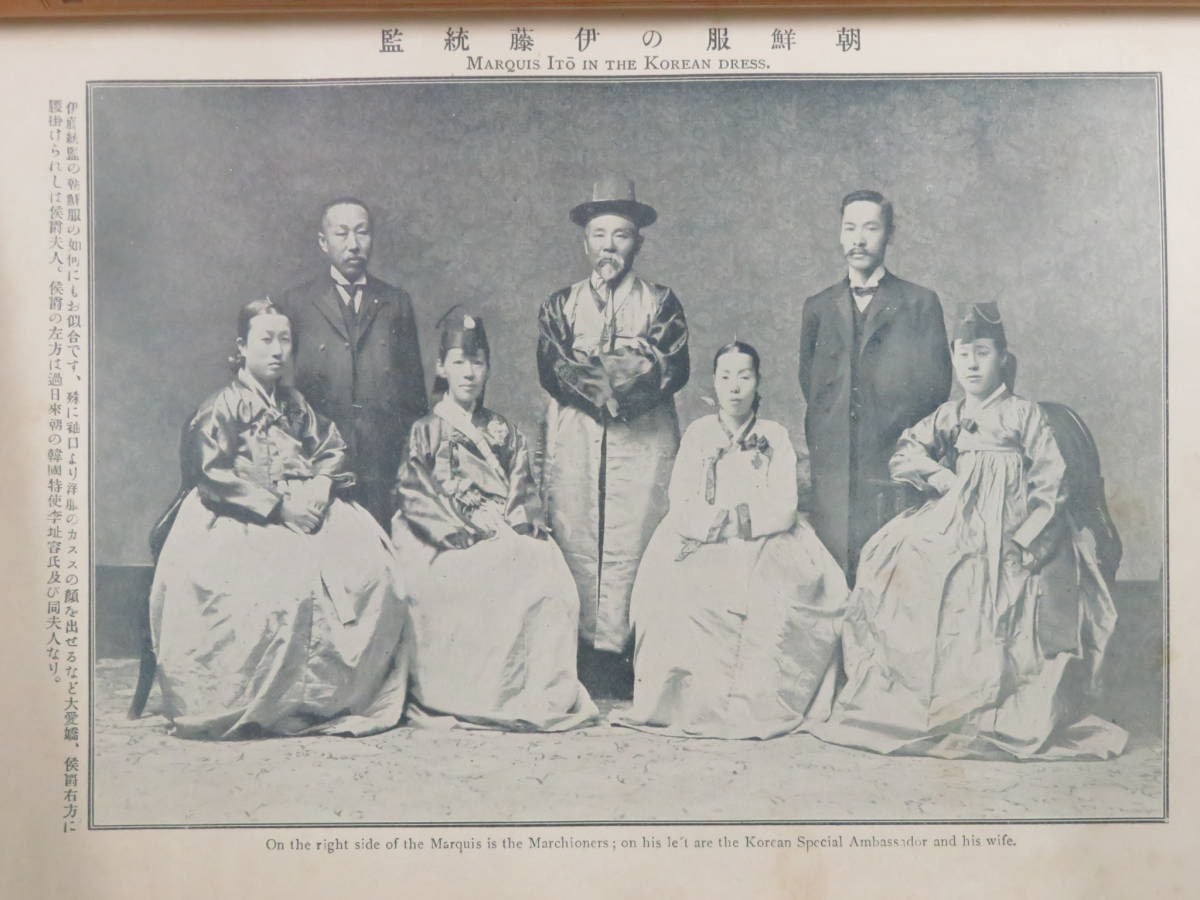
Another piece of evidence for the theory that Ito Hirobumi was a Joseon person is a photo of Ito wearing a hanbok and a photo taken on March 24, 1904, wearing a Korean order received from Emperor Gojong. The hanbok is said to have been a gift from Lee Ji-yong, one of the Eulsa Five Traitors, to Ito in November 1906, and the name of the Taegeuk Order is the Grand Order of the Golden Ruler (大勳位金尺大綬章), established in 1900. Furthermore, in photos of Ito in his youth, wearing a samurai (侍) hakama (袴) outfit, there are no moles on his face, and his facial features are completely different. While there are many photos of warriors from the late Edo period who shaved their heads and changed into Western clothes, such a drastic transformation is not common. These photos suggest a great deal.
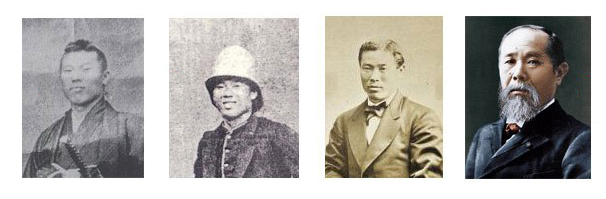
One is the discrepancy in perspective: even if we read history books, that is, general and specialized books, which we are familiar with, we cannot fully interpret the numerous modern black-and-white photographs remaining worldwide to accurately reflect the actual facts of the time. Without knowing who took the photographs, when, with what camera, and under what circumstances, we can only infer the era from the circulating pictures. Even photographs taken at the moment, and recent video recordings made possible by technological advancements, do not easily provide a complete illumination of the past.
Next, I want to point out that many old photographs could have been sufficiently forged or altered even with the technology of the time. The moment we see an old black-and-white photograph, we tend to get caught up in the past and reminisce, but if we look closely at the picture, we can find traces of intentional modification to the glass plate itself. Just as a book read without knowing about censorship in its era leaves no room for doubt, if we are unaware that there was an era of manipulated photographic staging, all those black-and-white photographs are merely beautiful memories.
I don't intend to complicate the subtle issues of history with just a photo, but Ito's hanbok photo was taken when he was older. Moreover, even his wife, a family member, was dressed beautifully in hanbok. At an old age and at the stage of completing the annexation of Korea, why would he bother to wear hanbok and even clasp his hands for a photo? Was it a perverse hobby of the pro-Japanese collaborator Lee Ji-yong and Ito at the critical juncture of national ruin and betrayal? Since there are many examples of foreigners wearing both medals and hanbok, we cannot define Ito as a Joseon person based solely on these two photos, but the unexplained background of the photo leaves an unsettling feeling.
Finally, there is this one photo. It is a photo of a wish for colonial rule carved into a rock in Jeongdong.
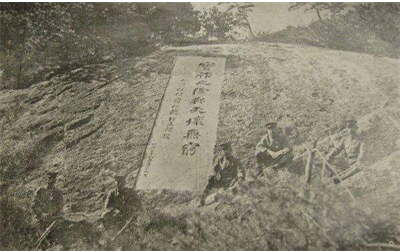
보조지융여천양무궁 (The prosperity of the imperial throne is as boundless as heaven and earth)
Inscribed by Marquis Itō Hirobumi, Grand Order of Merit (大勳位候爵伊藤博文謹題)
Carved in November 1905
"The prosperity of the imperial throne, boundless as heaven and earth" is a phrase from the *Nihon Shoki*. What historical significance does it hold that a desire to rule us forever would be taken from a passage of ancient history, carved into stone, and sworn to the emperor with such fervent aspiration? These photos are easily found in Japan and are even sold as postcards. However, there is no explanation that makes sense of these photos. Whether a few photos that modern people might casually overlook and the facts of past events are revealed depends on the reader's interest.
댓글
( 0 / 500 )
신고내용
신고내용을 선택해주세요
회원비난/비하/욕설글 및 댓글도배성 게시물저작권 침해/불법자료 유출허위사실유포개인정보 유출.사생활 침해무단광고/홍보음란물 및 도박 불법 광고물범죄행위 관련 글불법행위 관련 소개물품 판매 및 사기글악성코드 및 스파이웨어 유포기타 사유 및 운영진 판단


비밀번호를 잊으셨나요?
Sign in with Google
All information provided by us is free of charge and is for the public good.