品

Corea든 Korea든, 품격은 이름보다 먼저다
Whatever the name—Corea or Korea—dignity comes first.
Whatever the name—Corea or Korea—dignity comes first.
Now
지금
751 Diaspora
Heritage
유산
Humanity
인문
Mirengsi
未冷尸
Politics
정치
Media
언론

뉴욕 컬럼
칼럼
andante
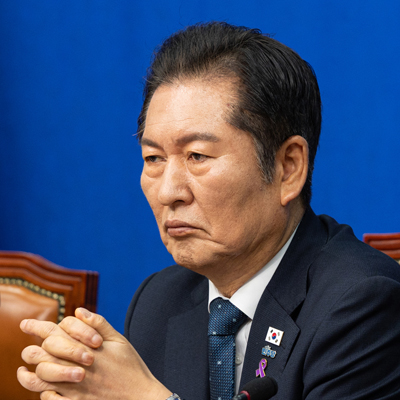
Is Jeong Cheong-rae's path for the Democratic Party?

0
2026. 07. 02
- The Democratic Party's national convention is escalating beyond a mere policy debate into a struggle for survival and legitimacy among factions.
- Former leader Jeong Cheong-rae's self-proclaimed "Roh Moo-hyun kid" status is interpreted as a strategy to strengthen his political standing and serve the interests of a specific faction.
- Given the responsibility for the local election defeat and his actions that fueled internal party conflict, the prevailing critical view is that Jeong's re-election would hinder the success of the Lee Jae-myung administration.
- It is argued that the election of Kim Min-seok as party leader, through a Kim Min-seok-Song Young-gil alliance, is essential for the stable governance of the Lee Jae-myung administration and the Democratic Party's expansion to the center.
- Ultimately, this convention is highlighted as an opportunity to properly support the Lee Jae-myung administration and for the Democratic Party to be reborn as a party for the people, urging former leader Jeong Cheong-rae not to run.
The Democratic Party of Korea's August 17 national convention is escalating beyond a policy debate into a struggle for legitimacy and a fight for survival among factions. Former leader Jeong Cheong-rae, who is seeking re-election, emphasizes his connection with former President Roh Moo-hyun, claiming to be a 'Roh Moo-hyun Kid.' However, this appears to be a strategy to solidify the interests of the pro-Moon, Cho Kuk, and Kim Eo-jun factions and his own political standing, rather than a path for the unity of the Democratic Party and the success of the Lee Jae-myung administration. By analyzing Jeong Cheong-rae's actions since the Lee Jae-myung administration took office and examining the internal power dynamics within the Democratic Party, I aim to explain why he should abandon his bid for party leader and why Kim Min-seok's victory through a Kim Min-seok-Song Young-gil alliance is essential for the success of the Lee Jae-myung administration.
Former leader Jeong Cheong-rae has consistently appealed more strongly to party members than to the general public. His discord with President Lee Jae-myung, who advocates for being 'everyone's president,' was structurally inevitable. Even within the Democratic Party, there are strong criticisms of his attitude in defining the local elections as a 'big victory.' The reasons why he should take responsibility for the election defeat and withdraw his bid for re-election are clear. The June 3 local elections were a public judgment stage to evaluate the first year of the Lee Jae-myung administration. While the greatest political responsibility for a ruling party's defeat falls on the president, Jeong Cheong-rae's role as party leader is by no means insignificant. Nevertheless, the impression that he is shifting responsibility to the president or the government only amplifies internal party conflicts.
On June 8, at a press conference marking his first year in office, President Lee lowered his stance, saying, “This is a warning from the people to me.” However, the nuance of shifting responsibility to the ruling party leadership without concrete self-reflection left something to be desired. The decisive moment that shook the election landscape was the ruling party's sudden proposal of the 'Fabricated Indictment Special Prosecutor Bill' on April 30. This bill, which opened up the possibility of withdrawing the indictment in the President's case, provoked strong attacks from the opposition, and confusion grew in the ruling party's battleground camps. Although President Lee stated on May 4, “I ask the Democratic Party to make a judgment after gathering public opinion,” his failure to actively demand the withdrawal or amendment of the bill was a stark contrast. It is being evaluated that there was a lack of swift action, unlike during the controversy over the trial suspension law.
Messages posted on SNS on election day, such as “Did you vote to avoid being governed by the worst scoundrels?”, and controversies surrounding the exposure of early voting ballots, accelerated the departure of swing voters and those in their 20s and 30s. The election results clearly showed a trend of conservative consolidation and the departure of swing voters and those in their 20s and 30s. This is a result of the public's desire to check the government, and voters who were disappointed with the 'arrogant' conservatives returned to the polls to check what they perceived as an arrogant power. Ignoring this and blaming only internal problems within the ruling party is only a partial diagnosis. The core of the decline in approval ratings was the departure of swing voters and those in their 20s and 30s, and the expectation that a leadership more aligned with the Blue House would automatically restore support is a misconception.
Excessive power invites backlash. While this local election was a check, the next general election could be a judgment. President Lee Jae-myung, who keenly reads public sentiment, must be well aware of this. Recently, there have been signs of him returning to the restrained demeanor he showed in the early days of his administration, both in public appearances and on social media. To secure momentum for the second year of his administration, he must untangle the knots. In particular, the issue of the special prosecutor bill containing the indictment withdrawal clause is critical. Abuse of prosecutorial power must be corrected, but the majority of citizens do not agree with the withdrawal of the indictment itself. If President Lee declares the withdrawal of the indictment withdrawal clause, public sentiment will empower a restrained government. The warning from the local elections lies precisely at this point.
In this situation, the Democratic Party's August 17th national convention appears even more complicated. When former representative Jeong Cheong-rae officially announced his bid for re-election, emphasizing his connection with former President Roh Moo-hyun, Representative Song Young-gil strongly objected. Representative Song stated, "Former Representative Jeong turned his back on former President Roh and couldn't even attend his funeral," and despite former Representative Jeong's rebuttal that it was "100% false information," Representative Song pointed out, "He cannot claim to be a 'Roh Moo-hyun kid'." Representative Song plans to visit Bongha Village in Gimhae, emphasizing "our collective responsibility for failing to protect President Roh." This aligns with the analysis that former Representative Jeong's self-proclaimed "Roh Moo-hyun orthodoxy" is a strategy reminiscent of the "Hudanhyeop incident" to keep Prime Minister Kim Min-seok in check. This was an attempt to remind people of Prime Minister Kim, who came from the Donggyo-dong faction, and his past demand for Roh Moo-hyun to withdraw from the 2002 presidential election in favor of a unified candidacy with Chung Mong-joon.
Former Representative Jung's actions are not aimed at unifying the Democratic Party, but rather at consolidating his support base, which extends from the pro-Moon faction to Cho Kuk and Kim Eo-jun. His remarks, emphasizing his background as a "Nosamo" member and stating that he became a National Assembly member through political reform and the introduction of a regional primary system, are moving. However, as party leader, his focus on party member and factional unity rather than national unity resulted in a defeat in the local elections. Within the party, there is an assessment that a 2-to-1 structure has become clear, with candidates from the 'anti-Jung Cheong-rae (anti-Cheong)' faction. Representative Song Young-gil mentioned that he could "ally" with Jung Cheong-rae if he and Kim ranked first and second, emphasizing a safety net through a runoff election.
Jeong Cheong-rae must give up his bid for party leadership. His attempt to seek re-election is seen as an evasion of responsibility for the election defeat, hindering the future of the Lee Jae-myung administration and the Democratic Party. Behind his actions are the influence of the pro-Moon faction and the political calculations of the Cho Kuk Innovation Party and Kim Eo-jun's media. They are trying to check the Lee Jae-myung administration's expansion to the center and its pragmatic line, and to lead the party around "their side." However, it is no longer the time for the Democratic Party to be consumed by faction-centered legitimacy struggles. It must be reborn as a "party for all" in the eyes of the people.
The best outcome for the next Democratic Party leader is the victory of Prime Minister Kim Min-seok through a Kim Min-seok-Song Young-gil alliance. Prime Minister Kim Min-seok, hailing from the Donggyo-dong faction, can demonstrate stable and practical leadership, and his alliance with Representative Song Young-gil provides a safety net that can encompass a broad range of forces within the party. A leadership that is in 'harmony' with President Lee Jae-myung can prevent the defection of moderates and those in their 20s and 30s, and lay the groundwork for a recovery in approval ratings. Jeong Cheong-rae's re-election would only deepen internal party conflicts and hinder the government's administration. If candidate Kim Min-seok wins, the Lee Jae-myung government will establish stable party-government relations in its second year in office and gain momentum in resolving the controversy over the withdrawal of indictments, presenting the correct direction for prosecutorial reform, and promoting people-centered policies.
Looking at the dynamics of the forces behind the internal strife in the Democratic Party, the pro-Moon and Cho Kuk factions' support for Jeong Cheong-rae is a factional survival strategy disguised as inheriting the legacy of Roh Moo-hyun. However, this is out of touch with public sentiment in 2026. The defeat in the local elections is a signal that the public is checking 'arrogant power.' If former representative Jeong ignores this and insists on re-election, it is not a choice for the Democratic Party but a path for his own political advancement. Conversely, the Kim Min-seok-Song Young-gil alliance is a mature choice that prioritizes party unity and government success.
Ultimately, the Democratic Party's national convention boils down to the question of 'who can properly support the Lee Jae-myung government.' Jeong Cheong-rae's insistence on running carries a high risk of plunging the party into a quagmire of division. He must make a responsible decision to withdraw his candidacy and contribute to the party's grand unity. Through the victory of candidate Kim Min-seok, the Democratic Party can heed the warning from the local elections and be reborn as a restrained and practical party. It is again the President's time, and at the same time, it is time for the Democratic Party to return to being the people's party. The success of the Lee Jae-myung government depends on the party's wise choice.
댓글
( 0 / 500 )
Rose
8
지방선거 결과를 단순히 "졌지만 잘 싸웠다"로 해석하면 같은 실수를 반복할 가능성이 큽니다. 집권당은 항상 국민 눈높이에서 스스로를 먼저 돌아봐야 합니다. 전당대회도 계파 경쟁이 아니라 국민 신뢰를 회복하는 출발점이 되어야 한다는 점에 공감합니다.
( 0 / 500 )
조기호
6
정당의 대표는 강성 지지층만 바라보는 사람이 아니라 국민 전체를 설득할 수 있는 인물이어야 합니다. 지금 민주당에 필요한 것은 적통 경쟁이 아니라 통합과 확장입니다. 결국 중도층을 잃으면 어떤 정치도 오래가기 어렵다는 사실을 잊지 말아야 합니다.
( 0 / 500 )
弘益人間
6
노무현 정신을 이야기한다면 특정 계파의 정치적 자산으로 소비할 것이 아니라 통합과 원칙이라는 가치부터 계승해야 한다고 생각합니다. 과거의 상징을 앞세우기보다 현재 국민이 무엇을 요구하는지 답하는 정치가 더 중요합니다. 정청래 대표는 물러나는게 맞습니다.
( 0 / 500 )
홍민성
5
권력은 견제를 받을 때 더 건강해집니다. 지방선거 결과를 국민의 경고로 받아들이고 국정 운영 방식을 조정해야 한다는 지적은 의미가 있습니다. 당내 경쟁도 누가 더 강성인가가 아니라 누가 정부를 안정적으로 뒷받침할 수 있는가를 기준으로 이루어졌으면 합니다.
( 0 / 500 )
민주
5
정청래 후보가 정말 이재명 정부의 성공을 생각한다면 강성 지지층만 바라보는 정치에서 벗어나야 합니다. 지금 필요한 것은 당원 결집이 아니라 중도층을 다시 끌어오는 전략입니다. 계파 정치가 계속되면 결국 정부도 부담을 안게 됩니다.
( 0 / 500 )
大望
5
노무현 정신은 특정 계파가 독점할 수 있는 것이 아닙니다. '노무현 키즈'를 앞세워 정치적 정통성을 주장하기보다 현재 국민에게 어떤 비전과 성과를 보여줄 것인지 경쟁하는 것이 훨씬 설득력 있어 보입니다.
( 0 / 500 )
미남
4
친문 세력도 이제는 과거의 정치적 영향력을 유지하는 데 집중하기보다 이재명 정부의 성공을 위해 한발 물러설 때가 됐습니다. 적통 논쟁을 반복할수록 국민은 민주당이 민생보다 내부 권력 다툼에 더 관심이 있다고 느낄 수 있습니다.
( 0 / 500 )
東方77
4
지방선거에서 민심이 보낸 경고를 제대로 읽었다면 지도부는 먼저 책임을 이야기했어야 합니다. 그런데 책임론보다 연임과 적통 논쟁이 먼저 나오는 모습은 국민 눈높이에서는 쉽게 공감받기 어려워 보입니다.
( 0 / 500 )
koa
2
친문 정치의 가장 큰 한계는 내부 결속에는 강하지만 외연 확장에는 약했다는 점입니다. 만약 지금도 같은 방식으로 당을 운영하려 한다면 민주당은 중도층을 되찾기 어려울 것입니다. 이제는 계파의 이해보다 국민의 선택을 우선하는 정치가 필요합니다.
( 0 / 500 )
신고내용
신고내용을 선택해주세요
회원비난/비하/욕설글 및 댓글도배성 게시물저작권 침해/불법자료 유출허위사실유포개인정보 유출.사생활 침해무단광고/홍보음란물 및 도박 불법 광고물범죄행위 관련 글불법행위 관련 소개물품 판매 및 사기글악성코드 및 스파이웨어 유포기타 사유 및 운영진 판단


비밀번호를 잊으셨나요?
Sign in with Google
All information provided by us is free of charge and is for the public good.