
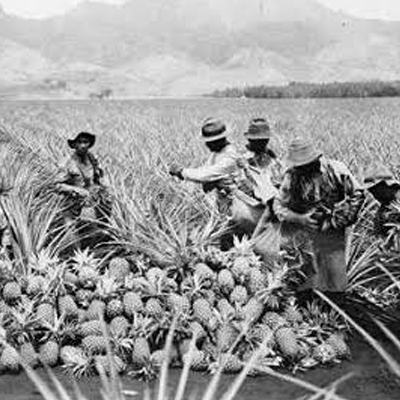

아픈 손가락
47. Situation before and after the organization of Hawaiian diaspora groups

- It criticizes the existing colonialist historical view for distorting the essence of nationalism by defining Hawaiian immigration history as Protestant support for anti-Japanese movements.
- Korean immigration to Hawaii began out of a need for mutual aid for survival, but gradually evolved into an ideological community embodying resistance to foreign powers and political aspirations.
- It argues that Hawaiian immigration was not King Gojong selling his people, but rather closer to human trafficking, where US Minister Allen and businessman Deshler exploited labor amidst the Joseon government's dysfunction.
- Missionary George Jones's persuasion of his congregants to encourage immigration to Hawaii was not merely missionary work but part of a labor export scheme, a result of combined religious and political motives.
- It points out that the existing historical view, which separates the immigration of Ahn Chang-ho's couple to mainland America from Hawaiian immigration, is a deliberate manipulation to construct a narrative of the independence movement centered on Syngman Rhee and Protestantism.
Before tracing the nature of Hawaiian diaspora organizations, it was necessary to first address the beginning of Korean immigration to Hawaii. However, the existing colonial historical perspective made it difficult to break readers' prejudices, and I didn't want to delve into it, feeling like I was selling goods from a street stall, worried about rent.
Looking at the declining modern civilization, it is now that we realize that nationalism is not just an ideology for establishing a historical view, but rather a driving force that constitutes and maintains biological species. The past years, during which nationalist traditional monarchical states were dismantled by colonialism and war, and their phenomena and realities were concealed, have culminated in anxiety about a questionable future world and modern Korean society. Monarchies and imperial families still coexist with communist and capitalist systems around the world, so why did Korea have to lose its long history and be reborn as a Christian nation? The root of this lies in this lost national love, and it seems that the nation itself has the conditions for extinction.
Colonial historiography has defined the beginning of Korean immigration to the Americas as the Protestant support for the anti-Japanese movement. As a result, we find ourselves in a dogma where no one questions the strange phenomenon of modern Korean Christianity promoting and ignoring national division. At the very bottom of the contradictions of this sleepless ideological game lies the history of Hawaiian immigration.
Modern immigration tends to reveal a cultivated gene of mutual aid.
Below is a table summarizing the changes in Korean organizations in the Americas.
Date | Organization | Region | Nature/Remarks |
1903.8.7 | Shinminhoe (新minhoe) | Honolulu, Hawaii | The first Korean social and political organization in Hawaii Hong Seung-ha, Yoon Byung-gu, Moon Hong-sik, etc. participated. Disbanded in 1904. |
1903.9.28 | Sanghang Chinmokhoe (Sanghang Chinmokhoe) | San Francisco | Organized by Ahn Chang-ho and others. The first Korean organization on the US mainland and the predecessor of the Gongnip Hyeophoe. |
1905.4.5 | Gongnip Hyeophoe (Gongnip Hyeophoe) | San Francisco | Expanded and integrated Sanghang Chinmokhoe and others. A representative early anti-Japanese and self-governing Korean organization on the US mainland. |
1905.5.3 | Ewa Livestock Association [Data notation] | Oahu, Hawaii | Small local Korean organization in Hawaii |
1905.12.9 | Daedong Gyoyukhoe (Daedong Gyoyukhoe) | California Pasadena | Kim Woo-je, Jang Kyung, etc. at the center. National sovereignty recovery movement through education and enlightenment. |
1906.3.16 | Waipahu Gongdonghoe | Oahu, Hawaii | Local Korean organization |
1906.5.10 | Hyeolseongdan (Blood and Sincerity Group) | Ola, Hawaii | Anti-Japanese and Korean community unity organization |
1906.6.4 | Jaganghoe (Self-Strengthening Society) | Ola, Hawaii | Self-strengthening, education, and national enlightenment movement, publication of newsletter |
1906.6.4 | Gongjinhoe (Progressive Society) | Honolulu | Korean enlightenment and anti-Japanese organization in Hawaii |
1906.6.4 | Labor Alliance | Hawaii waterfront area | Korean community organization centered on laborers |
1906.12.2 | Uiseonghoe (Righteousness Society) | Maui, Hawaii | Anti-Japanese and ethnic unity organization |
1907.2.3 | National Assembly | Ola, Hawaii | Korean anti-Japanese organization in Hawaii |
1907.2.5 | National Unity Association (National Unity Association) | Maui, Hawaii | Advocated for grand unity and rejection of Japanese goods |
1907.3.2 | Daedong Bogukhoe (Great Unity and National Preservation Society) (Great Unity and National Preservation Society) | San Francisco | Expanded and reorganized Daedong Education Association, with Jang Gyeong, Kim Woo-je, Moon Yang-mok, Jang In-hwan, etc. participating |
1907.3.22 | Singanhoe (New Cadre Society) | Hawaii | Anti-Japanese organization in Hawaii. Different from the Singanhoe in Korea in 1927 |
July 1907 | Siljihoe (Practical Will Society) | Hilo area, Hawaii | President Park Seung-ryeol, promoting martial arts, promoting industry, and boycotting Japanese goods |
July 1907 | Buheunghoe (Revival Society) | Maui, Hawaii | Anti-Japanese and Korean community solidarity organization. |
1907.7.20 | Jeonheung Association (Jeonheung Association) | Honolulu | Published newsletter, later merged with Korean Synthetic Association |
1907.7.25 | Gongjehoe (Mutual Aid Society) | New York | Early Korean organization in the eastern United States |
1907.9.2 | Korean Synthetic Association (Korean Synthetic Association) | Hawaii | Integrated 24 organizations in Hawaii President Im Jeong-su, Vice President Ahn Won-gyu, approximately 800 members |
1907.11.7 | Dongmaeng Sinheunghoe (Alliance for New Prosperity) | Seattle | Early Korean organization in Washington State |
1908 | Korean Women's Association | Mainland United States | First women's organization in the Americas |
1909.2.1 | Gukminhoe (Korean National Association) | United States, Hawaii | Merged Gongnip Association and Korean Synthetic Association Gongnip Association was the North American General Assembly Synthetic Association was the Hawaii General Assembly |
1909.5.9 | Korean National Association Merida Local Chapter | Merida, Mexico | Over 70 people, including representatives from 16 farms, held the founding convention President Lee Geun-young. 314 members |
1910.2.10 | Korean National Association and Daedong Bogukhoe Integration | San Francisco | Daedong Bogukhoe merged with the Korean National Association to form the Korean National Association system |
1910.5.10 | Korean National Association (Korean National Association) | San Francisco | The largest integrated Korean organization in the Americas, encompassing North America, Hawaii, and Mexico |
1913.5.13 | Heungsadan (Young Korean Academy) | San Francisco | An Chang-ho founded an organization representing 8 provinces Practical action, character cultivation, and development of capabilities |
1913 | Korean Women's Association | Honolulu, Hawaii | Early Korean women's organization in Hawaii, supported the independence movement and community activities |
1914.8.29 | Great Joseon National Military Corps National Military Corps (National Military Corps) | Kahaluu, Hawaii | Military training and independence army training organization centered on Park Yong-man |
1917 | Korean Women's Association | Sacramento | Women's independence movement and relief organization |
1919.3 | Sinhan Buinhoe (New Korean Women's Association) (New Korean Women's Association) | California Dinuba | Kang Won-shin, Han Shin-ae, Han Seong-seon, etc. formed and participated in the women's organization integration movement |
1919.4.1 | Korean Women's Relief Association | Hawaii | Actively supported the financial and relief efforts of the independence movement |
1919.8.5 | Korean Women's Patriotic Corps | USA | A representative women's independence movement organization that integrated various Korean-American women's groups, supporting independence funds, Korean language education, and domestic relief |
1921.6.14 | Cuban Korean Association | Matanzas, Cuba | Organized by Koreans who settled on the El Bolo farm, later developed into the Cuban branch of the Korean National Association |
1921.7 | Dongjihoe (Comrades' Association) | Honolulu, Hawaii | Organized by Syngman Rhee, Min Chan-ho, Ahn Hyun-kyung, Lee Jong-gwan, and others A political organization that supported Syngman Rhee's diplomatic independence policy |
1921.9.21 | Korean National Association Manati Branch | Manati, Cuba | Organized by about 30 Koreans with the approval of the North American Regional General Assembly |
1922.3 | Korean National Association Cárdenas Branch | Cuba | Organized by Koreans who moved from Matanzas to Cárdenas |
1922.3.22 | Hawaii Korean Residents' Association | Hawaii | Disbanded the existing Korean National Association Hawaii Regional General Assembly and organized according to the Provisional Government's decree for overseas Koreans, affiliated with Syngman Rhee and the Korean Commission in Washington, D.C. |
1922 | Korean National Association of North America | Mainland USA | After the separation of the Hawaii Regional General Assembly, the existing mainland organization of the Korean National Association was reorganized into the Korean National Association of North America |
1929.10 | Naseong Dongjihoe | Los Angeles | A branch of the Dongjihoe organized following Syngman Rhee's visit to LA |
1930.1.30 | Naseong Korean Community Association | Los Angeles | An organization for supporting the Gwangju Student Movement and uniting Koreans in America |
1930.3.8 | Central California Korean Community Association | California Dinuba | Formed around Kim Ho, Oh Chung-guk, and others. Later participated in the formation of the United Korean Committee in America |
1931.12.7 | United Korean Committee in America (United Korean Committee in America) | USA | The Korean National Association, Central California Community Association, Naseong Korean Community Association, and Mexican factions formed a united front centered on the Provisional Government |
1933 | Korean National Association Reconstruction of the Hawaii Regional General Assembly | Hawaii | Reorganized after being disbanded in 1921-22 |
1941.4.20~27 | United Korean Committee in America | Honolulu, LA | The largest united organization integrating 9 Korean-American organizations as a result of the Overseas Korean Congress The legislative branch was in Honolulu, and the executive branch was in LA. |
1942.2.15 | Korean National Defense Corps | California | A Korean military organization promoted by the United Korean Committee in America Operated within the California State Guard system |
The beginning of these many Korean-American organizations was not made overnight. It started in December 1902, with the first Hawaiian immigrants recruited from the Incheon and Gyeonggi regions, boarding an immigrant ship as Protestant believers from Naeri Church, and then forming a self-governing farming community called a Donghoe (洞會) to help each other survive. The twists and turns of mutual aid organizations being born, dissolving, merging, disappearing, and being reborn among the displaced people of a ruined nation, all for survival, symbolically reveal how the Korean people have endured long years of hardship. Although these organizations cannot be fully explained as merely the manifestation of the people's will, it is clear that they have evolved into a characteristic of modern Koreans, full of political aspirations. There are various diaspora peoples and organizations in the world, but beyond economic communities, they form ideological communities. Although currently entrenched in a Christian historical perspective, a closer look at their roots reveals a political orientation of resistance to foreign powers and internal consolidation.
Initially, immigration to Hawaii was the prelude to the dismantling of the Joseon nation.
There is abundant evidence that Koreans who arrived in Hawaii in 1903 were assigned to sugarcane plantations and worked under the whip. They were treated like trafficked laborers, much like the Africans brought to North America on slave ships. However, instead of defining the beginning of modern immigration as human trafficking on slave ships, Korean historians have positioned it as modern immigration based on voluntary decision-making. The US military government and the pro-Japanese remnants of the government reorganized official colonial history to suit their convenience. The assertion that the Shinminhoe was an organization in which missionary Hong Seung-ha (洪承河, 1863~1918) was involved is not only lacking in factual proof but also goes against reason. A historical view created by the combination of religion and politics cannot become a theory that accounts for all of history. The contradictions that Korean Christianity currently faces began at this time. Or, perhaps, they bore fruit at this time.
In 1902, a Hawaiian sugar cane company proposed employing immigrants to the government of a ruined nation, a land without an owner. It was not our side that requested immigration as a policy for the sake of our people's livelihoods. Already, Chinese, Japanese, Spanish, Portuguese, German, Norwegian, British, American, and African people were being mobilized for sugar cane cultivation in Hawaii. We were never taught about the diverse mix of races in the jobs on Hawaiian sugar cane plantations. We never encountered the history of sugar cane being transported on railways that no longer exist. It is also unrelated to the narrative of the fall of the Hawaiian Kingdom. If so, the Hawaii where the people of Joseon, a ruined nation, were deceived into going might not be the current Hawaii, the last state of the United States. Why has the world linked Hawaii to the place where Korean immigration first began and to the Hawaii of the Pearl Harbor attack?
Perhaps it is because the colonial hegemonic nations of the world have secrets they cannot tell the subjugated peoples. This secret dates back to the 18th century. Even the Sinyu Persecution (1801), the first large-scale Catholic persecution in Joseon during the first year of King Sunjo's reign, omitted many problems in the process of Western missionaries entering Joseon by removing Westerners from the birthplace of Catholicism and drawing a line through Chinese missionaries as intermediaries. By allowing only the history where Joseon became the perpetrator under the name of persecution to reign as official history, the role of Christianity in distorted Korean history and the harm of deep-rooted dogma are beyond imagination.
At that time, it was Horace N. Allen (1858~1932), the American minister to Korea, who arranged the recruitment and introduction of Korean laborers needed in Hawaii. Allen went directly to Hawaii, received requests from sugar cane plantation owners, and persuaded King Gojong. Therefore, we were taught that King Gojong sold out his people. Because of this, we, who believed and recited the history of a dynasty that became worse than a dog, also became people with a lineage like dogs in the past, and colonial historiography thus deeply ingrained itself in us.
It should not be assumed that David W. Deshler (1872-1927) had full legal authority over immigration simply because he received permission from Emperor Gojong to recruit Korean laborers. The unquestioning attitude towards a historical narrative that portrays Emperor Gojong as being involved in all the accumulated evils and malpractices of the late Joseon Dynasty also played a part. Even the immigration to the United States that began in 1965 was driven by poverty and the desire for a better life, so it is premature to accept the circumstances of a nation in decline as fact. It should not be overlooked that the Joseon court's administrative functions were already paralyzed even before the establishment of the Suminwon (綏民院) under the Imperial Household Department. Instead of assuming the Joseon government's functions were paralyzed, one should consider the forces that had seized control of the palace or were competing to do so.
Deshler first profited from the Great Chosŏn Ramie Spinning, Ltd. (大朝鮮苧麻製絲會社), established in Seoul in 1897, and then, with a bank, set up a labor export company. The Great Chosŏn Ramie Spinning, Ltd. was a Korean-foreign joint venture that processed hemp and ramie into thread and then exported it to weaving factories in places like Shanghai, China. Among the Korean executives were Seo Jae-pil and Ahn Gyeong-su. Foreigners always needed a local escort, and it is noteworthy that several figures from modern history alternately appeared among these escorts.
This company was a joint venture between Deshler and American Walter D. Townsend (1856-1918), who worked under James Rolland Morse (1848-1921), one of Japan's 'enterprising Yankees.' Morse was one of those engaged in coercive trade or predatory trade in the East after the Opium Wars, establishing a base there.
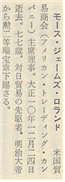
James Rolland Morse, a pioneer in trade with Japan <Taisho Kakochō Butsukojinmei Jiten 1973>
In Joseon, which had become communist, Deshler established The East-West Development Company in Jemulpo, the gateway for Westerners, for his immigration business. He then placed an advertisement in the Hwangseong Sinmun, seeking English-speaking young people to work at his Deshler Bank. Although the advertisement was placed, recruitment was difficult due to resistance from people hesitant to leave their hometowns for an unfamiliar foreign land. George H. Jones (1867-1919), a missionary at Naeri Methodist Church in Incheon, actively recruited workers for Hawaiian sugarcane plantations and persuaded his parishioners. He encouraged them to embark on a pioneering journey for economic improvement, educational benefits for their children, and missionary work.
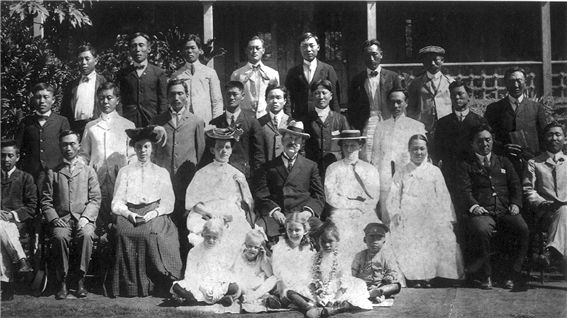
1906 visit to Honolulu Methodist Church (center front) George Heber Jones
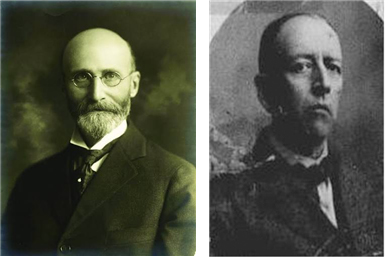
(Left) Horace N. Allen (Right) David W. Deshler
What does Hawaii symbolize?
Even a hundred years ago, it is unreasonable that the Christian missionary activities and their actions resulted not in spiritual stability, but in encouraging the emigration of Joseon people. When some of the Naeri Church believers, persuaded by faith, moved to Hawaii after about two weeks of sea travel, Missionary Jones received strong criticism from the Methodist Mission in Korea. Resentment towards Jones continued until 1905, on the grounds that he had caused the loss of church members and trained ministers. How could news of innocent people being sold off, from Yeongheungdo to Hawaii, have reached the home country?
This was thanks to the installation of submarine cables, the essence of modern colonial hegemony. On December 28, 1902, a ship departing from San Francisco on the west coast of the United States arrived at Kaimana Beach near Waikiki Beach in Hawaii after two weeks, and installed a submarine cable by canoe. On January 1, 1903, the first message was sent to President Theodore Roosevelt Jr. via the connected cable. And just as the railway carrying Hawaiian sugarcane was closed, this submarine cable also ceased operation in 1951. Even if one were to thoroughly search the seabed, there would likely be no trace of the old cable. It probably was never laid in the first place.
The records state that missionary Hong Seung-ha (洪承河, 1863-1918), who did not board the first immigrant ship, left his homeland in the fall of 1903 with his 14-year-old son, Hong Hyung-jun (洪亨俊, 1888-?), and arrived in Honolulu. Although there are many conflicting accounts about Hong Seung-ha, the majority religious community has prevailed, making him like the father of the Shinminhoe. In fact, the person who led the Shinminhoe was Im Chi-jeong (林蚩正, 1880-1932), also known as Chungok (春谷), who was born in Yonggang-gun, Pyeongnam, and studied classical Chinese for a long time. The fact that he left his wife after marriage and immigrated alone to America as a labor immigrant gives us a glimpse into the late Joseon society. Im Chi-jeong and Hong Seung-ha are said to have returned to Korea later, but their exact places of death are unknown. Most immigrants never returned in their lifetime, so how could these leaders have returned? There is no photo of Hong Seung-ha's son, Hyung-jun, but there is a photo of Hyung-jun's son, Hong Ga-reuk (洪加勒, 1913-1850), born in Namyang, Gyeonggi-do, taken at Seodaemun Prison. He was a member of the Uiyeoldan and fought for independence against Japan, but after liberation, the Rhee Syng-man regime, a stooge of the US military government, arrested him under the National Security Act and executed him by firing squad after the outbreak of the Korean War. Don't you wonder why descendants from the same Hawaii, who fought against Japan, had to be rooted out for some reason even after liberation, under the pretext of something or other?
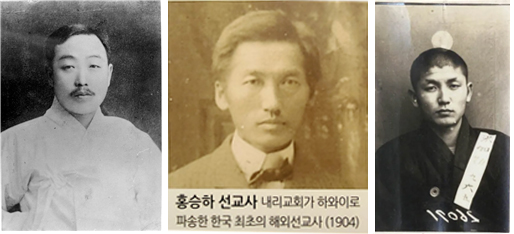
Left) Im Chi-jeong
Center) Hong Seung-ha (photo of his son Hong Hyung-jun could not be found)
Right) Hong Hyung-jun's son Hong Ga-reuk (photo taken on January 10, 1935, at Seodaemun Prison, Namu Wiki)
Hong Seung-ha is a figure with a legendary story, even a theory of a namesake, that he became a missionary by chance when he fought with a Japanese policeman in Seoul, earning him the nickname 'Hong Slap,' and the house he fled into happened to be Appenzeller's house. Although it is now part of Incheon Metropolitan City, he was born into a wealthy family as an only son on Yeongheungdo Island (靈興島), Gyeonggi-do, studied classical Chinese, and then went to Japan to attend a military academy, but no related records have been found. I also haven't found any decisive reason why a classical Chinese scholar, with a traditional mindset, would convert and decide to go to Hawaii with his son, risking his life for difficult missionary work.
The journey of Koreans in mainland America and Hawaii, which unfolded differently
While there was a grand wave of Korean immigration to Hawaii, Ahn Chang-ho and his wife, who went to San Francisco on the US mainland, are defined as the first Korean couple to immigrate. Why is the history of entire families leaving for Hawaii together and even arranging marriages through photo matchmaking there ignored, and only Ahn Chang-ho and his wife are mentioned as the first couple to immigrate to the US? This is where immigration to Hawaii and immigration to the US mainland are treated as completely separate. Ahn Chang-ho organized the Sanghang Chinmokhoe (San Francisco Friendship Association) in September 1903, which later became the Gongnip Hyeophoe (Korean National Association), and in 1905, his actor son Philip was born in California, near Hollywood. There is no difference between Hawaii and the mainland in terms of being armed with the same anti-Japanese spirit, and even though Hawaii's incorporation into the US mainland only happened in 1959, Hawaii was already a US territory (Territory of Hawaii) when Korean immigrants first set foot there. Therefore, it is not easy to understand why Korean organizations on the mainland and in Hawaii are clearly distinguished as having different characteristics.
Perhaps the connections Ahn Chang-ho made after being shocked by the destruction of Pyongyang and coming to Seoul, where he enrolled in Gusehaktang (Salvation Academy) run by Horace Grant Underwood (1859-1916) and converted to Presbyterianism, led him to the US mainland. In 1902, Ahn Chang-ho boarded a ship to the US with his wife, aiming to study there. Seo Jae-pil was the first Korean American citizen of an earlier generation. So, it seems that on ships from Joseon to the US, mainly laborers went to Hawaii, and intellectuals chose the mainland as students. Missionaries dispatched from the US to Joseon might also have been assigned to Hawaii and the mainland separately, depending on their denomination. However, as reviewed above, missionaries from the mainland were dispatched to Hawaii not so much as pure religious figures but for manpower export, or in the context of the time, labor export. The selection of immigrants from the island of Yeongheungdo might have been a kind of test market. It is presumed that the immigration business, which was no different from human trafficking, evolved by mixing with religious businesses testing faith and political organizations in Hawaii and on the mainland.
Leaving behind the scattered Korean diaspora around the world, the victor who survived all odds among the sacred people of the Korean Empire was Syngman Rhee. The titles of Syngman Rhee, Protestantism, and the father of the independence movement all began with this narrative of Hawaiian immigration. To create one HUMINT, the essence of mainland America and Hawaiian immigration can be seen as having been manipulated across time and space, and this history hides the centuries-long history of the failure of Western colonial hegemony.


All information provided by us is free of charge and is for the public good.