品

Corea든 Korea든, 품격이 먼저다
Whether Corea or Korea, dignity comes first.
Whether Corea or Korea, dignity comes first.
Now
지금
751 Diaspora
Heritage
유산
Humanity
인문
Mirengsi
未冷尸
Politics
정치
Media
언론
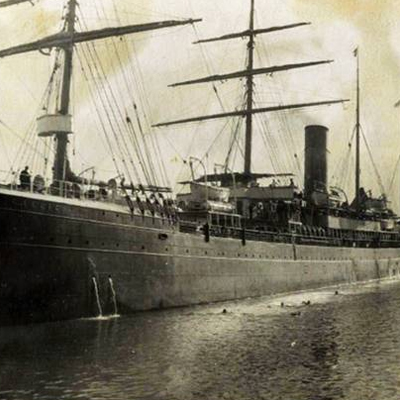
1903년 1월 하와이에 도착한 미국 상선 갤릭호

아픈 손가락
칼럼
jeffrey
45. The Korean American Diaspora Driven by Laborers and Elites

0
2026. 04. 29
What the Incompetence of Immigration Agencies Means
Korean immigration to the United States began during the late Joseon Dynasty, Gukseon, or the Korean Empire (also known as the Old Korean Empire), with emigration to Hawaii. This process was handled by the Ministry of the Royal Household (궁내부), under a department called Suminwon (綏民院), which was responsible for immigration documents. This marks the official beginning of U.S. immigration. However, this department was only a temporary measure, issuing visas from 1902 to 1903 before disappearing. Subsequent immigration records were distorted into colonial exploitation, making the early history of Korean immigration to the U.S. appear as a purely formal narrative. In reality, it is highly unusual to discuss Korean emigration to the U.S. without properly detailing the beginning of Japanese emigration during Korea's modern period of national decline. A history that begins with emigration to distant Hawaii in the modern era carries significant historical ambiguity.
During the period of Western pressure for openness, entry into Joseon by foreigners required a visa (사증) called Hojo (護照), issued by external authorities. Joseon subjects going abroad were issued passports called Jipjo (執照). With the opening of ports by external forces, the Gamri-seo (監理署), an office for judicial and administrative affairs, was established. Prior to this external influence, the traditional Joseon foreign affairs agency was Yejo (禮曹), where diplomacy and rituals were intertwined. Under the guise of "Gaehwa" (enlightenment), the old system became paralyzed, rendering existing institutions dysfunctional. New agencies emerged, and Koreans were packaged as the Korean diaspora under the name "immigration." Therefore, the emigration to Hawaii can be seen as an interpretation of the tragic narrative of the scattering of Dangun's descendants through the lens of the perpetrator's historical perspective.
The recruitment of immigrants to Hawaii was initiated by David Wagner Deshler, an American who admired Japan to the extent of marrying a Japanese woman. In 1902, he established the East-West Development Company in Incheon to gather labor. The diplomatic affairs related to immigration were handled by Horace Newton Allen, the U.S. Minister to Korea, as part of a labor export business. The narrative was twisted, masking the process of a impoverished people of a lost nation being sold as cheap labor abroad, and instead presented as participation in the wave of enlightenment. In this process, Deshler even established Deshler Bank, providing financial support by lending $50 in travel guarantees to immigrants seeking employment on Hawaiian plantations, while Allen also amassed considerable wealth. Lending money for emigration is akin to a prostitute in a brothel borrowing money from her pimp to buy cosmetics and daily necessities. Just as they sold their property and gold to repay national debt through the National Debt Repayment Movement in Daegu, these individuals endured harsh labor and the humiliation of the whip in the Hawaiian sugarcane fields, accumulating dollars to fund the independence movement. The authenticity of the great Koreans vanished, and the misfortune of an era unfolded, where the narrative of a nation that deserved to perish due to its people's fate in the flow of world history was imposed upon the displaced people of a lost nation.
The difference between the distant import of African indigenous people as American slaves in early times and the export of modern Koreans to America lies precisely in the guise of "immigration." When Japanese forces landed during the Russo-Japanese War, Deshler personally went to the headquarters and personally guided the commander to his home, where he was warmly welcomed. His house was located on a mountainside, and to the east of the park on the mountain lived the wealthiest German in Incheon, with whom he reportedly wagered 50,000 yen on the Russo-Japanese War. The German residing in Incheon was Carl Wolter, the president of the Incheon branch of the German firm E. Meyer & Co., known as Sechang Yanghaeng (世昌洋行); or possibly Paul Georg von Möllendorff, a diplomatic advisor; or Hermann Budler, the vice-consul who advocated for the neutrality of Joseon. However, based on available records, their roles involved partitioning Joseon, intervening in business interests, commercializing them, and exporting cultural artifacts and daily necessities abroad. This pattern of treaties, not only with Germany but also with the United States in 1882 (Treaty of Amity and Commerce), Germany and Britain in 1883, and subsequently with Italy, Russia, France, Austria, Turkey, Denmark, and others, followed a similar trajectory: introducing loans, developing mines, and exporting cultural assets and labor. Yet, it remains a question why this ultimately led to Japan's colonization.
However, it cannot be said that the results of early immigration or diaspora played a role in positively influencing the identity and self-esteem of modern Koreans. American immigration, which began with immigration to Hawaii, was lower in status than that of local Japanese, and they continue to experience various forms of social structural racism from the white mainstream society. In particular, Korean Americans politically tend to be treated with a very subservient perspective in American politics. The nominee for the US Ambassador to Korea, designated by the second Trump administration, is no exception. Where should the identity of Koreans, who live as "Comericans" for American politics, having originated as Joseon wanderers, be placed?
The Reality of Immigration to Hawaii
The diaspora of Korean Americans began on December 22, 1902, when 121 people departed from Jemulpo Port. It was then initiated by approximately 7,226 Korean laborers who immigrated to Hawaiian sugar plantations between 1903 and 1905, and 1,033 laborers who immigrated to Mexican sugar plantations in 1905. The reasons and justifications for moving from Hawaii to Mexico are beyond the scope of discussion now.
However, the 97 people out of the initial 121 immigrants who finally set foot on Hawaiian soil were meticulously screened and selected to form a standardized immigrant group, with those found to have illnesses, particularly carriers of infectious diseases, being eliminated during physical examinations. While 121 people departed from Incheon Port after being disqualified for visible illnesses during their application in Korea, another 20 were rejected after a physical examination in Kobe, Japan. Consequently, only the remaining 101 people arrived in Honolulu, Hawaii, on January 13, 1903, aboard the American merchant ship 'Gaelic'.
Numbers in history are both statistical data and tools for manipulating statistics, so they are not important variables. It holds no greater significance than the unfortunate lives many Koreans faced, and the data figures of enslaved status will only increase as more political scapegoats of irresistible force are concealed.
Following the first disembarkation, continuous immigration occurred with 63 people arriving on the ship "Kap-tik" and 72 on the ship "Korea" consecutively. In that year, a total of 1,133 people immigrated on 16 ships. In 1904, 3,434 people arrived on 33 ships, and in 1905, 2,659 people migrated on 16 ships, bringing the total to 7,226 people on 65 ships. Among them, there were 6,048 men, 637 women, and 547 children. Immigration likely continued on ships that were counted and those that were not, from the latter half of 1905 until immigration was prohibited, or even after. The immigrants were composed of individuals from various social strata, including "Christians, students pursuing education, scholars from their hometowns, farmhands from rural areas, laborers working double shifts, and idle vagrants" (from "The Origin of Overseas Compatriots" p24, Yoon Byung-seok, Jipmundang, 2005).
The lives of the first-generation "labor immigrants" who arrived in Hawaii at that time were so miserable that they were comparable to slavery. The living conditions of Koreans in America appear to have been similar for most, with only slight variations depending on the farm. The following is an example from the reminiscences of farm life in Hawaii by Lee Hong-ki (李鴻基, 95 years old in 1971). Before immigrating, Lee Hong-ki served as the village head (이장) in his hometown, embezzled some public and private funds, and then came to Hawaii as a labor immigrant, working at the Kolora farm on the island of Kauai. He later served as a deacon at the Korean Methodist Church in Honolulu. The following is his vivid account of his labor life in Hawaii.
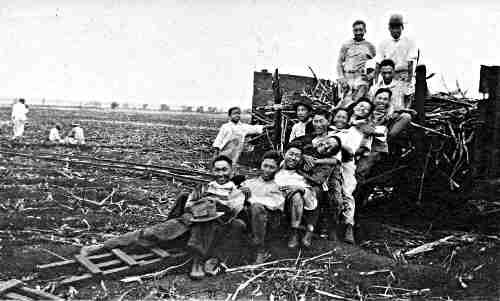
Sugarcane Farm Immigrants
"I got up at 4:30 and ate breakfast. I had to go to work at 5 o'clock and started work at 5:30. I finished work at 4:30 in the afternoon, with a 30-minute lunch break in between. I worked 10 hours for 67 cents a day. (Omitted) The foreman was called 'lunas' in Hawaiian, and my foreman was German. He was very strict with me. (Omitted) He didn't allow us to smoke or straighten our backs once we started working. He treated us like oxen or horses. If anyone disobeyed his orders, they were usually slapped or whipped mercilessly. We couldn't fight back against his abuse for fear of being fired. (Omitted) We wore numbered tickets as proof cards, and our names were not written, but numbers were used instead. I was number 1414. I lived in barracks, which were like soldiers' barracks, and slept on a blanket on the wooden floor and bed. Usually, four single men shared a room. (Omitted) Sometimes I couldn't sleep at all due to the stifling indoor temperature."
Thus, for 10 hours of labor a day, the wages were about 65 cents for men and 50 cents for women and children, with an average monthly income of $16 for 25 days of hard labor (‘The Origin of Overseas Koreans’ p27, Yoon Byung-seok, Jipmundang, 2005). Meanwhile, January 13, the day Koreans first set foot on American soil, is still recorded as a monumental day for Korean Americans. In 2003, the Korean American Centennial Commemorative Association resolved to establish ‘The Korean American Day’ (January 13) on May 9 of that year. Subsequently, the Korean American Foundation, launched based on the commemorative association, petitioned various sectors for the establishment. Following the Los Angeles City Council on October 22, 2003, and the California State Legislature on January 12, 2004, the U.S. House of Representatives and Senate successively passed the establishment bills on December 13 and 16, 2005, officially creating Korean American Day in the United States. Why has California taken the lead in commemorating Korean immigration to Hawaii? It is now time for Koreans scattered across the United States to reconsider the status of Koreans in world history, outside of churches and amidst its many errors.
Early Korean Students in the U.S. Become Elites
Among the international students, after the signing of the Treaty of Amity and Commerce between the United States and Korea, and before the era of labor immigration, by 1902, there were individuals who first sought refuge in mainland America and studied there, or who came to the United States with the sole purpose of studying. These included Dr. Yu Gil-jun (俞吉濬), Park Young-hyo (朴泳孝), Seo Jae-pil (徐載弼), Kim Gyu-sik (金奎植), Yun Chi-ho (尹致昊), and Ahn Chang-ho (安昌浩). Even after the labor immigration era began, there were about 40 individuals such as Lee Kang (李剛), Park Yong-man (朴容萬), and Syngman Rhee (李承晚). However, there were already people who had studied in the United States even before this period.
In 1896, the first Korean international students were admitted to Howard University in Washington D.C. According to newspaper records, Lim Byung-gu (19), Lee Bum-soo (24), Kim Hoon-sik (27), Ahn Joong-sik (23), Yeo Byung-hyun (26), and one unnamed individual stole 400 won from a Korean bank in the spring of 1896 and fled to Vancouver, Canada. Having spent all their money on travel expenses, they were in a desperate situation, and their predicament worsened because they could barely speak English. In their panic, they went to the Japanese consulate and requested that a telegram be sent to Seo Gwang-beom, who was then the Korean envoy to the United States. Seo Gwang-beom was one of the first Koreans to visit the United States as part of a diplomatic mission with Min Young-ik in 1883. After returning to Korea, he was exiled to the United States again for leading a failed reform movement, and in 1896, he returned to Washington and was serving as the Korean envoy. Seo Gwang-beom helped them gain admission to Howard University, and The Washington Post described their arrival as "a somewhat bizarre and romantic story."
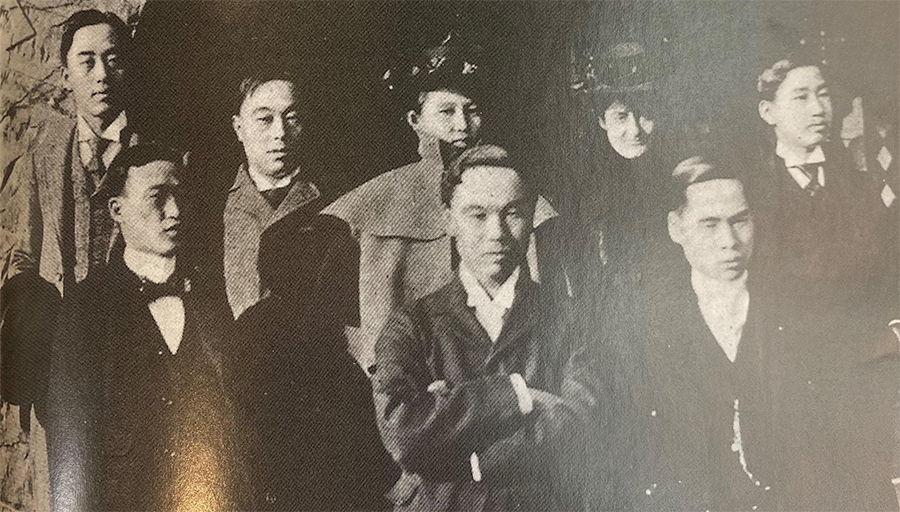
Korean students with Professor Raskin at Howard University in 1896 (Source: Korean American Association of Greater Washington via The Kiplinger Library of the Historical Society of Washington)
The Washington Post reported about them, stating, "All were from yangban families and were studying in Japan, but they suddenly decided to study in the United States." There was no mention of a theft, and it was said that only the minister and the students knew the exact details. The night they arrived at Howard University, their musical talents were first revealed at a campus gathering. When the students asked them to "sing a song," they initially refused, saying, "We cannot sing in English." However, they eventually sang songs like "Suwanee River" and Korean folk songs. The Washington Post article described this day as "a special day when Howard University first experienced Koreans." On July 24, 1896, American ethnomusicologist Alice C. Fletcher invited three of them to her home. She then made the first audio recording of the Korean folk song 'Arirang'. The six recorded cylinder recordings can currently be viewed at the American Folklife Center at the Library of Congress, and they were also exhibited at the Seoul Arirang Festival in 2017.
1896 was a very early period. The official history we know and the hidden history that emerges show a difference of several years in physical time even in the materials related to early American students studying abroad. How much truth was hidden in this interval, or before it, is difficult to imagine. Furthermore, the fact that they stole money from a bank and boarded a ship to Canada is not only surprising but also seems to prove the reality that Joseon was not functioning as a nation, its administration was paralyzed, and it was out of control. In such circumstances, what did they see and what did they think as they boarded a ship to a strange foreign land? I believe that the theft by the yangban and the chaos of that society cannot be concealed and replaced with modern terms like immigration and studying abroad.
Among them, an astonishing 75% graduated from universities there, showing a fierce passion for learning. These students who went to America to learn the enlightened civilization, witnessing their homeland fall into colonial status before their eyes, gave up returning home and became active mainly in the Americas. Especially after the annexation of Korea by Japan in 1910, they engaged in vigorous national movements along with a considerable number of young men who came to America as "newly arrived students" (신도학생) between 1910 and 1918 (from 'The Origin of Overseas Compatriots' pp. 20-21, Yoon Byung-seok, Jipmundang, 2005).
They played a pivotal role in leading the nation's independence movement in the future, and their descendants played a leading role in the industrialization and economic development of their homeland. In this regard, the two pillars of the Korean diaspora in the Americas can be seen as the approximately 100 'laborers' who first set foot in Hawaii and the 'elites' who came to the United States, such as Washington and California, for study or independence movements before and after them. In the next issue, we will examine the driving forces behind the active national movement of the early Korean diaspora in the Americas and their lives centered around Korean organizations.
댓글
( 0 / 500 )
insoon
8
초기 미주 한인들의 삶을 이렇게 구체적으로 들여다보니, ‘이민’이라는 말 뒤에 가려진 고통의 무게가 새삼 크게 다가옵니다. 단순한 해외 진출이 아니라 생존과 존엄을 건 선택이었다는 점이 인상 깊습니다.
( 0 / 500 )
windy
10
‘이민’이라는 단어가 가진 미화된 이미지에 균열을 내는 글입니다. 그 이면에 존재했던 착취와 생존의 문제를 직시하게 만든다는 점에서 의미가 큽니다.
( 0 / 500 )
불꽃
7
미주 한인 이민을 단순한 성공 서사가 아니라 생존과 착취의 역사로 풀어낸 점이 인상 깊습니다. 숫자 뒤에 가려진 개인들의 고통과 선택이 생생하게 드러나며, 우리가 알고 있던 이민사의 인식을 다시 돌아보게 만듭니다.
( 0 / 500 )
origin69
6
디아스포라를 ‘정체성의 문제’로까지 확장한 결론이 특히 의미 있습니다. 오늘날 미주 한인의 위치를 단순한 성공 서사가 아니라 역사적 맥락 속에서 다시 고민해봐야 한다는 점에 공감합니다.
( 0 / 500 )
순정
5
초기 유학생들의 일화는 충격적이면서도 상징적입니다. 혼란한 시대 속에서도 배움을 향한 의지와 이후 독립운동으로 이어지는 흐름이 인상 깊습니다.
( 0 / 500 )
namgang
4
하와이 노동 이민의 실상을 구체적으로 보여주면서 ‘개화’라는 이름 아래 감춰진 구조적 모순을 짚은 점이 의미 있습니다. 역사 서술이 누구의 시선에서 쓰였는지 고민하게 되는 글입니다.
( 0 / 500 )
soo9
4
노동자와 엘리트라는 두 축으로 디아스포라를 해석한 시각이 흥미롭습니다. 특히 독립운동 자금 마련과 지식인의 역할이 동시에 작동했다는 점에서, 미주 한인 사회의 복합성이 잘 드러난 글입니다.
( 0 / 500 )
Oliver7
4
서구 열강과 일본의 이권 개입을 함께 조망한 부분이 흥미롭습니다. 한반도의 운명이 단순한 양자 관계가 아닌 복합적인 국제 구조 속에서 결정되었음을 느끼게 합니다.
( 0 / 500 )
bora91
3
이민을 ‘자발적 선택’이 아닌 시대 구조 속 강요된 이동으로 본 시각이 인상적입니다. 개인의 의지보다 국제 질서와 권력 관계가 삶을 좌우했다는 점을 다시 생각하게 됩니다.
( 0 / 500 )
최혁수
3
사탕수수 농장의 노동 현실을 통해 당시 한인들의 처지를 구체적으로 보여준 점이 강하게 와닿습니다. 기록과 증언이 결합되어 역사적 사실이 더욱 생생하게 전달됩니다.
( 0 / 500 )
Jeong Byeon_72828
3
이민자의 삶이 거의 노예 수준같아 가슴이 아픕니다
( 0 / 500 )
신고내용
신고내용을 선택해주세요
회원비난/비하/욕설글 및 댓글도배성 게시물저작권 침해/불법자료 유출허위사실유포개인정보 유출.사생활 침해무단광고/홍보음란물 및 도박 불법 광고물범죄행위 관련 글불법행위 관련 소개물품 판매 및 사기글악성코드 및 스파이웨어 유포기타 사유 및 운영진 판단


비밀번호를 잊으셨나요?
Sign in with Google
All information provided by us is free of charge and is for the public good.