品

Corea든 Korea든, 품격은 이름보다 먼저다
Whatever the name—Corea or Korea—dignity comes first.
Whatever the name—Corea or Korea—dignity comes first.
Now
지금
751 Diaspora
Heritage
유산
Humanity
인문
Mirengsi
未冷尸
Politics
정치
Media
언론
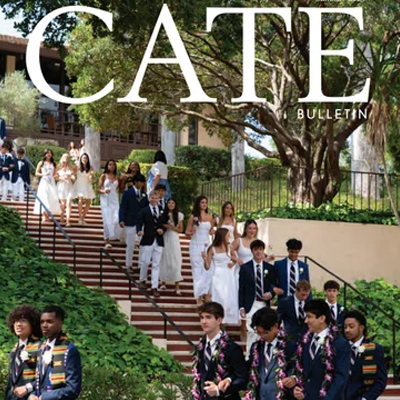
Cate School, 1960 Cate Mesa Road Carpinteria,
CA 93014-5005
Telephone: (805) 684-4127

Education Story
칼럼
blueSky
California School Introduction (1). Cate School

0
2026. 10. 09
Following the introduction to East Coast boarding schools, I'd like to present a series on California's most distinguished schools. The first school I'm introducing is Cate School in Carpinteria, south of Santa Barbara. It frequently ranks #1 in the state on Niche Boarding School rankings, and its acceptance rate is estimated to be in the mid-10s. Unlike the East Coast top ten schools that start their websites with long messages from the head of school and historical timelines, Cate School describes itself through three pillars: a small community on the mesa, service, and inquiry. From the moment you open the page, it's clear this school is different.
Its location is the school's first asset. The campus is situated on a mesa overlooking the Pacific Ocean, about 11 miles from downtown Santa Barbara. Los Angeles is about an hour and a half drive away, so students are neither completely isolated from nor fully immersed in big-city culture. The Channel Islands dot the horizon, and avocado groves and the coast embrace the slopes. Just as East Coast schools utilize Boston, New York, and Philadelphia as cultural resources within a half-day's travel, Cate integrates Santa Barbara's music and art scene and coastal outdoor programs into daily life. Surfing, outing weeks, and trails on the edge of campus are not elective extracurriculars but part of life.
College matriculation is not concentrated at a single institution. For the graduating classes of 2022–2026 combined, the University of Chicago and UC Berkeley are the most popular, each with around 13 students, followed by NYU, Barnard, Bates, Northeastern, and Brown. Stanford and Ivy League schools consistently admit a small number each year. Unlike Lawrenceville, which leans towards Princeton and Penn as an extension of a neighboring university, Cate School exhibits a California-style distribution, sending students to both liberal arts colleges and research universities. The middle 50% SAT scores are 650–750 for Reading & Writing and 660–780 for Math, with a composite ACT score of 34–35.
The school was founded in 1910 in Santa Barbara by Curtis Wolsey Cate, a 25-year-old graduate of Roxbury Latin and Harvard. It was initially named Miramar School and started with twelve boys. Later, it moved to a ranch in Carpinteria, then to Mesa, which was once an ostrich farm, and finally settled in its current location in 1929. In 1950, the founder retired, and the school's name became Cate School. Its motto is Servons, which means “Let us serve.” On May 1, 1980, the board of trustees approved the transition to coeducation, and in the fall of 1981, the first female students arrived at Mesa. In 2023, Alexandra Lockett, a Brown biology graduate, became the first female head of school. Prior to this, she was responsible for student life and school operations at Crystal Springs Uplands School and San Francisco University High School.
Currently, there are approximately 313 students, spanning grades 9–12, with a boarding rate of 79%. About 21% of boarding students are from overseas, coming from 17 countries and 18 states. Korea is on that list. The percentage of students of color is 58%. For the 2026–27 academic year, boarding tuition is $87,340, and day tuition is $70,990. Approximately $5.4 million in financial aid is awarded, benefiting about 25% of students. Aid is need-based, and admission decisions and financial aid assessments are separate.
The school's self-imposed weight is not solely on matriculation lists to prestigious universities. The founder wanted students to learn the “joy of work and the pleasure of accomplishment.” With a size of around 300 students, dormitories and classrooms form a single living area. Unlike the house systems in the East, the dormitories do not become overly hierarchical as identity communities, and many teachers live on campus, meeting students in the evenings and on weekends. A common sentiment among students is that the school feels much smaller than its numbers suggest.
While the nature of the classes does not explicitly name the Harkness Table, the direction is the same. There are five subjects per semester with an art requirement, and 9th graders go through Foundation Art. Many advanced courses are designed as Advanced/Honors rather than AP, and seniors conclude the year with an Inquiry Project. Service trips to Mexicali, Mexico, which have been ongoing since the 1970s, Public Service Night, and international exchanges through Round Square are almost graduation requirements. It is repeatedly emphasized at admission briefings that students spend more time asking questions at the table than teachers spend pushing through material.
The admissions office looks for students who, in addition to being top academic performers, are more inclined to ask questions themselves, take risks, and treat others as equals. Applications are evaluated based on SSAT or ISEE scores, essays, recommendations, and interviews, with regional and background diversity considered last. The exact acceptance rate is not widely disclosed by the school each year, and external estimates fluctuate between 14-17%. Due to the small class size (around 80 students per grade), many excellent applicants are not admitted. Similar to Ivy League admissions in the East, a single number does not determine acceptance or rejection.
The intensity after admission differs from the public school system's nine-subject structure. Being on a semester system, students cover many units each year, and academic and college counseling are integrated within the dormitory. Computer science, art, and outdoor activities are separate tracks, and service remains a recurring field experience, like Mexicali, rather than just fulfilling hours. In 11th-12th grade, leadership roles such as prefect and teaching assistant become available.
The alumni association has been leaving its mark on Mesa's buildings since shortly after 1910. Similar to East Coast schools that consider students alumni after attending for two semesters or more, Cate also includes students with shorter attendance periods in its network. The fact that Vanessa Cruz Santana, the Director of Financial Aid, is a 2006 graduate means that the structure of alumni returning to manage the very doors they once entered with aid is actually functioning. Inquiries about Cate can be directed to the Admissions Office at 805-684-4127.
댓글
( 0 / 500 )
alpha_k
3
학비가 연간 8만 7천 달러를 넘는다는 사실은 부담스럽지만, 학자금 지원 제도가 있고 입학 심사와 보조 심사를 분리한다는 점은 눈여겨볼 만합니다. 성적만이 아니라 학생의 잠재력과 인성을 함께 본다는 교육 철학이 실제 선발과 지원 과정에서도 지켜지기를 바랍니다.
( 0 / 500 )
김은우
2
태평양이 내려다보이는 아름다운 캠퍼스도 매력적이지만, 제가 더 관심 있게 본 것은 교사와 학생이 교실 밖에서도 함께 생활한다는 점입니다. 교육은 수업 시간에만 이루어지는 것이 아니지요. 학생이 질문하고 실패하며 다시 도전할 수 있는 환경이 좋은 학교의 진정한 자산이라고 생각합니다
( 0 / 500 )
아리아리
2
해외 보딩스쿨을 알아보는 학부모에게 상당히 유익한 소개입니다. 특히 소규모 학교의 생활 방식과 입학 전형, 대학 진학 분포, 학비 지원까지 구체적으로 짚어 주셔서 실질적인 판단에 도움이 됩니다. 앞으로 다른 캘리포니아 학교들도 비교해 보면 학교마다 추구하는 교육 철학과 아이에게 맞는 환경을 찾는 데 큰 도움이 되겠습니다.
( 0 / 500 )
김형석
1
케이트 스쿨을 보니 명문대 합격자 숫자보다 어떤 환경에서 아이를 성장시키느냐가 더 중요하다는 생각이 듭니다. 작은 공동체 안에서 스스로 질문하고, 다른 사람과 협력하며, 봉사를 생활로 익히는 교육이야말로 대학 졸업 이후까지 이어지는 진짜 경쟁력 아닐까요?
( 0 / 500 )
신고내용
신고내용을 선택해주세요
회원비난/비하/욕설글 및 댓글도배성 게시물저작권 침해/불법자료 유출허위사실유포개인정보 유출.사생활 침해무단광고/홍보음란물 및 도박 불법 광고물범죄행위 관련 글불법행위 관련 소개물품 판매 및 사기글악성코드 및 스파이웨어 유포기타 사유 및 운영진 판단


비밀번호를 잊으셨나요?
Sign in with Google
All information provided by us is free of charge and is for the public good.