品

Corea든 Korea든, 품격은 이름보다 먼저다
Whatever the name—Corea or Korea—dignity comes first.
Whatever the name—Corea or Korea—dignity comes first.
Now
지금
751 Diaspora
Heritage
유산
Humanity
인문
Mirengsi
未冷尸
Politics
정치
Media
언론
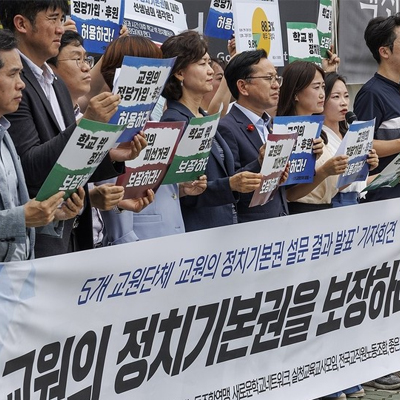
교사도 국민이다. 선거권을 갖고, 정책에 영향을 받으며, 세금을 내고 사회적 의무를 부담한다.

Education Story
칼럼
hanna_Kim
Citizens outside the classroom, teachers inside the classroom

0
2026. 08. 19
- Teachers should be guaranteed the same fundamental political rights as ordinary citizens, arguing that these rights should not be excessively restricted due to their profession.
- While strict political neutrality must be maintained within the classroom, clear boundaries are needed to allow teachers' individual political expression and participation outside school grounds.
- Guaranteeing teachers' political freedom is urgent for their field experience to be reflected in policy and for the consistency of democratic education, which is a goal of a mature democratic society.
- It is emphasized that political circles should focus on establishing sophisticated laws that both guarantee teachers' civic rights and uphold educational neutrality.
Teachers' basic political rights, now they must be guaranteed.
Teachers are ordinary citizens who vote in presidential, parliamentary, and local elections, pay taxes, and are affected by national policies. However, the moment they leave school, a significant portion of their political freedom is restricted due to their profession as teachers. While they are allowed to hold opinions, public expression, party membership, and political activities are strictly prohibited. As citizens, they have the right to participate in politics, but as professionals, they are in a dual position where they must give up a significant portion of their fundamental rights. Now, we must ask again whether this situation should be accepted as a matter of course.
Political neutrality and fundamental rights are not the same issue.
Strict political neutrality is required in the classroom. However, there is no reason for a teacher outside the school gates to be a politically neutral person. If teachers are citizens, they should be guaranteed the right to hold and express political views and participate in the political process. This is not a privilege, but a demand not to excessively restrict fundamental rights as citizens due to their profession.
교원 정치기본권 확대는 오래전부터 교원단체와 시민사회가 요구해 온 과제였다. 이재명 대통령도 대선 과정에서 교원·공무원 정치기본권 보장을 공약했다. 그러나 정부 출범 후 입법 속도는 기대에 훨씬 못 미쳤고, 2025년에는 논의가 정체되면서 교원단체의 국회 앞 농성으로까지 이어졌다. ‘사회적 합의가 필요하다’라는 말은 반복되지만, 기본권은 모두가 동의할 때만 허용되는 권리가 아니다. 다수의 편의와 기존 관행 때문에 제한돼 온 권리를 어디까지 회복할 것인지가 민주주의의 수준을 가른다.
In 2026, discussions began to move again.
In 2026, the Democratic Party launched a task force to guarantee the political freedom of teachers and public officials and began discussions in the education subcommittee. In April, three teacher organizations, including the Korean Teachers and Education Workers' Union (KTU), the Korean Federation of Teachers' Unions (KFTU), and the Korean Federation of Teachers' Associations (KFTA), held a working meeting with the Democratic Party and began drafting a joint bill. The focus of the debate is shifting from "will it be guaranteed?" to "to what extent will it be guaranteed?".
With the results of the June local elections, a new era of progressive superintendents has begun, with a large number of progressive superintendents elected in Seoul, Gyeonggi, Incheon, Busan, Ulsan, and Jeju. According to an analysis by the Korean Teachers and Education Workers' Union, 12 out of 16 provincial and metropolitan superintendents nationwide supported guaranteeing teachers' basic political rights through amendments to the Political Parties Act, the Public Official Election Act, and the National Public Officials Act. Although superintendents cannot directly amend laws, the fact that the heads of educational administration are collectively demanding institutional improvements can put significant pressure on the National Assembly and the government. However, the essence of this issue is not about progressive or conservative, or the interests of a specific organization. It is a question of whether teachers should be viewed as citizens, or as individuals whose civic rights should be restricted due to their profession.
Rights cannot be restricted simply because of influence.
Entrepreneurs, lawyers, doctors, professors, and other professionals express their political views, join political parties, and participate in politics. The only reason a stricter standard is applied to teachers is "because they can influence students." However, if fundamental rights are restricted merely because of the existence of influence, there will be few professionals left who can fully enjoy political freedom. What is important is the space and manner in which influence is exercised. It is natural that acts of forcing students to support a specific candidate or party during class, or attempting to influence students' political choices, should be strictly prohibited. However, there is no need to prevent a teacher from discussing politics with friends after work, criticizing policies on personal social media, or attending a political party debate. A teacher's political neutrality is a principle for the classroom, not a principle to control a teacher's thoughts and personality.
Prohibiting party membership does not eliminate a teacher's political leanings, nor does restricting SNS expression prevent them from making political judgments. What is important in a democracy is not to eliminate citizens' political thoughts, but to allow them to be expressed and debated within legitimate and open procedures.
Field experience should be reflected in politics.
Teachers encounter issues directly related to national policies, such as the education gap, college entrance examination system, childcare, school violence, teachers' rights and students' human rights, regional decline and low birth rates, and youth problems, every day in the field. However, the political participation of teachers in the field has been restricted in the policy-making process. They are the subjects of policies, but they have not been recognized as full citizens in the process of creating policies. Policies become closer to reality when citizens with field experience can participate in politics.
It is ironic that teachers, who teach students about democracy and citizens' rights, do not fully enjoy their political rights as citizens. If we teach students to express their thoughts freely and respect different opinions, but then demand that teachers not express their political thoughts, education itself falls into contradiction. Democracy is not a concept written in textbooks but must be realized in the actual lives of citizens.
Boundaries must be clear
The more political fundamental rights are expanded, the clearer the standards of neutrality within schools must become. We must distinguish between personal SNS and official school accounts, between joining a political party and political propaganda directed at students, and clearly differentiate between a teacher's participation in political debates and actions that encourage students to support a specific candidate.
Because the boundaries have been excessively ambiguous until now, there was a risk that the abstract concept of 'political neutrality' would be used as an all-purpose yardstick for disciplinary action. Legally, even if there is freedom of expression, in reality, it becomes a right that is difficult to exercise. Along with legal revisions, specific guidelines at the school and education office level are needed. Consistent and objective standards must be established for what constitutes a violation of neutrality and what constitutes individual expression.
Ultimately, the freedom of citizens and the political neutrality of education are not incompatible values. Strict neutrality should be demanded within schools, and the freedom of citizens should be guaranteed to the maximum extent outside of schools. The key is not to control teachers' thoughts, but to hold them accountable for their actions. The political inclinations in one's mind are not something the state should manage. Professional responsibility should only be assigned when those inclinations are used to force students into specific political choices.
We must trust teachers
We demand medical ethics from doctors without depriving them of political freedom, and we recognize both professional ethics and civil liberties for lawyers and professors. The same principle should apply to teachers. Teachers know the professional ethics that they should not impose their political views on students in the classroom, and they must be capable of taking responsibility for that. Educational neutrality should not be maintained by treating teachers as politically incompetent citizens. A mature society should move towards trusting teachers' professionalism and sense of responsibility and guaranteeing their civil rights.
The September regular session of the National Assembly is a test.
The September regular session of the National Assembly will be an important test. The National Assembly must choose whether to once again postpone issues amidst political calculations and disputes, or to properly address long-delayed fundamental rights issues. Hastily passing bills should not be the only goal. It is important to clearly define the boundaries inside and outside the classroom and to create sophisticated laws that can protect both teachers' political freedom and students' right to learn. What the political establishment should do is not to eliminate teachers' political thoughts. That is neither possible nor desirable. It is to create a rational system that allows teachers to freely participate in politics as citizens while strictly upholding students' rights and educational neutrality in the classroom.
Teachers are also citizens. They have the right to vote, are affected by policies, pay taxes, and bear social obligations. Therefore, their right to hold and express political views and participate in the political process should, in principle, be recognized. This is not a special privilege, but rather the normalization of civil rights that have long been excessively restricted due to their profession. Teachers should be recognized as teachers within the school and as citizens outside the school. While the strictest neutrality is required in the classroom, after leaving the school gates, they should be able to enjoy political freedom just like ordinary citizens. That is the way to protect teachers' rights while also protecting students' rights.
It's time to move beyond the outdated notion of making teachers politically sterile. What's important in a democracy is not uniformity of opinion, but an environment where different views can freely exist and be debated. Teachers are also members of that civil society. A society where teachers fulfill their responsibilities in the classroom, and outside the classroom, can freely participate in politics as citizens. That is the form of teachers' basic political rights we should aim for, and it is a right that teachers, like all citizens, should enjoy in a democratic nation.
댓글
( 0 / 500 )
kimyoon
9
교사도 시민이고 국민입니다. 교실 안에서 정치적 중립을 지켜야 한다는 원칙과 교문 밖에서 시민으로서 정치적 자유를 누리는 것은 전혀 다른 문제입니다. 이제는 이 둘을 구분할 때입니다.
( 0 / 500 )
auto70
8
이제는 교사를 정치적으로 무균 상태의 존재로 취급하는 낡은 사고에서 벗어나야 합니다. 교실에서는 철저히 중립을 지키고 교문 밖에서는 자유로운 시민으로 살아갈 수 있도록 법과 제도를 정비해야 합니다.
( 0 / 500 )
88Lee
5
학생에게 특정 정당이나 후보를 지지하도록 강요하는 행위는 당연히 엄격히 금지해야 합니다. 그러나 퇴근 후 개인의 정치적 견해까지 통제하는 것은 과도합니다. 권리와 책임을 함께 설계해야 합니다.
( 0 / 500 )
曲筆
6
교사도 국민이라는 너무나 당연한 사실에서 출발한 글이라 공감합니다. 교실 안에서 정치적 중립을 지키는 것과 교실 밖에서 시민으로서 정치적 자유를 누리는 것은 분명히 구분해야 합니다. 직업을 이유로 시민의 기본권까지 제한하는 관행은 이제 재검토할 때가 됐습니다.
( 0 / 500 )
강남77
4
정치기본권 확대에 찬성하지만 가장 중요한 것은 학생 보호 장치라고 봅니다. 교사의 개인적 정치 활동은 최대한 보장하되, 수업이나 상담 과정에서 학생에게 특정 정당이나 후보를 지지하도록 유도하는 행위는 엄격하게 금지해야 합니다. 권리 확대와 책임 강화가 함께 가야 합니다.
( 0 / 500 )
낮은구름
삭제된 내용입니다
( 0 / 500 )
백남희
5
교사도 시민이고 국민입니다. 교실 안에서 정치적 중립을 지켜야 한다는 원칙과 교문 밖에서 시민으로서 정치적 자유를 누리는 것은 전혀 다른 문제입니다. 이제는 이 둘을 구분할 때입니다.
( 0 / 500 )
64Marco
4
민주주의를 가르치는 교사에게 정작 민주주의의 핵심인 표현과 정치 참여의 자유를 제한하는 것은 아이러니합니다. 교사의 생각을 없애려 하기보다 공정하게 행동할 책임을 강화하는 것이 바람직합니다.
( 0 / 500 )
AI720
4
학생들에게 민주주의와 다양성을 가르치는 교사가 정작 자신의 정치적 의사를 자유롭게 표현하지 못한다는 것은 분명한 역설입니다. 중요한 것은 교사를 정치적으로 ‘무색무취’하게 만드는 것이 아니라, 서로 다른 정치적 견해를 가지고도 공정하게 학생을 대할 수 있는 전문성과 윤리를 갖추게 하는 것입니다
( 0 / 500 )
김태일
4
다만 ‘교문 밖에서는 일반 시민과 똑같이’라는 원칙을 적용할 때 현실적인 경계도 세밀하게 따져야 합니다. 교사는 학생과 학부모에게 상당한 영향력을 가진 직업인인 만큼 SNS나 지역사회 활동이 학교와 연결될 가능성도 있습니다. 정치적 자유를 보장하되 학생과 교육의 중립성을 침해하지 않는 명확한 기준이 반드시 필요합니다.
( 0 / 500 )
소망
3
교사의 정치기본권은 특정 진영의 전유물이 되어서는 안 됩니다. 진보 교사든 보수 교사든 동일한 기준으로 시민적 권리를 보장받아야 합니다. 정권과 정치 성향을 넘어 원칙의 문제로 접근해야 합니다.
( 0 / 500 )
Jeong Byeon_72828
2
이제는 성숙한 시민이 되어가는 인상입니다. 주입식 교육이 아닌 자유토론과 한국인의 정체성과 고유한 역사 학습을 올바르게 습득하는 교육 환경을 그려봅니다.
( 0 / 500 )
radichelove
0
우리나라처럼 교사출신 국회의원이 없는 나라도 찾아보기 힘듭니다. 그만큼 교사라는 직업이 정치적 자유를 통제 받고 있는 것이 사실입니다. 수 많은 개혁과제 중에서 교육만큼 미래를 위한 중요 과제는 없을 듯 합니다. 그런 차원에서 교사의 현장 경험과 지식이 반드시 정치와 입법에 충분히 반영되어야 합니다.
( 0 / 500 )
신고내용
신고내용을 선택해주세요
회원비난/비하/욕설글 및 댓글도배성 게시물저작권 침해/불법자료 유출허위사실유포개인정보 유출.사생활 침해무단광고/홍보음란물 및 도박 불법 광고물범죄행위 관련 글불법행위 관련 소개물품 판매 및 사기글악성코드 및 스파이웨어 유포기타 사유 및 운영진 판단


비밀번호를 잊으셨나요?
Sign in with Google
All information provided by us is free of charge and is for the public good.