品

Corea든 Korea든, 품격이 먼저다
Whether Corea or Korea, dignity comes first.
Whether Corea or Korea, dignity comes first.
Now
지금
751 Diaspora
Heritage
유산
Humanity
인문
Mirengsi
未冷尸
Politics
정치
Media
언론
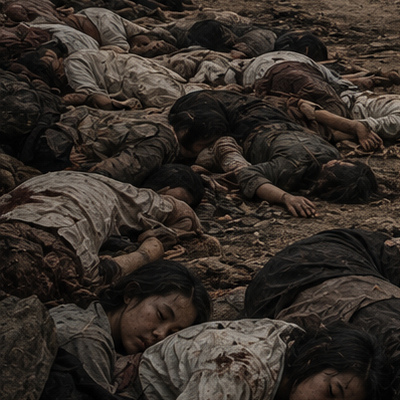
황해도 신천군에서 1950년 가을 전쟁이라는 극단적 상황 속에서 지역 공동체 내부의 갈등이 무장 세력과 결합하여 폭력으로 폭발한 학살 사건

코리안 제노사이드
칼럼
狂奴者
The Sinchon Massacre and the Internal Enemy Created by War

0
2026. 10. 25
- The massacre in Sinchon County, Hwanghae Province, during the Korean War was not merely the act of an external army, but a tragedy where ideological, class, and religious conflicts accumulated within the local community since liberation were amplified into violence during the war and the period of changing occupying powers.
- The perpetrators and victims of the incident were intricately intertwined, with countless civilians sacrificed without legal process as local residents retaliated and purged each other, demonstrating how war destroys trust within a community.
- State and military powers claimed to restore order, but in reality, they classified and controlled residents based on political animosity and failed to protect civilians, leading to the horrific outcome where collective affiliation took precedence over individual survival.
- North Korea exploited this incident as a tool for anti-American propaganda, simplifying its complexity, while South Korea neglected discussions about civilian massacres in North Korean areas within the Cold War system, revealing how history can be politically reconstructed.
- The Sinchon County massacre is an important historical lesson that helps understand how war transforms ideology and conflict into extreme violence, sacrificing ordinary residents, and warns that civilian massacres can structurally occur when specific groups are designated as enemies and legal procedures are ignored.
The Korean War was a conflict that cannot be explained solely as a military clash between the North and the South. Apart from the battles fought on the front lines, there were repeated instances in various regions where political and social conflicts among residents led to violence. The Sinchon Massacre, which occurred in Sinchon County, Hwanghae Province, in the fall of 1950, is one of the representative examples demonstrating how large-scale such internal violence could become.
After the South Korean and UN forces advanced north and occupied the Hwanghae Province area in October 1950, a large number of civilian casualties occurred in Sinchon County. The scale of the casualties is known to be approximately 35,000, but the exact number remains a subject of debate. North Korea has characterized this incident as a massacre by the US military, but various studies both domestically and internationally focus on its nature as a large-scale internal massacre resulting from a complex interplay of the occupying forces, local right-wing factions, remaining left-wing factions, religious groups, and class conflicts at the time.
The Sinchon incident is difficult to view as a unilateral massacre by an external army. It holds significant historical meaning as an example where internal conflicts within a local community, in the extreme situation of war, combined with armed groups and erupted into violence.
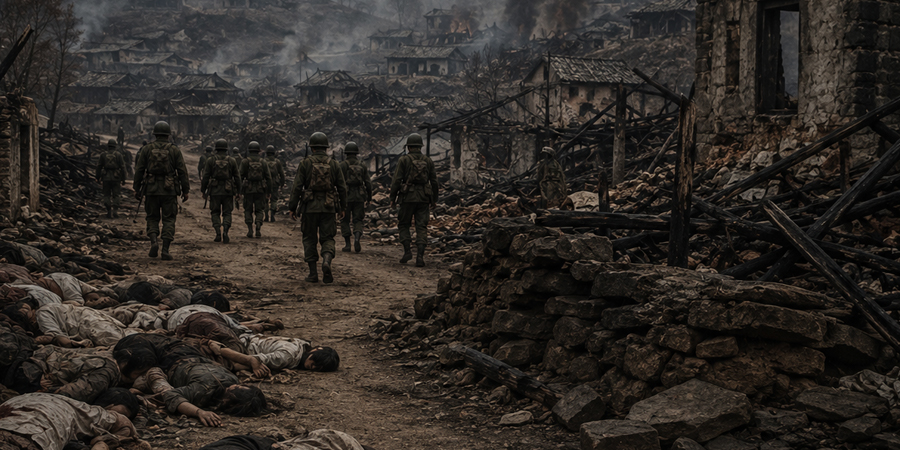
War amplifies existing conflicts
After liberation, rapid land reform and political reorganization took place in North Korea. In this process, the landlord class and religious groups, especially some Christian communities, felt strong anxiety and opposition to the new system, while left-wing forces emphasized the legitimacy of revolutionary change. These conflicts had accumulated in local society even before the war.
With the outbreak of the Korean War, these conflicts escalated beyond political confrontation to a matter of survival. Those who had cooperated with certain factions during the North Korean occupation could become targets of retaliation after the South Korean and UN forces advanced north, and conversely, those who had previously been oppressed had the opportunity to punish their opponents under the new power. The violence that occurred in Sinchon County expanded precisely within this cycle of power change and retaliation. The war did not create new enemies but rather brought existing conflicts to the surface in an armed form.
Violence committed within the community
A characteristic of the Sinchon Massacre is that the boundaries between perpetrators and victims are not simple. Some researchers analyze this incident as a case of mutual retaliation and collective purging within the local community. While the military control and political environment of the occupying forces enabled the violence, local residents, political organizations, and religious communities were involved in various ways in the actual massacre process.
Who accused whom, what criteria were used to distinguish collaborators, and how existing class and religious conflicts combined with political hostility are key issues in understanding the Sinchon incident.
During wartime, legal procedures are virtually non-existent. Political suspicion immediately became grounds for punishment, and cooperation was often determined by rumors and testimonies rather than clear evidence. As a result, many civilians were executed without trial or became targets of retaliation. This incident shows how war destroys trust within a community. Violence was not only introduced from outside but also appeared in a more brutal form by combining with the internal conflict structure of the local community.
Who did the state and occupying power protect?
The Sinchon incident shows how state power and military power operate under a wartime occupation system. Military control was carried out under the pretext of restoring order, but in reality, political purges and retaliation often proceeded together. Especially in situations where power rapidly changed, there was a strong incentive for any force to eliminate or exclude opposing groups.
The problem is that civilian protection was almost non-existent during this process. Residents could become targets of suspicion simply for residing in a specific area or being connected to certain people, regardless of their political leanings. War prioritized collective affiliation over individual actions, and as a result, the entire local community repeatedly became targets of violence. The Sinchon Massacre is an example of what happens when state and military power classify and control citizens according to the logic of political hostility rather than protecting them.
History between Memory and Propaganda
The Sinchon incident also demonstrates how historical facts and political memory combine. North Korea has long used this incident as a prime example symbolizing the brutality of the US military. The Sinchon Museum became a key space for anti-American education, and the incident was reconstructed as history to strengthen the legitimacy of the regime.
However, political propaganda tends to simplify the complexity of the incident. Conversely, in South Korea, massacres of civilians that occurred in North Korean territory have long not been the subject of sufficient research and social discussion. This is because, within the Cold War system, the sacrifices of North Korean residents were relatively overlooked. As such, the Sinchon massacre is an example that shows not only the massacre itself but also how the state selects and reconstructs specific memories.
Why we need to re-examine the Sinchon massacre
The Sinchon massacre shows that understanding the Korean War simply as a war between North and South is insufficient. This incident is a historical example of how large-scale civilian casualties can occur when ideological confrontation, class conflict, religious conflict, grudges within local communities, and an occupation system combine.
Furthermore, this incident makes us reconsider who suffers the most in war. The phenomenon of more casualties among civilians than in clashes between armed forces was repeated throughout the Korean War. Sinchon is also on that continuum.
The reason we should remember the Sinchon massacre is not to repeat the propaganda or blame of one side. It is to understand how war transforms internal social conflicts into extreme violence. The moment a specific group is defined as an absolute enemy, and political suspicion takes precedence over legal procedures, civilian massacres become not an exceptional event but a structurally possible outcome.
Most of the victims in Sinchon County were ordinary residents who could not influence the direction of the war. Their deaths show that war was not just a conflict between nations, but also a process that destroyed communities from within. The reason we must remember is not to repeat the past, but to understand how war and ideology dismantle individuals and communities. In that respect, the Sinchon County massacre remains a significant historical case even today.
댓글
( 0 / 500 )
東方不敗
6
신천군 학살을 단순히 미군의 책임이나 북한의 선전이라는 틀에 가두지 않고, 해방 이후의 이념 갈등과 계급적 대립, 전쟁 중의 보복이 어떻게 민간인 학살로 이어졌는지 살펴본 점이 의미 있습니다. 희생자들의 고통을 이념보다 앞세우는 역사 인식이 필요합니다.
( 0 / 500 )
파도
6
전쟁은 전선에서만 벌어지는 것이 아닙니다. 오랫동안 쌓인 이웃 간의 원한과 정치적 적대가 전쟁을 만나면 얼마나 참혹한 결과를 낳는지 보여주는 글입니다. 신천군 학살을 제대로 이해하려면 책임을 단순화하지 말고 구체적인 사실부터 밝혀야 합니다.
( 0 / 500 )
blue
4
북한의 반미 선전이 사건의 복합성을 가려온 측면이 있다면, 남한 역시 북한 주민들의 희생을 외면해 온 것은 아닌지 돌아봐야 합니다. 어떤 이념을 가졌든 억울하게 희생된 민간인의 생명은 똑같이 존중받아야 합니다. 그것이 역사적 진실을 대하는 출발점입니다.
( 0 / 500 )
타미르
4
가장 경계해야 할 것은 상대를 절대적인 적으로 규정하는 순간입니다. 의심만으로 사람을 처벌하고 가족과 이웃까지 적으로 몰아가는 사회에서는 누구도 안전할 수 없습니다. 신천군 학살은 과거의 비극이면서 동시에 오늘날 우리 사회에도 던지는 경고입니다.
( 0 / 500 )
弘益人間
3
역사적 비극을 특정 세력의 책임으로만 설명하면 진실은 사라지고 선전만 남습니다. 그렇다고 책임을 모두에게 나누어 모호하게 만들어서도 안 됩니다. 누가 명령하고 실행했으며 누가 방조했는지 구체적인 사료와 증언으로 밝혀야 합니다. 희생자를 위한 진정한 추모는 정확한 역사 규명에서 시작됩니다.
( 0 / 500 )
Rose
2
신천군 학살을 바라보는 데 필요한 것은 이념적 확신이 아니라 역사적 겸손입니다. 내가 믿고 싶은 이야기와 실제로 일어난 일은 다를 수 있습니다. 불편한 사실까지 마주할 용기가 있어야 역사는 선전의 도구에서 벗어나고, 희생자들의 죽음도 비로소 온전히 기억될 수 있습니다.
( 0 / 500 )
오리온
0
해방 이후의 토지개혁과 이념 갈등, 전쟁 중의 권력 교체와 보복이 한데 얽히면서 평범한 주민들이 희생자가 되었다는 점이 가슴 아픕니다. 역사를 남과 북의 대결 구도로만 읽으면 그 안에서 죽어간 사람들의 삶은 또다시 지워집니다. 이제는 민간인의 관점에서 한국전쟁을 다시 살펴봐야 합니다.
( 0 / 500 )
신고내용
신고내용을 선택해주세요
회원비난/비하/욕설글 및 댓글도배성 게시물저작권 침해/불법자료 유출허위사실유포개인정보 유출.사생활 침해무단광고/홍보음란물 및 도박 불법 광고물범죄행위 관련 글불법행위 관련 소개물품 판매 및 사기글악성코드 및 스파이웨어 유포기타 사유 및 운영진 판단


비밀번호를 잊으셨나요?
Sign in with Google
All information provided by us is free of charge and is for the public good.