品

Corea든 Korea든, 품격이 먼저다
Whether Corea or Korea, dignity comes first.
Whether Corea or Korea, dignity comes first.
Now
지금
751 Diaspora
Heritage
유산
Humanity
인문
Mirengsi
未冷尸
Politics
정치
Media
언론
한국갤럽 집계에서 민주당 지지율은 8월 40%대에서 9월·10월을 거치며 36%대로 뒷걸음질 쳤고, 이재명 대통령 직무 긍정률도 비슷한 흐름을 보였다.

단상斷想
칼럼
Mizuno
The Democratic Party, unable to separate or reconcile

0
2026. 11. 23
- The Democratic Party apologized after raising suspicions of a 'anti-Lee, divisive, Shincheonji alliance,' but internal power struggles intensified, turning into a self-destructive war of attrition.
- The party leader's unverified accusations damaged the party's fundamental values, provided ammunition for the opposition, and accelerated the decline in approval ratings.
- Factional conflicts have devolved into struggles over nominations and shares, even in the Women's Committee election and discussions of merging with the Rebuilding Korea Party, shaking the foundation of the pan-progressive alliance.
- The Democratic Party's self-consumption, focused more on internal power restructuring than on winning the general election, is eroding the trust of the entire progressive camp and deepening the crisis.
- Currently, the Democratic Party is unable to find institutional and political compromises to stop the conflict and focus on policy and public welfare, leaving its future uncertain.
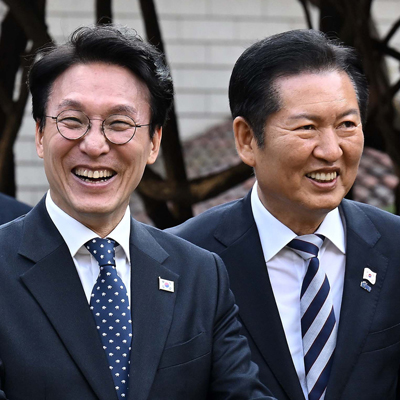
The Democratic Party's self-inflicted damage, unable to separate or reconcile, is a cost that the entire democratic camp must bear. The 'anti-Lee, divisive, Shincheonji three-way secret alliance' theory, brought up by Chairman Kim Min-seok on the podium of the August national convention, went beyond an election strategy and became a gamble that simultaneously shook the party's identity and the foundation of progressive politics. That remark, widely interpreted as targeting former Chairman Jeong Cheong-rae's faction, continued to smolder through the party's YouTube channel and internal statements even after the election. However, the moment Chairman Kim admitted and apologized at a closed-door general meeting of lawmakers on November 3rd, stating, 'There is no verified three-way secret alliance,' the cost of that gamble spread throughout the entire party.
Among his close associates, there was an opinion to request an investigation based on the data collected by the task force. However, there was a significant burden that disclosing the data would hand over the entire party membership list to investigative agencies, potentially leading the party to an uncontrollable catastrophe. It was a situation where a sword was drawn, but wielding it would first cut one's own flesh. The basic value of progressives, wary of religious intervention in politics, is clear. However, using unverified suspicions as a weapon in a power struggle within the party, and as a result, the ruling party exposing its own weaknesses, is far from that value. Chairman Kim's apology was a minimum responsibility, but the fact that it did not become a period but rather a signal for a counterattack reveals the fragility of the party's internal power structure.
Former representative Jeong Cheong-rae immediately took to social media that day, labeling Chairman Kim's allegations as a 'successful political maneuver' and demanding a public apology and accountability. The following day, the Supreme Council meeting effectively turned into a forum for condemnation, with Supreme Council members Han Min-soo, Choi Min-hee, and Lee Seong-yoon successively sharpening their criticism. Supreme Council member Lee Seong-yoon even cited Article 52 of the Political Parties Act, mentioning punishment for spreading false information during the primary election process, and some even discussed a provisional injunction to suspend the chairman's duties. Chairman Kim sidestepped the issue by stating he would focus on unity and public welfare, but this was effectively an evasion without further explanation. While the counterattack from the pro-Jeong faction is legitimate, it's another problem when that counterattack deepens the party's wounds and escalates into a war of beliefs among supporters. The trap where supporters perceive compromise by politicians as betrayal is an old ailment of progressive politics.
The external counterattack also accelerated. The People Power Party, which had already suffered from the Shincheonji issue, pushed forward with floor leader Jeong Jeom-sik, stating, "If it's false, Chairman Kim should be investigated; if it's true, the Democratic Party should be investigated." Regardless of the conclusion, it's a losing scenario for the Democratic Party. The situation where the leader of the ruling party raised unverified allegations, and those allegations became a weapon for the opposition party, is clear self-harm. At a time when the progressive camp should be uniting against the conservative forces' offensive, revealing internal divisions is a failure both strategically and morally.
The election for the national women's committee chair, held on the same day, became another front in this conflict. This is because the position of women's committee chair automatically includes eligibility to be a member of the 2028 general election nomination management committee. Ostensibly a sectoral organization election, it was in reality a proxy war between the Myeong and Cheong factions over nomination rights. Representative Kim tried to avoid a direct clash by having Representative Jeon Jin-sook withdraw her candidacy, but the field was split again with the candidacy of first-term pro-Myeong faction Representative Kim Nam-hee. Representative Kim Nam-hee's victory over Representative Moon Jeong-bok in the primary was an upset, defeating a two-term incumbent, but the process was marred by overheating and warnings. It is understandable that the pro-Cheong faction, which experienced 'bimyeonghoengsa' (a term referring to the elimination of non-Lee Jae-myung faction members) in the 2024 general election, reacted with fear that the blade could turn on them. However, if that fear leads to nominations becoming factional spoils, the party will once again lose the trust of voters. Nominations in a democratic party should be based on policy competence and an understanding of people's livelihoods, rather than factional loyalty.
The decline in approval ratings shows the cost of this internal conflict in numbers. According to Korea Gallup's tally, the Democratic Party's approval rating fell from the 40% range in August to the 36% range through September and October, and President Lee Jae-myung's positive job performance rating showed a similar trend. This is the exact opposite of Representative Kim's promise to raise the party's approval rating by 10 percentage points within 100 days of taking office. Former Representative Jeong Cheong-rae's prediction of a '100-day judgment' on YouTube at the end of October was based on these numbers, but that prediction itself also exacerbated the party's crisis. While acknowledging that a significant portion of the decline in approval ratings is due to policy performance in areas such as livelihoods and real estate, we must not ignore the fact that internal conflicts accelerated that decline.
Discussions about merging with the Joguk Innovation Party are also being distorted in the same context. When former leader Jeong set a deadline for the merger to be completed by January of next year at the latest, the pro-Lee Jae-myung faction opposed it, defining it as a means to expand their share within the party. Representative Lee Hae-sik's point about the failure of the forced merger attempt just before the June 3 local elections has a valid aspect. However, with the Innovation Party first demanding trust restoration and an official apology, and signaling that they might compete in the 2028 general election, using the merger as a card in factional struggles is an act that undermines the foundation of the pan-progressive alliance. The strength of the progressive camp lies not in the dominance of a single party, but in diverse forces uniting around policies and values.
The back-and-forth between YouTube and commentators is solidifying this internal conflict into a war of beliefs among supporters. The disputes surrounding Kim Eo-jun, Lee Dong-hyung, and Yoo Si-min, which originated from politicians' interests, are spreading into animosity among supporters. This creates a vicious cycle where even if politicians try to compromise, their supporters perceive it as surrender. The balance of power also perpetuates this attrition. Representative Kim holds the party leadership but doesn't have an overwhelming advantage over former leader Jeong's faction, and while former leader Jeong lost, his influence isn't weak enough to step down from the stage. The match has been decided but not concluded. Although there's an assessment that Representative Kim's side, having conceded a point with the Shincheonji apology, has more to lose, neither side is packing up. This is because the moment they relinquish the ruling party's signboard, their nominations and share in national governance also disappear.
The problem is that with a year and a half left until the general election, expanding one's own faction seems like a more profitable endeavor than the calculation of 'let's just win first.' The fact that the People Power Party is floundering, unable to even resolve the issue of Han Dong-hoon's return, has also, in a way, robbed the Democratic Party of its vigilance against external enemies. There are no mediators either. Although Representative Park Ji-won tried to soothe both sides, there was no echo. With the two leaders who should be resolving the conflict being the parties involved themselves, the arena without a referee only sees punches being thrown.
From CEO Kim's perspective, they calculate that if they can just overcome this crisis, the power to nominate candidates rests with the CEO, so it won't be disadvantageous in the long run. However, for that calculation to hold true, the premise is that the conflict must end before the general election. Currently, the Democratic Party has no mechanism to guarantee that premise. The dispute that began with Shincheonji has escalated into discussions of violating the Political Parties Act and suspension from duty, the election for the women's committee chair has turned into a nomination battle, and the merger theory has become a struggle over shares. When one fire is extinguished, a bigger one ignites elsewhere. Cho Kuk, head of the Innovation Policy Research Institute, sharply pointed out the reality facing the progressive camp when he asked, “Do you think we can lose the general election and win the presidential election?”
This internal conflict is not a factional dispute. It is self-consumption, where politics postpones its original tasks of people's livelihoods, democracy, and resolving inequality, and instead focuses on internal power restructuring. The two factions, walking into a swamp hand-in-hand, are collectively dragging down the trust of the entire progressive camp in the process. As the general election approaches, lawmakers in competitive districts in the Seoul metropolitan area will start worrying about the election, but if that worry remains a factional calculation, the outcome will not change. What is needed now is not the victory of one side, but a minimum institutional and political compromise that allows the party to regroup around policies, people's livelihoods, and progressive values. If they refuse such a compromise and continue to hold each other's wrists, the outcome of 2028 is already foretold. For the Democratic Party to remain the main political space for progressives, it must show the courage to stop its self-consumption. That courage is not sufficiently visible in any faction right now.
댓글
( 0 / 500 )
textan
9
민주당이 지금 싸워야 할 상대는 당내 다른 계파가 아니라 민생의 어려움과 국민의 불신입니다. 신천지 의혹에서 시작된 갈등이 공천권과 합당 문제까지 번지는 모습을 보면 국민이 무엇을 걱정하는지 생각해야 합니다. 승자도 패자도 없는 소모전을 이제는 끝내야 합니다.
( 0 / 500 )
dongjoo
7
김민석 대표도 정청래 전 대표도 자신들의 정치적 입지만 생각할 때가 아닙니다. 당권을 잡았다고 당을 독점할 수 없고, 전당대회에서 졌다고 당의 운영을 흔들 권리가 생기는 것도 아닙니다. 서로 책임을 인정하고 당의 원칙과 질서부터 바로 세워야 합니다.
( 0 / 500 )
joongchul
6
계파 갈등이 심해질수록 가장 큰 피해자는 이재명 정부와 민주당을 지지했던 국민들입니다. 국민은 누가 최고위원회의에서 더 큰 목소리를 냈는지, 누가 공천권을 더 많이 가져가는지에 관심이 없습니다. 민생과 개혁을 위해 무엇을 했는지를 묻고 있습니다.
( 0 / 500 )
bora90
5
신천지 의혹은 처음부터 사실관계를 엄정하게 확인했어야 할 문제입니다. 근거가 부족했다면 책임 있게 사과하고 끝냈어야지, 이제 와서 서로 정치공작과 책임론을 주고받는 것은 문제의 본질을 흐릴 뿐입니다. 정치적 유불리보다 사실과 원칙이 먼저입니다.
( 0 / 500 )
sukdo
5
민주당에는 지금 통합을 말하는 사람은 많지만 실제로 통합을 실천하는 사람은 보이지 않습니다. 계파의 승리가 당의 승리라는 착각부터 버려야 합니다. 공천과 당권을 둘러싼 싸움에 매몰되는 순간 민생도 개혁도 뒷전으로 밀립니다. 정치는 결국 국민을 위해 존재한다는 사실을 잊지 말아야 합니다.
( 0 / 500 )
joongsub
4
김민석 대표의 신천지 관련 발언과 정청래 전 대표 측의 반발 모두 냉정하게 돌아볼 필요가 있습니다. 의혹은 증거로 말해야 하고, 책임은 결과에 따라 져야 합니다. 정치적 주장이 사실 확인보다 앞서면 결국 당원과 국민의 신뢰만 잃게 됩니다.
( 0 / 500 )
radichelove
4
당내 여러 잡음속에서 과연 민주당이 이제것 해내지 못한 개혁을 이루어낼 수 있는가를 시민들은 지켜보고 있습니다. 오로지 정쟁과 권력장악에만 열을 올리고, 시대정신과 전혀 관계없는 사익에만 빠져있는 인물들이 다수 포진해 있습니다. 이러지도 저러지도 못하는 리더쉽과 비젼이 보이지 않는 그런 모습을 어느 시민이 원하겠습니까? 정치의 본질이 무엇인지 잘 들여다보시고 부디 시민들의 신뢰를 받는 그런 정당이 되기를 바랍니다.
( 0 / 500 )
백현이
3
민주당이 경계해야 할 것은 내부 비판이 아니라 비판을 적대행위로 취급하는 정치문화입니다. 잘못을 지적하는 목소리도 필요하고, 책임을 묻는 절차도 필요합니다. 다만 그것이 계파의 세력 확장을 위한 수단으로 변질되어서는 안 됩니다. 지금 필요한 것은 충성 경쟁이 아니라 정책 경쟁입니다.
( 0 / 500 )
68jongman
3
집권당이 내부 권력 다툼에 시간을 허비하는 동안 국민의 삶은 기다려주지 않습니다. 부동산, 물가, 일자리, 민생경제 등 해결해야 할 과제는 산적해 있습니다. 민주당이 지금처럼 내부 문제에만 매달린다면 국민이 기대했던 개혁의 동력도 약해질 수밖에 없습니다.
( 0 / 500 )
Kang726
2
민주당의 가장 큰 위기는 계파가 둘로 나뉘었다는 사실이 아니라, 서로를 경쟁자가 아닌 제거해야 할 적으로 취급한다는 데 있습니다. 당권을 둘러싼 갈등이 당의 존재 이유까지 흔들어서는 안 됩니다. 지금은 누가 이기느냐가 아니라 무엇을 지켜야 하는지를 생각할 때입니다.
( 0 / 500 )
남일준
1
전당대회는 끝났지만 계파 전쟁은 끝나지 않았습니다. 패배한 쪽은 결과를 존중하고, 승리한 쪽은 반대편을 포용하는 것이 민주정당의 기본입니다. 어느 한쪽의 일방적인 굴복을 통합이라고 부를 수는 없습니다. 서로 지켜야 할 원칙을 인정하는 데서 출발해야 합니다.
( 0 / 500 )
신고내용
신고내용을 선택해주세요
회원비난/비하/욕설글 및 댓글도배성 게시물저작권 침해/불법자료 유출허위사실유포개인정보 유출.사생활 침해무단광고/홍보음란물 및 도박 불법 광고물범죄행위 관련 글불법행위 관련 소개물품 판매 및 사기글악성코드 및 스파이웨어 유포기타 사유 및 운영진 판단


비밀번호를 잊으셨나요?
Sign in with Google


All information provided by us is free of charge and is for the public good.