品

Corea든 Korea든, 품격이 먼저다
Whether Corea or Korea, dignity comes first.
Whether Corea or Korea, dignity comes first.
Now
지금
751 Diaspora
Heritage
유산
Humanity
인문
Mirengsi
未冷尸
Politics
정치
Media
언론
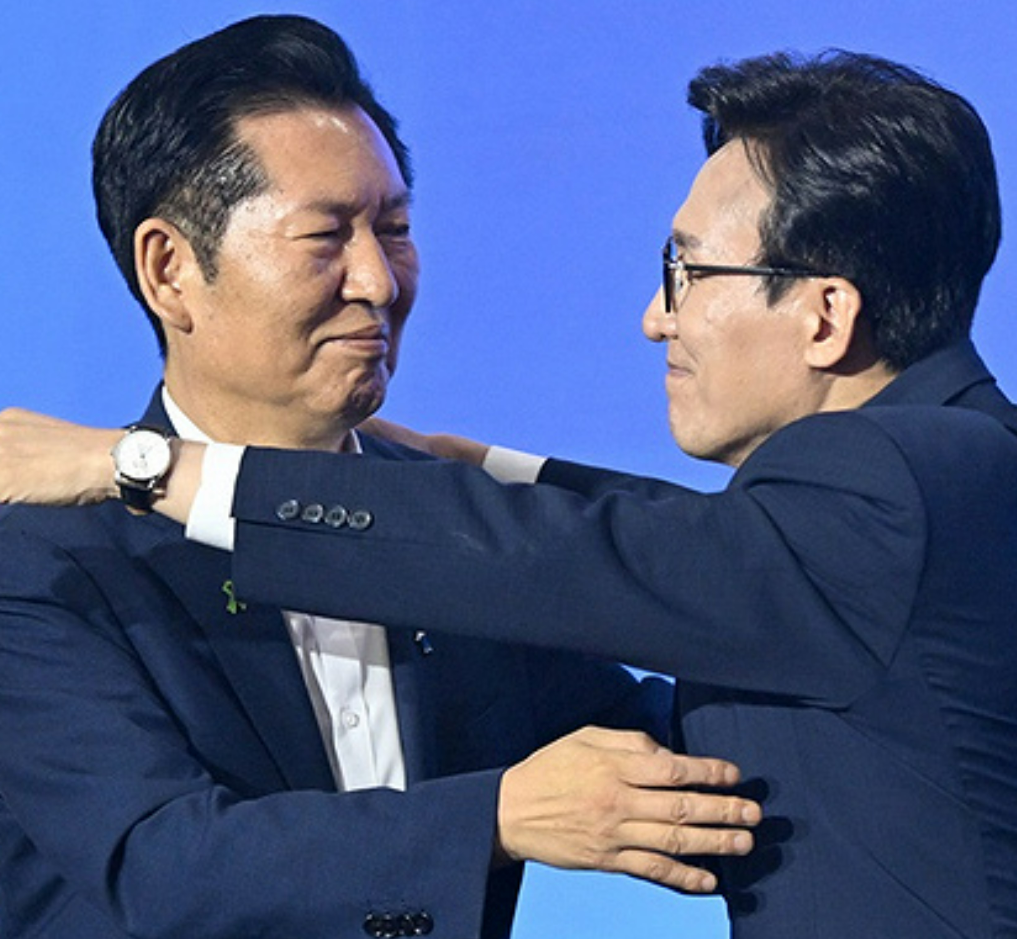
더불어민주당 김민석 당 대표가 지난 8월 17일 대전 컨벤션센터에서 열린 제3회 더불어민주당 정기 전국당원대회에서 당 대표로 선출된 뒤 정청래 후보와 포옹하고 있다.

단상斷想
칼럼
뉴크로스
With Shincheonji and Choi Min-hee's disciplinary action, the pro-Lee and pro-Cheong factions enter an all-out war. Who will have the upper hand?

0
2026. 11. 19
Gyeonggi Governor Choo Mi-ae officially entered the internal conflict within the Democratic Party's Shincheonji on the 17th. Governor Choo publicly criticized Chairman Kim Min-seok that day, saying, “This is not something that can be resolved with an apology.” As a result, the controversy over 'Shincheonji intervention' that emerged during the party convention in August is once again escalating into factional conflict within the party, intertwined with the issue of disciplinary action against Senior Supreme Council Member Choi Min-hee.
The day after Governor Choo's entry, former Chairman Jung Cheong-rae appeared. On the 18th, regarding the party's Ethics Tribunal reviewing the disciplinary issue of Supreme Council Member Choi Min-hee, who was embroiled in controversy over her remark that 'President Lee Jae-myung also opposed the impeachment of former President Yoon Suk-yeol,' former Chairman Jung stated, “I strongly oppose the disciplinary action against Supreme Council Member Choi Min-hee. It is not something that will help the party.”
It was six days after Democratic Party Chairman Kim Min-seok ordered an ethics investigation into Supreme Council Member Choi that former Chairman Jung broke his silence and publicly expressed his opposition. Furthermore, former Chairman Jung also said, “I believe Supreme Council Member Choi was confused and her true intentions were distorted.”
Until now, former Chairman Jung had not made any particular comments amid the ongoing controversy over disciplinary action following Supreme Council Member Choi Min-hee's remarks opposing President Lee Jae-myung's impeachment, leading to much speculation about his background. Some interpreted that former Chairman Jung's stance had changed after his dinner with President Lee and the Blue House.
There were also opinions that, as a former leader of the ruling party, it might be burdensome for him to get involved in every sensitive internal party conflict. However, former Chairman Jung broke his silence and openly opposed the party mainstream's attempt to discipline Supreme Council Member Choi Min-hee.
As a result, the pro-Lee Jae-myung faction and the pro-Jung Cheong-rae faction have entered an all-out war over Chairman Kim Min-seok's Shincheonji apology controversy and whether Supreme Council Member Choi Min-hee should be disciplined. With both leaders drawing their swords, this situation is expected to inevitably lead to consequences on the level of a party split, unless there is a defeat or concession from one side or the other.
Not many people expected Jung Cheong-rae's full-fledged appearance.
In fact, not many people expected former representative Jeong to take such a serious stance and confront the situation head-on. As the factional conflict between the pro-Myeong and pro-Cheong factions escalated to a serious level, there was a hopeful expectation that if at least former representative Jeong refrained from taking a hardline stance, it would signal reconciliation or a truce between the two sides.
There were also predictions that Chairman Kim Min-seok would lower the level of disciplinary action against Supreme Council member Choi to prevent the worst possible outcome. Furthermore, some within the Democratic Party expressed a cautious view, stating that “it would be better to approach the disciplinary action against Supreme Council member Choi Min-hee as a personal issue of Representative Choi, rather than engaging in an all-out war on a factional level.” This reflected a consensus that an extreme head-on confrontation between the pro-Myeong and pro-Cheong factions should be avoided.
However, all these predictions and expectations were shattered by former representative Jeong Cheong-rae's command to commence battle. Now, both sides must engage in a desperate struggle for the survival of their factions until one side 'dies.' So, which side has the advantage in the second round of the war between the pro-Myeong and pro-Cheong factions, which was triggered after the party convention in August?
First, in terms of apparent strength in this battle, the pro-Myeong faction can be said to have the upper hand. Looking at the current distribution of power among factions within the Democratic Party, the pro-Myeong faction is dominant in the National Assembly, while the pro-Cheong faction is relatively at a disadvantage. A clear example of this is the recent collective action of first-term lawmakers.
Out of 71 first-term lawmakers, 55 (77.5%) participated in a statement urging severe disciplinary action and a decision on the future of Choi Min-hee, a supreme council member of the pro-Cheong faction. Sixteen members, including those classified as pro-Cheong, did not participate. Of course, not all participating lawmakers can be classified as pro-Myeong, but it confirms that the parliamentary force supporting the Kim Min-seok system has considerable cohesion.
On the other hand, the pro-Cheong faction's power is concentrated around a few lawmakers, limiting its ability to take organized action within the National Assembly. In particular, the authority of the incumbent party leader and leadership, who can influence nominations for the 2028 general election, is a crucial political asset held by the pro-Myeong faction. A Democratic Party official also stated, “The pro-Myeong faction holds immense power not only among lawmakers but also in the distribution of delegates, so why would they easily back down?”
While the pro-Lee faction holds an advantage in parliamentary power, the overall situation is not favorable to them.
However, the power dynamics among party members outside the National Assembly differ from those within. In the party convention last August, Chairman Kim Min-seok defeated former Chairman Jeong Cheong-rae, but among the five elected supreme council members, three pro-Jeong candidates were elected, while only two pro-Lee candidates succeeded. This demonstrates that the pro-Jeong faction has secured considerable organizational strength and mobilization capability among party members and supporters.
While the pro-Jeong faction has a relatively weak base of parliamentary seats, they can rely on the political influence of former Chairman Jeong Cheong-rae and the opinion-forming power of influential progressive speakers like Kim Eo-jun and Yoo Si-min. Ultimately, if the pro-Lee faction attempts to secure nomination dominance based on the official authority of the party leader and parliamentary organizational strength, the pro-Jeong faction will try to counter this by mobilizing party member opinion and external supporters. The asymmetry between parliamentary power and external public opinion is a key characteristic of this factional rivalry.
Although the pro-Lee faction holds significant power within the National Assembly, there are doubts about whether they can effectively wield that power in the current Shincheonji and Choi Min-hee conflict. For now, the pro-Jeong faction, which seeks to destabilize, is in a more advantageous position than Chairman Kim Min-seok, who aims to maintain stability. The pro-Lee faction may be ahead in terms of power, but they are falling behind in the overall dynamic.
The political presence of the pro-Jeong faction is bound to diminish significantly the moment Chairman Kim Min-seok's system stabilizes and runs smoothly. The fact that Chairman Kim has struggled with approval ratings since taking office in August and has failed to provide stability is, in itself, good news for the pro-Jeong faction.
While the pro-Lee faction shows a superiority in strength, the side holding power also bears the responsibility of maintaining that power stably and unifying the party. Conversely, the pro-Jeong faction is in a structure where their political standing narrows as Chairman Kim's system stabilizes.
In particular, if Chairman Kim firmly seizes power within the party ahead of the 2028 general election nominations, pro-Chungcheong faction lawmakers will inevitably feel a sense of crisis that they could be disadvantaged in the nomination competition. For the pro-Chungcheong faction, even if they cannot force Chairman Kim to resign, they can achieve certain political results simply by weakening the authority of the leadership and shaking the balance of power within the party. The perception that the stability of the Kim Min-seok system could lead to the decline of the pro-Chungcheong faction is the fundamental driving force behind the all-out offensive.
Shincheonji is a confirmed case, while Choi Min-hee's disciplinary action has room for extenuating circumstances.
From this perspective, the current confrontation is a favorable structure for the pro-Chungcheong faction to launch an offensive. Chairman Kim must resolve internal party conflicts and support state administration, but the pro-Chungcheong faction can intensively delve into the leadership's mistakes and controversies. If Chairman Kim responds strongly, he could be criticized for escalating factional conflicts, and conversely, if he concedes, he could be evaluated as having weakened leadership.
However, the pro-Chungcheong faction also has its limitations. Even if they succeed in shaking the leadership in a situation where their parliamentary power is inferior, it is not easy to connect this to actually securing party leadership. Moreover, if the conflict prolongs and party members' fatigue increases, the pro-Chungcheong faction could also face responsibility for the division. For the pro-Chungcheong faction, they are in an ironic situation where internal party instability is the nourishment for the faction's survival. This is why the Democratic Party is even more desperate in the future.
The second decisive point is the Shincheonji intervention theory and the disciplinary action against Supreme Council member Choi Min-hee. First, the Shincheonji intervention theory is a pit dug by Chairman Kim Min-seok himself. Chairman Kim tried to resolve the situation by apologizing for the Shincheonji controversy, but the controversy expanded again when Gyeonggi Governor Choo Mi-ae publicly raised the issue of responsibility. Furthermore, with former Chairman Jeong Cheong-rae also opposing the disciplinary action against Supreme Council member Choi, the two issues have virtually become linked as a single factional confrontation.
The Shincheonji controversy itself is like a very nasty malignant tumor. It's not an issue that will end just because CEO Kim apologizes. If CEO Kim handles this malignant issue, which even smells of undermining intra-party democracy and political maneuvering, in an inadequate way, it will inevitably lead to greater backlash and resistance. For the pro-Chung faction, it's a bone that can be boiled down again and again as long as CEO Kim is at the head of the party.
However, while the issue of disciplining Supreme Council member Choi Min-hee is in itself a malicious attack on the president, there are various opinions on whether it's an issue that warrants a severe disciplinary action such as suspension of party membership. This is because, unlike the 'definite issue' of Shincheonji, the disciplinary case has an element of 'extenuating circumstances' in the form of party harmony.
If the pro-Lee faction imposes a severe disciplinary action that removes Supreme Council member Choi from her position, the aftermath could be unmanageable. Ultimately, it's possible that Shincheonji will lead to a clear apology and recovery plan, while the disciplinary case will result in an appeasing conclusion under the pretext of harmony. If Shincheonji is undeniable, the disciplinary action is an issue that can simply be withdrawn. This also doesn't put the pro-Chung faction at a disadvantage. A severe disciplinary action against Choi Min-hee is more likely to further unite and strengthen the pro-Chung faction.
The pro-Chung faction shows that the sword is in the scabbard without drawing it.
The third turning point is that the pro-Chung faction can gain an advantageous position by simply showing that the sword is in the scabbard, without actually drawing it. If the pro-Chung faction uses the possibility of merging with the Cho Kuk Innovation Party, leaving the party, or splitting the party as a political card, it can put significant pressure on the Kim Min-seok leadership even without actually taking action.
For the pro-Lee faction, which holds the nomination rights for the 2028 general election, if a collective defection of the pro-Chung faction materializes, they would have to bear the burden of not only intra-party division but also a flood of candidates and dispersion of support in the general election. What the pro-Chung faction is aiming for may not necessarily be a split or defection itself, but rather to highlight that possibility to secure their share in nomination negotiations. In fact, impressing upon the opponent that the sword can be drawn at any time can be a more effective negotiation strategy than actually wielding the sword.
In this regard, the argument for merging with the Cho Kuk Innovation Party, which former representative Jeong Cheong-rae has been raising, is a very useful political card that the pro-Cheonggye faction can utilize. Simply put, it's a 'flower viewing' card, meaning it's fine whether they play it or not. If the merger materializes, the composition of forces within the party, the party member organization, and the nomination competition structure could change, and the pro-Cheonggye faction could secure a new foundation to compensate for their numerical inferiority in the National Assembly.
However, even if the merger does not materialize, merely keeping open the possibility of solidarity with external political forces can be expected to have the effect of checking the nomination leadership of the Kim Min-seok leadership. If a large number of pro-Cheonggye lawmakers are excluded during the nomination process, some may choose to join the Cho Kuk Innovation Party or form their own political force.
Of course, there is no confirmed evidence that the pro-Cheonggye faction is currently preparing for a collective defection or party split, and it is also uncertain whether the Cho Kuk Innovation Party would accept them. However, in political negotiations, how seriously the other party takes the possibility is as important as the will and ability to take actual action. If the pro-Myeonggye faction holds the real power of nomination rights, the pro-Cheonggye faction can counter by reminding them of the political cost they would have to pay if they unilaterally exercised that power.
It is unlikely that Chairman Kim Min-seok, who bears unique responsibility for internal party discord due to Shincheonji, will achieve a complete victory in an all-out war with the pro-Cheonggye faction. On the contrary, if the pro-Cheonggye faction comes out fighting to the death, saying, 'We're only going after Kim Min-seok,' the cards Chairman Kim can play will further diminish. The battlefield of Shincheonji is also not favorable to him. The merger argument is also stuck in a gorge where he can neither advance nor retreat, only fueling political attacks.
Does Chairman Kim Min-seok have a card that can overturn this entire disadvantageous structure at once? No. Politics is not an all-or-nothing game, but a fight where you give up your arm to take the opponent's neck. Chairman Kim must offer his arm first. Does Chairman Kim Min-seok have the courage and strategy to do so?
댓글
( 0 / 500 )
검정고무신
7
민주당이 지금 싸워야 할 상대는 내부의 정치적 경쟁자가 아니라 내란 세력과 민생의 어려움입니다. 신천지 논란의 책임은 명확히 규명하고, 최민희 문제는 원칙과 상식에 따라 처리해야 합니다. 계파의 유불리로 당의 미래를 결정해서는 안 됩니다.
( 0 / 500 )
crown77
6
김민석 대표가 당대표로서 당내 혼란을 수습하고 원칙을 세우려는 것은 당연한 책무입니다. 전직 대표나 일부 최고위원의 반발에 흔들리지 말고, 잘못된 부분은 분명하게 바로잡아야 합니다. 당의 중심을 잡는 것이 대표의 역할입니다.
( 0 / 500 )
Barbarian
5
정청래 전 대표가 최민희 최고위원 징계에 공개적으로 반대하고 나선 것은 당내 갈등을 봉합하기보다 키우는 행동입니다. 전직 당대표라면 특정 인물 감싸기에 앞서 당의 원칙과 지도부의 권위를 존중하는 모습을 보여야 합니다.
( 0 / 500 )
미나
5
정청래 전 대표와 최민희 최고위원은 민주당이 지금 무엇을 위해 존재하는지부터 돌아보기 바랍니다. 대통령을 뒷받침하고 국정을 안정시키는 데 힘을 모아도 부족한 상황에 내부 권력투쟁과 계파 결집에 몰두한다면 당원들의 실망만 커질 것입니다.
( 0 / 500 )
이기상
5
지금 민주당에 필요한 것은 계파의 이해관계를 대변하는 정치가 아니라 국민과 대통령을 뒷받침하는 책임 정치입니다. 김민석 대표에게 힘을 실어야 할 때입니다. 당내 갈등에 발목 잡혀 국정 운영의 동력을 잃어서는 안 됩니다.
( 0 / 500 )
newM
4
김민석 대표가 가진 원내 권력과 공천권이 당의 정당성을 보장해 주지는 않습니다. 그렇다고 정청래 전 대표가 당원 여론을 등에 업고 지도부를 흔드는 것도 책임 있는 정치라고 보기 어렵습니다. 양쪽 모두 권력투쟁보다 당과 대통령을 먼저 생각해야 합니다.
( 0 / 500 )
radichelove
6
정당민주주의의 근간을 훼손할 정도의 파괴적인 신천지 문제 등 만만치 않은 사안들이 김민석대표를 에워싸고 있는 현 상황을 일반시민들은 어떤식의 리더쉽으로 돌파해나갈지 예의주시하고 있습니다. 비상적인 일탈행위를 일삼으면서도 당권을 가져가려고 하는 반대파를 어떻게 컨트롤할지 아니면 적당히 지난번 신천지처럼 덮을지 관심사지만 더욱 중요한 것은 정치적계산을 내세워 결정한다면 미안하지만 앞으로 김민석대표는 선택받지 못할 가능성이 매우 높습니다. 죽을 각오로 이번 사안을 대해야 그간의 우유부단한 리더쉽을 만회할 수 있을 겁니다.
( 0 / 500 )
kasandra
4
신천지 개입 의혹과 최민희 최고위원의 발언 논란은 성격부터 다른 사안입니다. 두 문제를 하나의 계파 전쟁으로 묶는 순간 진실 규명은 사라지고 정치적 계산만 남습니다. 민주당 지도부가 원칙 없이 대응하면 당원들의 신뢰부터 무너질 것입니다.
( 0 / 500 )
僞史打破
3
김민석 대표에게 필요한 것은 정청래와의 힘겨루기에서 이기는 기술이 아니라 당을 통합할 정치력입니다. 잘못은 분명하게 책임을 묻되, 징계가 보복이나 계파 숙청으로 비쳐서는 안 됩니다. 지금 민주당에 필요한 것은 승자와 패자를 가르는 전쟁이 아니라 원칙을 세우는 지도력입니다.
( 0 / 500 )
Pohang
3
당대표의 권위는 누구의 눈치를 보느냐가 아니라 원칙을 얼마나 일관되게 지키느냐에서 나옵니다. 신천지 논란도 최민희 징계 문제도 계파 간 타협의 대상이 아니라 사실과 당헌·당규에 따라 처리해야 합니다. 김민석 대표가 중심을 잃지 않기를 바랍니다.
( 0 / 500 )
automobile99
2
정청래 전 대표의 공개 반대는 단순한 의견 표명이 아니라 당내 권력투쟁의 재개로 읽힐 수밖에 없습니다. 전직 당대표라면 특정 인물을 방어하는 데 앞서 당의 안정과 대통령의 국정 운영에 어떤 영향을 미칠지부터 생각해야 합니다.
( 0 / 500 )
misfortune
1
신천지 문제와 정청래 문제는 연관이 있는지 몰라도 최민희의 징계문제와는 그 성격이 다른데, 이걸 묶어서 엮으려는게 저들의 전략입니다. 거기에 놀아나신 글이라서 안타깝네요. 친명이 열세이며 김민석이 팔을 내놓으라는 논리도 현실인식이 매우 안타깝습니다.
( 0 / 500 )
신고내용
신고내용을 선택해주세요
회원비난/비하/욕설글 및 댓글도배성 게시물저작권 침해/불법자료 유출허위사실유포개인정보 유출.사생활 침해무단광고/홍보음란물 및 도박 불법 광고물범죄행위 관련 글불법행위 관련 소개물품 판매 및 사기글악성코드 및 스파이웨어 유포기타 사유 및 운영진 판단


비밀번호를 잊으셨나요?
Sign in with Google


All information provided by us is free of charge and is for the public good.