品

Corea든 Korea든, 품격이 먼저다
Whether Corea or Korea, dignity comes first.
Whether Corea or Korea, dignity comes first.
Now
지금
751 Diaspora
Heritage
유산
Humanity
인문
Mirengsi
未冷尸
Politics
정치
Media
언론
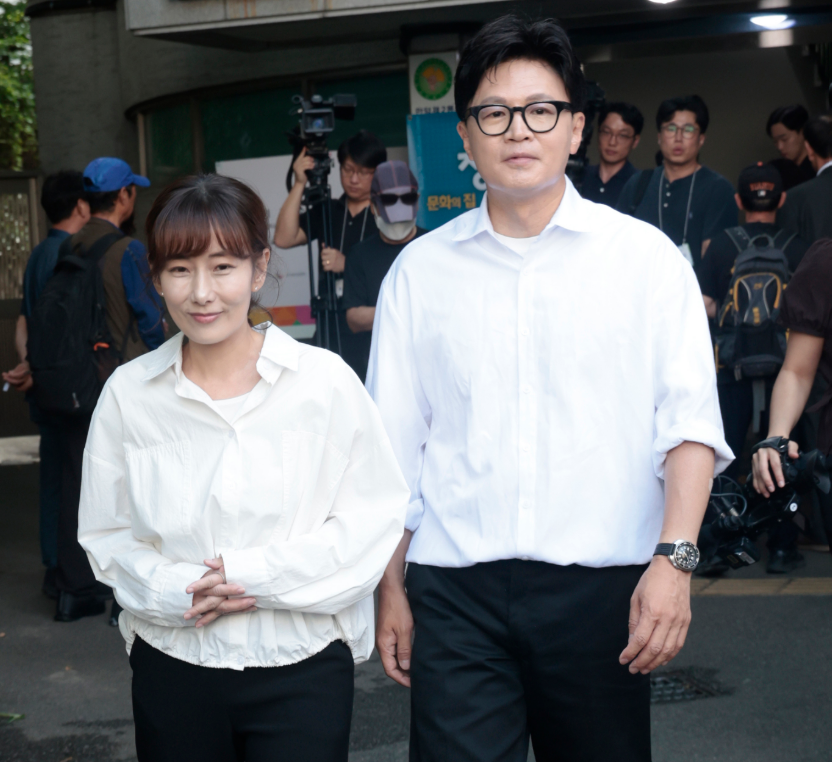
지난 5월 29일 한동훈 당시 무소속 부산 북구갑 국회의원 후보와 아내 진은정 변호사가 6·3 지방선거 및 국회의원 재보궐선거 사전투표를 한 뒤 이동하고 있다.

단상斷想
칼럼
뉴크로스
The father-in-law who called for the first special prosecutor, the son-in-law who watched him leave the prosecutor's office... The strange fate of Jin Hyeong-gu and Han Dong-hoon

0
2026. 11. 18
Recently, Jin Hyung-gu, former head of the Public Security Department of the Prosecutor's Office and father-in-law of independent lawmaker Han Dong-hoon, passed away. As news of Han's father-in-law's passing spread, it became a topic of conversation when Representative Jang Dong-hyuk, who had an awkward relationship with him, personally came to pay his respects. Seoul Mayor Oh Se-hoon also paid his respects.
The fact that the 'three emperors' of the conservative presidential race each visited the same place due to the death of Han's father-in-law became a small topic in political circles. Who visited the funeral home and how long they stayed became news. Seoul Mayor Oh Se-hoon visited the funeral home of independent lawmaker Han Dong-hoon's father-in-law around 5 PM on the 16th, stayed for about 10 minutes, and after paying his respects, replied to a question about conservative unity, saying, “I have nothing to say today.”
People Power Party leader Jang Dong-hyuk did not go in person that day but sent a wreath to express his condolences. The next morning, on the 17th, he visited the funeral home with other party leaders, stayed for about 7 minutes, and then left. The two had been in conflict over disciplinary action and reinstatement issues, and Representative Jang had even expelled former leader Han, so every interpretation was bound to follow even a simple condolence visit.
Rather than the signals of reconciliation and relationship restoration that might have occurred at Han Dong-hoon's father-in-law's funeral, I want to examine the life and narrative of Han's father-in-law, former prosecutor Jin Hyung-gu. Jin Hyung-gu, former head of the Supreme Prosecutors' Office's Public Security Department, who passed away on the 15th at the age of 81, is a familiar figure to veteran political reporters. This is because he has a history of 'inducing' the first special prosecutor in constitutional history.
The incident began on June 7, 1999, in the office of the head of the Supreme Prosecutors' Office's Public Security Department. At that time, it was common for reporters and public officials to drink 'poktanju' (a bomb shot) at lunch. The problem was Director Jin's drunken 'after-talk.' Director Jin, who had drunk poktanju at lunch, told reporters that the prosecution had induced the Korea Minting and Security Printing Corporation strike the previous year, stating that he had discussed it with Kang Hee-bok, the president of KOMSCO, to make it an example of public enterprise restructuring, and had the machinery at the Okcheon Minting Plant moved.
It was said that the prosecution not only suppressed the workers' strike but also orchestrated it. When this fact became known, Director Jin, who had been nominated as the Chief Prosecutor of the Daejeon High Prosecutors' Office, resigned, and even Minister of Justice Kim Tae-jung, who had resisted the clothes lobby scandal, was dismissed. On August 27th of that year, at a National Assembly hearing, he backed down, claiming it was a slip of the tongue made while intoxicated, and even said, “Whiskey is strong, so I mix it with some beer.”
Jin Hyung-gu, Head of Public Security Department, made remarks suggesting inducement of Korea Minting and Security Printing Corporation strike after drinking poktanju.
At the time, the head of the Supreme Prosecutors' Office's Public Security Department played a significant role in maintaining the regime by handling those involved in various demonstrations. However, even if it was a slip of the tongue, the fact that the prosecution induced a union strike was, in itself, an enormous political 'incident.'
The repercussions were particularly significant because the statement came from a high-ranking prosecutor. If true, it meant that an institution wielding the state's punitive power had intervened in labor-management relations to create conflict. When Director Jin's remarks became known, former President Kim Dae-jung ordered a thorough investigation, and the prosecution even formed a special investigation headquarters to launch an inquiry.
The special investigation headquarters of the prosecution arrested Director Jin in July of that year on charges of abuse of power, but cleared Kang Hee-bok, president of Korea Minting and Security Printing Corporation, and former Minister of Justice Kim Tae-jung. However, criticism that the results of an investigation conducted by the prosecution itself into a case involving a high-ranking prosecutor could not be trusted did not subside. Even a National Assembly hearing was held, but the suspicions were not resolved, and controversy arose over the prosecution's downplaying and cover-up of the investigation in the clothes lobby scandal surrounding then-Minister of Justice Kim Tae-jung.
Finally, after nearly three months of deliberation, the ruling and opposition parties agreed to pass a special prosecutor law on September 20, 1999, to investigate the two cases. Former President Kim Dae-jung appointed lawyer Kang Won-il as the special prosecutor for the Korea Minting and Security Printing Corporation strike inducement case and lawyer Choi Byung-mo as the special prosecutor for the clothes lobby case, from among the candidates recommended by the Korean Bar Association.
The two special prosecutors began their full-scale investigation on October 19. This was the background for the launch of the first special prosecutor system in constitutional history. The Jin Hyung-gu strike inducement statement incident was a historical turning point that saw the emergence of an independent external investigative body in power-related cases, which had previously been monopolized by the prosecution. Ironically, the statement by the head of the Supreme Prosecutors' Office's Public Security Department, whose role was to uphold the authority of the prosecution, became an opportunity to crack the prosecution's monopoly on investigations.
The first special prosecutor's investigation into the Jin Hyung-gu case dealt a significant blow to the credibility and standing of the prosecution. The public began to perceive the prosecution as an organization that would not shy away from illegal acts below common sense, and it also served as an opportunity for them to concretely realize the hollowness of strict law enforcement.
Damage to the credibility and fairness of the prosecution due to the first special prosecutor in constitutional history
However, unlike its political repercussions, the legal responsibility in this case ended ambiguously. The prosecution believed that Director Jin had taken the lead to achieve personal accomplishments, while the special prosecutor viewed it as a solo act by Kang Hee-bok, president of the Korea Minting and Security Printing Corporation. In 2001, the Seoul District Court overturned both conclusions and acquitted them of charges of abuse of power and obstruction of business.
What remained as a guilty verdict was Director Jin's act of calling Kang Hee-bok, president of the Korea Minting and Security Printing Corporation, and telling him to carry out restructuring, implying that the strike would be suppressed by public authority. The court judged this to be an undue interference in labor disputes, going beyond mere advice.
The Supreme Court upheld the original ruling, sentencing Director Jin to 8 months in prison with 1 year of probation for this part. The core charges of abuse of power and obstruction of business were acquitted. Despite being a power-related corruption case that the Kim Dae-jung administration responded to by even launching a special prosecutor, its conclusion was surprisingly anticlimactic.
However, its political significance did not disappear. The very scene of the head of the Supreme Prosecutors' Office's Public Security Department calling the president of a public enterprise to discuss workplace closures and restructuring was a glimpse into the 'political prosecution' of the time, revealing where the prosecution itself stood.
A generation has passed since then. Assemblyman Han Dong-hoon is the husband of lawyer Jin Eun-jung, the daughter of public security prosecutor Jin Hyung-gu. He became known as a special prosecutor, serving former President Yoon Suk-yeol as his 'elder brother,' and then became a politician after serving as Minister of Justice.
Former President Yoon Suk-yeol and Assemblyman Han Dong-hoon rose to the pinnacle of prosecutorial power through special investigations. However, in this process, large-scale raids, separate investigations, dust-till-you-find-something investigations, and controversies over the leakage of information about suspects fueled distrust in the political neutrality of the prosecution. In particular, through the investigation of former Minister of Justice Cho Kuk's family, the debate intensified over whether the prosecution was an institution that investigated crimes or a 'political group' that controlled cases involving politicians.
Yoon Suk-yeol and Han Dong-hoon, did they invite the dismantling of the organization by claiming to be political prosecutors?
Afterward, Yoon Suk-yeol became president, and Han Dong-hoon became the leader of the ruling party after serving as Minister of Justice. Those who wielded powerful prosecutorial authority directly moved to the center of political power. As Minister of Justice, Assemblyman Han promoted the so-called 'Geomsuwonbok' (restoration of prosecutorial investigative powers), which expanded the scope of direct investigations through enforcement decrees in response to the reduction of prosecutorial investigative powers.
However, with former President Yoon Suk-yeol's December 3rd emergency martial law and impeachment, controversies over political power from prosecutorial backgrounds further intensified, and prosecutorial reform also accelerated. Ultimately, in October 2026, the Prosecutor's Office was abolished 78 years after its establishment. The two individuals did not directly intervene in the abolition of the Prosecutor's Office. Rather, they were figures who tried to protect the authority of the prosecution.
Nevertheless, it is difficult to deny the paradox that the actions of these two individuals, who expanded prosecutorial power to political power, ultimately strengthened the argument for the dismantling of the prosecution. Those who vowed to protect the prosecution ultimately brought about its demise. The father-in-law's remarks, which flaunted the power of the prosecution, led to the first special prosecutor in constitutional history, and the son-in-law, in his attempt to protect the power of the prosecution, instead ushered in an era where the Prosecutor's Office disappeared.
Of course, the rise and fall of the prosecution is not attributed solely to the father-in-law and son-in-law. Prosecutorial reform involves long-standing institutional conflicts and the responsibility of various administrations, and the son-in-law cannot be held accountable for the father-in-law's mistakes. However, given that one left a legacy of distrust in the prosecution and the other the stigma of a political prosecutor, the influence of these two figures on the history and fate of the prosecution will indeed not be light.
If Jin Hyeong-gu's death became the starting point for clipping one of the wings of the powerful prosecution, it makes one wonder what kind of legacy Han Dong-hoon will leave for the prosecution, which now only has the right to prosecute. The late former head of the prosecution's public security department, Jin Hyeong-gu, was known for advocating "press-friendly" and enjoying tea or "bomb shots" with reporters. However, excessive drinking inevitably leads to trouble.
Han Dong-hoon is known to be a teetotaler and a Coca-Cola enthusiast. This is the one thing the two men did not have in common. This is also due to changing times. In the era of former Director Jin, those who drank well and were generous were considered elites, but now it seems to be a world where thorough self-management is required for promotion.
Han Dong-hoon, who had a particular interest in politics since his time as a prosecutor, was also quite skilled at managing reporters. He was so good at organizing the "yama" (main point) of cases and networking with reporters through high-quality information that he was rumored to be the "Editor-in-Chief of Seocho-dong." Perhaps he learned that strategy by observing his father-in-law, a master of "press-friendly" tactics.
It's difficult for two prosecutors to come from the same family, but the fact that both were at the center of the prosecution's first special prosecutor investigation and its final organizational dissolution seems to speak to the strange fate of an elite family.
댓글
( 0 / 500 )
Donghak
8
장인의 시대와 사위의 시대가 검찰 역사의 양 끝에서 만났다는 점이 흥미롭습니다. 한 사람은 검찰의 노동탄압 개입 논란으로 첫 특검을 불러왔고, 다른 한 사람은 검찰 권한을 지키려다 조직 폐지의 시대를 맞았습니다. 역사의 아이러니를 잘 짚은 글입니다.
( 0 / 500 )
JudgmentDay
6
진형구 전 공안부장의 조폐공사 파업 유도 사건은 단순한 취중 발언으로 치부할 일이 아닙니다. 국가 권력이 노동 현장에 어디까지 개입했는지를 보여준 사건이었습니다. 당시 사건을 오늘의 검찰개혁과 연결해 돌아볼 필요가 있습니다.
( 0 / 500 )
Jupiter74
5
장인의 과거를 사위에게 책임지울 수는 없지만, 두 사람의 검찰 이력을 한 시대의 흐름 속에서 비교한 시각은 의미가 있습니다. 검찰 권력이 정치와 결합했을 때 어떤 결과를 낳는지 되짚어보게 합니다.
( 0 / 500 )
임미란
5
검찰은 오랫동안 스스로를 정의와 법치의 수호자라고 내세웠지만, 정작 권력의 통제와 자기 조직의 이해관계 앞에서는 국민의 신뢰를 잃기도 했습니다. 첫 특검에서 검찰청 폐지까지 이어지는 역사의 흐름을 되새기게 하는 글입니다.
( 0 / 500 )
충식
4
한동훈 의원의 장인상에 누가 조문했는지가 정치 뉴스가 되는 현실도 씁쓸하지만, 그보다 진형구라는 인물이 검찰 역사에 남긴 흔적을 돌아본 점이 인상적입니다. 개인의 부고를 넘어 한 시대 검찰 권력의 흥망을 조명한 글입니다.
( 0 / 500 )
son90
4
조폐공사 파업 유도 사건은 검찰이 수사기관이라는 본분을 벗어나 노동 현장과 국가 정책에 개입했을 때 어떤 문제가 발생하는지 보여준 사례입니다. 27년이 지난 지금도 검찰의 정치적 중립성과 권력 통제는 여전히 중요한 과제입니다.
( 0 / 500 )
崔先生
2
검찰 권력의 역사를 돌아보면 권한이 강하다고 반드시 정의가 바로 서는 것은 아니라는 사실을 확인하게 됩니다. 장인은 첫 특검의 계기를 만들었고 사위는 검찰개혁의 거센 흐름을 경험했습니다. 참으로 역설적인 가족사이자 검찰사의 한 장면입니다.
( 0 / 500 )
이상준
2
한동훈 개인의 정치적 행보를 떠나 그가 검찰이라는 조직과 어떤 관계를 맺어왔는지는 충분히 평가할 문제입니다. 검찰 권한을 확대하고 방어하는 데 앞장섰던 인물이 이제 달라진 사법제도 아래서 어떤 정치적 역할을 할지 지켜볼 일입니다.
( 0 / 500 )
john89
1
권력은 영원할 것 같지만 제도와 시대는 변합니다. 과거 검찰 공안부장의 말 한마디가 특별검사제 출범으로 이어졌고, 검찰 권력을 지키려 했던 후배 세대는 조직 자체가 사라지는 변화를 맞았습니다. 역사는 참으로 냉정합니다.
( 0 / 500 )
신고내용
신고내용을 선택해주세요
회원비난/비하/욕설글 및 댓글도배성 게시물저작권 침해/불법자료 유출허위사실유포개인정보 유출.사생활 침해무단광고/홍보음란물 및 도박 불법 광고물범죄행위 관련 글불법행위 관련 소개물품 판매 및 사기글악성코드 및 스파이웨어 유포기타 사유 및 운영진 판단


비밀번호를 잊으셨나요?
Sign in with Google


All information provided by us is free of charge and is for the public good.