品

Corea든 Korea든, 품격이 먼저다
Whether Corea or Korea, dignity comes first.
Whether Corea or Korea, dignity comes first.
Now
지금
751 Diaspora
Heritage
유산
Humanity
인문
Mirengsi
未冷尸
Politics
정치
Media
언론
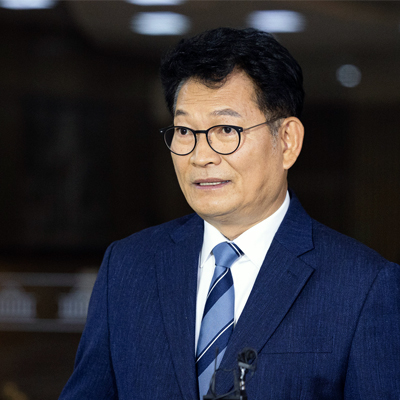
2026년 11월 9일 송영길 의원이 민주당 사무총장실에서 당원정비 태스크포스(TF) 조사 자료를 직접 열람한 뒤 연 기자회견을 했다.

단상斷想
칼럼
HumanX
Song Young-gil's 'Freedom of religion and freedom to commit crime are different.'

0
2026. 11. 10
- Rep. Song Young-gil urged a full investigation and strict measures regarding the alleged organized infiltration of Shincheonji into the Democratic Party, framing it as a responsible challenge from a senior member to protect party democracy.
- He highlighted the confirmation of over 14,000 Shincheonji members with dual party membership and over 8,000 full party members within the Democratic Party, suggesting organized intervention similar to the People Power Party's case, and emphasized the need for party membership revocation and legal punishment.
- He stressed that this issue should not be downplayed as factional conflict, but rather that member sovereignty must be protected and clean politics realized through identifying and expelling disguised members, and strengthening punishment for anti-social activities by cults.
- Rep. Song's remarks are a crucial signal to restore the party's self-purification capabilities and protect its democratic foundation, warning that ignoring this would lead to the Democratic Party abandoning its ability to respond to external organizational infiltration.
Representative Song Young-gil's call for a full investigation into Shincheonji is a significant statement from a senior member of the Democratic Party, and the party must ensure the identification and expulsion of relevant individuals within the party, the revocation of party membership, and stronger penalties for pseudo-religions.
The emergency press conference held by Representative Song Young-gil on November 9, 2026, after he personally reviewed the investigation materials of the party member reorganization task force (TF) in the Democratic Party's Secretary-General's office, was not an extension of factional disputes but a responsible challenge from a senior politician aiming to uphold the fundamentals of party democracy. As a six-term lawmaker, former party leader, and former Incheon mayor who has experienced various crises within the party, Representative Song declared, “The Constitution, which guarantees freedom of religion, does not guarantee freedom for crimes disguised as religion.” His confirmation of evidence of Shincheonji's organized collective infiltration and his call for a full investigation and strict measures are an important signal to restore the party's self-correcting ability. He made it clear that this issue should not be reduced to a blame game between specific factions, and that what we must confront are anti-social crimes disguised as religion and illegal political interference. This statement, made to protect party member sovereignty and party autonomy, holds significance as a senior member stepped forward to declare principles in a situation where investigation results under the Kim Min-seok leadership were only partially disclosed and internal interpretations differed.
The circumstances confirmed by the Democratic Party's TF cannot be taken lightly. A comparison of past Shincheonji member information (a list of approximately 100,000 people) with the current party membership roster revealed 14,000 overlaps, of which 8,000 were full party members. Some estimates, considering the total size of Shincheonji members and subsequent growth, suggest that the current number of members within the Democratic Party could reach 30,000 to 50,000, or even more. The joint investigation headquarters of the prosecution and police have already confirmed that at least 56,000 Shincheonji members joined the People Power Party between 2021 and 2024, along with evidence of church-level directives for joining and allocation of personnel, and have indicted Chairman Lee Man-hee and others. The content conveyed by Rep. Song in his conversation with former Daegu Mayor Hong Joon-pyo—the Shincheonji side's hostility towards then-Gyeonggi Governor Lee Jae-myung's efforts to secure their list during COVID-19, and the logic of 'repaying a favor' for then-Prosecutor General Yoon Suk-yeol's failure to conduct a search and seizure—also shows this pattern of organized intervention. Given that similar circumstances have been confirmed not only in the People Power Party but also in the Democratic Party, Shincheonji-related individuals within the party must be thoroughly identified, their party membership revoked, and legal penalties pursued if evidence of coercive or organized intervention is found.
As Rep. Song emphasized, a full investigation must be conducted into the entities that directed and led organized party recruitment, and whether illegal activities such as coercion or proxy payment of party dues occurred. For confirmed related party members, expulsion and revocation of party membership should be the principle, and if the conditions for urgent disciplinary action are met, it should be applied immediately. It should not be concluded with an apology and downplaying, such as 'there is no clear evidence of a secret alliance of three parties in the investigation results.' With overlaps between the party roster and Shincheonji list, evidence of concentrated recruitment by region, and past cases of organized access already revealed, neglecting related individuals is an act of self-harm to party member sovereignty. If disguised members, dual members, and those involved in organized mobilization are not identified and their party membership sorted out, the same attempts at intervention will inevitably be repeated in future primaries, national conventions, and local elections. Rep. Song's assertion of 'defending party member sovereignty and clean party politics 3.0 in the Republic of Korea' is precisely aimed at this point.
Furthermore, penalties for the anti-social activities of pseudo-religious groups must be significantly strengthened. Shincheonji has long shown a pattern of separating families and existing religious communities through disguised proselytization, hiding its true identity, and has a history of obstructing disease prevention efforts by refusing to submit member lists during the early stages of COVID-19. Acts that infringe upon human rights and freedom using religious authority, such as the JMS Jeong Myeong-seok case, fall outside the scope of religious freedom. Organized infiltration, coercion, and election interference in the political sphere directly violate the democratic decision-making principles under the Political Parties Act and fairness under the Election Act. Therefore, the Political Parties Act and party regulations must explicitly prohibit joining the party or exercising party rights through undue control, coercion, threats, or the provision of financial benefits by external organizations. Verification procedures for large-scale group memberships and the obligation to confirm the voluntary nature of party fee payments must be strengthened. At the same time, sentencing guidelines for anti-social acts such as disguised proselytization, family destruction, obstruction of disease prevention, and organized election interference must be raised, and aggravated punishment for repeated and organized acts, as well as the requirements for organizational dissolution, must be clarified. Systems to protect victims and whistleblowers must also be implemented concurrently.
It is by no means insignificant that Representative Song Young-gil, as a senior member, has publicly stated these principles at this time. As a former party leader, he has experienced the party's crises multiple times, and even after his recent return to the party, he has continued to speak out on the party's identity and democratic operation. His career as a six-term lawmaker holds more than just numerical significance. In a situation where factional conflicts within the party are intensifying and interpretations of investigation results differ, a senior member stepping forward to urge, “Let's face the uncomfortable truth beyond factions,” is an important political act that opens up the possibility of the party's self-purification. If these remarks are ignored or dismissed as an attack by a specific faction, the Democratic Party would be effectively abandoning its ability to respond to organized infiltration by external organizations. Representative Song's emphasis that “unity is not about covering up the truth, but about facing it together, sharing responsibility, and moving towards a greater democracy,” should be understood in this context.
Shincheonji's political involvement is not a new phenomenon. In 2021, during the People Power Party's presidential primary, candidate Hong Joon-pyo claimed that the organized enrollment of Shincheonji members influenced the primary results, which was largely confirmed by a subsequent joint investigation. One of the key charges against Chairman Lee Man-hee was precisely the act of forcing members to join a specific political party. Now that similar circumstances have been observed within the Democratic Party, self-consolation like 'only our party is clean' will not work. In fact, if this is left unaddressed, especially after thousands of duplicate entries were found when cross-referencing party membership lists, there is a high risk that the same problem will recur in future local and general elections. Given the reports of concentrated enrollments, particularly in the Honam region, a thorough review at the regional committee level and the identification of those involved are necessary.
Identifying Shincheonji-related individuals within the party and revoking their membership is not retaliation against specific individuals, but rather a minimum measure to genuinely protect the sovereignty of party members. In cases where individuals joined under coercion or organized directives, those members should be guaranteed the opportunity to maintain their party membership based on their free will. However, those who actively participated in organized mobilization or were involved in illegal activities such as paying party dues on behalf of others should be expelled, and their cases should be considered for referral to investigative authorities. As proposed by Representative Song, it is also important to establish procedures that protect whistleblowers and provide ample opportunity for explanation. Otherwise, only the stigma of 'Shincheonji' will remain, and the true nature of organized intervention could continue to be concealed.
Strengthening penalties for cults is not an infringement on religious freedom, but rather a measure to prevent acts that undermine social order under the guise of that freedom. The freedom of religion guaranteed by the Constitution only means the freedom of individual belief and religious activity, and does not exempt anti-social acts such as organized coercion, fraud, election interference, and obstruction of disease prevention. As seen in the JMS case, structures that mobilize followers and produce victims under the absolute authority of a cult leader can already be subject to criminal punishment. Shincheonji has also shown similar patterns in disguised proselytization and political interference, so it is necessary to clarify the scope of application of relevant laws and strengthen sentencing. At the same time, institutional mechanisms should be established through amendments to the Political Parties Act to fundamentally block external organizations from interfering with party authority.
Rep. Song Young-gil's press conference is an important statement that provided an opportunity for the Democratic Party to purify itself. Beyond factions, we must confront uncomfortable truths, identify and expel Shincheonji-related individuals within the party, and move towards strengthening penalties for the anti-social activities of cults. Rep. Song's point that we must respect religious freedom but firmly respond to acts that shake social order and the foundations of democracy under the guise of that freedom is valid, and it is now time for the party and the nation to institutionally complete this. Now that a veteran politician has stepped forward to declare these principles, the party cannot ignore them. Party member sovereignty and clean party politics are not achieved merely by shouting slogans, but by confronting uncomfortable truths and taking necessary actions.
댓글
( 0 / 500 )
bigBOY
9
종교의 자유는 존중받아야 하지만 종교라는 이름으로 정당에 침투하고 당원 주권과 민주적 의사결정을 훼손하는 행위까지 용납할 수는 없습니다. 송영길 의원의 지적처럼 계파를 떠나 철저한 전수조사와 책임 규명이 필요합니다.
( 0 / 500 )
poly
5
신천지 문제를 국민의힘만의 문제로 몰아가서는 안 됩니다. 민주당에서도 유사한 정황이 확인됐다면 스스로 먼저 도려내야 합니다. 내 편이라고 감싸고 상대편이라고 비난하는 이중잣대부터 버려야 정당 민주주의를 말할 자격이 있습니다.
( 0 / 500 )
Elastic9
8
종교의 자유와 범죄의 자유는 다르다는 송 의원의 말이야말로 이번 사태의 핵심이다. 신앙은 개인의 자유이지만 조직적 동원과 정치권 침투는 별개의 문제다. 당원 주권과 민주주의를 지키기 위한 송 의원의 소신 있는 행동을 지지한다.
( 0 / 500 )
古代
6
송영길 의원의 발언에 공감합니다. 종교의 자유와 범죄의 자유는 엄연히 다릅니다. 조직적인 입당과 당권 개입이 사실이라면 지위고하를 막론하고 책임을 물어야 합니다. 당원 주권을 지키는 일에 타협이나 정치적 계산이 있어서는 안 됩니다.
( 0 / 500 )
Augustine
5
이번 사안은 단순한 당원 정비가 아니라 대한민국 민주주의의 독립성을 지키는 문제입니다. 종교단체든 시민단체든 외부 조직이 집단적으로 정당의 의사결정에 개입하는 것은 민주주의에 대한 도전입니다. 송영길 의원의 문제 제기가 선언에 그치지 않고 실질적인 개혁으로 이어지길 바랍니다.
( 0 / 500 )
오현철
4
민주당이 진정 국민주권과 당원주권을 말하려면 불편한 진실부터 직시해야 한다. 조사 결과를 축소하거나 계파 갈등으로 덮는 순간 국민의 신뢰는 무너진다. 철저한 조사, 투명한 결과 공개, 합당한 징계가 신뢰 회복의 출발점이다.
( 0 / 500 )
joon71
4
송영길 의원의 발언에 깊이 공감합니다. 종교의 자유는 헌법이 보장하는 소중한 권리지만, 그 자유가 조직적인 정치 개입과 민주주의 훼손의 면죄부가 될 수는 없습니다. 원칙을 지키려는 이런 목소리가 당내에 더 많아져야 합니다.
( 0 / 500 )
최광호
3
정치와 종교가 각자의 자유를 누리는 것은 당연하지만, 어느 한쪽이 다른 한쪽을 지배하려 해서는 안 됩니다. 특히 종교조직이 신도들을 정치적 도구로 동원하는 행위는 엄중히 다뤄야 합니다. 이번 기회에 정당의 독립성과 민주적 운영 원칙을 확실히 세워야 합니다.
( 0 / 500 )
포도
3
계파의 유불리를 떠나 문제의 본질을 정확히 짚은 송영길 의원의 발언입니다. 민주당이든 국민의힘이든 종교조직의 집단적인 정치 개입은 반드시 차단해야 합니다. 불편한 진실도 외면하지 않는 것이 진정한 정치인의 책임입니다.
( 0 / 500 )
ssabi
1
민주당이 신천지 문제를 제대로 해결하지 못한다면 국민의힘의 조직적 입당을 비판할 명분도 잃게 됩니다. 내 편의 잘못에 더 엄격해야 국민의 지지를 받을 수 있습니다. 송영길 의원의 용기 있는 문제 제기를 당 지도부가 행동으로 뒷받침해야 합니다.
( 0 / 500 )
신고내용
신고내용을 선택해주세요
회원비난/비하/욕설글 및 댓글도배성 게시물저작권 침해/불법자료 유출허위사실유포개인정보 유출.사생활 침해무단광고/홍보음란물 및 도박 불법 광고물범죄행위 관련 글불법행위 관련 소개물품 판매 및 사기글악성코드 및 스파이웨어 유포기타 사유 및 운영진 판단


비밀번호를 잊으셨나요?
Sign in with Google


All information provided by us is free of charge and is for the public good.