品

Corea든 Korea든, 품격이 먼저다
Whether Corea or Korea, dignity comes first.
Whether Corea or Korea, dignity comes first.
Now
지금
751 Diaspora
Heritage
유산
Humanity
인문
Mirengsi
未冷尸
Politics
정치
Media
언론
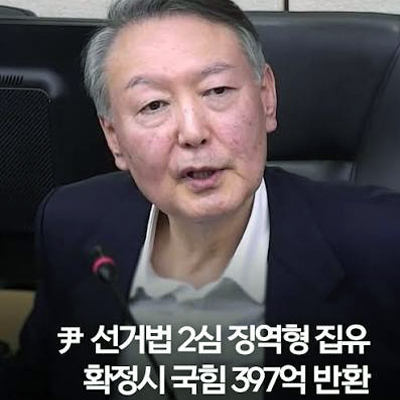
윤석열의 공직선거법 위반 항소심에서 1심과 동일하게 징역 1년 6개월에 집행유예 3년을 선고하고 항소를 기각

단상斷想
칼럼
wonderboy
The price for 39.7 billion won is dissolution.

0
2026. 11. 05
- The appellate court's guilty verdict against President Yoon Suk-yeol for violating the Public Official Election Act reconfirmed that the dissemination of false information during the presidential election was a grave crime that undermined the electoral system itself.
- If this ruling is upheld by the Supreme Court, the People Power Party will have to return 39.7 billion won in election expenses, a fatal financial blow equivalent to one-third of the party's assets, which could shake the very foundation of its existence.
- People Power Party leader Jang Dong-hyuk actively defended President Yoon Suk-yeol, condoned martial law, and excluded critical voices within the party, thereby reverting the party to a pro-Yoon far-right faction and causing it to lose its democratic legitimacy as a political party.
- This situation justifies the dissolution of the People Power Party and suggests that it could become an opportunity for the party to splinter into regional-based minority parties.
- Supreme Court Chief Justice Cho Hee-dae has become a target for clearing out judicial malpractices, having put the brakes on judicial reform and being embroiled in suspicions of complicity in insurrection, necessitating an investigation and impeachment process to determine accountability.
Yoon Suk-yeol's Election Law Appeal Reveals the End of the People Power Party and the Path to Judicial Reform
On November 4, 2026, the Seoul High Court Criminal Division 2-1 (Presiding Judge Baek Seung-yeop) upheld the lower court's sentence of 1 year and 6 months in prison, suspended for 3 years, for Yoon Suk-yeol's violation of the Public Official Election Act, dismissing his appeal. The court ruled that his act of disseminating false information during his presidential campaign distorted voters' sound judgment and infringed upon the election system itself, which guarantees representative democracy. The court stated, “As a candidate recommended by a political party in a presidential election to choose the nation's highest leader, he had an obligation to submit accurate information, but he disseminated false information,” adding, “The legitimacy of the process was undermined.” If this sentence is finalized by the Supreme Court, the People Power Party will have to return 39.7 billion won in election expenses, which it received as reimbursement during the 20th presidential election, to the National Election Commission. Given that the party's assets are reportedly around 120 billion won, this would be a blow equivalent to one-third of its total assets, and considering its limited cash assets in the past, the sale of real estate and other substantial asset erosion may be unavoidable.
The essence of this ruling goes beyond a mere election law violation; it points to a structural crime of manipulating the truth in the process of acquiring power. On December 14, 2021, at a debate hosted by the Kwanhun Club, Yoon Suk-yeol denied introducing a lawyer to Yoon Woo-jin, the former head of the Yongsan Tax Office and brother of his close associate, former prosecutor general Yoon Dae-jin. On January 17, 2022, in an interview with the Buddhist Leaders Forum, he stated that he was introduced to 'Geonjinbeopsa' Jeon Seong-bae but never met him with Kim Keon-hee. The court found both statements to be false. His actions to cover up his close associate network and suspicions related to his spouse during his time as a prosecutor were deemed intentional distortions aimed at preventing a decline in approval ratings. The fact that the same conclusion was reached in both the first and second trials indicates that there were no clear errors in the factual findings and legal application. While Yoon Suk-yeol's side has announced an appeal to the Supreme Court, it is unlikely that the High Court's judgment will be overturned by the Supreme Court, as the consistent guilty verdict from two instances and the gravity of disseminating false information in a presidential election have been repeatedly confirmed.
The People Power Party and Yoon Suk-yeol must pay the price for this crime. A political party is the entity that nominates candidates, receives reimbursement for election expenses, and exercises power. A political party cannot be exempt when a candidate's false statements lead to the nullification of their election. The return of 39.7 billion won is not a financial loss, but a process of recovering the cost of a fraudulent election paid for with public taxes. If the sale of the party headquarters or disposal of assets becomes unavoidable, as in the past 'cha-ttaegi' incident, it signals that the very foundation of the party's existence is shaking. If it is confirmed that the starting point of the Yoon Suk-yeol administration was already built on lies, then the responsibility for the subsequent abuse of power and the flow that led to the 12·3 martial law will inevitably be re-examined. This is why we must liquidate the party structure itself that enabled that power, beyond individual punishment.
The responsibility of the People Power Party led by Jang Dong-hyuk is even heavier. Jang Dong-hyuk, who was elected party leader at the party convention in August 2025, actively embraced the support of the 'Yoon Again' faction and far-right YouTubers, returning the party to a pro-Yoon Suk-yeol party. From his time as a candidate for party leader, he promised to visit Yoon Suk-yeol, and after actually visiting him at the Seoul Detention Center in October 2025, he posted on SNS, 'He was firmly armed with Bible verses and prayers,' adding, 'Let's unite and fight too.' On December 3, 2025, the first anniversary of the 12·3 martial law, he virtually defended it, stating, 'The martial law was to counter parliamentary tyranny,' and while expressing regret for the impeachment and presidential election defeat, he attributed the responsibility for the martial law itself to the Democratic Party's 'parliamentary tyranny.' He characterized internal voices demanding a break with Yoon Suk-yeol as 'forces dividing the party' and said they should be resolutely excluded. This is why Cho Kuk, leader of the Cho Kuk Innovation Party, criticized him as 'a far-right supporter of Yoon Suk-yeol, the leader of the rebellion.' Even after Yoon Suk-yeol's first-instance life sentence for charges of being the leader of the rebellion, Jang Dong-hyuk stated, 'It's regrettable and devastating,' and 'It's still the first instance,' emphasizing the principle of presumption of innocence, thereby drawing a line. This goes beyond political calculation; it is an attitude of not acknowledging responsibility for the rebellion and maintaining those forces as the core foundation of the party.
The responsibility of the People Power Party (PPP) lawmakers who have defended Yoon Suk-yeol must also be addressed. In the process of electing Jang Dong-hyuk, pro-Yoon lawmakers formed the mainstream, and a trend of condoning martial law and conspiracy theories about election fraud dominated the party. Although some first and second-term lawmakers issued separate apologies and promised a political break with the Yoon Suk-yeol faction, their voices lost strength amidst the mood of the party leadership and hardliners. The collective attitude of lawmakers defending Yoon Suk-yeol's false statements and martial law, or shifting responsibility externally, demonstrates the party's loss of self-purification capability as a political party. Now that the conviction for violating election law has been confirmed in the first and second trials, the lawmakers who nominated and protected that candidate until the end cannot avoid accomplice responsibility. The fact that the People Power Party has still not liquidated Yoon Suk-yeol's political legacy, but rather moved to strengthen his support base, is a result of this party voluntarily abandoning its democratic legitimacy.
This situation justifies the dissolution of the People Power Party. When power obtained by violating the election system stipulated by the Constitution and laws is repeatedly confirmed, and even afterwards, the party leader and lawmakers protect insurrectionary forces and are eager to evade responsibility, it is difficult to see that the party maintains democratic legitimacy. Through the dissolution request and the Constitutional Court's judgment process, their responsibility will be questioned, and the remaining forces are likely to naturally split into small, regionally based minority parties. Reorganization into small parties representing specific regional interests, rather than a single conservative party at the national level, is a historically repeated pattern. If the regional concentration of the support base is severe and the central party's finances and organization collapse, the process accelerates. If the return of 39.7 billion won becomes a reality, the party's capacity for activity will rapidly decrease, and internal disputes over responsibility will further promote division. The structure of the Jang Dong-hyuk system, which relies on far-right and pro-Yoon forces, is already acting to reduce the party from a national party to a regional party with a specific hardline base.
Although the Supreme Court's final decision is pending, the likelihood of the High Court's ruling being upheld is high. The same guilty verdict has been reached in two previous instances, and the court explicitly stated that 'the electoral system guaranteeing representative democracy was infringed upon.' This ruling should serve as a catalyst for stronger judicial reform. The establishment of a special court dedicated to insurrection-related cases, the creation of punitive regulations for acts of legal distortion, and the normalization of the Supreme Court justice nomination process are tasks that can no longer be delayed. The delays and leniency observed in the handling of cases related to Yoon Suk-yeol, and the resistance from some parts of the judiciary, actually prove the necessity of reform.
In particular, holding Chief Justice Cho Hee-dae accountable and eradicating deep-rooted problems within the judiciary must proceed concurrently. Chief Justice Cho has repeatedly put the brakes on judicial reform proposals, such as the special court for insurrection cases, stating that 'sufficient discussion and public discourse are necessary.' Suspicions of 'sympathy for insurrection' regarding the Supreme Court's response during the December 3rd martial law, his refusal to nominate justices leading to prolonged vacancies, and controversies surrounding his business expenses and cash incentives must be thoroughly investigated through a parliamentary inquiry and additional investigations. If the judiciary, which should be the last bastion for upholding constitutional order, instead consistently delays and resists swift and decisive judgments on crimes of power, then this constitutes a deep-rooted problem. While the question of Cho Hee-dae's personal involvement in insurrection and the institutional cleansing of the entire judiciary can be treated separately, both are prerequisites for restoring public trust in the judiciary, which the public demands. Investigating the connection between his actions during martial law and subsequent trial delays in a parliamentary inquiry, and considering impeachment procedures if necessary, is not political retaliation but a process of restoring constitutional order. While Jang Dong-hyuk and the People Power Party shield Yoon Suk-yeol and label attacks on the judiciary as 'dictatorship,' the true agents for holding those responsible for insurrection accountable and restoring judicial independence and trust must be the people and democratic reform forces.
Ultimately, this ruling is merely the beginning of the price that Yoon Suk-yeol, the People Power Party, and the lawmakers, including Jang Dong-hyuk, who defended him to the end, must pay. Now that power obtained through falsehoods has been judicially confirmed, the dissolution of the party, its reorganization into a regional minority party, and the eradication of judicial malpractices represented by the Cho Hee-dae system must be pursued simultaneously. Assuming the Supreme Court upholds the High Court's ruling, the National Assembly and the government must accelerate judicial reform. History has recorded the cost of condoning the falsehoods of power. It is now up to the people to break that record. If the People Power Party does not liquidate itself, the people must lead it down the path of dissolution.
댓글
( 0 / 500 )
Whiskey79
7
선거는 국민의 선택을 받는 과정이지 거짓으로 권력을 얻는 수단이 아닙니다. 397억 원 반환은 국민 세금에 대한 최소한의 책임입니다. 더 중요한 것은 윤석열을 공천하고 끝까지 비호한 국민의힘의 정치적 책임입니다. 스스로 쇄신할 능력을 잃었다면 국민의 심판을 피할 수 없습니다.
( 0 / 500 )
purple
10
윤석열 개인의 일탈로만 정리할 문제가 아닙니다. 그를 대통령 후보로 만들고, 당선 이후에도 비호하고, 계엄 이후에도 정치적 단절을 거부한 국민의힘 전체의 책임입니다. 397억 원은 재정적 손실이 아니라 정당이 민주주의를 훼손한 대가라는 점을 명심해야 합니다.
( 0 / 500 )
김정균
8
장동혁 지도부가 윤석열과의 절연을 거부하는 순간 국민의힘의 미래도 함께 닫히고 있습니다. 내란을 옹호하고 허위 사실을 외면하는 정당이 어떻게 민주주의를 말할 수 있습니까? 지금 필요한 것은 말뿐인 사과가 아니라 책임자 퇴출과 근본적인 정치적 청산입니다.
( 0 / 500 )
이민호
7
정당 해산은 감정이나 정치적 보복으로 결정할 사안은 아닙니다. 헌법과 법률이 정한 요건에 따라 엄정하게 판단해야 합니다. 다만 선거의 공정성과 헌정 질서를 훼손한 정당이라면 그 책임을 끝까지 물어야 합니다. 민주주의를 지키는 데 예외가 있어서는 안 됩니다.
( 0 / 500 )
ak56
5
국민의힘이 정말 보수정당으로 살아남고 싶다면 윤석열과 내란 옹호 세력부터 단호하게 정리해야 합니다. 과거의 잘못을 부정하고 극우 지지층에만 의존하는 정당은 미래가 없습니다. 397억 원 반환보다 더 무서운 것은 국민의 신뢰를 완전히 잃는 일입니다.
( 0 / 500 )
monalisa
5
397억 원은 단순한 선거비용이 아닙니다. 국민의 세금으로 지원받은 정치적 신뢰를 거짓으로 훼손한 대가입니다. 후보의 허위 발언이 사법적으로 인정됐는데도 당이 책임을 회피한다면 정당으로서 존재 이유부터 다시 물어야 합니다.
( 0 / 500 )
park72
4
윤석열을 대통령으로 만들었던 세력, 계엄을 옹호했던 세력, 지금도 윤석열과 절연하지 못하는 세력이 바로 오늘의 국민의힘입니다. 지도부 몇 명을 교체한다고 해결될 문제가 아닙니다. 당의 노선과 정치적 토대 자체를 바꾸지 않는다면 국민의 심판은 계속될 것입니다.
( 0 / 500 )
x7
4
사법개혁은 특정 정치인을 처벌하기 위한 수단이 아니라 무너진 법치와 사법 신뢰를 회복하기 위한 제도적 과제입니다. 조희대 대법원장에 대한 의혹도 국정조사를 통해 사실관계를 명확히 밝혀야 합니다. 사법부 역시 국민의 감시와 책임에서 예외일 수 없습니다.
( 0 / 500 )
석훈
3
국민의힘이 스스로 윤석열의 정치적 유산을 청산할 기회를 이미 여러 차례 놓쳤습니다. 이제는 당의 존속보다 헌정 질서와 민주주의의 회복이 우선입니다. 정당 해산 역시 헌법적 요건에 따라 엄정하게 검토하고, 그 결과에 대한 책임을 분명히 물어야 합니다.
( 0 / 500 )
파란곰탱이
1
정당은 권력을 얻을 때만 국민을 찾고 책임을 져야 할 때는 개인의 문제라며 뒤로 숨습니다. 윤석열의 허위 발언으로 선거보전금을 반환해야 한다면 후보를 내고 그 권력을 함께 누린 정당도 정치적 책임을 져야 합니다. 책임 없는 정치는 더 이상 용납되어서는 안 됩니다.
( 0 / 500 )
신고내용
신고내용을 선택해주세요
회원비난/비하/욕설글 및 댓글도배성 게시물저작권 침해/불법자료 유출허위사실유포개인정보 유출.사생활 침해무단광고/홍보음란물 및 도박 불법 광고물범죄행위 관련 글불법행위 관련 소개물품 판매 및 사기글악성코드 및 스파이웨어 유포기타 사유 및 운영진 판단


비밀번호를 잊으셨나요?
Sign in with Google


All information provided by us is free of charge and is for the public good.