品

Corea든 Korea든, 품격이 먼저다
Whether Corea or Korea, dignity comes first.
Whether Corea or Korea, dignity comes first.
Now
지금
751 Diaspora
Heritage
유산
Humanity
인문
Mirengsi
未冷尸
Politics
정치
Media
언론
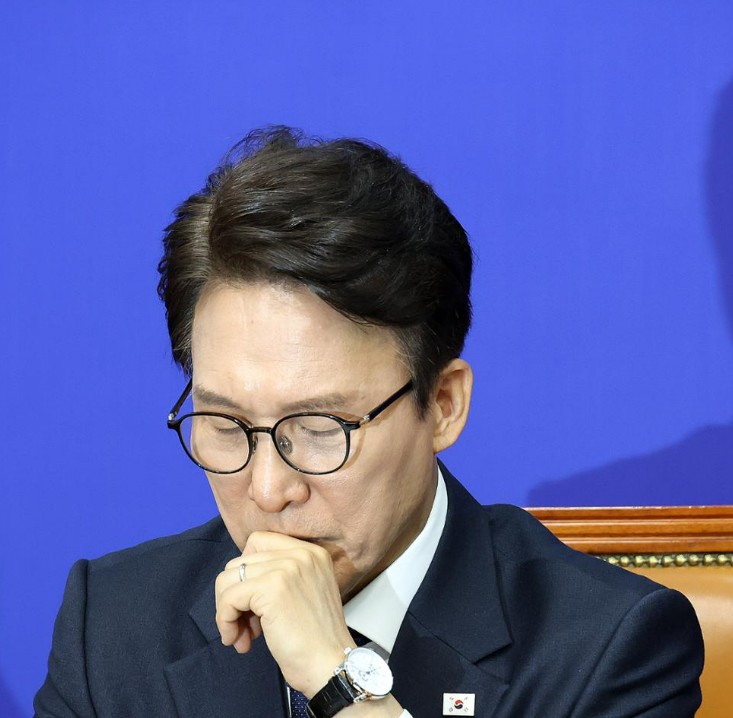
김민석 더불어민주당 대표가 10월 19일 국회의사당에서 열린 최고위원회의에 참석해 한병도 원내대표의 발언을 들으며 생각에 잠겨 있다.

단상斷想
칼럼
뉴크로스
Kim Min-seok's two months as party leader, is he following 'Lee Nak-yeon's path'?

0
2026. 10. 21
These days, looking at Kim Min-seok, the leader of the Democratic Party of Korea, I feel a frustrating sensation, like having eaten a few sweet potatoes. Today (October 21st) marks his 66th day in office, and Chairman Kim is busy apologizing daily for the controversy surrounding Gyeonggi Governor Choo Mi-ae's 'firefighting finance drain' remark.
Even immediately after being elected party leader at the national convention last August, he was full of confidence. He announced a major transformation, promising to create a more competent and people-centered party, and showed a strong will to change the party's very nature, beyond just a change in direction. As a long-term goal, he aimed to go beyond a simple general election victory and envision a 20-30 year golden age for the Democratic Party, planning to establish a framework for 'continuous governance'.
He held his first public supreme council meeting in Busan, declaring 'livelihood, practicality, and expansion' and 'a party without factions.' As a unity pledge, he promised during the primary to establish an internal party organization to promote integration and solidarity within the democratic camp and expand outreach to the moderate center starting the day after his inauguration.
In particular, what was impressive among Chairman Kim's 'pledges' was related to approval ratings. In an interview on July 30, he stated, 'From August 18, the Democratic Party will change 100%,' and promised to dedicate all efforts to increasing approval ratings by more than 10% within three months. He also announced that he would create a virtuous cycle where both the President's and the party's approval ratings rise together within 100 days.
However, two months later, the results are the exact opposite. Since Chairman Kim took office, the Democratic Party has actually allowed the People Power Party to overtake it in approval ratings. The plan to expand outreach to the moderate center has encountered difficulties even in preventing the defection of existing supporters, and the 'virtuous cycle' that aimed to raise both the President's and the party's approval ratings has not materialized. Although the promised 100-day deadline remains, the current trend is completely different from the rebound Chairman Kim was confident about. Moreover, the momentum for a turnaround is hardly visible.
What happened to Chairman Kim Min-seok over the past two months? Unfortunately, the shadow of former Democratic Party leader Lee Nak-yeon now looms over Chairman Kim Min-seok's face. Former Chairman Lee, as the first Prime Minister of the Moon Jae-in administration, was recognized for his stable governance capabilities and emerged as a strong contender for the next presidency.
Kim Min-seok following a similar path to Lee Nak-yeon's Prime Minister-Party Leader
His political standing reached its peak after leading the Democratic Party to a landslide victory in the April 2020 general election and defeating Hwang Kyo-ahn, then leader of the United Future Party, in Jongno, Seoul. He then solidified his position as a potential presidential candidate by becoming party leader in August 2020. Looking at the Prime Minister-Party Leader model, the paths to presidential candidacy for Chairman Kim Min-seok and former Chairman Lee Nak-yon have similar aspects.
The problem is that he failed to fully leverage the advantage of being nominated by the president into his own political capacity. Former Chairman Lee Nak-yon's image as a stable prime minister in the Moon Jae-in administration raised expectations for him as a presidential candidate, but he failed to convert those expectations into his own independent political support.
The event that decisively revealed Lee Nak-yon's downfall was the debate over pardoning former presidents Lee Myung-bak and Park Geun-hye in early 2021. He put forward national unity as a justification, but the Democratic Party's core supporters strongly opposed it. However, the pardon debate alone cannot explain Lee Nak-yon's decline. His political presence was already weakening in major national issues such as the failure of real estate policies and the conflict between Choo Mi-ae and Yoon Seok-yeol.
His strengths of prudence and stability were sometimes perceived as a passive attitude in times of political conflict. In contrast, then-Gyeonggi Governor Lee Jae-myung showcased his political colors by prioritizing policy agendas, including basic income. What Lee Nak-yon lacked was not merely leadership capability, but conviction and vision regarding what kind of politics he pursued and what political efficacy the results would bring to the public.
Lee Nak-yon was overly sensitive to the situation of the ruling party, including former President Moon Jae-in, and believed that this was the prudence a leader should possess. However, despite having many opportunities to explain to the public what kind of leader Lee Nak-yon was without going against Moon Jae-in, he wasted his time.
Chairman Kim Min-seok also has aspects of a similar political inclination to Lee Nak-yon. His passive demeanor, which seeks to maintain the 'appointing authority' of the president, could be perceived as a lack of his own distinct identity, rather than consideration for his superior.
What kind of leader is Kim Min-seok, exactly?
If you ask the public what kind of politician Kim Min-seok is, what kind of answer would you get? Lee Jae-myung can be classified as an administrative type who prioritizes performance, Roh Moo-hyun as a reformist who challenged vested interests, Park Geun-hye as a charismatic type based on a strong support base, Moon Jae-in as a stable type who prioritizes trust and image, and Yoon Suk-yeol as a fighter type who used the confrontational structure from his time as Prosecutor General as a political asset.
Although this classification is somewhat arbitrary, at least they had a political image that the public could easily recall. So, what type of politician is Kim Min-seok? Is he a unifying type, a reformist type, or a managerial type? Or is he an autocratic type? No single answer readily comes to mind.
If one were to pinpoint something, it would be a politician who overcame 18 years in the political wilderness and made a comeback. Perhaps the biggest problem with Kim Min-seok's politics lies here. He has not yet clearly imprinted on the public what kind of politician he is.
Lee Nak-yeon, once a strong presidential contender, had the image of a stable national administrator, but he often showed signs of backing away at politically crucial moments. He failed to show his own clear stance and conviction. Kim Min-seok also has a similar tendency.
For a leader, especially a politician dreaming of the next presidency, they should not show passive behavior such as hesitating or hiding behind choices to gauge the situation when faced with any issue. Such cautious behavior cannot be free from criticism that they are too greedy for the presidency.
Kim Min-seok's problem is ambiguity, lack of principles, and indecisiveness disguised as centrism. This is fatal for a leader. A politician who only chases issues by hiding behind public opinion appears to lack the ability to lead the political situation.
Ambiguity and vagueness disguised as centrism are fatal for a leader.
When asked about the party's stance, he replied, "We are the president," and changed the method of integrating the Rebuilding Korea Party from 'absorption and merger' to "I won't use that term" depending on the situation, while simultaneously advocating for expanding to the center and progressive solidarity. During this time, the philosophical axis showing what he was leading the party for did not emerge. What he built over two months was a skill in managing fragmented messages, not leadership that provides direction. A party leader being busy with stopgap measures and making excuses every time an issue arises is a functional area sufficient for a spokesperson.
Kim Min-seok's situation, in particular, has a more disadvantageous point than Lee Nak-yeon's. Lee Nak-yeon at least had the asset of public popularity, and losing that was his downfall. Kim Min-seok has never risen due to individual approval ratings. The background of his primary victory was thanks to the 'support' of party members and the president.
Moreover, Kim Min-seok is currently failing to achieve results in the early part of the presidential term, when presidential power is strongest. In this case, the president has even greater justification to pull out another card in the succession plan. Rumors have circulated in some political circles that 'President Lee Jae-myung was frustrated after seeing Chairman Kim Min-seok's past two months.' This suggests that Chairman Kim is not delivering the political performance President Lee expects.
Kim Min-seok has no time. The position of ruling party leader is a golden opportunity that may never come again. He must boldly express his convictions and constantly seek public evaluation. Even if it sometimes means a loss, he must clearly articulate his political philosophy, earn the people's choice, and humbly accept it.
So what does CEO Kim Min-seok need? First, he needs to clarify his political role in his relationship with President Lee. Unconditionally defending the president, or artificially creating conflict for differentiation, cannot be the answer.
The party leader should play the role of conveying public sentiment that the president may find difficult to hear, supplementing issues overlooked by the government, and sometimes persuading the government to revise its policies. Since taking office, Chairman Kim has experience in requesting the government to supplement issues such as the comprehensive real estate tax reform, which led to actual policy adjustments. It is important whether such cases do not remain as one-time responses but can establish themselves as a consistent principle of party-government relations.
Those who promote integration must send a message of compromise and sacrifice.
We must also adopt a proactive and concrete strategy for the unity of the progressive camp. The two important missions for Chairman Kim are to ensure the success of the Lee Jae-myung administration and to realize the politics of unity. Unity is not about making moderate compromises with all forces.
In the conflict with former leader Jeong Cheong-rae's side or in the relationship with the Rebuilding Korea Party, it is necessary to clearly distinguish between issues for cooperation and issues for competition, and to publicly explain the criteria for this. For integration, the party that initiates it must send a message of concession and sacrifice to the other side. The moment Chairman Kim calculates the pros and cons, conscious of the next presidential election, integration will be out of the question.
It is also absolutely necessary to concretize Kim Min-seok's unique political agenda. Livelihood, practicality, and expansion are goals that any politician can put forward. If Chairman Kim presented "cost of living politics" as a core task, it is necessary to focus the party's capabilities on creating changes that the public can feel in areas such as housing costs, prices, and youth employment. Rather than operating dozens of TFs, selecting a few key policies and taking responsibility for legislation, budget, and implementation results can be more effective in explaining political achievements. What is important is not slogans and numbers, but results that the public can feel.
Finally, what Chairman Kim needs is to take responsibility for his political judgments. This is precisely what can be learned from Lee Nak-yeon's case. A stable image can be an asset for political advancement, but at moments of escalating conflict, one must explain their judgments and principles. Chairman Kim, too, must clearly state what he will choose and what he will give up as party leader, going beyond his identity as the President's political comrade.
Politics is a continuous process of choices and scrutiny. The public is not attracted to leaders who hide or hesitate on that journey. One should confidently be evaluated and await the results. After all, for Kim Min-seok, who experienced the lowest point as a politician during 18 years as a private citizen, any time from now on is just a bonus. Politics is a world of competition where you only start to gain when you throw yourself in with nothing to lose.
댓글
( 0 / 500 )
이철민
6
김민석 대표에게 필요한 것은 대통령의 뜻을 잘 전달하는 대변인이 아니라 당의 방향을 제시하는 지도자의 모습입니다. 민생과 통합을 외치는 것만으로는 부족합니다. 무엇을 지키고 무엇을 바꿀 것인지 분명한 원칙과 실천으로 보여줘야 합니다.
( 0 / 500 )
jindong
8
김민석 대표가 걸어온 정치 역정에는 오랜 인내와 재기의 시간이 담겨 있습니다. 지금 필요한 것은 조급한 비판에 흔들리는 것이 아니라 자신이 내세운 민생·실용·통합의 원칙을 일관되게 실천하는 일입니다. 이재명 정부의 성공과 민주당의 미래를 함께 책임지는 당대표로서 뚝심 있게 나아가길 기대합니다.
( 0 / 500 )
doong_A
6
당대표는 대통령의 호위무사도 아니고 차기 대권을 위한 발판도 아닙니다. 대통령이 놓치는 민심을 전달하고 당의 목소리를 정책에 반영하는 것이 본분입니다. 이재명 정부의 성공과 민주당의 독자적인 리더십을 함께 세울 수 있어야 진정한 당정 협력입니다.
( 0 / 500 )
manhee
4
통합은 구호만으로 이뤄지지 않습니다. 상대에게 양보를 요구하기 전에 자신부터 무엇을 내려놓을 수 있는지 보여줘야 합니다. 민주 진영의 연대가 차기 권력 경쟁의 계산으로 변질된다면 국민은 금세 알아챌 것입니다. 김민석 대표가 명심해야 할 대목입니다.
( 0 / 500 )
AI720
4
김민석 대표에게 아직 기회는 있습니다. 그러나 민생·실용·확장이라는 말은 누구나 할 수 있습니다. 주거비와 물가, 청년 일자리처럼 국민의 삶을 바꾸는 구체적인 성과로 자신의 정치를 증명해야 합니다. 지금 필요한 것은 모호한 중도가 아니라 원칙 있는 실용주의입니다
( 0 / 500 )
olive
4
김민석 대표가 경계해야 할 것은 실패 자체보다 실패를 두려워해 아무런 선택도 하지 않는 정치입니다. 모든 계층과 계파의 눈치를 보다가 정작 누구의 신뢰도 얻지 못하는 상황이 가장 위험합니다. 지도자는 결국 자신의 판단으로 평가받아야 합니다.
( 0 / 500 )
모란
3
민주당의 지지율 하락을 단순히 홍보 부족이나 일시적인 악재로 돌려서는 안 됩니다. 국민이 무엇에 실망하고 왜 등을 돌리는지부터 냉정하게 살펴야 합니다. 당대표의 역할은 여론을 해명하는 데 있지 않고, 국민이 실망할 이유를 줄이는 데 있습니다.
( 0 / 500 )
은하수
2
김민석 대표가 말한 민주 진영의 통합이 진심이라면 당내 세력 간 유불리부터 따지는 정치를 넘어야 합니다. 통합은 자리 나누기가 아니라 공동의 가치와 정책을 확인하는 과정입니다. 자신의 정치적 미래보다 개혁의 지속성과 국민의 삶을 앞세울 때 비로소 명분도 힘도 생깁니다.
( 0 / 500 )
Tech84
1
정치인에게 재기의 기회는 소중하지만 그 기회가 무한정 주어지는 것은 아닙니다. 18년의 야인 생활을 견뎌낸 경험이 있다면 지금의 위기를 피할 것이 아니라 정면으로 돌파해야 합니다. 김민석 대표가 과거의 그림자에 머물지, 자신만의 정치적 색깔을 만들어낼지는 앞으로의 결단에 달려 있습니다.
( 0 / 500 )
신고내용
신고내용을 선택해주세요
회원비난/비하/욕설글 및 댓글도배성 게시물저작권 침해/불법자료 유출허위사실유포개인정보 유출.사생활 침해무단광고/홍보음란물 및 도박 불법 광고물범죄행위 관련 글불법행위 관련 소개물품 판매 및 사기글악성코드 및 스파이웨어 유포기타 사유 및 운영진 판단


비밀번호를 잊으셨나요?
Sign in with Google


All information provided by us is free of charge and is for the public good.