品

Corea든 Korea든, 품격이 먼저다
Whether Corea or Korea, dignity comes first.
Whether Corea or Korea, dignity comes first.
Now
지금
751 Diaspora
Heritage
유산
Humanity
인문
Mirengsi
未冷尸
Politics
정치
Media
언론
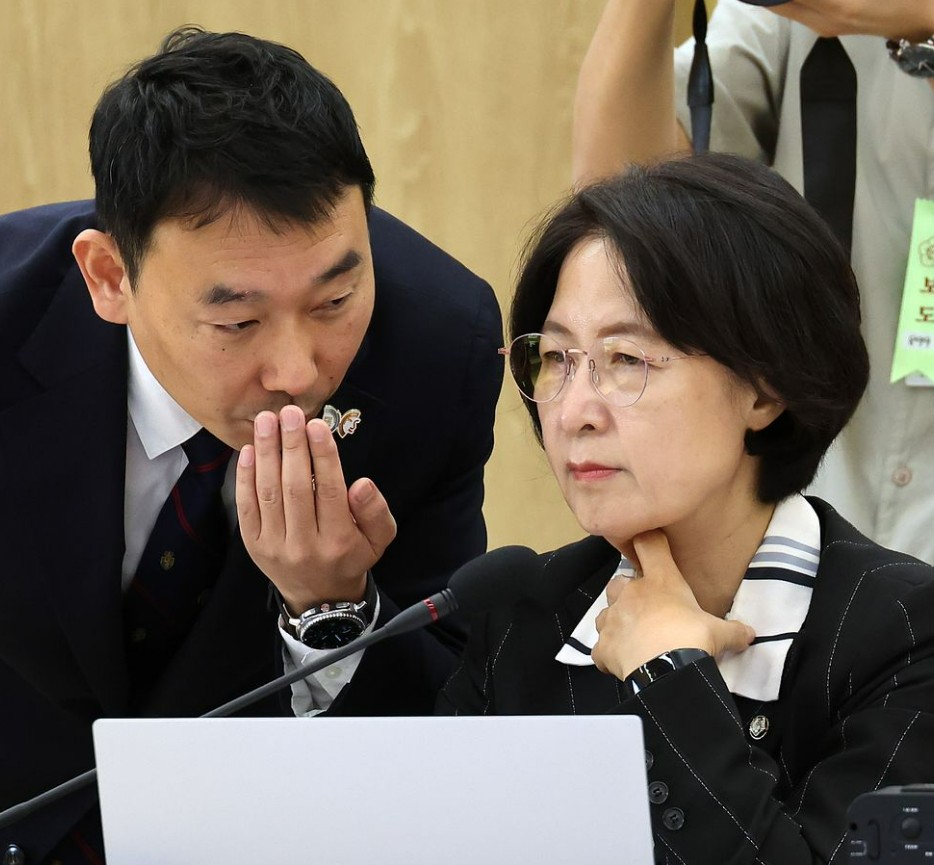
지난해 10월 서울 종로구 헌법재판소에서 열린 헌법재판소 등에 대한 법제사법위원회 국정감사에서 추미애 당시 위원장이 더불어민주당 김용민 간사와 대화하고 있다.

단상斷想
칼럼
뉴크로스
Does 100% pure reform exist?

0
2026. 10. 14
순도 100%의 개혁은 존재할까. 질문을 던져놓고 보니 답은 이미 나와 있는 것 같다. 그런데도 이 질문을 붙들고 있는 건 지금 한국 정치가 바로 이 오래된 명제 앞에서 좌표를 잃었기 때문이다.
A pro-Lee Jae-myung YouTuber scoffed at President Lee Jae-myung a few days ago on a broadcast, saying, "Reform? What reform?" He argued that if President Lee's approval ratings had collapsed while he was at least attempting reforms, there might be some excuse, but since he didn't even do that, there was "no reform whatsoever."
Is that really something to say to someone on the same side? But such words are no longer rare. The 'anti-Lee' strong supporters say the president lied. Even harsher insults than during the Yoon Seok-yeol administration are pouring out from their own side. The pro-Lee faction is bewildered. They say they have never seen a force attack the government to this extent. They say that even during the Moon Jae-in administration there were controversies, but not to this extent, and they don't understand why this is happening.
The logic of the attacking side is also firm. They argue that the reforms they have been calling for should be implemented now. Even the president cannot be absolved for not keeping promises. They ask what that has to do with national governance responsibility. They say that the head of the Central Investigation Agency can be appointed as they wish, and things can be reversed even now.
They deny being pro-Moon and, standing in opposition to Lee, pour out their anger. They even mention impeachment, claiming it's a part of justice. But the pro-Lee faction asks, "Is it really worth killing over?" and "What did you do when other presidents didn't keep their promises?"
A few days ago, I sat down with acquaintances from both the pro-Lee Jae-myung and anti-Lee Jae-myung factions at a private gathering. Their arguments were tense, and no common ground for compromise was found until the end of the meeting; they ran parallel. Honestly, I understand both sides' positions. This makes me question the purity of reform once again.
Even in the French Revolution, the conflict over what constituted a true revolution divided comrades into enemies. Danton, who advocated for easing the Reign of Terror, was executed by guillotine in April 1794, and the hardliner Robespierre, who sent him to the guillotine, met the same fate just over three months later. The fact that they participated in the same revolution did not guarantee the same path or judgment.
Even in the French Revolution, they killed each other over the purity of reform...
Of course, this tragedy cannot be placed on the same level as today's reform debates. What we should reflect on here is not the violence of the revolution, but the way of thinking that only recognizes one's own beliefs as the true revolution. The demand to uphold the principles of reform and the attitude of immediately judging different choices as betrayal must be distinguished. The same question ultimately comes back to those who ask about the purity of reform: By what is that purity measured?
Similar questions remain in the American healthcare reform. In 1974, Republican President Nixon proposed a reform plan that mandated employers to provide health insurance for full-time employees and expanded coverage for low-income individuals. Democratic Senator Edward Kennedy, who favored public health insurance, opposed the private insurance-centric approach, and although both sides sought compromise, they ultimately failed to reach an agreement. With Nixon's political base collapsing due to Watergate, the opportunity for reform disappeared.
Some of Nixon's ideas were reflected in Obamacare 36 years later, in 2010. Kennedy later cited his failure to agree on reform with Nixon as one of his biggest legislative regrets. The choice to miss out on a possible reform, simply because one desired a better reform, is not justified. While compromise carries the risk of losing principles, refusing to compromise also carries the risk of losing opportunities.
Looking back, the controversy over the abolition of the National Security Act during the Roh Moo-hyun administration in 2004 is an example of a reform that failed due to its purity. At the time, Lee Bu-young, chairman of the Uri Party, tentatively agreed with Park Geun-hye, leader of the Grand National Party, to delete five articles, including Article 7, which deals with praise, encouragement, and sympathy, and is considered a representative toxic clause of the National Security Act.
However, the agreement ultimately failed to lead to legislation due to opposition from hardliners within the ruling party, including floor leader Chun Jung-bae and lawmaker Yoo Shi-min, who advocated for complete abolition. Former chairman Lee Bu-young later publicly criticized Yoo Shi-min and other abolitionists for scuttling the compromise. Of course, considering the opposition party's resistance and the complex internal conflicts within the ruling party, the responsibility for the failure cannot be attributed solely to specific individuals.
However, the outcome was paradoxical. Amidst the conflict surrounding the complete abolition of the National Security Act, even partial amendments were thwarted, and 22 years later, the National Security Act is still in effect. President Lee Jae-myung also mentioned prosecutorial reform and pointed out his regret from that time. This old debate still poses a weighty question to our politics: did we fail to achieve even a part of the reform by insisting on 100% purity?
The current prosecutorial reform is moving in a direction that satisfies no one.
Of course, it is unreasonable to put these revolutions and the current Lee Jae-myung reforms on the same scale. Nevertheless, both reform and revolution are about dismantling existing orders and creating new systems. And that work is impossible without empathy and solidarity.
The French Revolution proved it. The passion that dismantled the old regime could not govern itself, erected the guillotine in the name of virtue, and ultimately brought back the emperor. It was a tragedy caused by the excess of revolution. Yoo Shi-min's 100% pure abolition of the National Security Act ultimately failed, and no one took responsibility for not being able to remove this heavy armor.
The current prosecutorial reform is moving in a direction that satisfies no one. Although Lee Jae-myung is leading the prosecutorial reform, his approval ratings suggest that both moderates and strong supporters have turned their backs. Moderates turned away because they found the infighting too noisy, while strong supporters turned away because they felt he was too soft. Opposite reasons are mixed within the same downward curve.
But is there really a reform that satisfies everyone? We must pause before this grand yet fundamental proposition. In 1919, amidst the defeat of World War I and the chaos of revolution, the German sociologist Max Weber spoke to young people about two ethics: the ethics of conviction and the ethics of responsibility.
A person who follows the ethics of conviction tries to uphold the principles they believe are right to the very end. In contrast, a person who follows the ethics of responsibility tries to take responsibility not only for their convictions but also for the real-world consequences of their actions. Simply put, if the ethics of conviction emphasize what is right, then the ethics of responsibility consider what results occur when one acts on what they believe to be right.
Weber did not say that only one of the two was correct. Rather, he emphasized that true politicians need both conviction and responsibility. Politics without conviction can easily devolve into opportunism, and conviction without responsibility can become self-righteousness that ignores reality. Ultimately, those who make politics their profession must bear not only the values they believe in but also the consequences of their choices.
The consequences of Yoo Si-min's 100% pure argument for the abolition of the National Security Act
When a president takes on the position of responsibility, they must consider all sides. This is not a matter of choice. It is a matter of efficiency and completeness. Pushing reform goals to the very end is different from actually completing reforms. Korean politics also experienced such difficulties with the controversy over the abolition of the National Security Act.
This is an old conflict. In revolutions or reforms, there are always people who insist on purity, on 100% purity. Even Kim Eo-jun's supporters start criticizing him if he's even slightly diluted from 100% purity. The critics don't think about the future. They just criticize.
Those who attack have no responsibility. All that matters is who is clearer, and who maintains that clarity to the end. In Weber's terms, they stand at the forefront of the ethics of conviction. That position is a pristine, pure realm free from responsibility. Because they don't bear the consequences, they are always right and pure.
That's not to say that hardline supporters should bear the responsibility for state affairs. However, the majority of pro-Lee Jae-myung faction members believe that rather than breaking power, they should understand and help it operate well. They ask, shouldn't we understand the president's reality?
That doesn't mean we should unconditionally accept the president's decisions. The argument that we should understand and help the president's reality can also easily devolve into a logic that even covers up the wrongdoings of power. Understanding, if prolonged, becomes absolution, and if absolution accumulates, oversight and checks and balances also evaporate.
Hardcore supporters see it differently. They believe that even if it's the president, if they're wrong, they should be immediately reprimanded and criticized. That instinct itself is a healthy instinct of democracy. Power should inherently be questioned.
Who will determine the purity of reform?
The problem is not the criticism itself, but its standards. When the standards they put forward appear arbitrary and partisan, criticism loses its objectivity and is not granted legitimacy. Today, those who call the president a liar use campaign promises as their standard.
However, campaign promises have more leeway than one might think. The phrase 'separate investigation and prosecution' does not specify where the separation ends and where the retreat begins. The problem is that the standard for reform can change depending on who interprets that promise and how.
So, who sets this standard? Is it the people? And who are these people? Is it the centrist who has turned their back, or the hardcore supporter who has turned their back? Both are the same people, but they hold diametrically opposed standards. The phrase 'the will of the people' has thus become something anyone can pull to their own side.
To discuss the purity of reform, there's something that needs to be asked first. To what extent have we agreed? Was there a consensus on that agreement? To what extent have we tolerated the purity that hardliners are now advocating? Even if a claim is confirmed by public opinion polls, we need to examine whether the results support the specific details of the reform. Purity asserted without such confirmation is a declaration, not a measurement.
Lee Jae-myung's logic is also correct, and the hardliners' logic is also correct. One speaks of results, the other of principles. As Weber said, true politics is only possible when these two hold each other within one person, within one community. Democracy is a compromise, a negotiation, and an agreement between any two points. If you go with all right or all wrong, there is no answer.
There is no such thing as 100% pure reform. What exists is only a sense of community that, despite endless disputes over the purity of reform, ultimately recognizes the need to live together, and a mature civic consciousness that acknowledges differences and seeks a path to coexistence.
The belief and tolerance that we will all return to the place of 'us' as a community—perhaps that is pure reform. If, on that path, we burn the bridges back and sneer, 'Reform is nonsense,' then that is not the purity of reform, but merely an impurity mixed into reform.
댓글
( 0 / 500 )
임미란
9
개혁은 구호의 선명함으로 완성되는 것이 아니라 현실을 바꾸는 결과로 완성된다는 말씀에 공감합니다. 원칙을 지키는 것도 중요하지만, 그 원칙을 실현할 기회마저 놓친다면 누구를 위한 개혁인지 돌아봐야 합니다. 신념과 책임이 함께 갈 때 진정한 개혁이 가능하겠지요.
( 0 / 500 )
弘益人間
7
대통령을 비판하는 것은 지지자의 권리이자 의무입니다. 그러나 비판이 곧바로 배신자 낙인찍기와 정권 흔들기로 이어진다면 개혁의 동력만 약화시킬 뿐입니다. 강성 지지층도 대통령의 현실적 한계를 살피고, 대통령 역시 개혁의 원칙에서 얼마나 멀어졌는지 스스로 점검해야 합니다.
( 0 / 500 )
타미르
7
국가보안법 폐지 논쟁에서 부분적인 합의조차 놓쳤던 과거는 지금도 뼈아픈 교훈입니다. 완전한 개혁을 외치다가 아무것도 바꾸지 못하는 것보다, 가능한 것부터 바꾸고 다음 단계로 나아가는 지혜가 필요합니다. 개혁은 순도 경쟁이 아니라 역사를 한 걸음이라도 앞으로 움직이는 일입니다.
( 0 / 500 )
남해송
5
신념윤리와 책임윤리의 차이를 오늘의 정치 현실에 연결한 점이 인상적입니다. 원칙만 강조하면 독선에 빠지고, 현실만 앞세우면 기회주의에 빠질 수 있습니다. 대통령에게는 책임 있는 결단이, 지지자에게는 냉정한 감시와 합리적인 비판이 필요합니다. 서로를 적으로 만들지 않는 성숙함이 절실합니다.
( 0 / 500 )
yeon85
5
과거 국가보안법 폐지 논쟁은 완벽한 명분이 반드시 좋은 결과로 이어지지는 않는다는 사실을 보여줍니다. 부분적인 성과를 발판으로 다음 개혁을 추진할 수도 있었지만, 내부의 강경한 대립은 그 기회마저 놓치게 했습니다. 지금도 같은 실수를 반복한다면 개혁을 가로막는 것은 외부의 적만이 아닐 것입니다.
( 0 / 500 )
아리
4
개혁은 마음속의 순수함을 증명하는 경연대회가 아닙니다. 현실의 벽을 넘어 제도를 바꾸고 국민의 삶을 개선하는 과정입니다. 100%가 아니면 실패라고 외치는 동안 기회는 사라지고 기득권은 웃습니다. 원칙을 지키되 성과를 만들어내는 정치, 지금 우리에게 필요한 것은 바로 그런 개혁입니다.
( 0 / 500 )
grace45
4
대통령의 선택이 언제나 옳을 수는 없습니다. 그렇다고 현실적인 타협을 모두 배신이라고 몰아붙이는 것도 옳지 않습니다. 지지자는 비판할 수 있고 대통령은 설명해야 합니다. 중요한 것은 누가 더 강하게 비난하느냐가 아니라 어떤 비판이 더 나은 개혁을 가능하게 하느냐입니다. 비판도 책임감을 가져야 합니다.
( 0 / 500 )
textan
2
결국 개혁의 순도를 누가 독점적으로 판정할 수 있겠습니까. 대통령도 강성 지지층도 자신만이 국민의 뜻을 대변한다고 주장할 수는 없습니다. 중요한 것은 서로 다른 요구를 민주적 토론과 합의로 조정하는 일입니다. 개혁의 다리를 불태우면서 순수성을 자랑하기보다, 함께 건널 다리를 놓는 정치가 보고 싶습니다.
( 0 / 500 )
dongjoo
1
순도 100%의 개혁이 불가능하다는 말은 원칙을 포기하자는 뜻이 아닐 것입니다. 원칙을 현실에 구현하기 위해 어디까지 양보하고 무엇만큼은 지켜야 하는지 끊임없이 토론하자는 뜻일 것입니다. 타협은 패배가 아니며 비판은 배신이 아닙니다. 서로를 적으로 규정하지 않을 때 비로소 개혁은 정쟁을 넘어 역사의 진전이 될 수 있습니다.
( 0 / 500 )
신고내용
신고내용을 선택해주세요
회원비난/비하/욕설글 및 댓글도배성 게시물저작권 침해/불법자료 유출허위사실유포개인정보 유출.사생활 침해무단광고/홍보음란물 및 도박 불법 광고물범죄행위 관련 글불법행위 관련 소개물품 판매 및 사기글악성코드 및 스파이웨어 유포기타 사유 및 운영진 판단


비밀번호를 잊으셨나요?
Sign in with Google


All information provided by us is free of charge and is for the public good.