品

품격있는 정치, 품위있는 정치인과 함께 하는 세상이어야 하는데
All Koreans are refugees like animals in the zoos. Corea, Korea, Corean, Korean, Coreans and Koreans. Whatever they are!
All Koreans are refugees like animals in the zoos. Corea, Korea, Corean, Korean, Coreans and Koreans. Whatever they are!
Now
지금
751 Diaspora
Heritage
유산
Humanity
인문
Mirengsi
未冷尸
Politics
정치
Media
언론
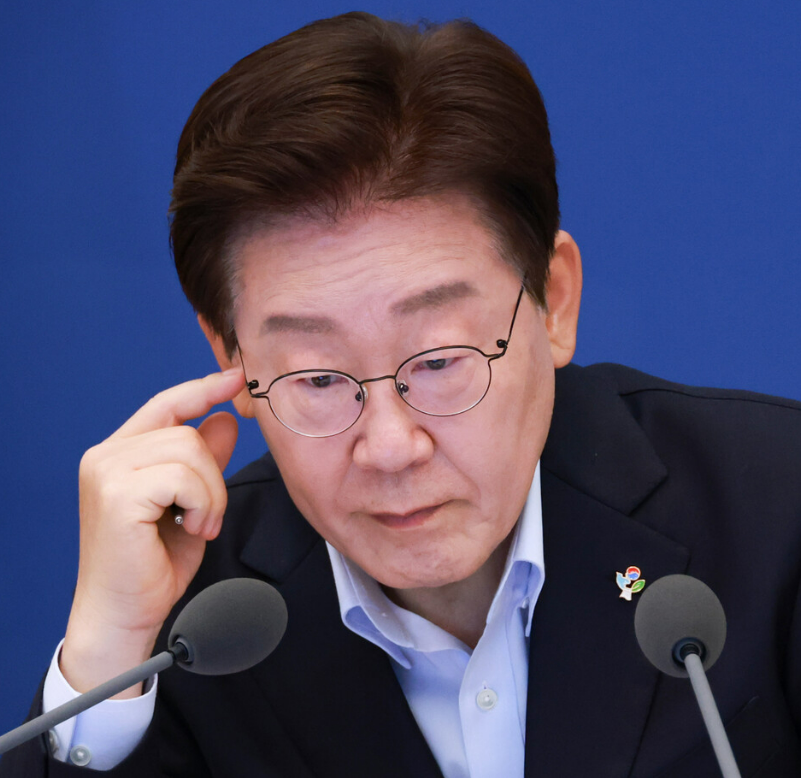
이재명 대통령이 6월 23일 청와대에서 열린 국무회의 겸 비상경제점검회의에 자료를 보고 있다.

단상斷想
칼럼
뉴크로스
Lee Jae-myung's approval rating plummets, the answer is known but cannot be fixed.

0
2026. 09. 15
President Lee Jae-myung's approval rating is falling relentlessly. A myriad of analyses and solutions are pouring out. Perhaps the answer is already there. Nevertheless, he is unable to write the model answer on the exam paper. What is President Lee afraid of?
Let's look at the problem-solving books currently on the market. Cho Kuk approaches analysis with a camp-based logic. Regarding the decline in President Lee's approval rating, he pointed out that it was "the result of a strategy to remove 'Moonjo-teollaeyu' (Moon Jae-in, Cho Kuk, Kim Eo-jun, Jeong Cheong-rae, Yoo Si-min) as enemies and form a 'structural majority' centered around 'New Lee Jae-myung'."
It is true that there is a defection from the camp, but if the decline in approval ratings is explained solely by a realignment of the camp, the causal relationship is not properly explained. In fact, recent public opinion polls show not only a defection from the progressive camp but also a weakening among those in their 20s, moderates, and those in their 40s and 50s, so the scope does not match if it is only a defection from Jo Guk's camp. The fact that approval ratings began a full-fledged decline starting with the real estate issue is also a flaw in the theory of major camp variables.
JoongAng Ilbo analyzed, "The reason for the decline in approval ratings is not a lack of clarity, but rather the disappearance of common sense, fairness, and a rational, centrist, pragmatic approach." While it accurately pointed out the phenomenon of centrist voters leaving, it lacked an explanation for why the pragmatic approach of the early administration wavered in just a few months. On the contrary, if clarity had been strengthened, the 'strong affirmative' faction might have held firm, preventing a significant drop in approval ratings.
Bae Seong-gyu, political editor of Chosun Ilbo, pointed out, "The obsession with withdrawing the indictment led to all sorts of unreasonable actions and a defection of the support base," adding, "For the president to escape this crisis, he must first abandon the idea that 'I know best'." While I partially agree that the essence of the falling approval rating is judicial risk, it is difficult to adequately explain the disappointment in the president's leadership that is simultaneously occurring in various areas, such as real estate and personnel management issues.
Yoon Kun-young, a Democratic Party lawmaker, emphasized, “We must abandon the idea that we cannot be pushed back,” adding, “The first step is to fully accept the voice of the people.” This is absolutely correct, but perhaps the president is actually powerless, and that is why he has been pushed back to this point. It is an even bigger problem if the system for gathering public opinion, which allows the government to fully accept the voice of the people, is broken.
Reasons for the decline in approval ratings from the perspective of people, structure, and trends
Ultimately, all the previous criticisms are valid, but they are only half the answer. They explain what went wrong, but not why President Lee Jae-myung, knowing these issues, has been unable to fix them. This is precisely where I focus my attention.
The previous analyses and criticisms are all persuasive. In addition, the three elements that determine the success or failure of elections and politics—namely, 'people, structure, and trends'—can also be used to explain the situation. This framework of variables does not disappear after an election. If an election is a process of winning the hearts of voters, then governance is a process of translating those hearts into support for state affairs. From this perspective, President Lee Jae-myung is currently facing difficulties in terms of people, structure, and trends.
First, 'people.' It is necessary to consider whether the pool of talent and political advice utilized by the Lee Jae-myung administration is becoming excessively narrow. It was not solely the strength of the so-called 'pro-Lee Jae-myung' faction that led to candidate Lee Jae-myung's victory in the presidential election.
It was the result of diverse forces, including the Democratic Party's traditional supporters, the pro-Moon Jae-in faction, regional bases such as Honam, and centrist and reform-minded voters, uniting under the single goal of regime change. For an electoral coalition to naturally transition into a governing coalition after taking power, the key must be 'personnel appointments.'
However, if the decision-making of the ruling power increasingly narrows to a small core group over time, the broad coalition formed during the election quickly disintegrates. The voices of those close to the center of power grow louder, while dissenting opinions from the periphery become increasingly difficult to convey.
The relationship with the pro-Moon Jae-in faction can be seen in the same context. Embracing only a few symbolic figures, such as former Gyeongnam Governor Kim Kyoung-soo, may not be enough. What is important is not the appointment of a few individuals, but whether people with different political experiences and perspectives are actually participating in the decision-making process of the administration.
The second is the issue of 'structure.' The Democratic Party's support base was never monolithic from the start. There is a traditional Democratic Party support base formed through the Roh Moo-hyun and Moon Jae-in administrations, and there is also a 'New Lee Jae-myung' support base that has newly coalesced during President Lee Jae-myung's political growth. In addition, there are swing voters who move with each election.
President Lee Jae-myung, inherently disadvantaged in terms of power structure
Therefore, the moment the Lee Jae-myung administration narrows itself to being a government of a specific political faction (the pro-Lee Jae-myung faction), its political outreach will inevitably shrink. The strengthening of structures like pro-Lee Jae-myung vs. anti-Lee Jae-myung, or pro-Lee Jae-myung vs. pro-Moon Jae-in, will not benefit the president. This is because the ruling power must govern for a much broader public than just its core supporters.
In particular, as the president's approval rating declines, the temptation to strengthen internal cohesion grows. Mobilizing core supporters can temporarily create a political shield. However, if moderate voters and peripheral supporters fall away in that process, a paradox arises where the president's overall support base actually narrows.
What was revealed through the last party convention was that the current power structure within the party is by no means favorable to President Lee. Although the pro-Lee Jae-myung faction waged an all-out battle, it ultimately came down to a close contest that went to a run-off vote. There is no guarantee that another party convention would yield the same 'narrow victory' as this time.
President Lee Jae-myung came to power with a political structure that was inherently unfavorable to him. The way to break this fragile power structure is not through war, but by finding a way to win without fighting. If the results of the battles fought so far have ultimately led to a decline in approval ratings and a weakening of the president's position, then it is time to change the method of engagement.
The third is 'wind.' The popularity of politicians is fleeting and futile. The so-called 'honeymoon effect' and 'market popularity' that arise from the expectations for a new government immediately after inauguration cannot last forever. The fervor during the presidential election and the expectations for a new government also transform into everyday evaluations over time. Voters begin to look at whether housing prices, rent, inflation, jobs, and their own lives are actually improving, rather than the president's messages.
This phenomenon is even more pronounced in Korean politics. Each time a president changes, voters expect the new president to solve problems that the previous government failed to address in a short period. However, it is almost impossible from the outset for a single-term president to solve accumulated social problems such as the economy, real estate, education, welfare, and regional disparities all at once.
In Korean politics, the speed at which 'freshness' turns into 'staleness' is felt particularly quickly. Disappointed voters then seek out new politicians who seem capable of solving all problems. This is an unavoidable fate of the five-year single-term system and the 'never-ending story' of Korean politics.
The reality of the heavy stone deeply embedded in the core of power
Indeed, even individuals who had successful political careers before becoming president invariably experienced a decline in approval ratings after entering the Blue House. Presidents who were symbols of democratization and reform, presidents who championed 'prepared presidents,' and presidents who vowed to change old politics could not avoid public disappointment and the defection of their support base during their terms. There are clearly structural problems with the Korean presidential system that are difficult to explain solely by the president's individual capabilities.
Looking at the rise and fall of past administrations, one can see that variables of people, structure, and 'wind' dominated them. However, another factor that the author focuses on is the 'heavy stone' placed at the center of Lee Jae-myung's power. This is too heavy and firmly embedded in the core of power, making it difficult for even President Lee to easily remove it with his own strength.
The Park Geun-hye administration had Choi Soon-sil, and the Yoon Suk-yeol government had Kim Keon-hee. The 'stumbling block' of the Moon Jae-in administration was not a specific individual, but rather the sentiment of the faction itself. It's a phenomenon where untouchable sacred cows emerge, and political judgment is skewed to avoid them.
The form of this 'stumbling block' could be a person, a specific group, an intangible atmosphere, or even the president's own authority. There's one commonality: it creates a bottleneck in the decision-making process. If there's a problem with the system when there's the capacity and talent pool to achieve the best political outcomes, but it's not happening.
If the Blue House's political strategy and policy formulation, and the final decisions on personnel, are made by a small core group, the best conclusions cannot be reached. If subordinates know that their opinions will be cut off at the upper levels anyway, they may simply stand by and do nothing. From this point, the political system of power begins to falter.
If the solution is buried under a stumbling block, that's what needs to be removed first.
This cabinet reshuffle is a symptom of that. Despite the snowballing allegations against candidates and the confirmation hearing situation threatening to spill over into Chuseok family gatherings, there's no political exit in sight. What's more painful than the criticism of inadequate vetting is the fact that the internal circuit to filter out deficiencies early on didn't work. If the collective intelligence within the Blue House is blocked and unable to function properly, only blind loyalty remains in its place.
The solution is not difficult. In principle, there is only one answer: to rejoin hands with the pro-Moon faction and restore the progressive camp's electoral coalition from the presidential election victory. However, there is a prerequisite: sharing the nomination rights for the general election and sharing power, essentially a form of co-governance.
However, this is tantamount to a surrender by those in power. It is not a condition that an incumbent president, whose term is not even halfway over, can accept. Reaching out to political rivals for help is an option that a powerless president nearing the end of their term might consider.
Then there is only one alternative left. It is to establish a political line that can raise approval ratings and accept at least some broad advice from outside the establishment, making it actually work in the realm of presidential governance. It is about creating a structure where advice is reflected in decisions, not just pretending to listen.
In fact, many ways to raise approval ratings have already been proposed in political circles. These include apologizing to the public, accommodating the opinions of hardliners, and withdrawing controversial appointments. None of these can be touched without abandoning or significantly overhauling the current stance. Reform should emphasize flexibility rather than consistency. Only then can reform be achieved in conjunction with public sentiment. Even just resolving immediate issues leaves room for a turnaround.
In a way, it's an easy answer. President Lee has probably heard this thousands of times. He himself must ask what the reason is for knowing but not being able to do it. Why did I seize power? Why do I run the country? If the answer is buried under a heavy stone, that must be removed first.
Past administrations have repeatedly failed in that task. It wasn't because the stone was too heavy. It was because power itself never thought to move it. President Lee Jae-myung is a ruler of pragmatism and reform. Can he be different?
댓글
( 0 / 500 )
kim_minsoo
8
지지율 하락을 단순히 진영 이탈이나 부동산 문제 하나로 설명하기보다 ‘사람·구도·바람’이라는 틀로 짚은 점이 설득력 있습니다. 특히 대통령 주변의 의견 수렴 구조가 좁아지고 있다면 정책 하나를 고치는 것보다 먼저 국정 의사결정 시스템부터 점검해야 할 것 같습니다.
( 0 / 500 )
hongjo
7
가장 인상적인 대목은 ‘무거운 돌덩이’라는 표현입니다. 결국 대통령에게 필요한 것은 자신에게 듣기 좋은 말을 해주는 참모가 아니라 불편하더라도 반대 의견을 정확하게 전달하는 사람들입니다. 권력의 핵심이 비판을 차단하기 시작하는 순간 국정은 현실과 멀어질 수밖에 없습니다.
( 0 / 500 )
sr84
7
선거에서 이긴 세력과 국정을 운영하는 세력은 달라야 한다는 지적에 공감합니다. 선거 때는 표를 얻기 위해 연합하지만 집권한 뒤에는 그 연합을 국정 운영의 폭넓은 기반으로 만들어야 합니다. 친명만의 정부가 아니라 민주개혁 세력 전체와 중도층이 함께 갈 수 있는 정부가 되어야 지지율도 회복될 것입니다.
( 0 / 500 )
최진성
5
이 글은 이재명 대통령을 무조건 비판하기보다는 왜 알면서도 해법을 실행하지 못하는지를 묻고 있다는 점에서 의미가 있습니다. 사과할 것은 사과하고 잘못된 인사는 과감히 바로잡고, 국민이 체감하는 문제부터 해결하는 것이 오히려 개혁의 동력을 살리는 길입니다. 강한 대통령과 고집 센 대통령은 전혀 다른 문제입니다.
( 0 / 500 )
rarara
5
대통령에게 필요한 것은 ‘내가 옳다’는 확신보다 ‘내 판단이 틀릴 수도 있다’는 경계심이 아닐까요. 지지율은 숫자이지만 그 숫자 속에는 국민의 불안과 실망이 담겨 있습니다. 이재명 정부가 지금이라도 권력 내부의 벽을 낮추고 다양한 목소리를 국정에 반영한다면 위기는 충분히 반전의 계기가 될 수 있다고 봅니다.
( 0 / 500 )
김범준
4
지지율이 떨어질 때마다 새로운 정책을 내놓는 것보다 먼저 해야 할 일은 왜 민심이 멀어지고 있는지 냉정하게 들여다보는 것이라고 생각합니다. 특히 대통령에게 불편한 이야기를 전달할 수 있는 참모가 없다면 아무리 좋은 정책도 타이밍을 놓치게 됩니다.
( 0 / 500 )
komando
4
‘사람·구도·바람’이라는 분석에 동의합니다. 선거에서 승리한 방식과 집권 이후 통치하는 방식은 달라야 합니다. 선거 때 함께했던 다양한 세력을 배제하고 핵심 지지층만으로 국정을 끌고 가려 한다면 결국 선거에서 얻은 넓은 지지 기반을 스스로 축소시키는 결과가 될 것입니다.
( 0 / 500 )
m504
3
대통령이 가장 경계해야 할 것은 야당의 공격보다 주변의 과도한 충성일지도 모릅니다. 반대 의견을 듣지 못하는 권력은 자신의 판단을 객관적으로 검증할 기회를 잃습니다. 지금 필요한 것은 대통령의 권위를 세우는 일이 아니라 대통령에게 쓴소리를 할 수 있는 정무 시스템을 복원하는 일이라고 봅니다.
( 0 / 500 )
radichelove
3
현재 지지율이 일시적인 현상인지 아니면 그 반대인지는 시간의 흐름속에서 두고 봐야합니다. 개혁은 일관성보다 유연성이라는 말에 동의하기 어렵습니다. 신뢰는 유연성이 아니라 일관성에서 나옵니다. 다만 출발점과 과정 어떤 결과를 만들어내는지가 중요합니다. 민의를 어떤 관점에서 보고 수렴해서 보다 나은 삶을 디자인할지는 현정부의 숙제입니다. 그 결과에 따라 지지율과 여론은 바뀌게 될 것이라 봅니다.
( 0 / 500 )
leeim
2
개혁을 한다고 해서 모든 사안을 끝까지 밀어붙여야 하는 것은 아닙니다. 국민이 납득하지 못하는 부분에서는 한발 물러서는 것도 정치적 능력입니다. 사과와 철회, 수정이 곧 개혁의 후퇴라는 생각에서 벗어나야 합니다. 유연하게 방향을 조정할 줄 아는 정부가 오히려 장기적으로 더 강한 정부가 될 수 있습니다.
( 0 / 500 )
namsun
2
질문은 하나인 것 같습니다. 대통령이 정말 국민의 목소리를 듣고 있는가, 아니면 자신에게 전달되는 목소리만 국민의 뜻이라고 생각하고 있는가입니다. 지지율 하락을 반전시키는 출발점은 새로운 구호가 아니라 권력의 문을 열어놓는 것이라고 봅니다. 이재명 대통령이 이 문제를 스스로 얼마나 솔직하게 성찰하느냐가 중요한 시점입니다.
( 0 / 500 )
최유미
2
정치를 정말 모르겠다. 사법 개혁, 언론 개혁, 사회에 만연한 이익 카르텔 개혁을 원한다. 좀 더 빨리 전진했으면 하는 마음도 있다. 그렇다고 해서 실질적 행정이 달라지고 외교 성과를 이루고 코스픽, 수출 성과가 역대적 실적을 달성하고 있는 대통령 지지율이 떨어질 수 있다고는 생각 못했다.
( 0 / 500 )
신고내용
신고내용을 선택해주세요
회원비난/비하/욕설글 및 댓글도배성 게시물저작권 침해/불법자료 유출허위사실유포개인정보 유출.사생활 침해무단광고/홍보음란물 및 도박 불법 광고물범죄행위 관련 글불법행위 관련 소개물품 판매 및 사기글악성코드 및 스파이웨어 유포기타 사유 및 운영진 판단


비밀번호를 잊으셨나요?
Sign in with Google


All information provided by us is free of charge and is for the public good.